The Three Evaluation Audiences Every Business Faces Today
Companies now face simultaneous judgment from AI systems, algorithms, and humans.

A business in 2026 answers to three separate judges at once: AI systems, algorithmic ranking systems, and human audiences. Each one works from different inputs, applies a different definition of credibility, and renders its verdict on its own schedule, without waiting for the other two to weigh in.
Why the three-audience problem is new
This is not a rebranding of "omnichannel" thinking or the old idea that a company has multiple stakeholders to please. Those frameworks assumed a single destination: human judgment, reached through different doors. Search algorithms could route human attention toward a business, but they did not render an independent verdict about it. Large language models did not evaluate brands at all, because they were not yet in commercial use. What has changed is structural. Human perception used to be the last stop: it was where all the marketing and sales effort finally landed and got judged. Now it's one of three stops, and not even the first one most of the time. A Hostinger 2026 compilation of LLM statistics found that 88% of organizations worldwide use AI in at least one business function. That means the typical buyer, vendor, or partner has likely already run a query through an AI system, or passed through an algorithmic filter, before ever speaking to a salesperson or reading a homepage. A business does not choose whether to participate in these three evaluations the way it chooses whether to run a Facebook ad campaign. It is already inside all three, scored continuously, whether or not anyone on staff is watching. Treating any one of them as optional is not a budget decision but a blind spot that compounds every day it goes unaddressed.
How AI systems form a view of a business
The first audience, and the least understood, is the AI system itself: ChatGPT, Claude, Gemini, Perplexity, and the rest, each forming something that functions like an opinion. These systems do not retrieve facts about a business the way a database lookup would. They synthesize a portrait from everything they have absorbed about the brand across news coverage, review sites, forums, and social threads, then present that synthesis in the confident, declarative tone of a stated fact. Even a negative story from several years ago, long resolved and forgotten by customers, can still sit inside the training data and shape how a model describes the company today. The research backs this concern up, so it is not just theoretical. The AI Perception Index 2026, published by Faruk Tugtekin through SSRN, measured six brands across GPT-4o and Claude Sonnet using standardized prompts, and found substantial drift in how the same brand was characterized across the two systems. The brand and the public signals were the same, but the two models still produced structurally different portraits of who that brand is. So if you assume AI systems are converging on some shared, objective truth about a company, the research says otherwise. The divergence traced back to each model's training data composition and the sources it weighs most heavily, not to anything the brand actually did differently for one system versus the other. If you spend money on marketing, you do not seem to get a better AI-generated portrait. Signal quality does.
How algorithmic ranking systems have changed what "discoverability" means
The second audience, algorithmic ranking systems, has quietly changed what it is actually deciding. For two decades, the algorithm's job was to rank a business's pages against competitors for a given query. Today, the more consequential decision an algorithm makes is whether to cite a business at all inside a synthesized answer. These are different verdicts, built from different inputs. Ranking rewarded backlinks, page authority, and keyword relevance. Citation rewards a business being clearly, unambiguously identifiable as a credible source on a given topic, which has little to do with how many links point at a page. The practical question for a business has shifted accordingly. It is no longer "do I appear on page one," but "am I the one cited when a customer asks the assistant which provider to use." Google made the structural shift explicit on August 31, 2026, when it rolled out a global Search Console control letting site owners opt out of AI Overviews, AI Mode, and AI Overviews in Discover. Google was direct about what that choice costs: sites that opt out receive no traffic or impressions from those features. There is no partial setting, no reduced-visibility middle ground. A business is either inside the system that is increasingly how customers discover businesses, or it has removed itself from that system. Regulation is only beginning to catch up to what this means for publishers and brands. The UK Competition and Markets Authority's June 2026 conduct requirement obliges Google to attribute publishers with clear links and grants publishers the right to opt out of AI search features, and the IAB introduced a voluntary disclosure framework in January 2026. Neither one is a full accountability structure for how businesses get represented in AI-mediated search: the CMA's requirement is a competition-law remedy, and the IAB's framework carries no enforcement mechanism. But both mark the first time anyone formally admitted that algorithmic citation, not just ranking, now carries enough commercial weight that it needs rules.
How the first two audiences shape human perception
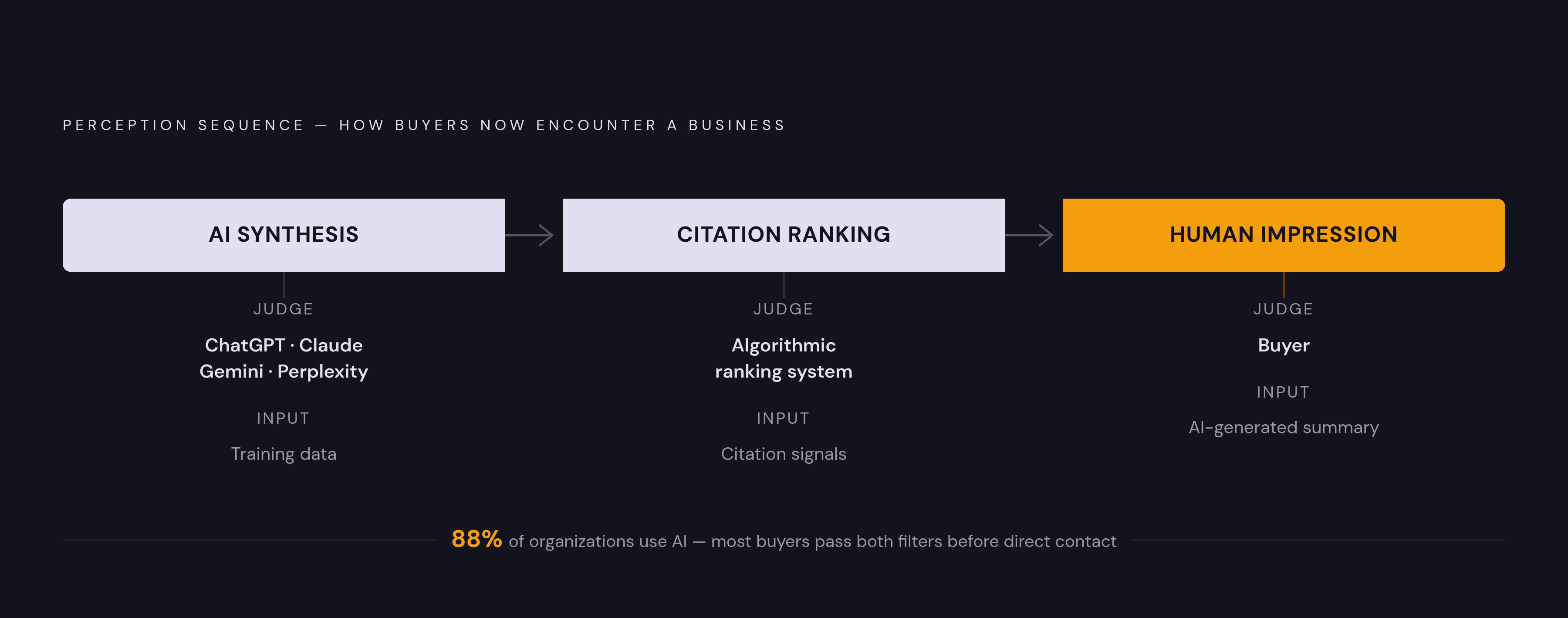
The third audience, human buyers and customers, no longer forms its first impression independently of the other two. The first encounter a person has with a business is increasingly an AI-generated summary or an algorithmically curated result rather than the business's own website or sales team. When a buyer asks an assistant whether a brand is legitimate, or how it stacks up against a competitor, the answer they get back is the synthesized portrait described in the first section, delivered with the fluency and confidence of settled fact. That portrait becomes the human's starting point, for better or worse, before the business has said a word for itself. This is not a fringe behavior. Hostinger's 2026 data shows generative AI reached population-level adoption faster than the PC or the internet did, in just three years, and most organizations now use it in at least one business function. The humans doing this mediated discovery are the mainstream of the buying public, not an early-adopter niche. What makes the situation harder to manage is that trust in these systems is not stable even as reliance on them grows. The same data shows inaccuracy has overtaken every other concern as the top-cited AI risk: it climbed 14 percentage points in a single year. People lean on AI-generated summaries to decide whether a business is credible, even as they suspect those summaries might be wrong, and in the moment they usually have no better source on hand to check against. If a business has a weak AI portrait and thin algorithmic signals, it will reach this third audience already misrepresented or simply absent, and the human on the other end rarely knows enough to catch the gap. The old sequence, earn trust first and let visibility follow, has effectively reversed. Visibility within the first two systems now shapes whether trust gets a fair chance to form.
Why optimizing for one audience creates compounding blind spots
Treating these three audiences as separate projects, each assigned to a different team with a different tool, is the mistake that turns a manageable gap into a structural liability. The three systems feed on overlapping inputs, so a weakness in one causes a failure in the other two instead of an isolated, contained problem. A business that has spent years optimizing for traditional search rankings may have strong page authority and still have weak entity signals: inconsistent business names, scattered addresses, no coherent structured identity tying its web presence together. Without that coherence, AI systems have no reliable way to identify the business as an authoritative source worth citing, even if its pages still rank well. Ranking and citation are different outcomes, and strength in one does not transfer to the other. A parallel trap catches businesses that watch their review sentiment closely but never check what AI systems are actually saying about them. Customers may have moved past a controversy from three years ago, and the review scores reflect that recovery. An LLM trained on older material may still be repeating the old story as though it were current, with no customer complaint to flag the error because the humans involved have already moved on. The reverse trap is just as common: a business that works hard to shape its AI-perception footprint while ignoring algorithmic trust signals, such as E-E-A-T markers, entity recognition, and structured data, will find that AI systems simply aren't citing it, even when the brand is actively trying to be recommended. A harder fact sits underneath all three traps: Hostinger's 2026 data shows hallucination rates across leading foundation models remain substantial, meaning even the best-performing systems get things wrong a meaningful share of the time. A business that is not actively tracking what these systems say about it has no defense against confident, fluent misrepresentation delivered at scale, repeatedly, to exactly the people it most wants to win over.
Requirements for a unified measurement framework across all three audiences
You need a multi-signal approach, because an SEO rank tracker, a review monitoring tool, and a social listening platform were each built to answer a narrower question than the one you now need answered across three structurally different audiences. Measuring the AI-perception audience means querying the major assistants, Google AI Overviews and AI Mode, ChatGPT, Perplexity, Claude, and Gemini, with the actual questions buyers type in: is this brand legitimate, what do its reviews say, how does it compare to a named competitor, what complaints exist against it. Doing this on a regular cadence, and logging whether the brand gets mentioned, whether the description is accurate, and which sources the model cites, is a distinct discipline from traditional rank tracking, with its own cadence and its own failure modes. Measuring the algorithmic audience now means tracking AI answer presence alongside the traditional ranking data a business has tracked for years. Semrush and Ahrefs have already added AI Overview appearance data to their reporting, so brand citation rate on high-value queries belongs in the primary KPI column, not filed as a secondary metric under page rank. A diagnostic already sitting inside Google Search Console for any business willing to look for it: queries where impressions are climbing while clicks and click-through rate are falling point directly at AI Overviews absorbing the traffic that used to land on the business's own page. The research behind this argument confirms that the work is measurable rather than a matter of guesswork. The AI Perception Index 2026 shows you can score perception across AI systems with standardized prompts and a repeatable method, the Perception Control Framework v2, so you can put a number on something that used to be treated as a vague reputational feeling. Academic researchers have pushed the same idea further with Multidimensional Perception Modeling, a neural architecture that jointly represents textual semantics, social interaction dynamics, and platform affordances in one structure. The direction of that research is clear: perception is a multi-faceted signal system, and no single score or single-channel tool captures it. Evident's approach, scoring businesses across more than 400 signals spanning three evaluation dimensions, algorithms, AI systems, and human audiences, is what this measurement requirement looks like once it's built into a working system rather than left as an academic proposal. Instead of three disconnected reports from three disconnected tools, you get one coherent read on where you stand with each of the audiences actually judging you.
Concrete actions a business can take to reduce blind spots across all three audiences
Closing these gaps is achievable, but the order of operations matters more than the length of the to-do list. Entity foundation comes first: fixing name, address, and phone number consistency across every listing, implementing Organization schema, and establishing sameAs links that tie a business's various web profiles back to one verified identity. If you skip this step, every later effort works less efficiently, because AI systems then have no reliable way to confirm that the sources they're synthesizing describe the same business. Content structure for machine extraction comes next: clear headings, tables, FAQ sections, original data, and cited sources, built so that an AI system can pull accurate, specific material rather than a generic summary it could just as easily generate on its own. Microsoft's guidance on content reused in AI-generated answers makes the point directly: it notes that examples, data, and cited sources help build trust when content gets reused in that context. Author identity functions as its own layer of verification infrastructure in 2026: author profiles linked to structured data and to social proof sources like LinkedIn, tied back to organization schema, give AI systems a trust reference they can check when deciding whether content is credible enough to cite. None of this replaces the discipline of actually checking the output: querying the major assistants with the questions real customers ask, logging what comes back, and repeating that process monthly is the only reliable way to know whether the AI-generated portrait of a business still matches reality or has drifted away from it. Adopting the IAB's January 2026 disclosure framework, voluntary as it is, gives a business a documented standard to point to as these three audiences, and the rules governing them, continue to take shape.