Franchise Brand AI Perception Consistency Across Locations
AI systems now decide which franchise locations appear in customer searches.

AI systems now decide which brands make it into a customer's consideration set, and that decision happens before a search results page ever loads. Google's AI Overviews already show up in roughly half of all Google searches. When a brand gets left out of that generated answer, or gets described wrong, it doesn't just lose a click. It loses the chance to be considered at all, regardless of how strong its ad spend or search rankings look on paper.
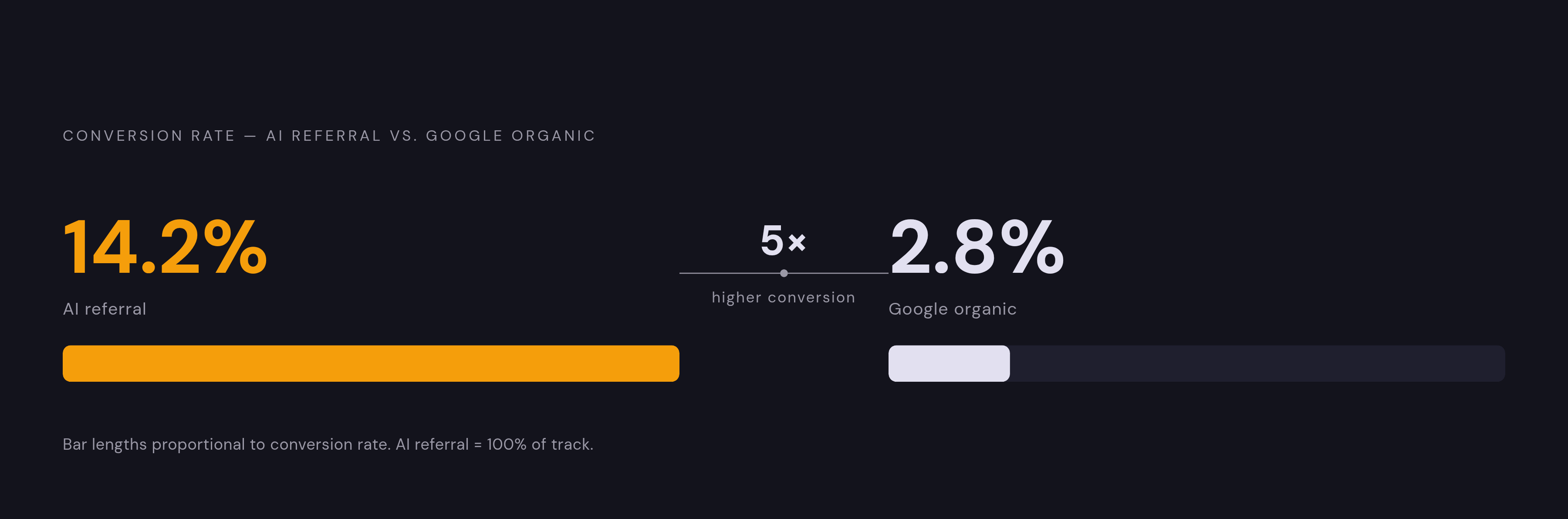
AI referral traffic converts at 14.2%, against 2.8% for ordinary Google organic search. That gap, five times over, turns AI placement into a revenue line instead of a vanity metric. This is a structural rewiring of how people find businesses, and for the most part, it's already done.
How LLMs build a picture of a brand, and why it differs from search
Search engines rank pages. Large language models do something else entirely: they build a short list of answers on the spot, at the moment someone asks. Research out of Northwestern and Boston University calls this an "emergent choice architecture." There's no shelf to stock, no ranking page to climb. The model just decides, query by query, who gets named.
That decision runs on trust signals, not keyword density: factual accuracy, how consistent a brand's identity is across the open web, and how often independent sources back up the same facts. A citation study from Rankfor.AI found that 85.7% of the URLs cited in AI brand answers point to third-party sites the brand doesn't own. Only 14.3% point back to the brand's own content, and the sourcing skews hard toward a narrow set of outlets: roughly 80% of citations trace back to about 18% of domains. Wikipedia tops the citation list in 11 of 12 languages studied. In Poland, HR and careers sites or YouTube take that spot instead, which says the source mix bends to the market rather than following one universal rule.
That flips old SEO logic on its head. A brand used to control its own narrative by controlling its own site. Now its own content is a minority input, and the sources doing the talking belong to somebody else. When a model hits a gap (incomplete data, conflicting facts about hours or services or reputation) it doesn't leave a blank. It fills the hole statistically, which is another way of saying it guesses, sometimes wrongly, sometimes in favor of a competitor. A brand with thin or inconsistent third-party coverage at the location level isn't neutral to an AI system. It reads as ambiguous, and ambiguous gets punished.
Why franchise structure creates a specific and compounding AI perception problem
Franchise brands multiply this exposure by the number of doors they operate. Every location is another place where the data can go stale, another spot where an address gets typed in wrong, another judgment call made by a local manager instead of corporate. One location with sloppy data is a rounding error. Three hundred of them is a pattern, and AI reads patterns.
Franchise systems live inside a tradeoff that predates AI entirely: centralize control and gain consistency but lose local relevance, or decentralize and gain local relevance but lose consistent quality. Whatever compromise a system lands on, AI just aggregates the result, warts included. SOCi's Local Visibility Index for 2026 found that only 68% of business contact details on ChatGPT and Perplexity actually match what's listed on the corresponding Google Business Profile. Close to a third of listings are wrong, incomplete, or missing entirely in the tools customers now use to find a business.
Ranking well on Google's local results no longer buys a franchise any safety on AI platforms. The two have split apart. Rio SEO's local search report, covering more than 239,000 enterprise locations across seven industries, found listing visibility down 13.2%, phone clicks down 12.9%, and website clicks down 7.7% over 2025. Local SEO is bleeding, and AI visibility is a separate wound.
The asymmetry that makes this dangerous specifically for franchisors: the parent brand's website and earned media can be clean enough for AI to represent the corporate entity fairly, while individual locations, thin on reviews, sloppy on address formatting, absent from local citation directories, generate a completely different and weaker signal. Franchisors already name brand consistency as their top reason for controlling marketing centrally, with 59% citing it as their primary concern. But brand guidelines and shared creative assets don't touch the third-party data AI actually reads. A style guide has never fixed a wrong phone number sitting on a directory site, and it never will.
The specific signals that determine whether a location appears, or is misrepresented, in AI answers
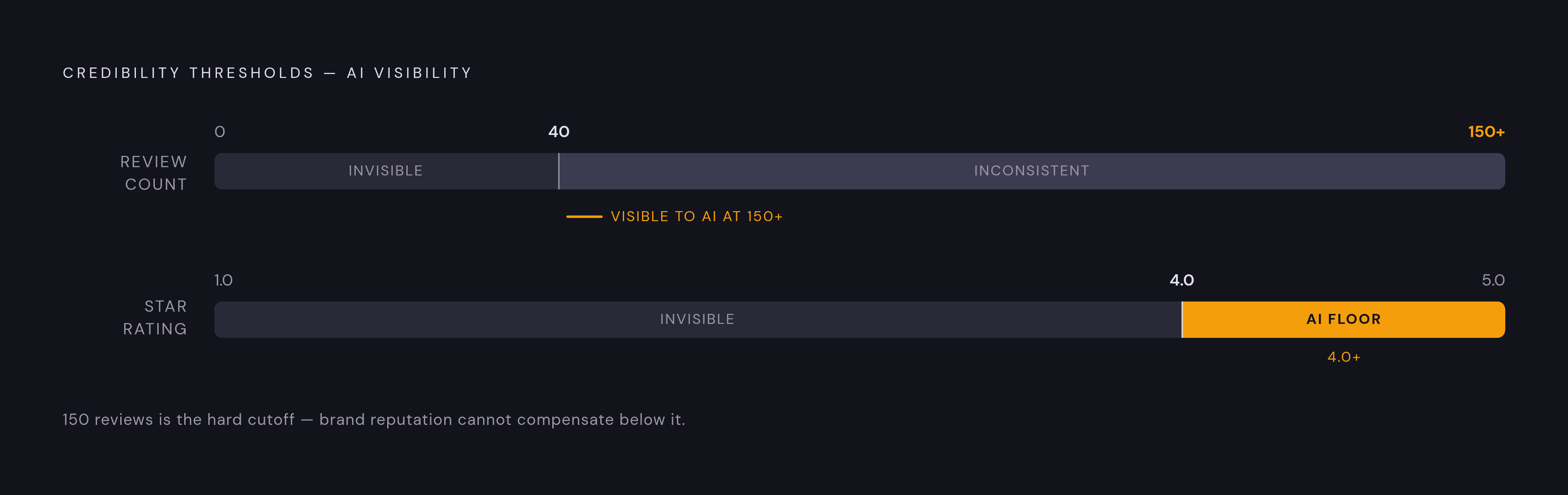
Reviews carry real weight, roughly 16% of total local ranking signal, and it isn't just star count. Quantity, velocity, recency, and sentiment all feed the calculation. Google tends to treat 4.0 stars as the line between credible and suspect, and 87% of consumers said in 2026 that they read reviews before visiting a local business.
AI platforms apply a steeper floor than Google does. Locations need something like 150 or more reviews before AI Overviews and other LLM tools will reliably name them as a recommendation. A location with 40 reviews is functionally invisible to an AI recommendation engine, no matter how strong the parent brand's national reputation happens to be. Brand equity doesn't trickle down to fix a thin review count, and it never has.
Address accuracy affects Local Pack rankings and AI visibility across locations the same way. One franchise system running 34 locations found 12 different address formats live across various citation platforms. After a centralized cleanup, average Local Pack position across all 34 locations improved by 1.8 spots within 60 days: a clean before-and-after showing how much of this is fixable with basic hygiene, not a marketing campaign.
Behavioral data plays a smaller but real role, around 8% of local ranking weight, covering click-through rate, mobile calls, direction requests, and website visits sourced from the Business Profile. The Map Pack drives somewhere between 70 and 80% of local leads, so a gap in behavioral signal at one location is lost revenue at that specific address. Third-party validation compounds all of this: research found brands with regular tier-1 press coverage saw a citation rate in AI Overviews 2.1 times higher than brands with comparable domain authority but no news presence. Local backlinks and directory citations still matter too, contributing something like 6 to 7% of local pack and organic weight, though the emphasis there has shifted from sheer volume toward accuracy and relevance.
The Northwestern/Boston University research found that when a prompt includes specific goals or constraints, the set of brands an LLM surfaces can shift meaningfully, a dynamic tied to needs-based queries rather than generic category ones. A location with sharp, accurate positioning might get pulled into a needs-based answer even if it never appears in a generic search. A location with thin or contradictory data gets neither.
AI can also name a brand in an answer without ever linking to or drawing from its content. A location can be mentioned, and mentioned inaccurately, without ever earning the credibility of an actual citation.
What happens when location-level AI signals contradict the parent brand
AI treats a brand less like a single entity and more like an assembly of the sources it trusts: corporate site, reviews, directories, forums, news coverage. Every location feeds its own slice into that assembly. When one slice is sparse or contradictory, the model bridges the gap statistically, and that bridging doesn't land evenly. It happens most where the signal is weakest, so the worst-performing locations generate the worst distortions.
The mismatch plays out directly. A parent brand carries a 4.5-star reputation across earned media nationally, but when someone in a given city asks an AI tool for a recommendation, the specific location with 80 reviews averaging 3.6 stars appears instead. Corporate reputation doesn't transfer down. Hours work the same way: the corporate site lists a consistent schedule across the brand, but one location's Google Business Profile still shows outdated hours, so the answer the AI generates contradicts what the customer finds when they actually show up at the door. Reputation events follow the same pattern, too: the brand may have earned solid national press, but local coverage of one location's closure, a customer complaint, or a health inspection becomes the dominant citation-weighted story for that city specifically. AI reflects whatever the strongest local signal happens to be, for better or worse. It reflects whatever the strongest local signal happens to be, for better or worse.
A location sitting on marginal signal doesn't just underperform consistently. The same query can produce different brands and different rankings across repeated runs. It appears inconsistently in AI answers, which from a customer's perspective looks like unreliable, confusing discovery. And when a brand gets left out of an AI answer, it isn't simply absent: a competitor with stronger location-level data fills that space instead, and the lost visibility converts directly into transferred market share. Brands cited in AI Overviews earn 35% more organic clicks and 91% more paid clicks than brands left out of the same query set. That gap is the mechanism doing the damage, not a side effect of it.
Why measuring AI perception brand-wide misses the problem entirely
Most brand tracking still produces one number. A "72% positive" sentiment score, a single brand health index, a tidy aggregate that flattens everything underneath it. Scoring like that cannot show where the actual damage sits, because it's built to average away location-level variance. A real read means breaking sentiment down by aspect: service quality, product, in-store experience, at the level where customers actually form their opinions.
Speed is its own problem. McKinsey's Marketing Performance survey found 91% of marketing leaders expect real-time performance data, yet most enterprises still run periodic brand tracking studies costing $40,000 to $50,000 that take weeks to turn around. AI citation patterns don't wait for that cadence. They shift faster than any quarterly study can catch.
Share of Model, a brand's mentions divided by the total AI answers across a tracked set of prompts, is the right unit to measure. But it only tells the truth when computed for each location, each geography, and each query cluster separately, not rolled up into one brand-wide figure. A brand can carry strong overall AI visibility while being nearly invisible on its highest-value queries, and that's a topic gap, not a general visibility problem. The same logic holds at the location level: a brand with a healthy national Share of Model can still be functionally absent in specific cities, and an aggregate score will never catch it.
Operational AI adoption inside franchise systems is already common. Industry research found that 73% of franchise systems with more than 50 locations have implemented some form of AI automation. Running AI tools internally has nothing to do with measuring how AI perceives those locations from the outside, though. Franchisors can feel prepared for AI on the operations side while individual locations quietly undermine the brand in exactly the markets where customers are making decisions. A signal never measured can't be fixed.
A location-level AI perception measurement framework for franchise brands
A real measurement stack for a franchise system runs on three levels at once, not one.
At the brand entity level, AI's representation of the parent company across broad category queries is visible in national Share of Model, the ratio of mentions to actual citations, and sentiment as it appears in third-party sources. At the location level, the question narrows to per-location Share of Model across geo-modified queries like "best [category] in [city]," review health measured against the 150-plus and 4.0-plus thresholds, citation accuracy across directories, and the strength of behavioral engagement signals. Between those two sits gap analysis: the delta between how the brand looks nationally and how each location looks individually, which shows exactly which locations are dragging performance down and in which topic clusters or geographies.
Four categories deserve individual scoring at every location within that stack. Review signals track count against the 150-plus threshold, rating against the 4.0-plus floor, recency velocity, and sentiment broken out by aspect. Citation accuracy checks whether address format, hours, and service list match across every platform where the location is listed. Third-party coverage covers local press mentions, inclusion in industry directories, and presence on HR or employer platforms, which the Rankfor.AI data shows can matter a great deal in certain markets. Behavioral engagement tracks the Map Pack interaction data feeding directly into that 8% behavioral ranking weight.
Not every underperforming location deserves the same urgency. Triage has to weigh the revenue potential of the market, the risk of a specific competitor filling the gap left behind, and how close a location sits to the key thresholds. A location close to the 150-review threshold needs a targeted push to clear it. A location far below needs an entirely different intervention, probably starting with a review request program built from scratch. Scoring across signals like these, spanning review health, citation accuracy, third-party coverage, and behavioral engagement, is what makes a multi-location audit operational: measurement has to come before optimization, and it has to happen at the location level as well as the brand level.
The mention-citation gap deserves its own diagnostic line. A location where AI mentions the brand but never cites its content is flagging a trust deficit in the content itself. That's a different problem from a citation accuracy issue or a thin review count, and each of the three needs its own fix, not a shared one.
The operational sequence for closing AI perception gaps across a franchise network
Start with citation hygiene. Standardize name, address, and phone data across every major citation platform before touching anything else. The 34-location case with 12 conflicting address formats makes the point on its own: cleanup alone moved average Local Pack position by 1.8 spots in 60 days, no ad spend required.
From there, build review velocity programs aimed at specific locations, not blanket brand-wide campaigns. Identify which locations sit below the 150-review AI citation threshold and which sit below the 4.0-star credibility floor, then build structured review request workflows aimed at those addresses specifically. A brand-wide review push wastes effort on locations that already clear the bar.
Local earned media directly shapes how AI models source and cite brands, and most franchise marketing teams still underuse it. Since 85.7% of AI brand citations trace back to third-party sources, local press coverage, regional publication mentions, and inclusion in local "best of" roundups directly expand the pool of material AI can draw from. Treat it as a sourcing tactic, aimed squarely at how these models actually pull information, rather than a PR nicety.
Next, complete every Google Business Profile properly: accurate hours, full service lists, current photos. That completeness generates the click-to-call, direction-request, and website-visit signals carrying that 8% behavioral ranking weight, and it feeds the Map Pack that drives most local leads. Build out needs-based positioning at the location level too. The Northwestern/Boston University research shows distinctive positioning cues can pull a brand into needs-based AI answers even when it's absent from generic category queries, so location pages and directory descriptions should describe specific use cases rather than settle for generic category labels.
None of this holds without ongoing monitoring. AI citation patterns move faster than any quarterly brand study can track, so the operational model needs continuous Share of Model tracking at the location level, catching new gaps before they compound into lost market share.
The franchise brands that come out ahead in AI-era discovery will treat each location's AI perception as something measurable and manageable, not an afterthought bolted onto brand strategy after the fact. The infrastructure required to measure that perception is the same infrastructure that makes every other improvement to it possible.