Algorithmic and AI Perception Challenges for Professional Services Firms
AI systems reward the earned media that professional services firms have traditionally avoided.

Professional services firms have a perception problem that has nothing to do with the quality of their work. The qualities that make a law firm, an accounting practice, or a consultancy trustworthy to a client (judgment, relationships, the kind of nuanced expertise that takes years to build) are exactly the qualities that algorithms and AI systems are worst equipped to read. That mismatch used to be a footnote. Now that AI-generated summaries sit between a prospective client and a firm's actual reputation, it's a structural problem with financial consequences.
This isn't a marketing failure. Firms haven't been slow to adopt SEO or content strategy. What's happened is that the evaluators changed faster than the firms could adapt, and the new evaluators read a different kind of evidence than the one professional services firms have spent decades building.
The operating layer for professional services discovery
The Thomson Reuters Institute's 2026 AI in Professional Services Report, drawing on more than 1,500 professionals, calls this the strategic phase: AI has moved out of the pilot-project stage and into the foundation of how firms plan and compete. Organization-wide AI use in professional services nearly doubled in a year, from 22% in 2025 to 40% in 2026, that same report found. Thomson Reuters' separate Future of Professionals 2026 report, based on 1,816 professionals across 62 countries surveyed in March and April 2026, found 74% now use AI several times a week and 44% use it multiple times a day.
The discovery side of this moved just as fast. ChatGPT passed 900 million weekly active users in 2026, up from roughly 400 million the year before. Google's AI Overviews now show up on 48% of all search results pages and reach more than 2 billion people a month. Gartner had predicted traditional search volume would fall 25% by 2026, a forecast that has been tracking closely against observed shifts in how clients find information.
What that means in practice: clients who once found a firm through a referral, or a plain Google search and a look at the "About" page, are now increasingly meeting that firm for the first time inside an AI-generated summary. No phone call, no meeting, no chance to correct a wrong impression before it forms. And clients notice the gap. Two-thirds of corporate respondents in the Thomson Reuters report say they want their outside firms using AI, yet fewer than 20% actually mandate it. The expectation is forming faster than the standard.
How large language models form a picture of a firm, and why that process disadvantages professional services
Large language models don't check a firm's website before answering a question about it. They draw on patterns absorbed during training, built from millions of pages that mention, describe, or link to that entity. If those patterns are thin or contradictory, the firm doesn't get a fair hearing. It gets left out or filled in wrong.
Authority, in this system, is not a single input. AI models weigh mentions, reviews, how cleanly an entity is recognized as a distinct thing, the quality of the content associated with it, the experts tied to it, and whether all of that stays consistent across the web. Research into how large language models form entity representations frames this as a field phenomenon: entities become recognizable to a model through citation density, patterns of co-citation, structured data, and their position inside a knowledge graph, not because the entity describes itself well on its own site.
The same body of research describes what it calls "ghost cartography." When an entity sits in a sparse, thinly documented corner of a model's training data, the model doesn't return a blank. It returns a confident, plausible-sounding answer stitched together from whatever denser, neighboring information it does have. A firm with a thin public footprint doesn't disappear from AI answers. It gets replaced by something invented that sounds correct.
Professional services firms are set up to lose this game structurally, for reasons that have nothing to do with how good the work is. Expertise in this world moves through conversation, through confidential engagements, through relationships, not through the kind of densely cross-linked public content that builds a machine-readable footprint. Client confidentiality limits exactly the case studies and outcome data that would otherwise generate third-party citations. Firm websites tend to be conservative by design, light on the opinionated, citable writing that AI systems treat as signal. And a partner's individual reputation rarely gets attached to the firm's entity in any structured, machine-readable way. So a model may confidently describe a firm incorrectly, or leave it out entirely, because that credibility never appeared in a place the model could read it.
The citation economy that decides which firms AI systems recommend
A Moz analysis of 40,000 queries found that 88% of AI Mode citations point to pages outside the organic top 10. Ranking well in traditional search and getting cited by an AI system are, for most practical purposes, two separate contests.
An AI SEO report from Fuel Online, covering 1,000 enterprise brands, put a number on the gap: 62% of those brands were invisible to generative AI models, despite 94% of them investing heavily in SEO. The disconnect is measured, and it's large. It's measured, and it's large.
Citation is concentrated, too. The top 20% of cited domains capture 80% of all AI references, according to research into AI citation patterns. Firms without a presence in the right publications are fighting over the remaining fifth. Volume of citations matters less than what actually earns them: a study by Fullintel and the University of Connecticut, presented at the International Public Relations Research Conference in February 2026, found that 89% or more of AI-cited links trace back to earned media, with 95% coming from unpaid coverage. Paid placement barely registers as a signal.
An Ahrefs analysis of 75,000 brands backs this up from a different angle: third-party mentions correlated with AI visibility at 0.66 to 0.71, while raw backlink counts correlated at just 0.22. The thing that moves the needle is other people talking about a firm, not the firm linking to itself. A Victorious analysis found that brands with fewer than 2,000 indexed third-party pages showed up in AI-generated answers only 3% of the time.
For a law firm or a consultancy, this points to one lever above the rest: earned editorial coverage where a practitioner is named as the source, not the firm's own thought leadership behind a registration form, not a directory listing. Research found that 37% of domains AI engines regularly cite don't show up in traditional search results. A separate citation graph runs alongside the search results firms are used to watching, produced by AI engines pulling from sources outside traditional rankings, and most firms haven't mapped it. The irony is that the exact topics most firms already compete on (regulatory change, sector-specific rulings, deal structuring) are the same topics that generate strong earned coverage, provided the firm's people are quoted as the source rather than the firm being mentioned in passing.
The review and reputation layer: where human trust signals and AI evaluation signals diverge
Humans and AI systems don't weigh the same evidence. BrightLocal's Local Consumer Review Survey found that 81% of consumers check Google reviews before visiting a business, so for a person deciding whether to call a firm, reviews still carry real weight. But when an AI engine builds its answer about that same business, it cites third-party sources like reviews and press coverage roughly 6.5 times more often than it cites the firm's own website. Humans trust the reviews most. AI systems cite the website most. Both facts are true at once, and they're pulling a firm's attention in two different directions.
Professional services sit in an awkward spot here. Clients don't tend to leave reviews for their lawyer or their accountant the way they'd review a restaurant. The relationship is private, and the outcome is often sensitive enough that nobody wants it on Google. B2B professional services simply aren't a natural review-generation environment the way consumer businesses are. And yet A large share of people read reviews before engaging with a business, and a meaningful portion now require a high star rating before they'll even consider it. A thin review profile doesn't read as neutral. It reads as absence of proof.
The review layer itself isn't a clean signal either. Google reported removing or blocking more than 240 million policy-violating reviews in 2024, up from 170 million the year before. The environment firms are being judged in is actively contested and manipulated at scale. Meanwhile, 89% of users expect a business to respond to reviews, a habit that costs nothing and that most professional services firms simply don't practice.
The stakes attached to all of this are bigger than reputation in the abstract sense. Intangible assets, brand and reputation chief among them, now make up about 92% of S&P 500 market value, Ocean Tomo's 2025 figures show, up from just 17% in 1975. Getting this wrong isn't a soft cost. It reduces the balance sheet's value of intangible assets.
What AI systems are saying about professional services firms
Research on what's been called the "Brand Hallucination Paradox" describes two distinct failure modes. One is fabricated presence: the model confidently states things about a firm that simply aren't true. The other is what researchers call Parametric-Retrieval Lag Asymmetry, where the model's picture of a firm is frozen at whatever point its training data was collected, and never catches up as the firm changes.
For a professional services firm, that second failure mode is quietly dangerous. A firm that restructured its practice groups, brought on new partners, or repositioned itself entirely can be described accurately to a human researcher looking at its current website, and simultaneously misdescribed with total confidence to anyone asking an AI system about it.
Some vendors have started building tools specifically for this gap. Peec AI, which launched a brand perception feature on September 17, 2026, shows which attributes AI models associate with a company, how those associations stack up against competitors, which objections keep recurring in AI-generated answers, and where an AI's claims about a company conflict with facts the company itself supplies. Peec AI has passed a substantial amount in annual recurring revenue since launching at the end of 2025, and has raised a sizable sum from investors including Singular, Antler, Combination VC, identity.vc, and S20. Investment moving that fast into a category this narrow says something about how urgently businesses want a straight answer to "what is AI actually saying about us." A growing number of brands and agencies now use platforms built to answer that question, and the market is still forming.
Evident works the same territory from a different angle, scoring businesses across more than 400 signals spanning multiple evaluation dimensions including algorithms, AI systems, and humans. That gives a professional services firm a structured read on how AI models are describing it, not just how a search algorithm ranks it or a client reviews it. The capability most firms lack right now is visibility into the problem itself. It's visibility into the problem itself. Most have no systematic way to see what AI systems say about them. They can't audit it, can't correct it, and can't tell whether anything they're doing is actually working.
Why measuring all three evaluation audiences, algorithms, AI, and humans, is not optional for professional services
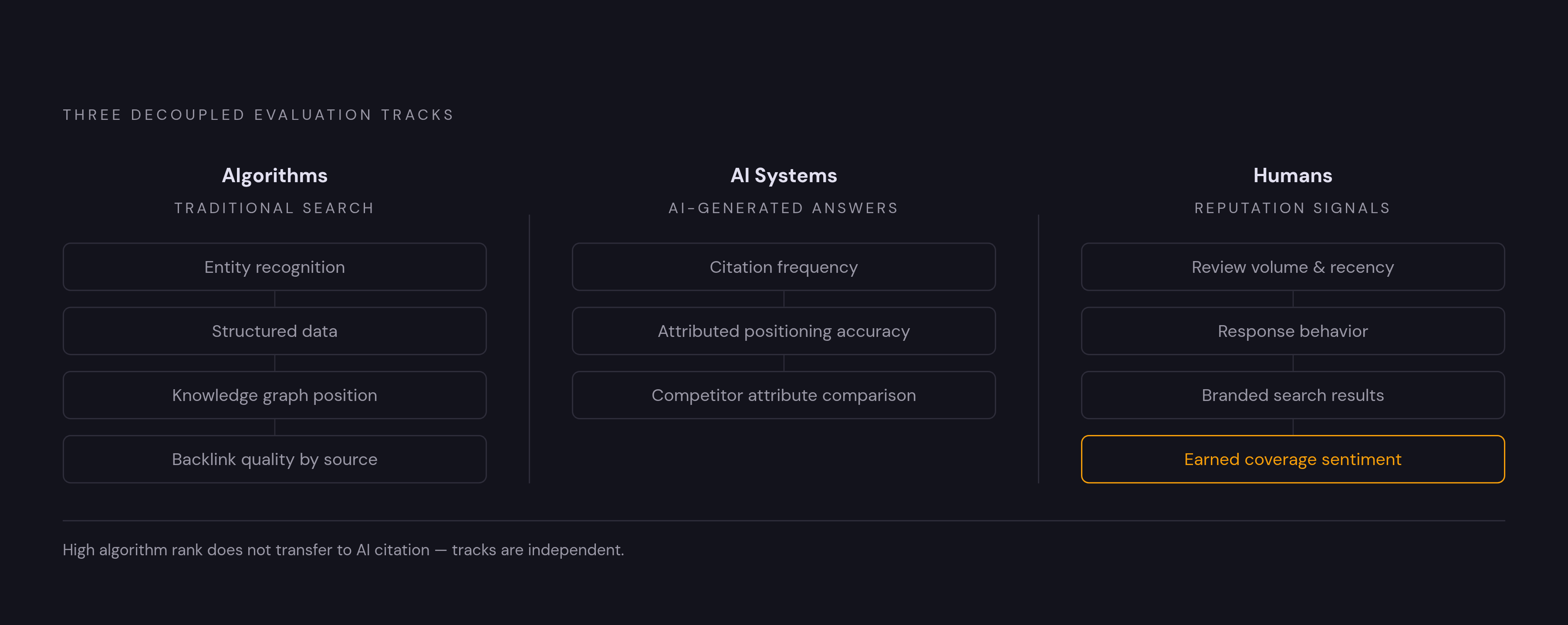
These three evaluators run independently of each other now, and a firm can pass one test while failing another without ever knowing it. A firm can rank well in traditional organic search and still be invisible in AI-generated answers. It can have strong AI citation and a review profile so thin that human trust collapses on contact. It can have an excellent reputation among the humans who know it and still lack the structured data or entity recognition that makes it legible to an algorithm.
Measurement inside the industry hasn't caught up to the stakes. Only 18% of professionals' organizations track the return on the AI tools they've adopted, the Thomson Reuters 2026 report found. If firms are that far behind on measuring their own AI investment, measuring how AI perceives them is barely on the radar. And the cost of waiting compounds: AI search traffic grew dramatically year over year through 2025 into 2026. A firm that puts off building this kind of measurement is losing ground every month it waits. It's losing ground every month it waits.
A workable scoring approach for professional services needs to look at three separate layers, not one. On the algorithmic side: entity recognition, structured data, position in the knowledge graph, and backlink quality measured by source, not just volume, in the specific publication ecosystems AI systems actually favor. On the AI perception side: how often the firm gets cited across ChatGPT, Google's AI Mode, and Perplexity, how accurately those citations describe the firm's real positioning, which attributes get attached to the firm versus its competitors, and where an AI's claims flatly conflict with what the firm says about itself. On the human trust side: review volume and how recent those reviews are, whether the firm actually responds to them, what shows up in its branded search results, sentiment in earned coverage, and whether the firm's story stays consistent across every place a human might go to check it.
One caution belongs here. That caution is worth keeping in mind. Simulated research is not a substitute for measuring the real thing. Firms need actual data pulled from actual AI systems and actual human behavior, not a model's guess about what an audience might think.
None of this works in reverse. A firm can't fix a hallucinated AI description it doesn't know exists, can't improve a citation pattern it hasn't mapped, and can't decide what to prioritize without a scored baseline across all three layers first. Evident's approach, scoring more than 400 signals across those three evaluation dimensions, exists for exactly that reason: to give a firm a clear, evidence-based read on where its perception gaps actually sit, and which of them to fix first, instead of asking it to guess at problems it can't see.