AI Visibility Benchmarks for Law Firms and Legal Services
Law firms' AI adoption hasn't made them visible to AI systems clients now consult.

Law firms are among the most enthusiastic AI adopters of any professional services business in the United States, but that enthusiasm has done almost nothing to make them visible to the AI systems their prospective clients now consult. The legal industry's AI story has two halves, internal and external, and they barely touch each other. Zen Media's 2026 benchmark, which tested 1,000 legal consumer prompts and analyzed several thousand resulting AI responses across ChatGPT, Gemini, Perplexity, and Grok, found no individual law firm among the twenty highest-visibility names in the study. That finding matters because a meaningful and growing share of consumer legal buyers now research lawyers inside an AI engine before they ever pick up a phone, so the invisibility documented in that benchmark is a risk happening now, not one sitting somewhere in the future. It is a pipeline problem happening now: the legal services market is large, and the 5WPR/Haute Lawyer 2026 report found a substantial share of it is AI-addressable. Even a modest shift in how clients find counsel carries real revenue consequences for individual firms.
This disconnect between internal sophistication and external invisibility reflects a broader pattern: law firms are among the most AI-adopting professional services businesses in the United States, yet that internal adoption has produced no corresponding presence in AI-generated client recommendations, leaving the two halves of the industry's AI story almost entirely disconnected. The rest of what follows is an attempt to map that gap with the data currently available, not to speculate about it.
How AI systems evaluate law firms
Large language models decide which legal sources to surface in a way that has little in common with how search engines rank web pages, so a firm that ranks well on Google is not automatically cited by ChatGPT or Claude. LLMs rely on retrieval-augmented generation pipelines, which match the tokens in a user's query to the most specifically relevant indexed content available. A firm's generic practice-areas page, the kind most firm websites still lead with, typically fails to satisfy a sub-vertical, jurisdiction-specific query like "best workers compensation attorney in Denver," because nothing on that page speaks precisely enough to the retrieval match the model is looking for.
The gap between traditional ranking and AI citation turns out to be wide. Martindale-Avvo's 2025-2026 analysis, cited in OpenLens's review of the public evidence, found that ChatGPT mirrors Google's top results less than a quarter of the time for legal queries. A firm that has climbed to the first page of Google results has not, by that fact alone, earned any comparable position in ChatGPT's answers, because a far higher share of legal queries in that engine pull from an entirely different set of sources than search produces. The unevenness runs deeper still once individual engines are examined separately. Claude weights epistemic transparency, rewarding content with explicit methodology, sourced statistics, and named expert authors; the OpenLens analysis of the Martindale-Avvo findings shows Perplexity and Claude together mirror Google's top ten results at a considerably higher rate than ChatGPT does.
The consequence for any firm that has spent years and budget on traditional search optimization is that the asset built there transfers only partially into the AI citation layer, and in engines like ChatGPT, it transfers barely at all. LLMs and search engines weight credibility and relevance signals so differently that you can no longer measure a law firm's perception with just one ranking. It has fractured into at least three distinct evaluation lenses, algorithmic search, AI retrieval, and human judgment, each with its own scoring logic. A single-channel SEO view misses the shift entirely, so multi-signal scoring across all three dimensions is necessary to know where a firm actually stands.
Sources AI cites for legal queries
Every major study published in 2025 and 2026 on this question reaches the same structural conclusion: a small cartel of legal directories, not individual law firms, dominates the AI citation layer across every query type tested.
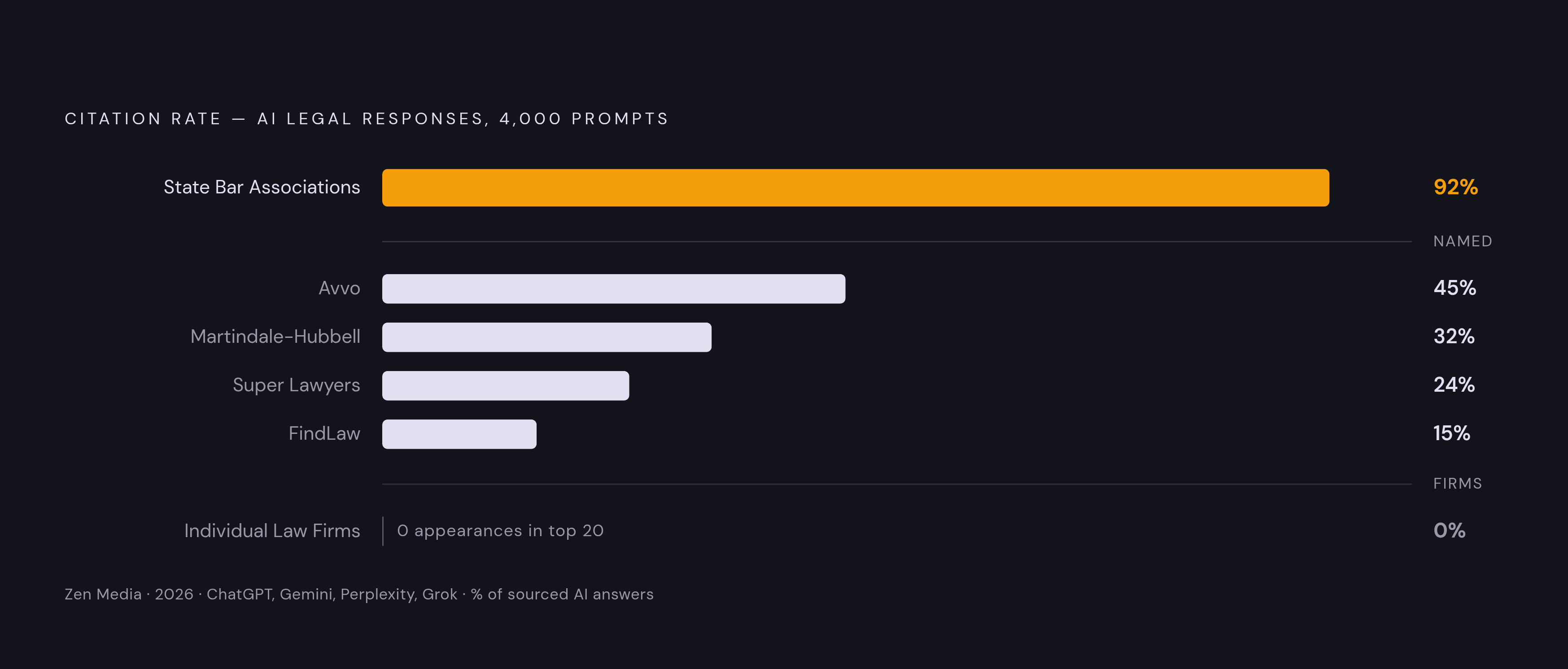
Zen Media's 2026 benchmark, the broadest and most recent of the studies, ran 1,000 prompts through ChatGPT, Gemini, Perplexity, and Grok and collected 4,000 resulting AI responses. Avvo was named in 45% of all responses, so it ranked as the single top entity in the entire study. Martindale-Hubbell followed at 32%, Super Lawyers at 24%, FindLaw at 15%, and LegalZoom also appeared among the top-cited entities. Legal directories and rating platforms together accounted for 45% of all company mentions across the full dataset. State bar associations outpaced every one of them: they were cited in 92% of sourced AI answers, a higher citation rate than any individual directory or review platform managed on its own. Against that backdrop, individual firms are missing from the top twenty highest-visibility names in the study, and that reads less like an oversight than a structural outcome.
The 5WPR/Haute Lawyer Network Legal AI Visibility Index 2026 tested ChatGPT, Claude, Perplexity, and Google AI Mode across multiple query categories. For finder-type queries, the kind a consumer types when searching for "best personal injury lawyer NYC," Super Lawyers consistently owns the top position, Justia ranks immediately below it, and Avvo, Martindale, and FindLaw round out the top tier, with individual firm websites appearing below all of them. The report names seven directories it identifies as functionally owning the legal citation layer: Chambers, Legal 500, Super Lawyers, Best Lawyers, Martindale, Avvo, and Justia.
Independent corroboration comes from OpenLens's 2026 synthesis of the public evidence, and it draws on Whitespark's Q2 2025 study of personal-injury lawyers and other local-service categories. That study found that the majority of personal-injury legal queries trigger AI Overviews, and that the sources feeding those overviews skew heavily toward Super Lawyers, FindLaw, and Justia. The pattern holds even once traditional SEO performance is controlled for: because ChatGPT mirrors Google's top ten so infrequently for legal queries, directory dominance inside AI answers cannot be explained away as a simple carryover from directory dominance in search results. It stands as its own separate structural reality.
The directory dominance pattern is measurable and consistent across these three benchmarks because AI systems score and rank sources using a different logic than human search behavior. It becomes possible, with the right measurement framework, to quantify which signals matter most to each AI engine and, by extension, where individual firms fall short against directory-level competitors.
Where individual law firms stand: the internal scoring gap
The directory story explains who dominates the citation layer, but a second finding matters just as much: how individual firms score against the specific signals AI systems use to evaluate legal sources. Most firms fall well below the threshold needed to generate meaningful citation presence, and the deficiency concentrates in citability rather than in any shortfall of technical infrastructure.
TechHorizonLabs ran a scoring-based benchmark of 38 law firms between June and July 2026, and it shows that gap at its sharpest. The firms in that study were not technically deficient: their websites were built correctly, properly indexed, and functionally sound. The diagnostic finding was that being built correctly does not make a site citation-worthy in the eyes of an AI system evaluating it for a recommendation. That distinction, between a site that works and a site that earns citation, is the central finding of the readiness gap this benchmark documents.
Scope's Q1 2026 AI Visibility Benchmarks covered 20 business categories, and law firms as a category landed at a notably low AI visibility score. Within that category, the spread between performers was unusually wide: top-quartile firms scored well above the category average, while bottom-quartile firms scored well below it, a gap tied for the widest spread among all the professional services categories the benchmark tracked.
The Everything-PR Law Firms Citation Share Audit 2026 gives you a useful calibration point at the top of the market, among the most prestigious firms in BigLaw. Kirkland & Ellis leads the composite BigLaw citation share ranking. Cravath holds second place in that ranking with a score of 69. The firm's low score illustrates that deliberate secrecy functions as an anti-strategy under AI evaluation: a firm that declines to publish the kind of specific, retrieval-relevant content these systems look for cannot expect to be cited, regardless of how well-known it is among lawyers and clients who already know to call it. Wachtell's position is counterintuitive precisely because its marketing budget is not the constraint. Marketing spend does not seem to drive citation share, but retrieval-relevant content does.
Morgan & Morgan is worth a brief mention here as a different kind of outlier. Its visibility in AI-mediated legal discovery owes a great deal to its scale and volume of content, a combination few firms in the market can realistically replicate, and its position should be read as a product of that scale rather than as a template other firms could follow by imitation.
What AI systems look for in a legal recommendation
The attributes AI systems most consistently include in legal recommendations form a de facto scorecard that reveals what firms are missing, and the list is more specific and more credential-heavy than most legal marketing content currently provides.
Zen Media's 2026 benchmark found credential verification present in 92% of AI answers to legal consumer questions, making it the single most consistent attribute in the entire dataset. Specialization appeared in the large majority of responses, fee structure transparency appeared in most of them, and the point that firm size does not predict attorney quality appeared in a substantial share of answers as well. A further set of attributes rounds out the picture: free consultations, trial experience, and local court knowledge each appeared in a majority of responses, with the latter two pointing toward jurisdiction-specific detail and documented case outcomes as the kind of content that retrieves well inside these systems.
Brand mention rate and citation rate are not the same metric: a firm can appear inside an AI answer without ever being cited as a source for that answer, and it can be cited as a source without being named as the actual recommendation offered to the user. Legal marketers who track only where their firm ranks are missing at least two of the three measures that actually determine whether a prospective client ever sees the firm's name in an AI-generated answer.
Sources
- The 2026 Legal AI Visibility Report: Why the Legal Industry Is Six Quarters Behind the AI Discovery Shift
- AI Visibility Benchmarks for Law Firms in 2026: What the Public Evidence Actually Shows
- Legal AI Visibility Index 2026: Firm citation share
- AI Visibility Benchmark for Law Firms and Attorneys Finds No Individual Firm in the Top 20 Across ChatGPT, Gemini, Perplexity and Grok
- Legal AI Visibility Index 2026
- AI Visibility Benchmarks by Industry: 2026 Data Report
- AI visibility benchmark: Law firms (38 measured)