Local Service Business Perception in AI-Powered Near-Me Recommendations
AI now picks winners and losers faster than any map pack ever could.
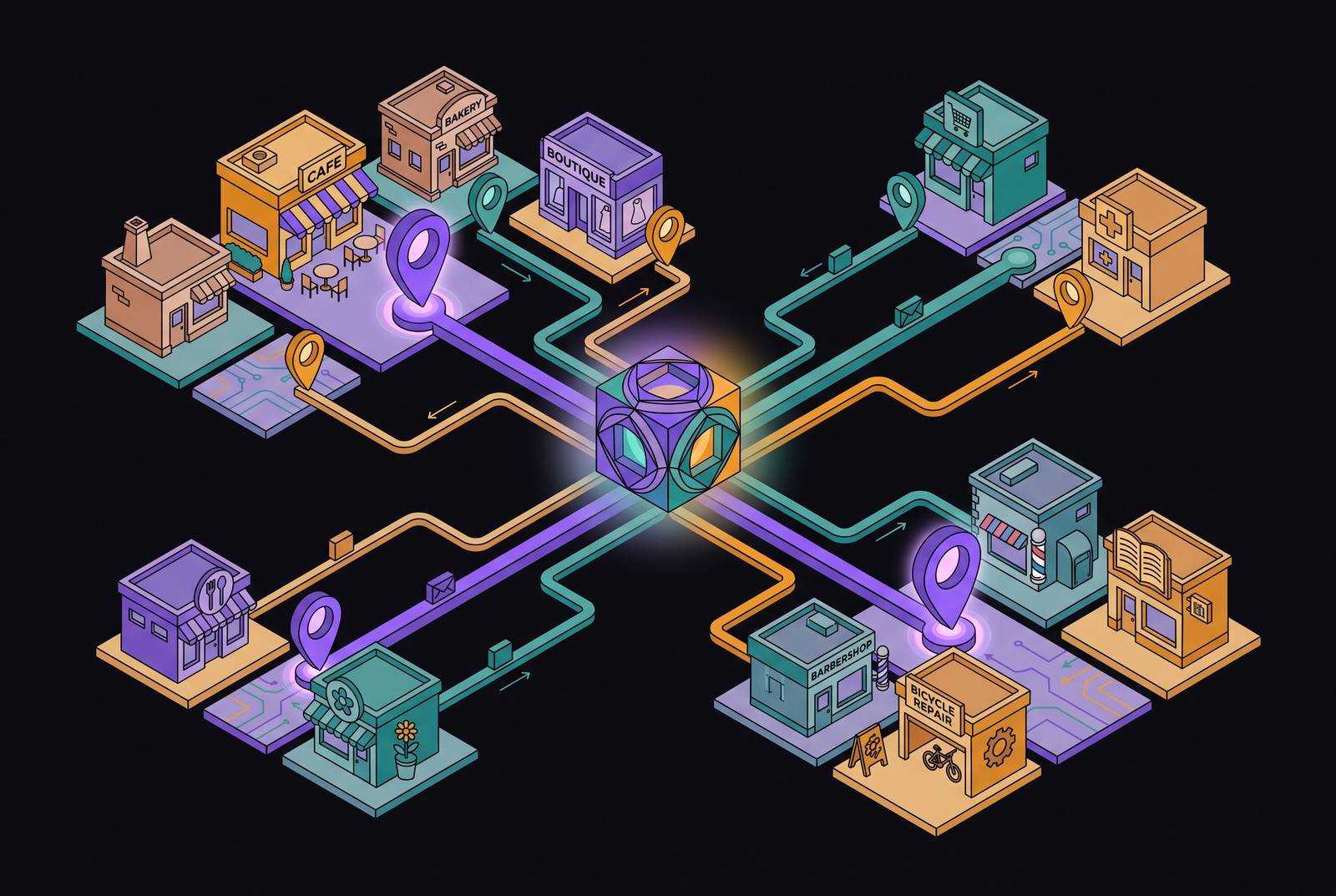
Local service businesses are competing for a spot in a conversation that has no map pack, no second page, and no scroll. AI has already passed Yelp and TripAdvisor as a local discovery channel, trailing only Google and Facebook. This piece lays out what that shift actually demands of a local business, and why the playbook that worked for traditional search doesn't transfer.
A jump from 6% to 45% in a single year is a behavioral snap, the kind that happens when a tool crosses from novelty to habit fast enough that most businesses haven't noticed the ground shift under them. It's a behavioral snap, the kind that happens when a tool crosses from novelty to habit fast enough that most businesses haven't noticed the ground shift under them.
Consider what that ranking means. AI has already overtaken Yelp and TripAdvisor, platforms that spent years building review infrastructure and local business trust. It sits third behind only Google and Facebook, two giants with decades of local data and billions in advertising infrastructure behind them. And the age skew makes the adoption curve even more consequential: the 30-44 cohort, at 64% usage, skews heavily toward high-consideration purchases, the kind where a bad recommendation costs real money and real trust. When that demographic asks an AI system where to go, the answer it gets back functions less like a suggestion and more like a decision.
AI local answers versus Google map pack placement
Showing up on Google's map pack and showing up in an AI recommendation are not the same achievement, and treating them as equivalent is the single most expensive mistake a local business can make right now.
The numbers make the gap concrete. Across a study spanning tens of thousands of locations and 2,751 multi-location brands, only 1.2% of locations were recommended by ChatGPT. Gemini recommended 11%. Perplexity recommended 7.4%. Compare that to the same brands' presence in Google's local 3-pack, at 35.9%. That gap, potentially many times harder to crack, reflects a structural difference in how these systems work. It reflects a structural difference in how these systems work.
Restaurants illustrate the problem well: 83% of them do not appear in AI-generated local recommendations. That's the majority outcome for an entire category of local business, not a niche failure mode.
The reason traces back to format. Google's map pack shows ten, twelve, sometimes twenty options, with photos, ratings, and a scroll bar to keep going. AI local answers name one to three businesses and stop. There's no "also consider," no second page, no fallback for the business that almost made the cut. Almost making the cut, in this environment, is functionally the same as not existing.
How AI Systems Evaluate a Local Business for Recommendation
AI systems build confidence in a business the way a skeptical customer builds confidence in a stranger's recommendation: by cross-referencing. The more places a business shows up with the same accurate details, the more willing the system is to vouch for it.
But different platforms check different places, and that's where the strategy gets complicated. Google's local AI leans heavily on the Google Business Profile, its own trusted structured data source. ChatGPT works differently, drawing on Bing-indexed web results, a location-discovery app, a reviews platform, a business-accreditation directory, industry directories, and the business's own website. Gemini, Perplexity, and voice assistants each mix their own blend of sources. No single profile, no single directory listing, covers all of them. A business optimized only for Google Business Profile is optimized for one-fifth of the battlefield.
Research analyzing 104,855 URL citations across OpenAI, Gemini, Perplexity, Grok, Copilot, and Google AI Mode found something that should unsettle anyone still running an SEO playbook built years ago: semantic relevance, meaning how directly a piece of content answers the actual question being asked, drives citation behavior far more than classical domain authority signals do. LLM citation ranking is largely decoupled from the domain authority metrics that have anchored search optimization for two decades. Schema markup, long treated as a near-mandatory technical checkbox, showed only a weak relationship with ranking position, correlations clustering near zero, though it may still help AI crawlers parse and trust content even without directly moving the ranking needle.
What does semantic relevance mean for a plumber in a mid-sized city or a family law attorney in another mid-sized city? The AI is asking something much more direct: is this business genuinely the right answer to this specific question, right now, for this specific person asking it. It's asking something much more direct: is this business genuinely the right answer to this specific question, right now, for this specific person asking it.
The signals that determine whether AI includes or excludes a local business
Review volume functions less like a ranking factor and more like a locked door. Below a certain threshold, roughly 150 or more reviews for platforms like Perplexity and Gemini, a business doesn't rank lower. It gets excluded from consideration.
Star ratings work the same way, with sector-specific bars. A 4.0-plus rating is the baseline for Google to treat a business as credible. High-consideration sectors, legal, healthcare, financial services, require 4.4 or higher. Businesses that ChatGPT actually recommends average 4.3 stars. And at the bottom end, locations with near 3.4 stars and review response rates under 5% get excluded entirely, not demoted, not buried on a second page that doesn't exist. Excluded.
Freshness matters as its own dimension, separate from volume. Consumers widely weight recent reviews more heavily than old ones, and AI systems mirror that human bias. A business with a large volume of reviews from three years ago and silence since reads, to both a human and an algorithm, like a business that might have coasted, changed hands, or closed. A steady trickle of recent, detailed reviews reads as a business that's alive and operating today. Whitespark's 2025 research found AI Overview prevalence at 92% for informational-intent queries and 97% for hybrid-intent queries, exactly the query types where fresh signals carry the most weight.
Platform presence itself acts as verification. Businesses with active profiles across multiple review platforms see meaningfully higher AI citation probability than businesses without that spread. The logic here isn't complicated: a business that's active and independently verifiable across Yelp, Google, industry directories, and elsewhere is harder to fake than a single polished website. AI systems treat that redundancy as evidence.
Then there's NAP consistency, name, address, phone number, appearing identically across Google Business Profile, Yelp, Apple Maps, Facebook, Bing, and relevant industry directories. Minor formatting differences, a suite number here, an abbreviated street type there, lower AI confidence in the entity as a single coherent thing. And when confidence drops, the AI doesn't hedge. It moves to a competitor it can verify with less friction.
Review management as an AI infrastructure problem
Review management used to be a customer service function, something handled by whoever answered the phone or ran the front desk. That framing no longer holds. Reviews are now a machine-readable input: an AI system's ability to see a business at all depends on them.
The consumer-side stakes were already high before AI entered the picture: A large share of consumers read reviews before choosing a local business, and many expect a business to actually respond to what's been written about it. Add to that the fact that 87% of homeowners won't consider a business rated below 4 stars, and Google uses review signals to shape how visible that business becomes. The effect compounds. A weak review profile doesn't just cost a customer here and there, it suppresses the discovery mechanism itself.
And yet nearly 53% of customer reviews go unanswered. That's not a minor oversight, it's simultaneously a trust failure in front of human readers and a visibility failure in front of the AI systems parsing that same page.
The content inside a review matters as much as the star attached to it. Modern AI systems don't stop at aggregate scores, they read the text. Aspect-based sentiment analysis, the method sophisticated platforms use to separate feedback into distinct categories like pricing, responsiveness, and quality of work, means a business can't hide a weak spot behind a strong average. The specific words customers use, "fast," "overpriced," "showed up late," "explained everything clearly," become the raw material AI systems draw from to describe what a business is actually known for. A composite star average tells a person almost nothing. The sentence beneath it supplies the raw description the AI relies on: it tells the AI everything.
What measuring AI perception requires
Rank trackers built for Google don't translate to this problem, because they're answering a different question. A keyword rank tracker tells you where a page is in a list of ten blue links. It says nothing about whether an AI system will actually say your business's name out loud, in what language, alongside which competitors.
Consistency is its own separate crisis. Many brands fail to maintain steady AI visibility from one query to the next, showing up sometimes and vanishing other times, depending on phrasing, session, or platform. A single audit, run once and filed away, tells a business almost nothing about where it actually stands, because the ground it's measuring keeps moving underneath it.
The measurement landscape is catching up, unevenly. Research efforts are expanding to track how brands actually get mentioned across AI-generated responses, offering clearer views into AI visibility than were previously available. 97% of digital marketing leaders report a positive impact from AEO work already underway, according to Conductor, reflecting growing recognition of AI-oriented optimization as a priority.
A genuine measurement framework, though, needs to go further than a single index snapshot. It has to track mention presence across the platforms people are actually using for local discovery, ChatGPT, Gemini, Perplexity, Google AI Overviews, not just one of them in isolation. It has to check whether the information surfacing about a business is accurate and consistent. It has to capture sentiment and specificity, how the AI characterizes the business, not merely whether the name gets said. And it has to score the underlying inputs, NAP consistency, review volume and recency and response rate, Google Business Profile completeness, the breadth of third-party citations, in a way that actually explains why the visibility outcome looks the way it does.
Measurement has to come before optimization. A business cannot meaningfully fix how it's perceived by AI systems without first knowing, in specific and current terms, how those systems are evaluating it right now, across algorithmic ranking, AI recommendation behavior, and plain human sentiment.
The practical starting point: auditing where your business stands across AI platforms today
The audit that matters most doesn't require a subscription or a dashboard. It starts with opening ChatGPT and asking it, directly, to recommend businesses in your category and your city, the same way a prospective customer would ask it. Then running the equivalent query in Google, phrased to trigger an AI Overview rather than a plain list of links.
Notice what comes back. Which competitors get named, in what order, with what descriptive language attached to them. Notice whether the business in question shows up at all, and if it doesn't, notice who occupies that space instead, and what about their review profile, their citation footprint, or their online consistency might explain why the AI chose them.
That single exercise, repeated across multiple AI platforms using a handful of realistic queries a real customer might type, produces more operational insight than most businesses currently have about their own AI visibility. It won't fix the gap by itself. But it draws the map, and right now, most local businesses are navigating this terrain without one.
Sources
- AI Overviews and Local Search: How SMBs Can Stay Visible in 2026
- How LLMs Rank Local Businesses: A Study of “Near Me” Query Citations
- Nearby or Most Trustworthy? How AI Recommends Local Businesses
- billhartzer.com
- dev.to
- grownearby.com
- How AI Search Works for Local Businesses in 2026 (Complete Guide) - Ansvisor
- searchenginejournal.com