How AI Evaluates Nonprofit and NGO Credibility and Trustworthiness
AI now picks one nonprofit as the answer, making third-party ratings vital.

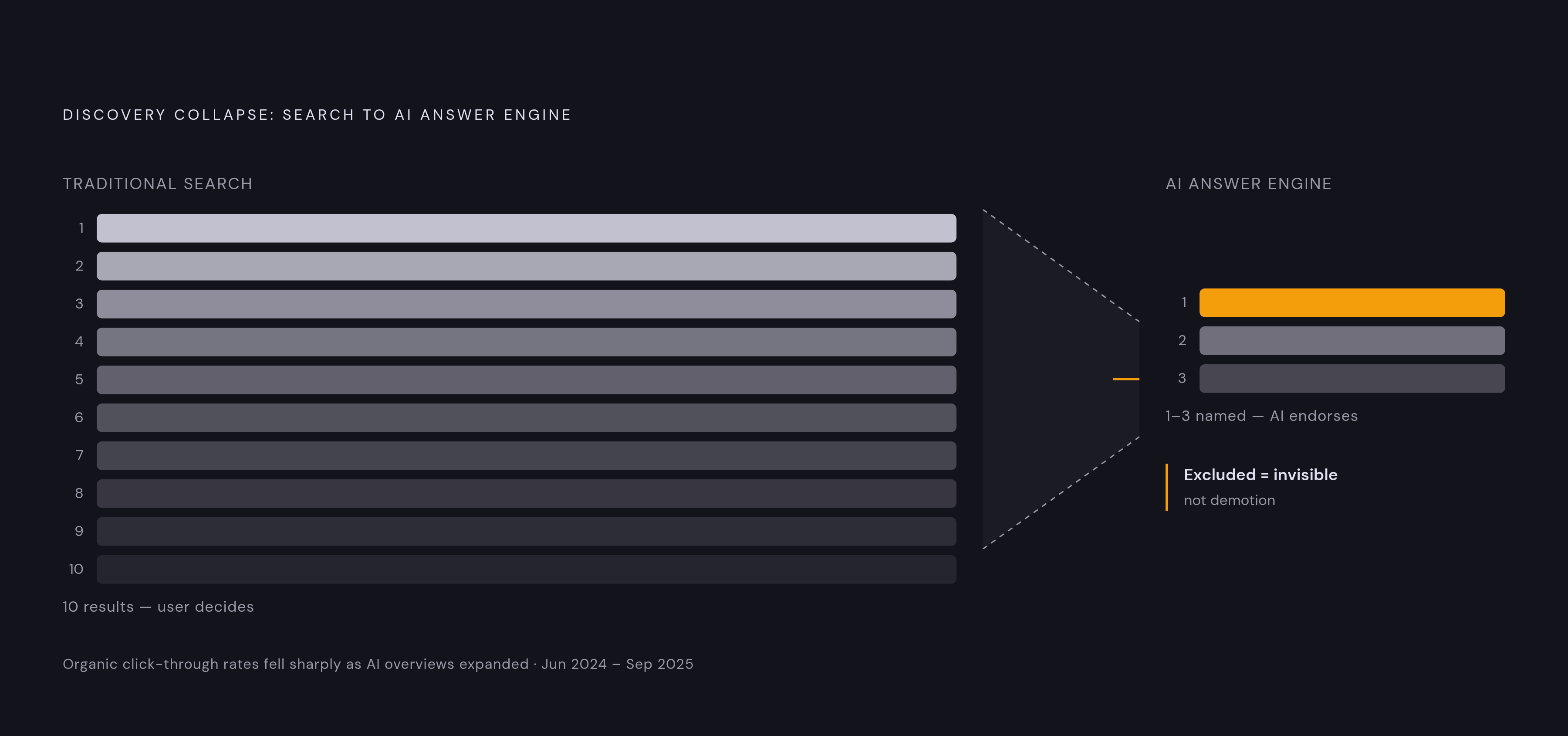
AI search no longer hands a user ten blue links and lets them decide. It picks one organization, maybe two or three, and names them as the answer. Speakers at the 2026 Nonprofit Fundraisers Symposium described this shift: AI has become an "answer engine," where visibility depends on being included in the response itself, and often only one to three organizations make that cut. A ranked list still lets a donor weigh options. A named answer is an endorsement, and the AI has to extend that trust before a donor or partner ever lays eyes on the organization.
The traffic data backs up what the shift feels like on the ground. Click-through rates from organic search fell sharply between June 2024 and September 2025 as AI overviews took over more search results, and the research points to a further sizable chunk of traditional search volume disappearing by the end of 2026. For nonprofits that built their outreach strategy around search engine optimization and a well-maintained website, that strategy is losing ground by design, not by neglect. Rebekah Walker, Managing Director of Fifty and Fifty, put it directly: keeping a website current used to be enough on its own. The move to AI and algorithmic discovery has shifted the weight toward earned media and building authority through outside recognition.
An AI model decides to name an organization out loud based on specific signals.
What LLMs assess when judging an organization's credibility
Large language models don't audit a nonprofit's finances or call its references. They make statistical guesses based on everything written about that organization across the sources the model has ingested or can retrieve, and credibility isn't something declared so much as something inferred from pattern and repetition across those sources. A framework from Google DeepMind on epistemic AI agents describes the behavior at work here: language models curate information and actively shape the shared knowledge environment users draw from, acting as evaluative participants rather than passive pipes that simply pass information along.
The logic governing which organizations clear that bar borrows heavily from search engine optimization's own E-E-A-T standard: Experience, Expertise, Authoritativeness, and Trustworthiness. Strong search optimization, earned press coverage, well-organized content, and visible thought leadership all raise the odds of being cited, while outdated websites, inconsistent messaging, and stale content lower them.
Getting indexed at all is a more basic obstacle, and it's mechanical rather than reputational. Onely's analysis found that a significant share of JavaScript-rendered content never gets indexed by search engines or AI systems, and pages linked only through JavaScript navigation had a discovery rate of zero for crawlers like GPTBot and ClaudeBot. A nonprofit can have a flawless mission, spotless finances, and years of program impact, and still be invisible to a model that literally cannot read its site.
Even when a model can read a site, it doesn't necessarily reach the same conclusion every other model reaches. Researcher Faruk Tugtekin's AI Perception Index 2026, published on SSRN in February 2026, documents substantial drift in how the same organization gets perceived across different AI systems. No single model holds the definitive verdict on any nonprofit's credibility.
Because the inference is probabilistic and drawn from many sources at once, the individual signals feeding that inference can be identified, tracked, and in most cases, strengthened deliberately.
The steeper credibility gap nonprofits face against commercial brands
Nonprofits enter this landscape at a disadvantage that predates AI entirely. Most have spent decades under-investing in digital infrastructure relative to commercial brands, so the credibility gap in AI systems starts wider before anyone even examines which specific signals are missing.
Commercial brands aren't necessarily thriving here either, which sharpens the gap nonprofits face. An AI SEO report from Fuel Online, analyzing a large sample of enterprise brands, found that most were invisible to generative AI models despite heavy, sustained investment in traditional search optimization. If well-funded commercial brands with dedicated marketing teams are struggling to get cited, nonprofits with a fraction of that investment face a compounded version of the same problem.
Internal structure compounds the issue further. The Nonprofit AI Adoption Report from Virtuous and Fundraising.AI found that nearly half of nonprofits operate with no formal AI governance policy, and most AI use inside these organizations happens individually and informally rather than through any coordinated system. That disorganization affects how staff use AI tools day to day and how coherently the organization presents itself to the AI systems evaluating it from outside.
Nearly every nonprofit now uses AI tools in some form, but only a small fraction report meaningful gains in organizational capability from that adoption.
None of this describes a permanent condition. The gap is diagnosable, and every piece of it traces back to a specific, addressable signal.
The structured signals AI uses most heavily to assess nonprofit credibility
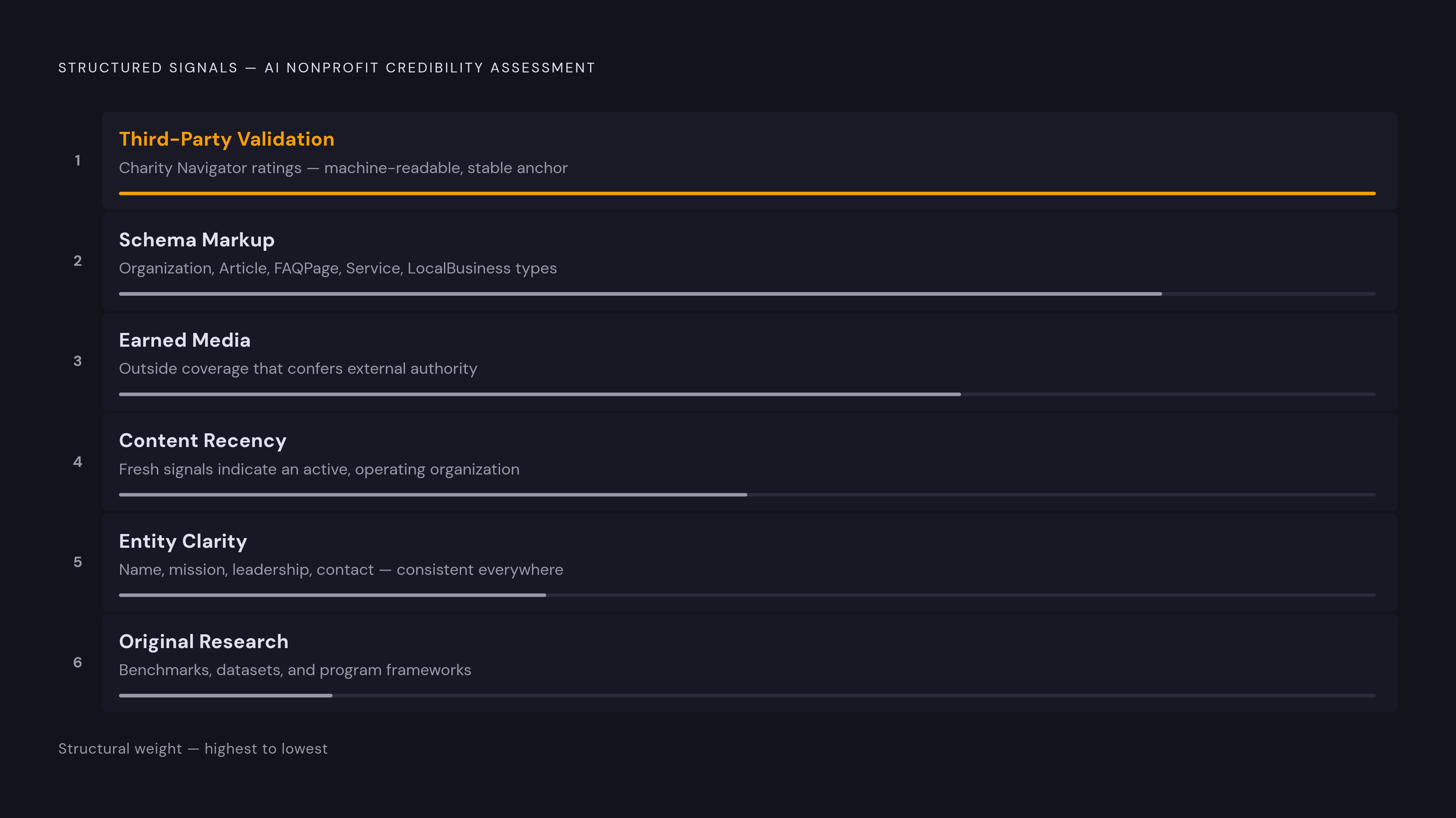
AI systems lean on a specific, identifiable set of structured signals to assess nonprofit credibility, and organizations that understand what those signals are can work to strengthen each one.
Third-party validation carries particular weight. Charity Navigator is the largest and most-utilized evaluator of charities in the U.S., providing data on 1.8 million nonprofits and ratings for a large number of charities across four dimensions: Leadership & Adaptability, Accountability & Finance, Impact & Results, and Culture & Community, dimensions that map closely to what AI models scan for in credibility assessment. Those four categories map closely onto the same dimensions AI models scan for when forming their own credibility judgments. Charity Navigator has launched its own AI search tool, called Horizon, which signals that watchdog data is increasingly built directly into AI interfaces rather than sitting to the side as a separate reference. A high rating from a recognized evaluator gives an AI model a stable, structured anchor for inference, functioning as a machine-readable trust endorsement rather than something the model has to piece together from scattered mentions.
Schema markup does something similar for a nonprofit's own website. It gives AI systems a machine-readable structure for understanding what an organization is, what it does, who runs it, and how it's been rated, rather than forcing the model to infer all of that from unstructured paragraphs of text, a process that produces weaker and less citable results. Adding Organization, Article, FAQPage, Service, and LocalBusiness schema types ranks among the highest-impact actions available in generative engine optimization.
Earned media and outside authority signals serve a function for AI models that mirrors their function for human readers. Coverage in trusted publications, expert commentary, and data-backed reporting all answer the same unspoken question a skeptical donor would ask: why trust this organization? That kind of coverage matters to AI models precisely because it's independent of anything the nonprofit says about itself, a different category of evidence entirely from self-reported content.
Recency plays its own distinct role. AI engines favor newer sources when choosing what to cite, so a guide published in 2024 and never updated loses ground to a more recent article covering the same territory. Refreshing cornerstone content on a regular basis, updating the data inside it, and adding a visible "last updated" date all keep that content in contention.
Entity clarity ties the rest together. Keeping an organization's name, mission description, leadership roster, and contact information consistent across its own website and every business listing reduces the ambiguity a model has to resolve, while conflicting details across those sources actively degrade the credibility signal. Citation research on generative AI systems shows that the large majority of citations trace back to sources the brand itself controls, so first-party consistency is a primary concern. It's the foundation everything else builds on.
Original research rounds out the structured signal set. When a nonprofit publishes something no other organization has, a benchmark study, a unique dataset, or a framework drawn from its own program work, AI models have a concrete reason to cite that nonprofit over generic alternatives covering the same subject. Field findings, outcome reports, and beneficiary research all count as original evidence, and nonprofits with active programs sit on more of this raw material than most commercial sources ever will.
Mission consistency, transparency, and organizational character
Structured data isn't the whole picture. AI systems also draw on the semantic consistency of what an organization says about itself across every surface it occupies online, beyond the pages purpose-built with data and schema.
Mission consistency sits at the center of this layer. When a nonprofit's stated mission, program descriptions, annual reports, press releases, and leadership statements all align, an AI model encounters the same claims described in the same terms wherever it looks. A mission statement that contradicts a grant application, which contradicts how the press has described the organization, creates the kind of semantic noise that weakens any inference the model draws from those sources.
Transparency functions as a signal for both audiences at once. The Nonprofit Leadership Alliance's guidance on AI and trust points to transparent communication, publishing an AI policy publicly, disclosing vendor relationships, and explaining governance decisions, as a direct trust signal for human readers. Published on a nonprofit's website, that same material becomes a structured credibility signal an AI model can read and weigh. Nonprofits that publish their financial data, leadership details, program outcomes, and governance documents openly give AI systems more verifiable material to draw on than those that keep this information informal or internal.
Authorship matters in a similar way. Content attributed to named, credentialed staff, people who can be identified and whose expertise shows up elsewhere online, strengthens the Experience and Authoritativeness dimensions that credibility inference depends on. Anonymous or uncredited content gives the model nothing to attach to a verifiable human expert, and that absence weakens the signal on its own.
Tone carries weight too. Organizations that explain their work in plain terms, keep their messaging consistent, update their information regularly, and communicate for human understanding rather than internal jargon build the same kind of trust with AI models that they build with donors. Language that reads as internal or jargon-heavy, when it departs from how outside coverage describes the same organization, opens a semantic gap that the model has to bridge through guesswork rather than direct evidence.
The throughline across both layers, structured and unstructured, is the same. AI reads organizational character from the sum of every signal it encounters, and coherence across all of them is what a model treats as credibility.
Why strong signals can be gamed
Every signal covered so far can be built honestly by an organization doing real work. It can also be manufactured by an organization skilled at self-presentation but not necessarily deserving of the trust that presentation projects, so AI systems risk surfacing whichever nonprofit packaged itself best rather than whichever nonprofit actually does the most credible work.
CharityWatch has made exactly this argument about the watchdog ecosystem itself. It describes itself as the only real aggressive watchdog in the space and argues that numerical rating systems already grant nonprofits a sheen of credibility through scores and gold stars, while showing how IRS disclosures can be structured to understate executive compensation and overstate program impact. If ratings data can already be shaped this way, and AI models now consume that data at scale through interfaces like Charity Navigator's Horizon tool, optimizing for AI citation risks amplifying misleading signals rather than correcting them.
The AI propaganda factories research from King's College London demonstrates that AI-generated content can maintain persona fidelity and rhetorical consistency at scale with minimal human intervention. It shows that AI-generated content can hold a consistent persona and rhetorical voice at scale with very little human oversight. The same capability that powers influence operations can also power an organization's self-presentation, producing content that reads as internally consistent while remaining externally misleading.
Tugtekin's AI Perception Index 2026 complicates the picture in a different direction. Because the same organization can be represented differently by different AI systems, there is no single "AI verdict" to game in the first place. A nonprofit might come across well in one model and poorly in another, with neither result reflecting the organization's actual record.
None of this argues for abandoning signal-building. Manufactured coherence tends to break down under scrutiny, because a constructed self-presentation eventually contradicts something, a financial disclosure, an outside report, a prior statement, that real organizational behavior would not. Tools built to detect inconsistency across sources and divergence across models are built for exactly this instability, and that instability is what makes manipulation difficult to sustain over time.
How nonprofits can monitor how AI systems represent them
A nonprofit can't improve how AI systems describe it without first knowing what those systems currently say, and that starting point takes deliberate measurement rather than assumption.
The AI Perception Index 2026 offers one way to do this measurement systematically, through what it calls the Perception Control Framework v2, scored using a Model Perception Index. The framework quantifies how AI systems semantically represent a given brand, and its findings document a real gap between how dominant organizations and emerging ones get represented, along with the same cross-model drift discussed earlier: the same nonprofit can look meaningfully different depending on which AI system a donor or partner happens to be using.
That drift is the practical reason measurement has to come before optimization. A nonprofit that only checks how it appears in a single AI system risks fixing a problem in one model while remaining invisible or misrepresented in another. Regular, cross-model checks, treated as a recurring part of communications work rather than a one-time audit, are what turn AI credibility from a guessing game into something a nonprofit can actually manage and improve over time.