AI Brand Perception for Non-Profits and Mission-Driven Organizations
AI systems now decide which nonprofits donors discover and trust.

A prospective donor opens ChatGPT and asks where to give toward pediatric cancer research, and the answer comes from sources that donor will never visit or even see named. That single exchange is the new front door for nonprofit discovery, and organizations left out of it are invisible to the donor regardless of how strong their own website or annual report might be.
AI as a gatekeeper for nonprofit discovery and trust
The donor in that example is not a hypothetical. The 2026 Brand Discovery in the Age of AI Report documents a donor pathway that barely existed a few years ago: people using chatbots like ChatGPT and Claude to find and research causes before they ever land on an organization's site. Total donor discovery through these tools is still a small share, but it is growing fast, and the platforms behind it work at a scale where even a modest percentage adds up to millions of donor interactions a year. What makes this shift structural rather than cosmetic is the mechanism behind it. When a large language model answers a question about a cause, it does not consult the organization's own messaging first. It grounds its answer in whatever web sources it retrieves and trusts, and those sources determine what gets said. Communicators once controlled the first impression through their own site, their own collateral, their own voice, but now they have lost a layer of that control. The first impression now happens one step upstream, in a synthesis process the organization does not run and often cannot see.
What AI systems evaluate in a nonprofit's credibility
Research published in Royal Society Proceedings A maps out how large language models weigh institutional credibility, and the finding is specific: integrity is the strongest predictor of trust in these evaluations, ahead of competence and ahead of benevolence. That ordering matters because it tells organizations which signals to prioritize. Accountability, transparency, and fidelity to a stated mission carry more weight in how a model judges an organization than claims about capability or reach. A nonprofit that can prove it does what it says it does outperforms one that only asserts it does a lot.
The second piece of the architecture is how models build their picture of an organization before anyone at that organization has a say in it. They do not read a nonprofit's own site in isolation and take it at face value. They draw on a wide corpus of third-party material, so what they say reflects the coverage and citation around an organization, not just what that organization publishes about itself. Mentioning an organization more often across the web raises the likelihood that its content surfaces in an AI-generated response, so organizations with thin third-party coverage are underrepresented no matter how good their own writing and design happen to be. None of this is arbitrary. You can identify specific signals and combine them with rule-based logic or machine learning, and that is what makes automated credibility scoring systematic and, with the right tools, auditable rather than mysterious.
The three signals that determine how AI systems represent mission-driven organizations
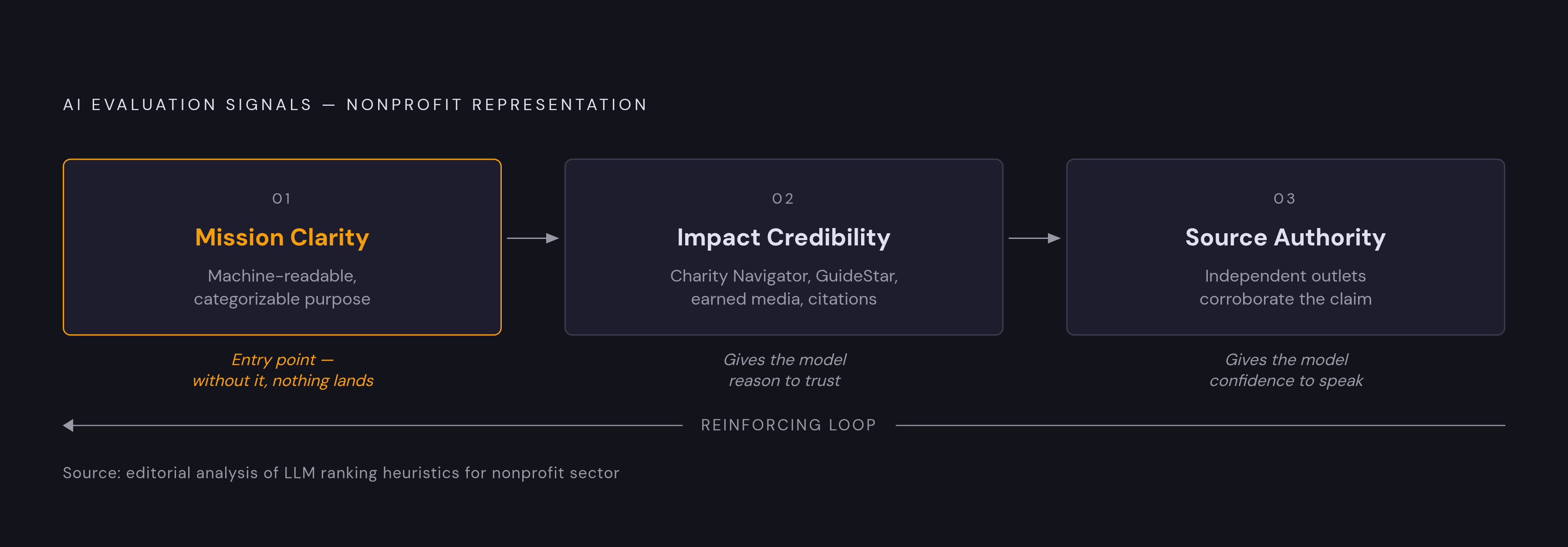
Three signals do the real work: whether the mission can be read and categorized by a machine, whether the organization's impact claims can be checked against outside evidence, and whether independent sources back up what the organization says about itself.
Mission clarity is the least obvious of the three and the one most nonprofits have never thought to engineer for a machine reader. Research mapping nonprofit mission statements found eight distinct topic clusters, four matching established institutional categories and four shaped by more specific contexts such as epidemic advocacy, genetic disease, emergency medicine, and financial hardship. A mission statement written in broad, aspirational language can fail to signal which of these categories the organization actually belongs to, and a model that cannot place an organization in a category tends to describe it in equally generic terms or skip it in favor of a peer whose language is sharper. A vague or internally focused mission statement fails twice over: it does not mobilize human stakeholders, and it gives AI systems no clear entity description to work from.
Impact credibility works differently: it asks whether what the organization claims to have done can be checked. Charity watchdog ratings from groups like Charity Navigator and GuideStar/Candid hold up better over time in an AI system's evaluation than anything published through the organization's own channels, and so do earned media coverage, academic citations of program research, and consistency across review platforms. Source authority closes the loop: the more an organization turns up across independent, authoritative outlets, the more confidently, and the more accurately, an AI system describes it. These three signals reinforce each other. A clear mission gives a model something precise to say, verifiable impact gives it reason to trust what it says, and outside corroboration gives it the confidence to say it.
AI visibility distribution across the nonprofit sector right now
St. Jude offers the clearest evidence of how uneven this landscape already is. Conductor's 2026 Nonprofit AI Search Benchmarks, covering January through May 2026, found that Google AI Overviews showed up on a substantial share of nonprofit-related searches, and that more than half of the citations behind those answers, 51.9 percent, came from pages that also ranked in Google's organic top 10. Against that backdrop, St. Jude moved from fourth place in citations to second place in mentions, so the model said the organization's name more often than it linked to St. Jude's own site. So the model trusts the name enough to say it even when it has no fresh source link to point to.
The structural lesson generalizes well beyond one organization. Nonprofits with strong third-party citation networks and high mention frequency across authoritative sources outperform what their own website traffic would predict in AI environments, but organizations lacking those networks stay unseen even when their owned content is well made. The gap can run in the opposite direction too: a benchmark study testing a large number of relevant prompts against a major travel brand found that brand appearing in AI-generated answers only a small fraction of the time, which shows that even organizations with strong name recognition offline can have a strikingly low share of model presence. Health-adjacent nonprofits with deep research pedigrees and decades of earned media dominate AI citation in the sector right now, and that concentration comes from the mechanics described above, a reflection of how smaller organizations are positioned rather than any flaw in their work. A regional food bank or a local housing nonprofit can build the same kind of citation network St. Jude has, just at a scale matched to its own reach and resources.
What unmeasured AI perception costs nonprofits
Most nonprofits using AI today are using it to produce things: grant drafts, newsletter copy, social captions. Very few are asking the harder question of how AI systems describe them to the people deciding where to give. The vast majority of organizations experimenting with these tools are doing so in ways that have no bearing on how AI systems perceive or recommend them, because they're treating AI as a shortcut for producing content rather than as an environment that evaluates them and needs active management. The 2026 Nonprofit AI Adoption Report, surveying 346 organizations, found that the overwhelming majority use AI in some capacity, yet only a small fraction report any mission-level improvement as a result, and most of that use happens in scattered, individual ways rather than as organizational strategy.
Understanding how an AI system describes the organization to a prospective donor is a perception management problem, and almost no nonprofit is approaching it that way. The gap is structural rather than a matter of attention. Nonprofits have built frameworks for tracking donor acquisition, program outcomes, and financial transparency over decades, but nothing equivalent exists yet for tracking how often an organization is mentioned in AI answers, whether those mentions are accurate, or whether the mission language a model uses actually matches the organization's own.
Lost donors who never materialize are where this cost is felt, invisible in any nonprofit's current reporting. If a platform describes a nonprofit's mission inaccurately, recommends a different organization for a cause this one actually serves, or leaves it out of an answer altogether, the donors who would have given simply never arrive, and the organization has no mechanism for knowing that happened. Fixing a problem requires first knowing the problem exists: an organization cannot correct how AI represents it without first finding out what that representation currently looks like. You measure first and optimize second, and that sequencing is the logical starting point for everything that follows.
What a rigorous AI perception audit covers
A proper AI perception audit for a nonprofit covers five dimensions, and the fifth is the one general-purpose frameworks for brand visibility tend to miss entirely. The first four come from existing generative engine optimization practice: how consistently the organization's name appears across relevant AI-generated answers; which sources the model treats as authoritative enough to cite; how the organization is positioned next to peer organizations working the same cause area; and how accurately the model's description matches reality. The fifth dimension is specific to mission-driven organizations: it asks whether the AI's characterization reflects the organization's theory of change, not just its name and category.
Running this kind of audit starts with a defined list of queries that represent the organization's cause area, tested across Google AI Overviews, AI Mode, ChatGPT, Perplexity, and Claude, with careful notes on whether the organization appears at all, whether it gets cited directly, which third-party sources the model draws from, and which peer organizations come up more often. Presence alone does not settle the question; the real test is whether the AI's description of the mission is accurate, whether it names the right program areas, and whether it surfaces the credibility markers that matter, watchdog ratings, research citations, documented impact, or whether it falls back on generic language that could describe almost any organization in the category.
This kind of structured, repeated prompt-testing is what AI Share of Voice measurement is built on, the metric increasingly standing in for click-through rate now that so much discovery happens inside the answer itself rather than on a results page. If you run this manually across five platforms and a meaningful set of queries, it takes real time, so dedicated tools exist to do it systematically. Platforms like Evident run this evaluation across more than 400 signals and three separate dimensions, algorithmic, AI, and human, giving a nonprofit a scored, actionable picture of its AI perception instead of a one-off manual check.
Entity markup and structured data as the technical foundation for AI recognition
The single highest-leverage technical fix available to most nonprofits is entity-level schema markup, and it is missing from nearly every nonprofit's digital strategy for a simple reason: it produces no visible feature in search results, so nobody notices its absence. An AI system's decision to cite the organization at all is where this effect becomes visible, one layer downstream from the search results page. If schema accurately describes an organization's content, AI Mode is more likely to cite it even when no traditional rich result ever appears on screen, because the benefit lands in the AI layer, not the visible search-results layer. The highest-value version of this is markup that identifies the organization as a known, verified entity in Google's Knowledge Graph, and that step is different from and more foundational than adding FAQ schema or Article schema, though both of those still help.
The mechanism that drives entity recognition is the SameAs identifier. Google and other systems look for consistent identity data across a set of external, authoritative sources, Wikidata, GuideStar/Candid, LinkedIn, Wikipedia where applicable, and the IRS EO database among them, and the more of those sources an organization has, and the more consistently they agree on its name, mission, and contact details, the higher its entity confidence score climbs. For a nonprofit communications team, this is a data hygiene project: auditing every external listing for the organization and making sure the name, the mission language, and the contact information match exactly across all of them. Beyond entity recognition itself, FAQ, Organization, Event, and Article schema each make specific kinds of content legible to AI systems during the answer-synthesis process, giving the model more structured material to draw from when it builds a response.
Content changes that increase AI citation rates without requiring technical resources
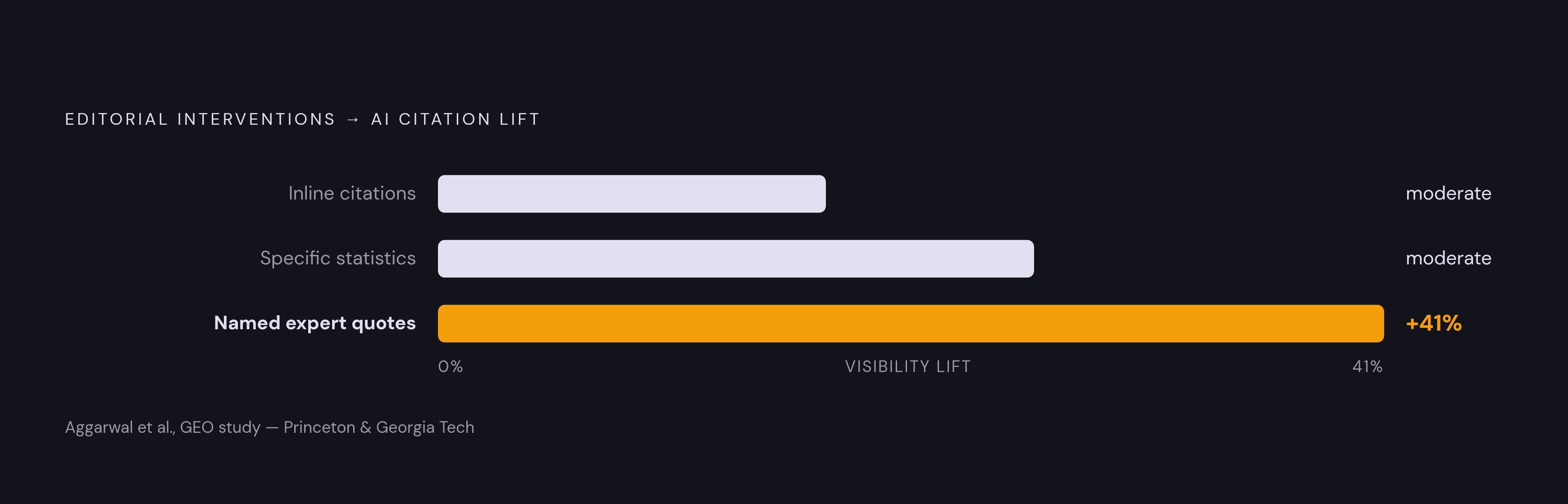
The content changes that move AI citation rates are structural choices about what goes into a piece of writing, not changes to code, and any communications team can make them without waiting on technical staff. Research from Princeton and Georgia Tech, cited by Vynce Digital, tested specific content interventions: adding inline citations to primary sources, adding specific statistics in place of vague claims, and adding named expert quotes. Each produced a measurable increase in AI citation rates on its own, and quotations alone drove a 41 percent visibility lift according to Aggarwal et al.'s GEO study. None of these require a developer. They require an editor willing to rewrite a paragraph.
The logic behind the finding is consistent with everything already established about how these models weigh evidence: AI systems favor content backed by authority and evidence, so expertise and credibility signals carry more weight in citation decisions than how often an organization publishes or which keywords it uses. For a nonprofit, that translates into specific editorial habits. Program impact data tied to named outcomes, bios for the researchers and practitioners running a program, external evaluation reports, and direct quotes from the people a program actually serves can do more than tell a good story. They are the exact signals an AI system uses to judge whether an organization's claims hold up.
Building third-party authority works alongside these content habits, not in place of them. A mention in a watchdog assessment from Charity Navigator or GuideStar/Candid, program research cited in academic work, and coverage in sector-specific publications all strengthen the citation ecosystem an AI system draws from when it decides what to say about an organization and whom to trust saying it. A mission statement belongs in this same conversation. Treated as a machine-readable document rather than a line of marketing copy, mission language becomes one more credibility signal a model can read, categorize, and repeat accurately, provided it was written with enough specificity to be read that way in the first place.