Citation Profile Building for AI Discoverability Beyond Backlinks
Brands invisible to AI need citations, not just backlinks, to get recommended.

It has already produced a real gap. A 2026 AI SEO report from Fuel Online, surveying 1,000 enterprise brands, found that 62% are invisible to generative AI models despite 94% of those same companies pouring money into traditional SEO. Companies are trying. They're just aiming the wrong instrument at a system that runs on different rules entirely. Backlinks answer one question: who vouches for your domain? A citation profile answers something else: does the model know your brand exists, trust what it knows, and feel good recommending it to a stranger who just asked. Building for one doesn't get you the other, and a lot of budget is currently proving that the hard way.
How large language models actually decide which businesses to surface
A large language model draws on patterns absorbed during training, then retrieves and weighs signals at query time. It isn't running a backlink check the moment someone types a question. Trustworthiness here is a composite, built from how a source shows up across thousands of documents the model read long before your query existed, rather than a score stapled to a domain.
The entity index sits at the center of it. When ChatGPT decides whether to cite a business, it's consulting an internal picture of that business, assembled from the open web, from Wikidata, from Wikipedia, from structured data scattered across dozens of sources that never asked the business's permission to be read. A brand that exists only as text on its own website is, from the model's vantage point, unverifiable. It gets quietly passed over in favor of entities the model already recognizes and can cross-check against something else.
Sentiment factors in too, and the mechanism runs deeper than the blunt positive-or-negative read most people assume. NLP analysis of reviews, forums, and commentary produces something closer to a confidence score than a verdict. A brand with a mostly negative footprint gets withheld from recommendations, no matter how strong its domain authority looks in a traditional SEO audit.
SEMrush drew a useful line between two things people tend to conflate. A citation means the model trusts your data enough to footnote it. A mention means it trusts your brand enough to actually say the name out loud in an answer. Fewer than one in five brands earn both, a gap SEMrush's September 2025 analysis called the Mention-Source Divide. The platforms don't even agree with each other: only 11% of domains show up in both ChatGPT and Perplexity results. Entity signals are platform-specific. Winning visibility on one system carries no guarantee it transfers to another, and I've watched teams celebrate a ChatGPT win only to find Perplexity has no idea who they are.
Think of it as an advisor sizing up a stranger's question. When an AI names one or two brands in response, it's putting its own credibility on the line, and that's a conservative act by nature. The model defaults to entities it can verify, ones corroborated across sources it didn't write itself. Optimizing for AI citation means making a brand legible to a system that has never once visited its website. The signals that do this look almost nothing like the ones that used to move a PageRank score.
The four signal categories that build a citation profile
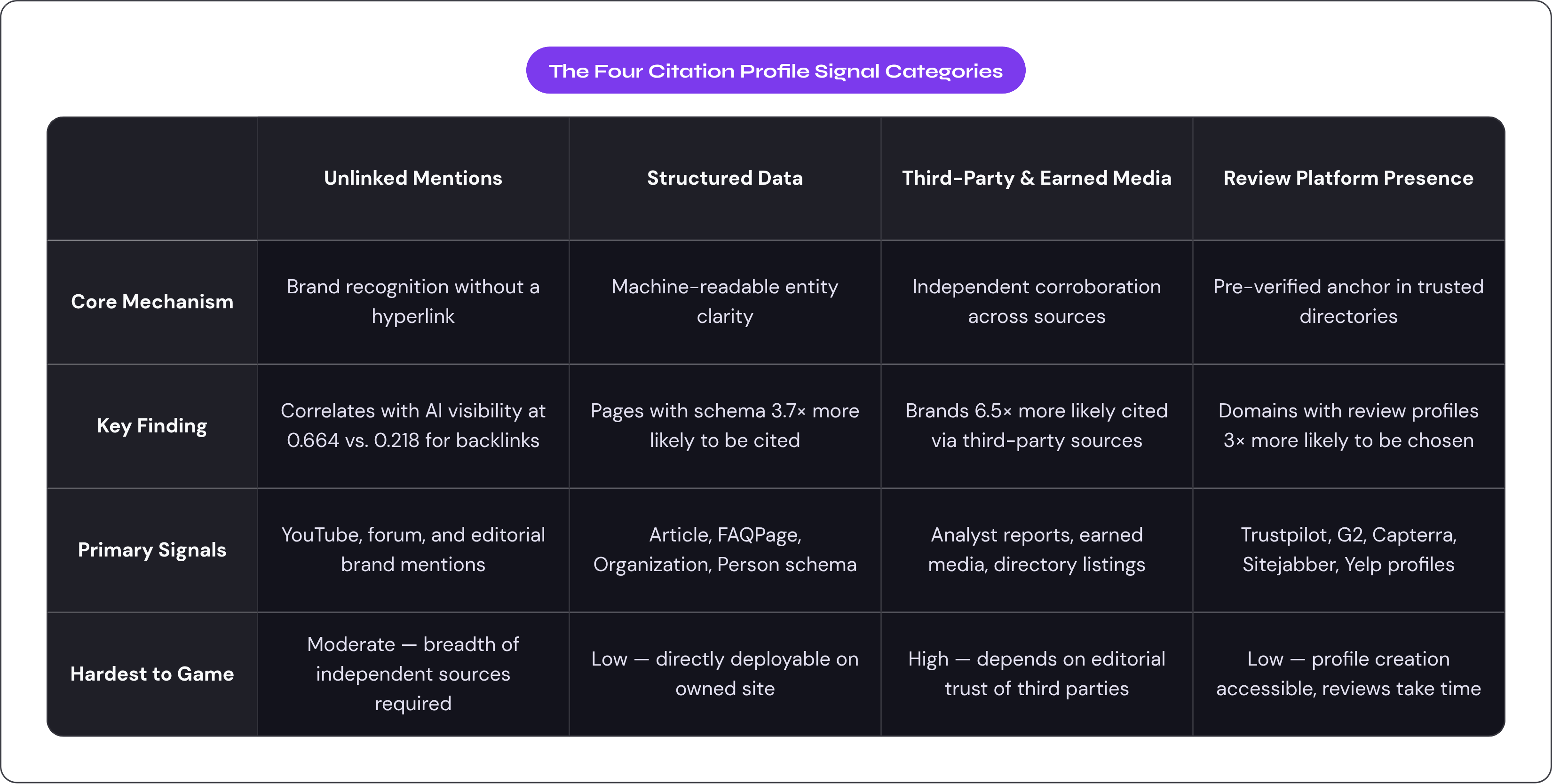
A citation profile stacks four distinct signal categories. Each works through its own mechanism, and each gets weighted differently depending on which retrieval system is doing the weighing.
Unlinked brand mentions carry more weight than almost anyone coming from traditional SEO expects. Ahrefs, studying tens of thousands of brands, found unlinked mentions correlate with AI Overview visibility at 0.664. Backlinks, in the same study, land at only 0.218. A mention with no hyperlink outperforms a link with no mention, which still sounds backwards to people who spent a decade building link graphs. Breadth and independence of reference matter more here than the link graph ever did. Ahrefs' December 2025 data separately flagged YouTube mentions and general branded web mentions among the top factors tied to visibility across ChatGPT, AI Mode, and AI Overviews.
Structured data and entity clarity do something different. Pages carrying Article schema with full metadata, FAQPage schema, and Organization schema for entity clarity are 3.7 times more likely to get cited. Author attribution using Person schema, linked to verifiable credentials, satisfies the authorship standard these systems check against. Structured data works as a readability layer, really, a way to make a brand legible to a machine that has no capacity to infer meaning the way a human editor would.
Third-party and earned media matter more than owned content, in nearly every study on this. Brands are 6.5 times more likely to get cited through third-party sources than through their own domain, per Airops research from October 2025. Position.digital found that 84% of AI citations trace back to earned media rather than a brand's own site, and Stacker reported in March 2026 that distributing earned media can lift AI citations by a median of 239%. Independent reference is exactly the kind of corroboration a model needs to move a brand from mentioned once, somewhere, to verified repeatedly across sources that have no idea the others exist.
Review platform presence does something almost mechanical to citation odds. SE Ranking, in November 2025, found domains with profiles on Trustpilot, G2, Capterra, Sitejabber, or Yelp have three times higher odds of being chosen as a source by ChatGPT. The gap in scale is almost absurd: brands with no Trustpilot profile see a median AI citation rate around 1%, while brands with even a minimal profile, as few as one to thirteen reviews, jump to 53.5%. Review platforms work as pre-verified anchors. The model already trusts these directories, so showing up there is a shortcut to legibility that would otherwise take years to earn on your own.
Then there's contextual co-occurrence, the hardest of the four to game and the strongest predictor in the data. A 2025 industry analysis spanning hundreds of millions of citations found semantic completeness correlates with AI citation at 0.87, the tightest relationship in the whole study. Co-occurrence means getting mentioned alongside the topics, categories, and entities your brand actually belongs to, consistently enough that the model starts associating the two on its own, without being told to. Brand search volume showed up as a predictor too, at 0.334, so demand itself feeds the citation signal. This work departs most sharply from backlink strategy here: it's a matter of semantic neighborhood, not link neighborhood, and that changes how you plan the work from day one.
Where backlinks fit in this system, and where they stop mattering
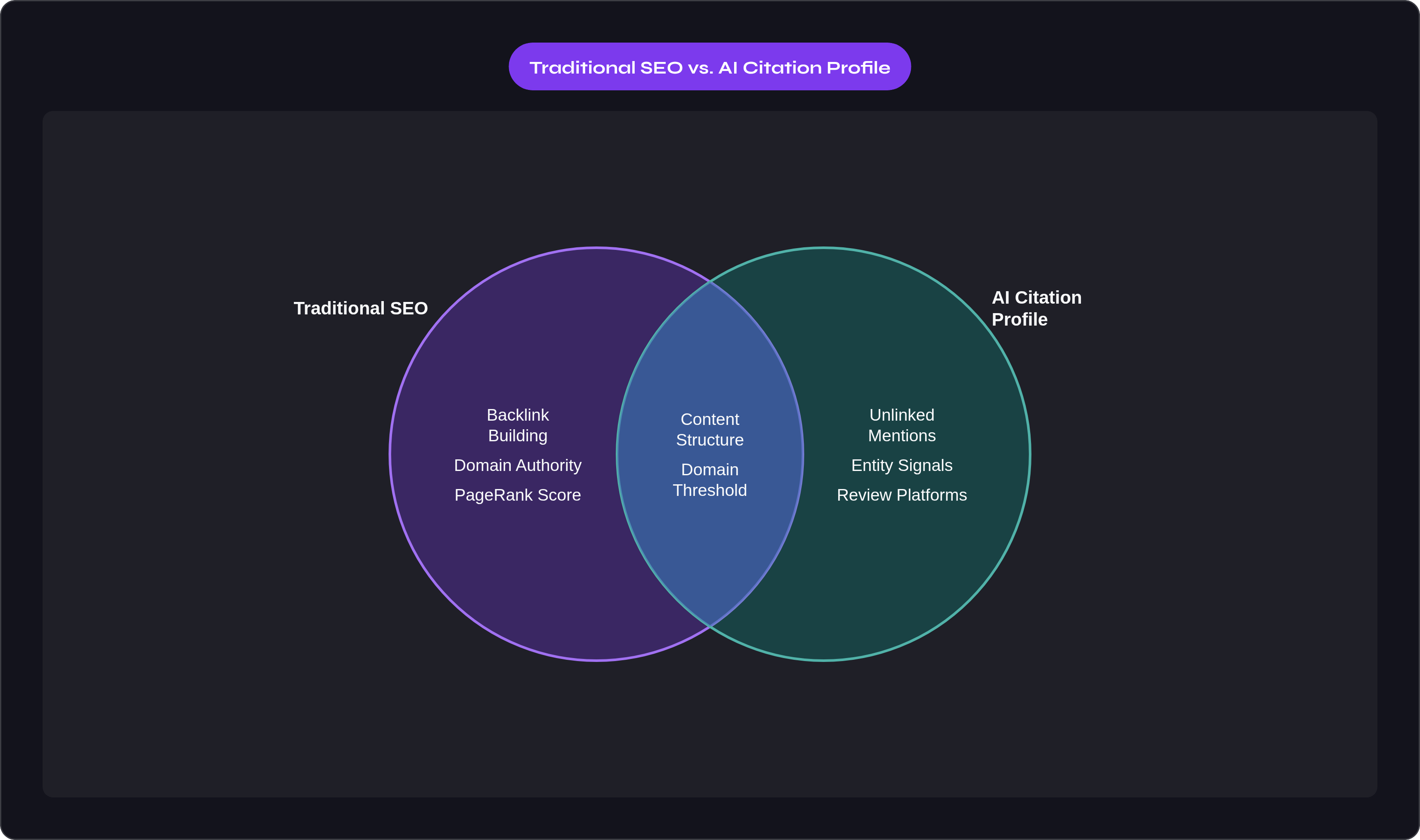
Backlinks function as a threshold condition, not the main driver. They help a domain clear the bar to even get considered by an AI retrieval system. Past that bar, brand mentions, co-citations, and content structure do most of the remaining work, and no amount of additional link building changes that math.
Semrush, in an October 2025 study of hundreds of domains, found Authority Score correlates with AI mentions at a Pearson coefficient of 0.65, but the gains only show up once a domain crosses a certain authority tier. Below that tier, adding more backlinks barely moves the needle. The signal seems to be losing weight over time anyway: domain authority's correlation with AI citation dropped noticeably from 2024 to 2025. These systems appear to be leaning on it less as they mature, which tracks with everything else in this piece.
The trust chain runs one direction. Backlinks build authority, authority feeds rankings, rankings determine citation eligibility, and brand mentions reinforce the whole thing from outside the link graph. Treat these as interchangeable, or as one continuous metric, and you'll confuse layers of a stack that behaves quite differently at each level.
Here's the practical shape of the problem, and it's one I see constantly. A team with a strong backlink base but no unlinked mentions, no entity signals, and no third-party presence sits right at the threshold, going nowhere past it. A team that skips backlinks entirely may never clear the threshold at all. The error that shows up over and over, especially in how agencies pitch this work, is treating citation profile building as backlink strategy with a PR spin bolted on top. The sequencing is wrong, the signal types are wrong, and the measurement is wrong, all three at once.
How content structure becomes a citation signal in its own right
Adding citations to mid-ranked pages produced a 115.1% increase in AI visibility. Adding statistics to a page raised visibility by 22%. Those are structural choices, made on pages a company already owns, with measurable consequences for whether a system decides to cite them.
Pages built with a clean H1-H2-H3 hierarchy are 2.8 times more likely to get cited, and 87% of pages that AI systems actually cite use a single H1. That's a legibility signal the retrieval layer acts on directly, rather than a stylistic preference. These systems pattern-match against the structural habits of documents that turned out to be reliable during training. Hierarchy, attribution, sourced claims: these keep showing up in what gets trusted, and the model keeps looking for them wherever it goes next.
FAQPage schema matters for a specific reason. It maps directly onto how these systems parse and excerpt answers at the moment someone asks a question. Author attribution through Person schema carries weight beyond an E-E-A-T checkbox left over from traditional SEO; it answers the same authorship question the model asks before deciding whether a claim came from a verifiable expert or an anonymous voice with no track record.
Two different plays are happening here, and they shouldn't collapse into one. Structure on a company's own site makes that content citable when the model retrieves it directly. Third-party mentions make the brand citable even when its own content never enters the retrieval path at all. Neither substitutes for the other, and companies that pour effort into one while ignoring the second end up with half a citation profile, wondering why the other half never showed up.
What a citation profile build actually looks like in practice
Sequence matters more than most teams expect. Entity establishment has to come before mention amplification, because a brand the model can't verify gets no benefit from a flood of mentions. Volume without verification is just noise the model discounts, however much of it you generate.
Start with entity establishment. A Wikipedia or Wikidata presence where notability rules allow it, since these feed directly into the entity index LLMs query. Organization schema deployed consistently across the site, matching name, address, and phone details, clear categorical descriptors, so the identity is machine-readable and not just human-readable copy. Profiles on the two or three review platforms that actually matter for the category (G2 or Capterra for software, Trustpilot for consumer brands, Yelp for anything local), since even a minimal presence lifts citation rate dramatically.
Corroboration follows that foundation. Earned media placements in publications the model already trusts matter more than volume; not every third-party mention carries equal weight, and a mention on a site with strong entity signals of its own counts for more than one buried on an obscure blog nobody reads. Analyst reports and directory listings that place the brand next to category-defining competitors build the semantic neighborhood the model needs to see. Podcast appearances, video content, and YouTube mentions all feed the branded web mention signal Ahrefs flagged as a top visibility factor.
Mention amplification builds on that base. Unlinked brand mentions across forums, communities, and editorial writing, aimed at breadth of independent reference rather than link acquisition in the old sense. Partner and customer case studies place the brand in specific, concrete use-case contexts, feeding the semantic completeness signal. Expert-sourcing outreach generates genuine third-party attribution, so the author's name and the brand's name get cited together in sources the model already trusts.
Owned content rounds it out. Pages structured for AI retrieval: a single H1, clean hierarchy, cited claims, embedded statistics, FAQPage schema on question-format sections. Topical depth across the brand's actual category matters just as much, since semantic completeness depends on a body of work that saturates the whole topic cluster the brand belongs in, not one great page sitting alone and hoping to carry the rest.
These four layers feed each other. A brand with strong entity signals gets more value out of every earned mention it picks up afterward. A brand with plenty of mentions but weak entity signals stays poorly legible at the verification step, no matter how much earned media it accumulates. That interdependency is the part most execution plans skip past, usually because it's harder to bill for than a link-building retainer.
Why citation profile performance is invisible to conventional monitoring tools
Social listening tools and SEO dashboards capture what happens on indexed, public surfaces. Seeing what happens inside an AI conversation sits structurally beyond their reach, because those conversations happen in private chat windows and leave nothing behind for a crawler to find.
A brand could get recommended by ChatGPT thousands of times a day, or get consistently passed over in favor of a competitor, and neither outcome registers on a conventional dashboard. A SERP rank report gives you position data: where you sit on a results page. A prompt-level citation report gives you something else entirely: which sources got cited for a specific prompt, run repeatedly, and whether your domain showed up at all, or didn't.
Monitoring this properly means running several kinds of prompts, not just one. Branded prompts, asking a model to describe a company, establish a baseline for how accurately it understands the brand. Category prompts, asking for the best tools in a space, measure competitive citation share. Comparison prompts, brand versus competitor, reveal how the model positions one against the other. Use-case prompts show exactly where a brand gets recommended and where it quietly gets left out of the conversation entirely.
Track mention frequency as a baseline, sentiment score (the actual language the model uses around the brand, not a simple thumbs up or down), share of voice across category prompts, and recommendation rate. Platform fragmentation makes this harder still. With only 11% of domains appearing in both ChatGPT and Perplexity results, a citation profile that looks healthy on one platform can be completely absent on another. Any approach watching just one engine misses that gap entirely, and most approaches still only watch one engine.
Measuring the citation profile: scoring what the model sees, not what the site shows
This measurement problem needs its own tool, one built to capture entity legibility, mention breadth, sentiment quality, and platform coverage together. None of those four signals means much read in isolation, which is precisely why a single dashboard number keeps failing everyone who relies on it.
A domain authority score tells you almost nothing about whether ChatGPT will name your brand in an answer tomorrow. A backlink count tells you even less. What the model sees is a scattered, cross-referenced picture built from reviews, forum threads, structured data, and third-party writing that a business rarely controls directly and almost never watches closely. Measuring a citation profile means building a mirror of that picture, rather than a mirror of your own site. Anyone still checking rankings and calling it a visibility strategy is measuring the wrong thing, in the wrong place, for a system that stopped caring about the old metric some time ago.