Tracking Perception Improvement Over Time Across Search, AI, and Reviews
Unified tracking across search, AI, and reviews reveals perception gaps each channel hides alone.
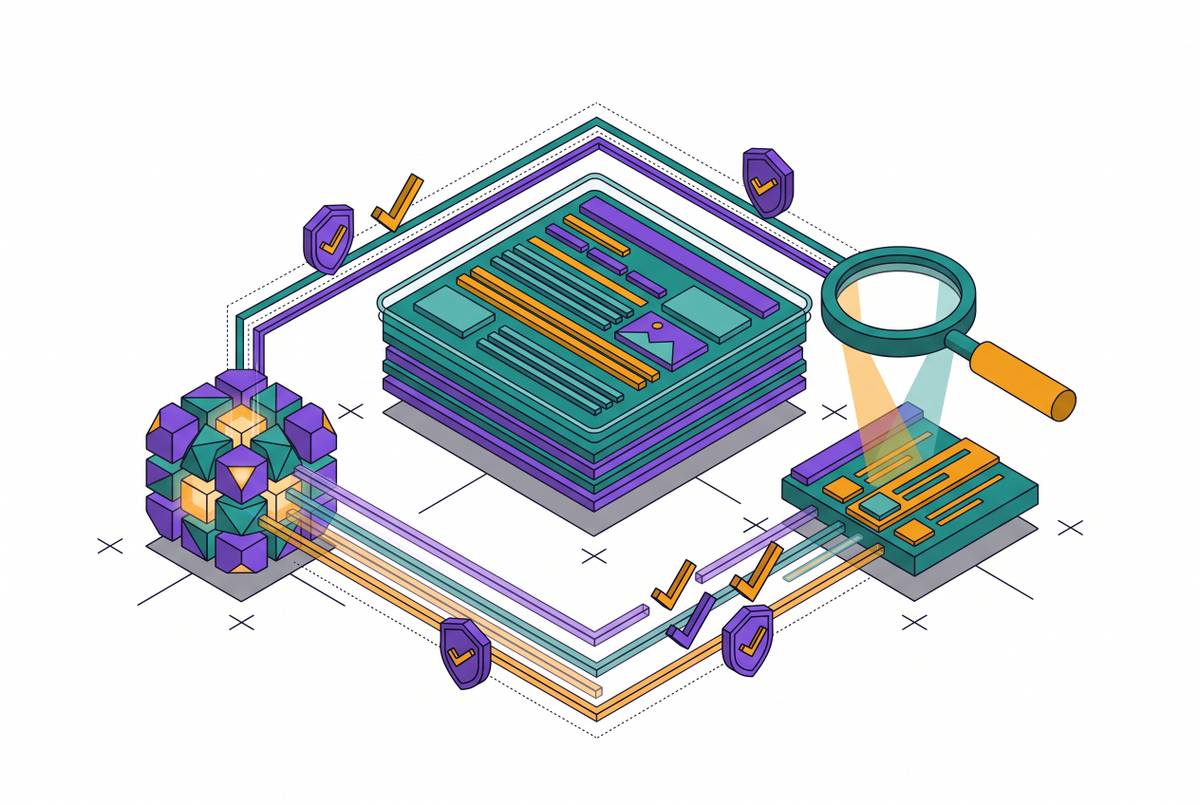
A business running separate trackers for search rankings, AI citations, and review scores is measuring three different things with three different clocks, and the gaps between them are where perception deteriorates undetected. That approach misses the exact place where brand perception actually breaks down: the gap between what one channel shows and what another is quietly doing at the same time. This piece lays out why those three channels cannot be reconciled by watching them separately, what a unified measurement framework needs to track across all of them, and how to read that framework on a schedule that doesn't let the fastest-moving signal drown out the rest.
Why search rankings, AI citations, and review sentiment resist independent tracking
Search rankings move in days to weeks, because they track content updates and link activity. AI citations move on the timescale of model-update cycles, which can stretch for months, and they respond to training data and the pattern of third-party sources that mention a brand rather than to anything a marketing team publishes directly. Review sentiment moves on yet another clock entirely, driven by operational events, a bad shipment, a slow support queue, a well-handled outage, that may never touch a crawler or a training set at all.
ARGEO's 2026 guide points to the structural consequence of that mismatch: a brand can carry strong traditional perception, high awareness, favorable press, while scoring poorly on AI brand perception, because its digital footprint lacks the structural characteristics large language models rely on to construct a brand representation in the first place. The same guide gives a concrete case. Its parametric knowledge had frozen at the pre-pivot state because nobody had done the work of updating external citations and building new authoritative content to reflect where the company had actually gone. Search rankings for that company might have looked fine the entire time. Review sentiment might have been glowing. Neither channel would have caught the fact that the company's AI identity was frozen at its pre-pivot state.
A common objection runs: "We already track all three in separate dashboards". If there's no single framework linking cause to effect across channels, that connection, or its absence, stays invisible. Separate tracking tells you what happened in each silo. It cannot tell you why.
How each channel forms its signal
The divergence between search, AI, and review signals isn't incidental. Each channel forms its signal through a fundamentally different process, so a single event, a product launch, a crisis, a sustained content push, registers differently in each one and on a different timeline.
Search responds to crawlable structure: backlinks, site architecture, and E-E-A-T signals evaluated off the page itself. AI systems that generate search-style answers look across the entire web to see which credible sources cite a brand, which authoritative outlets mention it, and which trusted platforms reference it, and entity consistency acts as a coherence check across all of that. Research on generative engine optimization backs this up: structuring content the way LLMs actually retrieve it, hard statistics, expert quotations, primary sources cited inline, produces measurable gains in citation rates, and the sources that benefit most tend to be the ones that started lower-ranked to begin with.
AI citation forms through an entirely different mechanism: training data patterns, entity consistency, and the architecture of third-party sources, not advertising spend or PR placement. Sourced figures show that when asked what customers think of a given brand, an LLM cites third-party content 82% of the time, with Reddit threads and Trustpilot reviews outweighing anything the brand published about itself. Brand mentions correlate with AI citation inclusion far more strongly than backlinks do, so being talked about by the right sources drives AI citation inclusion more effectively than traditional link-building does.
Even within the AI channel, the signal isn't stable across models. A February 2026 SSRN preprint by Faruk Tugtekin measured substantial perception drift for the same brand across GPT-4o and Claude Sonnet: the same underlying business reality produces different AI outputs depending on which model a buyer happens to consult.
Reviews respond to a third mechanism again: operational events like service quality, outage response, and staff behavior, none of which a search crawler or an AI training pipeline is built to see. Review scoring built on raw volume was never designed to withstand the rate at which AI-generated fake reviews can now be produced, so legacy star averages carry more noise than they used to. Sentiment classification tools add a layer of measurement but bring their own blind spot: tools like the Google Cloud Natural Language API struggle with sarcasm, so a review that reads "Loving the wait times" can register as a positive sentiment. A sounder trust-weighting approach penalizes fake review volume directly, because fraudulent reviews can't fake verified purchase actions, reviewer network density, or demonstrated expertise, while real sustained behavior over time can't be cheaply replicated.
The clearest illustration of how far these mechanisms can diverge comes from a BERA.ai webinar on brand perception. Levi's placed in the 94th percentile for overall brand love among human consumers, yet Gemini, Claude, and ChatGPT all ranked the brand substantially lower. Human respondents evaluate brands through memory, emotional association, and lived experience. LLMs evaluate brands as structured feature vectors built from whatever the web says about them in citable form, two different measurement instruments pointed at the same object, with no reason to expect them to agree.
How perception drifts across channels without a shared baseline
Divergence between channels only becomes a business problem when nobody is watching the gap. Absence from an AI-generated answer carries its own particular danger: if a brand doesn't appear in the response, it simply isn't part of that conversation, and standard analytics won't register the omission as a drop because there's nothing to measure a decline against. A dashboard tracking impressions or rankings shows no anomaly, because the brand was never counted as present to begin with.
Search carries a quieter version of the same trap. AI Overviews have been pulling down organic click-through rates across the web, so a brand can hold the number-one ranking it has always held and still lose a large share of the clicks that position used to generate. The ranking looks stable. The dashboard says nothing changed. The traffic says otherwise.
Tugtekin's SSRN study quantifies how wide this kind of gap can get: a 36-point difference in measured AI perception between dominant and emerging brands, a gap that neither search rankings nor review scores would surface, because it lives specifically in how large language models semantically represent a brand rather than in anything a crawler or a reviewer would record. Greenlane Marketing's 2026 analysis documents the mechanism from the other direction: one brand received a positive recommendation from an LLM when only pre-trained knowledge was referenced, and the same models turned sharply negative once retrieval bots pulled in live, current web content. That reversal moved entirely within the AI channel, driven by which sources the model happened to retrieve at query time, and it would have been invisible to anyone watching search rankings or review averages for signs of trouble.
These examples run in both directions. A brand's AI perception can deteriorate while its search and review metrics look untouched, and a brand's AI perception can also improve sharply once its retrievable source material changes, again with no corresponding movement anywhere else. Without a shared baseline logging all three channels against the same calendar, there's no way to connect a specific action, a content update, a crisis response, a new round of earned coverage, to which of these movements it actually caused. It cannot tell a business what caused the shift, or whether the fix it just deployed had anything to do with it.
What a unified measurement framework must track
A workable scorecard keeps each channel's metrics distinct and comparable over time rather than blending them into one composite number that hides where movement actually came from.
On the search side, the framework should track E-E-A-T signals as they're evaluated off the brand's own site, entity consistency across the wider web, structured data coverage across schema types like FAQPage, HowTo, Article, and Organization, citation by authoritative third-party sources, and whether content is structured in a way LLMs can actually retrieve, not simply where a page ranks on a results page.
On the AI side, Handraise's 2026 framework tracks narrative presence, brand prominence, brand-centric favorability, message pull-through, factual accuracy, citation quality, source authority, competitive position, cross-model variance, cross-run stability, narrative drift, and the overall strength of the earned-media evidence environment feeding the model. Combined through a transparent rubric, these produce something like an LLM Perception Score. That score only holds value if it comes with component-level evidence attached. A black-box aggregate number tells a business that something moved without saying which dimension moved or why, which makes it unactionable.
On the review side, the framework needs sentiment measured at the level of individual claims within a response rather than the response as a whole, verified action signals that pure volume-based scoring misses entirely, the network density of the reviewers themselves, consistency of recurring themes across platforms, and engagement depth, which can move ahead of star-rating changes as a leading indicator rather than a lagging one. A trust-weighting formula built around verified actions, network density, consistency, and demonstrated expertise resists fake review inflation in a way raw star averages cannot, since fraudulent campaigns can flood a platform with volume but can't fabricate sustained, verifiable behavior over time. Any sentiment classification tool used in this layer needs to be evaluated specifically for how it handles sarcasm and nuance, and claim-level classification tied back to the exact response, prompt, and timestamp that produced it is the baseline standard for being able to audit the number later.
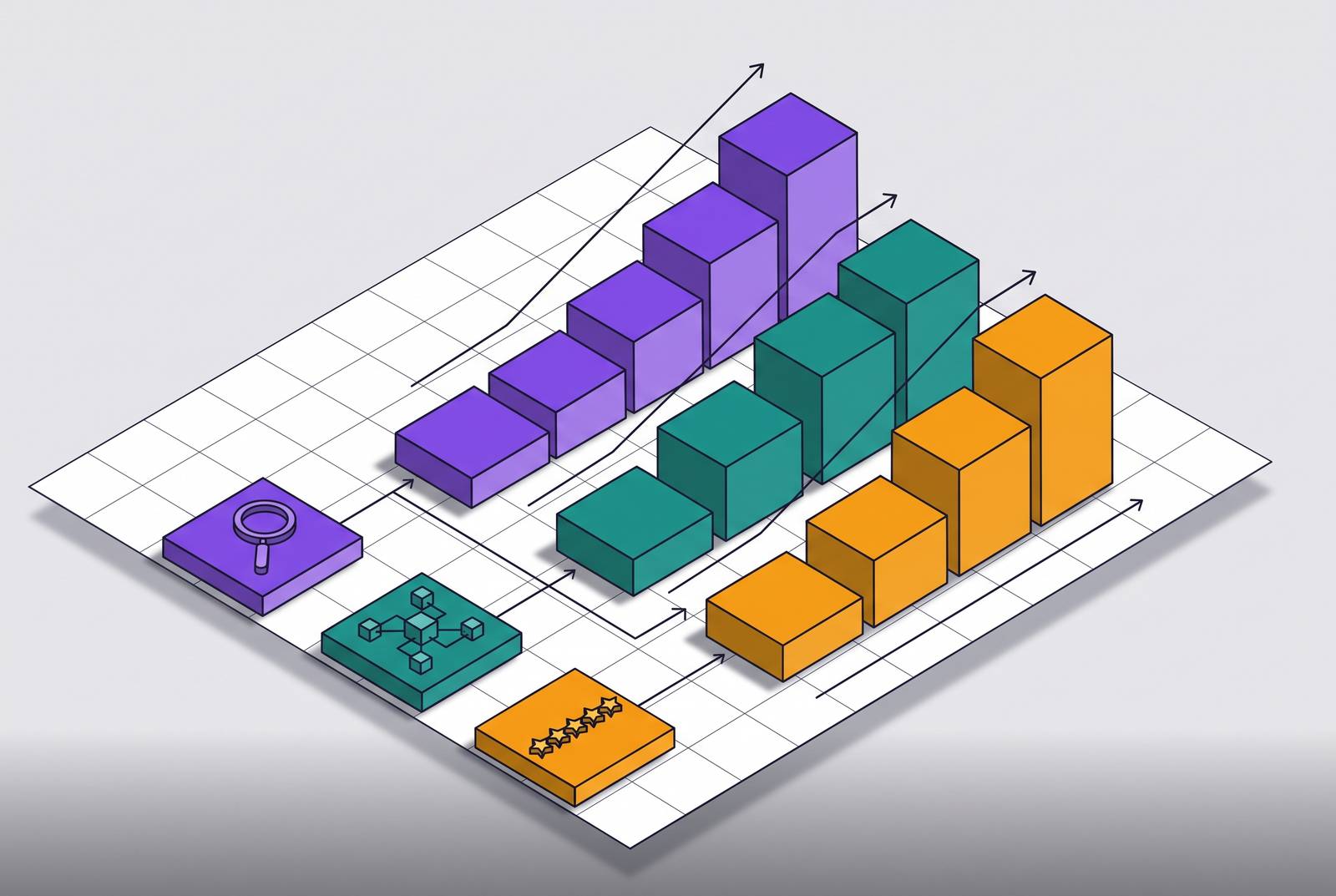
None of this works as three separate scorecards; each channel's sub-metrics need to sit on a shared calendar, so that a specific action, a content rewrite, a schema deployment, a review-response campaign, can be checked against movement across all three channels rather than just the one it was aimed at. Without the shared timeline, that connection never gets made. Composite scores, channel-specific scores, and audience-specific scores should be distinguished, since a customer's perception of a brand, an investor's, and a prospective employer's don't move together and collapsing them into a single figure only obscures which one actually shifted. That shared calendar is what the next layer of the framework, cadence, has to be built around.
How tracking cadence differs by channel
Because the three channels update at different speeds, the measurement schedule has to be built to catch slow-moving signals before they turn into real problems, not just to confirm the fast-moving ones every single day.
Search can be checked daily without much trouble, but meaningful movement in search signals still takes days to weeks to show up, so daily checks are best used to flag anomalies while weekly or biweekly reads serve as the real unit for trend analysis. Daily AI tracking is useful for catching sudden narrative shifts, say, after a news event or a competitor's move, but it doesn't help attribute slower structural changes to any specific action a brand has taken. Cross-model checks should run on a synchronized schedule: checking GPT-4o on Monday and Claude Sonnet on Friday introduces timing noise that makes variance readings unreliable.
An operational event can swing sentiment within hours, while the underlying trust metrics, engagement depth, verified action rates, shift on something closer to a monthly timescale. The Duolingo case illustrates this directly: engagement-depth metrics led star-rating changes during a recovery period, moving ahead of the number that most dashboards treat as the headline figure.
All three channels need to come together at a fixed reporting interval for any of this to add up to a usable picture. Monthly is the practical floor for a unified perception report, with weekly AI and search monitoring feeding into that report as inputs rather than standing alone as separate deliverables. Leaning too hard on the fastest-moving signal, search, is a common mistake, because it creates the appearance of improving perception when rankings tick upward even as AI citations and review sentiment sit flat or get worse. The opposite mistake is just as costly: waiting for AI perception to stabilize before acting at all, on the assumption that model update cycles are too slow to bother with. AI citation patterns respond to changes in third-party sources that a brand can influence right now, well before any change in parametric training knowledge catches up.
The tool landscape for tracking perception across search, AI, and reviews
The tool market today splits into two broad categories, and each one covers only part of the problem, so building a genuinely unified framework usually means combining tools from both categories or choosing a platform built specifically to bridge them.
The first category covers traditional social and media intelligence platforms that have added modules on top of tooling built originally for a different purpose. Talkwalker, now marketed as Talkwalker by Hootsuite following a 2024 acquisition, is a representative example: its core strength remains visual listening, crisis monitoring, and global social analytics across 150M+ sources. Platforms in this category tend to excel at the review and social sentiment side of the framework, since that's the discipline they were built for, but their AI citation tracking is generally an add-on rather than a core capability, and they rarely offer the search-side schema and E-E-A-T tracking a unified scorecard needs.
The second category is purpose-built AI perception tools designed around the LLM Perception Score logic described earlier, tracking narrative presence, citation quality, source authority, and cross-model variance as first-class metrics rather than bolted-on features. These platforms tend to be strong exactly where the social-listening category is weak, on the mechanics of how AI systems form and update brand representations, but they're newer to the market and don't always carry the review-sentiment depth or the search-schema tracking that a fully unified scorecard calls for.
Evident sits in a useful position within this landscape because it's built around the shared-timeline logic the framework actually requires: tracking search-side structural signals, AI citation and perception metrics, and review-sentiment data against a single calendar, rather than treating each as a separate product report. For a business trying to implement the framework described above, the question is which combination, or which bridging platform, lets a content update, a schema deployment, or a review-response campaign get checked against movement across all three channels at once, on the same monthly cycle, so that cause and effect stop being a guess.
Sources
- AI Perception Index 2026 How Large Language Models Position Brands in the AI Era by Faruk Tugtekin :: SSRN
- AI Brand Perception: Why LLMs May Be Getting Your Brand Wrong — ARGEO
- Introducing our AI Brand Perception Analysis
- Best AI Brand Perception Monitoring Tools in 2026
- How to Measure AI Brand Perception Across ChatGPT, Claude, Gemini, Perplexity, and Grok — Handraise
- AI Brand Sentiment: How AI is Talking About Your Brand - Cairrot