Structured Data Gaps That Suppress AI and Search Discoverability Simultaneously
Fixing structured data gaps boosts both search visibility and AI trustworthiness at once.

A business can have a flawless meta description and a perfectly optimized title tag, and still be invisible to the system that increasingly decides what gets recommended. That's because gaps in structured data don't just weaken search rankings; they starve AI models of the confidence they need to cite a brand at all. Search and AI used to be separate battles, fought with separate tactics, but they aren't anymore. Certain omissions in a business's structured data hit both at the exact same point of failure, and fixing that one point produces gains that compound rather than simply add up.
How search algorithms and AI systems both depend on entity confidence
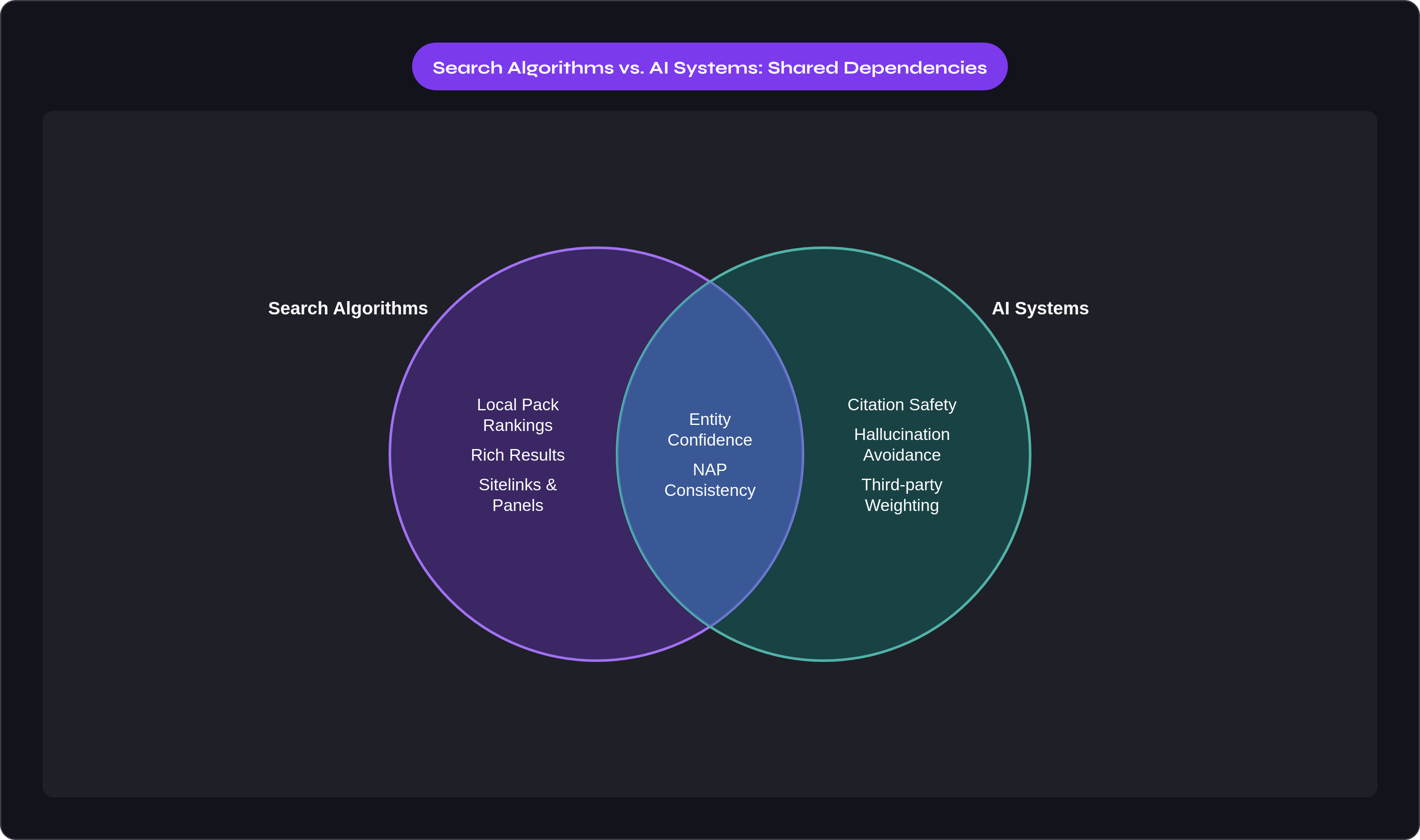
Search engines rank pages, while AI systems generate answers, and on the surface those look like different jobs that call for different fixes. Underneath, both systems need the same starting condition before they can do anything useful with a business: a stable, coherent read on what that business actually is.
I call this entity confidence, and it's worth sitting with the definition for a second because almost nobody outside a technical SEO team has had reason to think about it. It's the degree to which an algorithm, or a model, can resolve a business as one consistent object, with attributes that match no matter where the system goes looking for them. Google leans on entity confidence to decide whether a business earns a Knowledge Panel, shows up in the local pack, or gets its hours and star rating displayed as a rich result. AI models make a strikingly similar judgment call when they decide whether a brand is safe to recommend. These models are built to avoid stating things they can't back up, so a business they can't resolve confidently gets quietly dropped from the answer, left out without being flagged or penalized.
Both systems draw water from the same well: on-site schema, third-party directories, review platforms, news coverage. And both choke on the same mess: inconsistency, ambiguity, attributes that don't show up where they're supposed to. It's worth knowing the technical distinction here. Named entity recognition is how a model spots that "Acme" is an organization in the first place, while entity resolution is the harder task, the one that decides whether "Acme," "Acme Corp," and "Acme Corporation LLC" all point at the same organization or three different ones. A business that shows up differently depending on where you look may never get resolved as a single entity at all, in the eyes of either system.
Structured data is the mechanism that makes a business legible to any algorithmic evaluator out there, generative AI included.
The NAP inconsistency gap and the entity fragmentation it causes
Name, Address, Phone inconsistency looks minor on a checklist, but it isn't. Google's local ranking systems cross-reference a business's name, address, and phone number across directories, aggregators, and on-site schema to confirm the business is real and sits where it says it sits. When those details drift even slightly, local pack visibility and map rankings take the hit together.
AI models hit the same wall, just from a different angle. Scatter "Acme Corp," "Acme Corporation LLC," and "Acme Co." across the web, and a model has no clean way to decide these are one entity rather than three loosely related ones. The brand becomes unreliable as a source to cite, statistically speaking. Nothing it says is necessarily wrong, but the model just can't confirm who's saying it, and that uncertainty is enough to make the model look elsewhere.
Data aggregators make this worse in a way most business owners never see happening. These aggregators collect listings, standardize them (not always correctly, and I've seen phone numbers get mangled in this exact step more times than I can count), and redistribute that data to dozens of downstream platforms. One bad record at the aggregator level propagates outward from there, multiplying an error the business never actually made. For a multi-location brand, this isn't one entity resolution problem, but dozens, one per location, each fragmenting independently, the inconsistencies stacking across the entire footprint.
The fix isn't glamorous. Audit every directory listing, every aggregator record, every LocalBusiness schema block on-site, and settle on one canonical identity string, used word for word everywhere. What makes this fix worth doing first is that it's the same fix for both channels: the identity string that satisfies Google's local signals is the identical string that lets a model resolve the entity cleanly. One correction, two beneficiaries.
Missing or incomplete Organization schema and why AI models cannot safely recommend what they cannot describe
Organization schema is the foundational block that tells a crawler, or a model, what a business is, what it does, who it serves, and how to reach it. Skip it, and both systems are stuck inferring those facts from whatever prose happens to sit on the page. Inference is a liability either way.
For AI, inference is dangerous because models trained to avoid overstating their certainty will simply decline to recommend a brand when the only description available is unstructured, maybe ambiguous, maybe out of step with what other sources say about that same business. For search, no Organization schema means Knowledge Panels, sitelinks, and brand-related rich features have nothing solid to pull from, and those are exactly the visual signals that build credibility with a human before they've even clicked.
The attributes that go missing most often: founding date, employee count, areas served, legal name, parent organization, and sameAs links to authoritative external profiles like Wikipedia, Wikidata, or Crunchbase. That sameAs property deserves particular attention. It directly ties a business's own schema to its representation in Google's Knowledge Graph and other trusted sources, cutting entity ambiguity down at a structural level rather than a cosmetic one. Both Google and Microsoft have said publicly that their generative AI features draw on schema markup to understand content, so Organization schema is a direct input into how AI answers get built, not a nice-to-have.
Service businesses carry a gap of their own on top of this. Product schema is well understood and widely deployed, but Service schema and OfferCatalog schema, which exist to do the same job for businesses that sell expertise instead of objects, go almost entirely unused. A complete fix looks like this: a fully attributed Organization schema block, sameAs links to at least two or three credible external profiles, and, for service businesses specifically, a Service or OfferCatalog schema that names and describes each core offering with its own attributes.
Content without entity-attribute-value structure and why AI cannot safely cite it
Schema tells a system what a business is. Content structure tells it what claims the business is making, and whether those claims hold up. Both layers need to exist before a citation feels safe from the model's side of the transaction.
I think of this as entity-attribute-value-evidence structure, EAV-E for short, ugly acronym but useful shorthand. Content built this way names the attribute being described, states its value, and links that value to something checkable, which mirrors how a knowledge graph actually encodes facts under the hood. A page that makes its claims in flowing, ungrounded prose gives a model nothing to check the claim against, and a model that can't check a claim has every incentive to leave it out of its answer rather than gamble its own credibility on it.
The gaps show up in the same predictable spots every time: service pages that describe outcomes ("we help businesses grow") without naming the mechanism behind them, about pages that talk about culture and values in the abstract instead of naming founders, founding dates, geographic reach, and specific credentials, case studies that skip named clients, specific timeframes, or any outcome that could actually be checked, even a qualitative one.
There's a freshness angle too, and it's easy to underrate. Most AI citations pull from content that's recently published or recently updated; stale content faces a real disadvantage in AI answer generation no matter how well it was structured back when it was written. A page that was airtight three years ago and hasn't been touched since gets penalized twice, once for structure, once for age. The upside is that EAV-E content performs better in featured snippets and other structured answer formats in traditional search too, because underneath, both systems are hunting for the same thing: a clean, attributable, checkable claim.
Absent or thin third-party entity signals and the trust footprint gap
AI systems cite third-party sources far more often than they cite a brand's own site. A business with immaculate on-site schema and zero independent presence anywhere else is still, functionally, invisible to most generative AI answers, since immaculate isn't enough on its own.
Models weight independent corroboration over self-reported claims, and that logic makes sense once you say it out loud. A brand that only exists in its own copy is, from a model's vantage point, making assertions about itself that nobody else has bothered to confirm. Businesses with no presence on major review platforms, Trustpilot, G2, Capterra, Yelp, or their category equivalents, are missing a structured trust signal AI systems lean on hard. Even a thin presence, a dozen reviews scattered across two platforms, produces a real lift in citation likelihood over having none at all.
Search cares about this too, just through a different door. Review platform presence feeds into the E-E-A-T signals Google uses to judge content quality, and aggregateRating markup enables the star ratings that show up directly in search results, a rich feature that moves click-through rates more than most businesses seem to realize.
There's an author-level version of this same gap. Named individuals writing content on a business's site should themselves be resolvable entities, with LinkedIn profiles, outside bylines, or other signals a model can use to verify the expertise sitting behind the words. Content credited to an author nobody can verify carries less weight than content from someone with a documented presence elsewhere, and that's true even when the actual writing is better. Branded mentions, news coverage, podcast appearances, conference listings, industry citations, now correlate more strongly with AI citation than traditional backlinks do, a genuine shift in what "authority" means to an algorithmic evaluator. A business absent from third-party platforms loses AI citation potential, search rich features, and earned media signals all at once, three losses from one gap.
FAQ and HowTo schema gaps and the question-matching problem they create
AI answer engines are, at bottom, question-answering systems. A query comes in as natural language, and the system retrieves whatever content answers it most cleanly. Content that isn't organized around explicit questions starts that race a step behind, every time.
FAQPage schema fixes this directly by mapping question text to answer text in a form both search and AI systems can read without guessing. On the search side, FAQ schema can widen a listing's footprint on the results page without needing a separate featured snippet, since the questions sit right under the main result and expand the click surface. On the AI side, FAQPage markup on a relevant page makes it far easier for a model to pull out a precise, checkable answer instead of inferring one from paragraphs of prose, which lowers the odds the model hallucinates, or just picks a better-structured competitor instead.
HowTo schema does the same job for process-based queries, breaking a procedure into discrete, machine-readable steps that both channels can extract cleanly.
The gap tends to hit hardest in complex or nuanced fields: professional services, healthcare, finance, B2B technology. These businesses often have deep FAQ and process knowledge sitting in blog posts and long-form articles that never got converted into actual question-and-answer markup. That makes this an unusually efficient fix, since it hits both channels with the same markup change and requires no new content whatsoever, only restructuring what's already been written.
How to audit and sequence these gaps by compounding impact
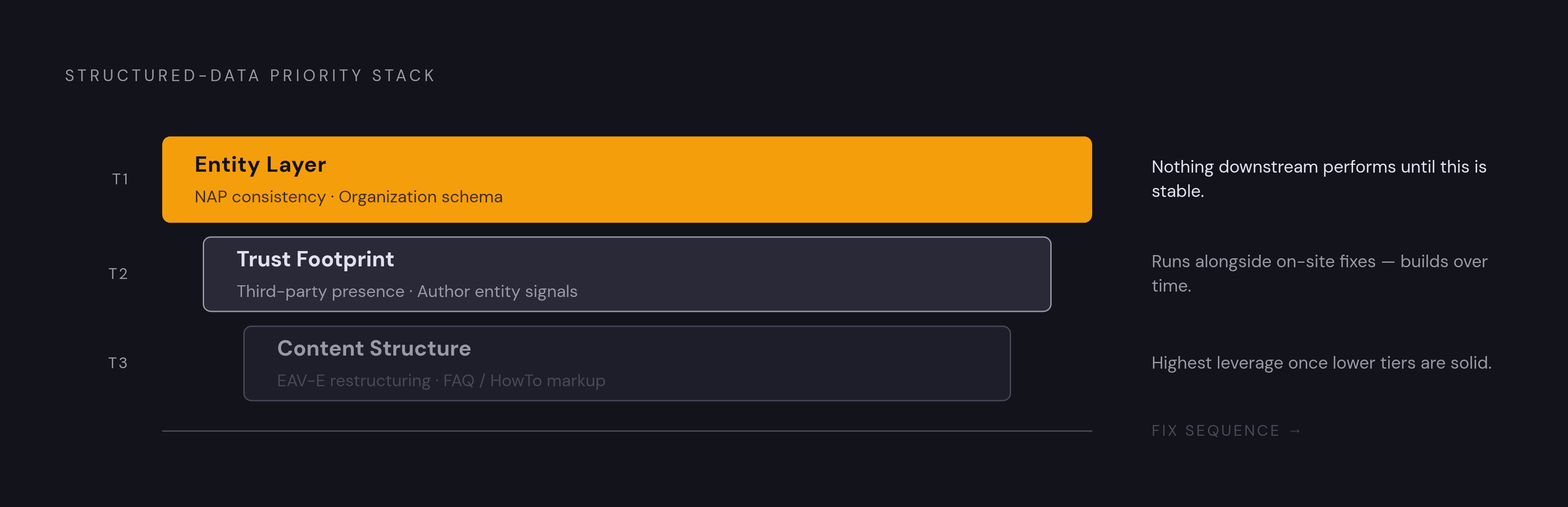
Not every gap deserves the same urgency. The sequencing rule is simple: fix whatever suppresses the most channels with the fewest interventions, first.
Tier one is the entity layer: NAP inconsistency and missing Organization schema. Everything else sits on top of this, and nothing downstream performs well until the entity itself is stable and legible across platforms. Tier two is the trust footprint: third-party platform presence and author entity signals, the off-site corroboration layer both search and AI require. This layer takes time to build, so it should run alongside the on-site fixes rather than wait behind them. Tier three is content structure, EAV-E restructuring and FAQ or HowTo markup, and it becomes highest-leverage once the entity and trust layers are solid, because that's what determines whether well-credentialed content can actually get pulled out and cited.
A reasonable audit starts with four things: a structured crawl of on-site schema for completeness and accuracy, a cross-platform NAP check against one canonical identity, a review of third-party platform presence, and a prompt-based test of how AI systems currently describe the business. That last one surfaces entity confusion faster than any technical crawl usually does, because it shows you exactly what the model thinks it knows, and exactly where that picture falls apart.
None of this works without a baseline. Fixing gaps without measuring them first is fixing in the dark, since there's no way to know afterward what moved or why it moved. I've watched teams spend months on schema work with no way to prove any of it mattered. A tool like Evident exists to prevent exactly that trap, scoring across algorithmic, AI, and human trust signals at once to show a business which gaps are causing the most suppression and which to fix first, going beyond simply handing back a list of what's broken.
Close these gaps, and what you get is one coherent, machine-legible identity that both systems can trust. That's the actual precondition for being found at all, in a discovery landscape that runs more on algorithms every year and less on a human simply scrolling.