Managing Brand Perception After a Reputation Crisis Across AI and Search
Damaging content now survives in AI systems long after news cycles fade.

A reputation crisis used to end when the press cycle moved on. It doesn't anymore: the damaging content survives inside AI systems and search algorithms long after the human narrative has settled, which means brands now manage three separate audiences instead of one, and each recovers on its own schedule, at its own speed, with no coordination between them.
How AI systems actually form their view of a brand, and why crisis content persists inside them
Large language models don't measure reputation the way a communications team does. They reflect what IR Impact's analysis of the Unzer case calls "discursive reputation": whatever has been said, written, and cited about a company across the public record, repeated often enough to stick. When a model answers a question about trustworthiness, it's synthesizing a probability distribution over text, summarizing the discourse it was trained on plus whatever it retrieves at query time. That distinction matters. A company can consider a matter fully resolved internally while the model keeps surfacing the unresolved version, and by its own logic, the model is working as intended. It's just reading old paper, and it doesn't know the paper is old.
The Unzer case from October 2025 shows exactly how this plays out. A merchant typed "Is Unzer trustworthy?" into Google, and the AI Overview said the answer "cannot be answered definitively," then pulled up past issues that had already been resolved. That answer sat above Unzer's own website. It sat above more recent, more accurate press coverage too. Most users never scroll past the summary at the top of the page, so the summary simply became the answer, regardless of what sat underneath it.
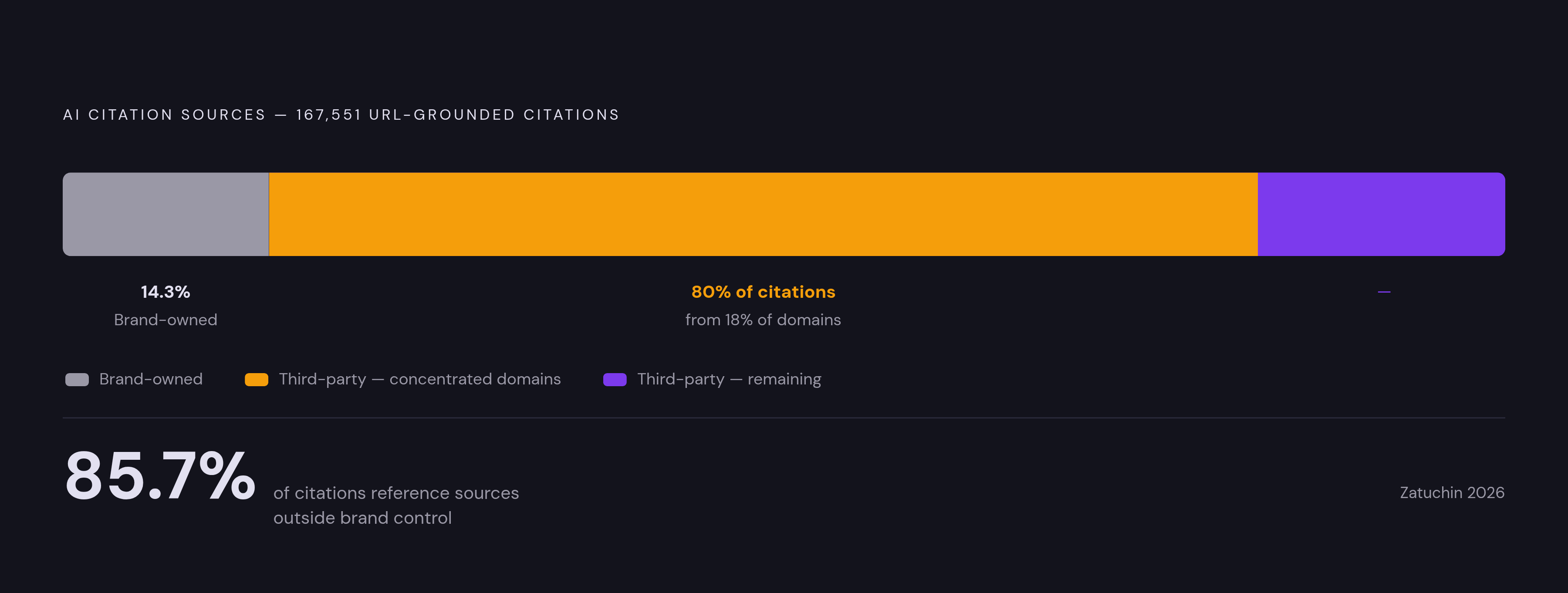
A June 2026 arXiv paper by Dmitrij Zatuchin explains why this keeps happening. Looking at 167,551 URL-grounded citations across 128 brands, 12 markets, and 13 languages, the study found that 85.7% of citations point to sites the brand doesn't own. Only 14.3% point back to owned properties, so a company's own site barely moves what a model decides to say about it. Citations also cluster hard: roughly 80% come from about 18% of domains, meaning a small set of outlets does most of the talking on a brand's behalf. Wikipedia topped the list in 11 of the 12 languages studied (Lithuanian was the exception), though which sources dominate shifts by market. Polish brands, for instance, get cited more from YouTube and from HR portals than from Polish Wikipedia: four careers portals generated 637 citations against 297 for Wikipedia, roughly double.
None of this holds still, either. Research into AI citation patterns has found that brand visibility can shift substantially from one answer to the next on the same query, and consistent visibility across repeated runs of the same query is considerably rarer still. Models don't maintain a fixed record between queries; each answer is constructed anew from whatever the model retrieves at that moment. That volatility cuts two ways: a bad citation is unstable, which helps, but a brand can't just wait it out either, since the model is just as likely to cycle a stale negative source back in as to drop it for good.
The stakes run higher here than in ordinary search, too, because of how AI systems present answers. Search shows ten blue links and lets the user judge. An AI answer names one brand, or maybe three, and puts its own credibility behind the pick. Getting left out, or getting framed badly, does more damage in that format than a mediocre rank ever did in the old one.
What the algorithmic layer registers during and after a crisis
Search rankings run on a separate mechanism, built from three trust signals: entity identity (can the brand be verified consistently across platforms), evidence and citations (does the rest of the web vouch for it), and technical health (does the site work the way a crawler expects). A crisis tends to hit all three at once, and most companies only notice one of them. Negative coverage crowds out the positive citations that used to anchor the evidence signal. Panicked edits to social profiles or business listings break entity consistency. Technical changes made under pressure, a hasty redirect, a page pulled without a proper 301, quietly degrade the third leg, and nobody notices until rankings slip weeks later.
Google's own framework for judging this is E-E-A-T: experience, expertise, authority, and trust. A 2024 SEMrush study found that pages carrying strong E-E-A-T signals had a 30% better chance of landing in the top three results. That framework matters more than usual after a crisis, because a crisis opens a vacuum, and low-quality content, plenty of it AI-generated filler, moves in fast to fill it. Google has tightened its emphasis on genuine expertise and lived experience partly in response to that same flood of synthetic content, so the bar for climbing back out of a crisis-created hole keeps rising, not falling.
Most brands assume the underlying gap is smaller than it is. A Fuel Online report examining 1,000 enterprise brands found that 62% were invisible to generative AI models, despite 94% of those same companies having invested heavily in traditional SEO. A crisis widens that gap; it doesn't create it. It strips out the trust signals that would otherwise bridge traditional search visibility and AI visibility, and those signals were often thinner than the SEO spend suggested.
There's a timing mismatch worth sitting with, too. Algorithmic signals move on their own clock, faster than the human news cycle in some respects and slower in others, and out of sync with when a model's underlying knowledge reflects the latest developments. Search ranking recovery moves on its own timeline, one that syncs with neither public opinion nor the model's version of events. Practically, a post-crisis audit needs to examine what the algorithmic and AI layers are surfacing on brand-name searches, and what sentiment those results carry.
How to score the damage before deciding where to intervene
An online reputation score typically blends signals like social engagement, review volume and tone, content relevance, and backlink quality into one number. That works fine in ordinary times. Right after a crisis, it's the wrong tool, because it can sit stable in aggregate while one specific, high-stakes query, "Is this company trustworthy," produces a damaging AI answer the average never catches.
Unzer's own post-crisis monitoring, as described by IR Impact in 2026, tracked three separate dimensions instead of one blended number. Awareness: does the brand show up at all when a realistic buyer asks a decision-making question? Sentiment: what tone does the response carry when it does show up? Attribution: what traits and narrative does the model keep pinning to the brand, and how far off is that from the positioning the company wants? Unzer ran standardized prompts across several LLMs rather than fixating on any single response, on the logic that one weird answer is noise, but a consistent pattern across models is signal.
The financial case for this work isn't abstract. WiserReview's data puts the cost of a single negative review on the first page of search results at roughly 22% of potential customers walking away, and four or more negative reviews can cut total sales by 70%. Separate figures from WiserReview (2025) and HookAgency (2025) put a one-star increase in average rating linked to a 5% to 9% gain in annual revenue. Those aren't rounding errors, and treating them as PR line items rather than revenue line items is the first mistake most companies make.
A useful benchmark structure, laid out by Incremys, tracks recovery across five audiences (customers, prospects, partners, candidates, influencers) and five dimensions (trust, credibility, preference, recommendation, and perceived leadership), measured at regular intervals with an added pulse check right after the crisis itself. Severity classification sets expectations here. A more contained event, such as an outage or product defect, is largely tactical and tends to clear relatively quickly. A more serious event, executive misconduct, a policy dispute, a competitive accusation, needs a real strategic communications response and can take considerably longer before the numbers settle.
One more distortion to watch for: fake reviews. The FTC's rule banning AI-generated reviews, announced in August 2024 and effective that October, carries fines up to $51,744 per violation. Consumer research shows 46% of people suspect a review is fake once it reads like AI-generated text, and 83% of review readers say spotting a fake review pushes them to avoid the business entirely. A post-crisis reputation score has to account for review authenticity on both sides of that ledger, fake negative reviews planted during the crisis, and the temptation to paper over damage with fake positive ones, since the second move tends to compound the original problem rather than fix it.
Rehabilitating AI perception: what to change in the third-party record LLMs actually read
A company can't edit what a model says about it, and it can't retrain the model on demand. It can only change what the model reads, and that work happens off the brand's own site, on the third-party record the model actually draws from. Most reputation teams still spend the bulk of their budget on the site itself. That's the wrong target.
Wikipedia sits at the top of the list, since it was the most-cited domain in 11 of the 12 languages in the Zatuchin study, which makes it the single highest-leverage repair target available. The right process is to audit the brand's entry for factually outdated negative claims, raise corrections through Wikipedia's Talk page rather than editing directly, and back any resolved issue with citations a reader, or a model, can verify. Direct edits by company staff without disclosed affiliation break Wikipedia's rules, and getting caught starts a second, smaller crisis stacked on top of the first.
Because citation concentrates so heavily, roughly 80% from about 18% of domains, earned coverage in the handful of outlets that dominate a given market beats a wide press release blast every time. Which outlets those are depends on the market: sometimes it's national press, sometimes YouTube, sometimes an HR portal nobody in the comms department has ever pitched. Finding that short list and prioritizing it is most of the strategy. The content that earns citation tends to be analyst reports, sector surveys, award recognition, and expert commentary placed with real outlets, not press releases restating the company's own version of events.
Citation volatility also opens a window. Because brand visibility in AI answers can shift substantially from one query to the next, fresh, credible content has a real shot at pushing older negative sources out of the answer. That only works with a steady pipeline of new coverage, though, not a single burst of activity timed to the anniversary of the crisis. Structured data and entity clarity matter here too: consistent name, address, and phone details, working schema markup, and matching profiles across platforms all help a model anchor the current version of the entity instead of blending it with the crisis-era one. And rather than waiting for a customer to send a screenshot of a bad AI answer, the more reliable approach, following the approach IR Impact describes, runs regular test queries across multiple models, catching shifts in the discursive record as they happen instead of after a customer complains.
Rebuilding algorithmic credibility signals after a crisis
Each of the three trust signals, entity identity, evidence and citations, technical health, needs its own repair track, since a crisis rarely damages just one and rarely damages them evenly.
For entity identity, that means auditing every platform profile (Google Business Profile, LinkedIn, industry directories, data aggregators) for consistency, correcting the Knowledge Panel through Google's own verification tools, and resisting the urge to make more changes than necessary. Inconsistency right after a crisis, born of hasty edits or deleted content, reads to an algorithm as instability, which is its own negative signal stacked on top of whatever the crisis already caused.
For evidence and citations, the work means building E-E-A-T back up deliberately: bylined articles from people who actually hold the expertise, detailed case studies, transparent author credentials, and a backlink profile that dilutes crisis-era negative links with new authoritative ones over time. That SEMrush finding, a 30% better shot at a top-three ranking for pages with strong E-E-A-T signals, is the payoff for doing this systematically instead of in fits and starts.
Technical health is the least glamorous track, and the one companies skip. Crisis response leaves behind broken redirects, pages pulled without a proper redirect, structured data that no longer validates, all because someone made fast changes under pressure without thinking through what came after. A post-crisis technical audit isn't optional, even though it's the least visible fix on this list. Core Web Vitals and crawlability often take a hit too, from traffic spikes during the crisis or from last-minute site changes, and that degraded performance needs its own diagnosis, separate from the narrative repair work happening everywhere else.
Reviews close the loop, since they're the most visible human-facing signal that algorithms also weight heavily. Systematic solicitation of reviews from satisfied customers, run consistently rather than in a single post-crisis push, rebuilds the star-rating baseline the crisis knocked down. A one-star increase in average rating is linked to a 5% to 9% gain in annual revenue, so movement in either direction carries real financial weight. It's one of the more direct levers available, and it runs in parallel with the Wikipedia work, the earned media work, and the technical cleanup, because AI perception, algorithmic signal, and human trust don't recover on the same clock. None of them recovers by itself, either.