Prioritizing Perception Fixes When Signals Conflict Across Channels
Start by ranking which conflicts hurt most with which evaluators before fixing anything.

When brand signals conflict across search, AI answers, and human review platforms, the fix is triage: figure out which conflicts matter most to which evaluator, then work through them in order of damage done. Teams routinely burn time on the wrong fix because nobody ranked the conflicts first, and that's the mistake this piece is trying to prevent.
The old discovery funnel ran in stages. Someone searched, clicked through a few sites, maybe checked a comparison page, maybe read a forum thread, and formed an opinion over several sessions. That funnel has folded in on itself. A single AI prompt now does the synthesis that used to take five browser tabs and twenty minutes, so every signal about a brand (accurate or stale, flattering or damning) gets pulled into one answer at once. Conflicts that used to stay siloed in separate channels now surface together, in the same paragraph, read by three evaluators that don't agree with each other. Algorithms, AI systems, and humans size up the same brand and often land on different verdicts. The question is which conflict is doing the most damage, to which evaluator, right now, and that's a triage question, not a dashboard question.
What makes signals conflict in the first place
Three things tend to cause it. Stale training data is the first: a model trained on a snapshot from eighteen months back still describes a company by its old positioning, its old pricing, its old feature set, and hands that description to anyone who asks. Thin signal volume is the second. A brand that doesn't generate much discussion online leaves gaps, and different systems fill those gaps differently: one model stays quiet, another guesses, a review site fills the space with whatever three people happened to post that month. The third is negative signal amplification, where one loud complaint outweighs a stack of quiet, satisfied customers simply because the positive side never showed up in enough volume to balance the scale.
Underneath all three sits a structural problem. A brand controls its own website, its schema markup, its listings. It has close to no control over a Reddit thread, a forum post from four years ago, or a competitor's comparison page ranking above its own site. Some of the conflict is a governance failure inside the company. Some of it is just the shape of an ecosystem the brand never owned in the first place.
Outdated facts don't read as neutral errors to an AI system, which is the part people miss. Wrong pricing, a feature that got replaced two product cycles ago, a tagline nobody at the company uses anymore. These register as negative sentiment, not harmless typos. Accuracy functions as a sentiment input, filed under the same heading as tone and reputation rather than housekeeping. None of this announces itself on a normal Tuesday. It takes active scoring to see it at all.
How the three evaluator types weight the same signal differently
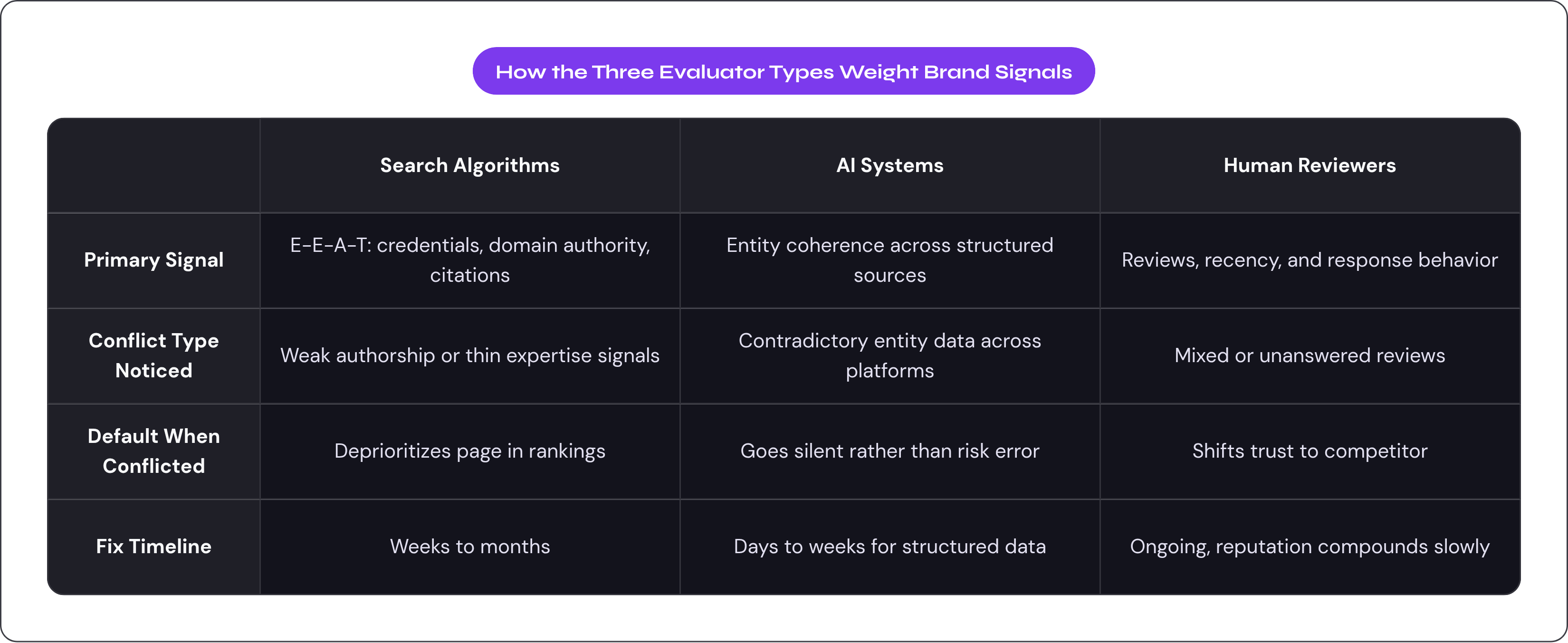
Traditional search algorithms lean on E-E-A-T: author credentials, domain reputation, cited sources, evidence of firsthand knowledge. It functions less as a ranking factor and more as a filter a page has to clear before it's even eligible to compete. That filter matters more than it used to, because Google's AI Overviews reportedly showed up in well over 60% of searches by 2025, up sharply from roughly a quarter of searches in mid-2024, according to an Ahrefs study. Fail the filter, and a page loses access to most of the results page, not just a ranking spot.
AI systems care less about page-level authority and more about whether the brand's identity holds together across sources. Wikidata, Crunchbase, LinkedIn, structured schema: if those line up, the model treats the brand as real and citable. If they contradict each other, most models default to saying nothing rather than risk repeating something wrong. The gap this creates runs large. Reports suggest something close to 96% of AI Overview citations pull from sources carrying strong E-E-A-T signals, and pages carrying fifteen or more recognized entities show something like five times the odds of getting selected at all.
Humans run on a different scoreboard entirely. Reviews, how a business responds to complaints, how recent the activity looks, these carry the weight. Consumers routinely check reviews before choosing a local business, and research consistently finds they're more likely to pick a business that responds to what customers write. A conflict a human notices (mixed reviews, say) and a conflict an AI system notices (contradictory entity data) call for different fixes, on different timelines, with different costs attached. A plan that doesn't separate these out ends up as a longer to-do list with a nicer font.
Why AI-layer conflicts deserve first-pass attention in most triage decisions
Start with scale. Capgemini's 2025 reporting put the share of users who've already swapped traditional search for AI tools when researching products at 58%. Separate research from Master of Code in 2024 found 64% of customers say they'd buy something an AI recommended. That's most of the funnel now, not a niche behavior.
Now the uncomfortable part. A 2026 AI SEO report from Fuel Online, looking at a thousand enterprise brands, found 62% were effectively invisible to generative AI models, despite 94% of those same companies pouring real budget into traditional SEO. Being well-optimized for search while absent from AI answers is a real gap, and it's a gap most SEO teams aren't built to notice, because their dashboards were never pointed at it.
There's a second problem stacked on top. A January 2025 MIT study found AI models run roughly 34% more likely to reach for confident phrasing, words like "definitely" or "certainly," exactly when they're generating something false. A model doesn't just misstate a fact about a brand. It states it with the tone of certainty, which makes a user far less likely to push back. And because one training signal shapes how a model answers millions of separate queries, a wrong or conflicting picture of a brand never stays contained. It spreads through every AI-mediated touchpoint at once.
Human signals still matter enormously, and there's one clear exception to the sequencing above. If a viral complaint or a review spike is happening right now, that human-facing fire is also what AI systems absorb next. In that specific case, fixing the human layer is the AI-layer fix. The two priorities collapse into one.
How to rank conflicts by impact before sequencing repairs
Start by sorting conflicts into types, not just flagging gaps in coverage. Entity conflicts are contradictions in structured facts across sources. Sentiment conflicts are the gap between glowing owned content and harsh third-party coverage. Recency conflicts sit in the space between what's true today and what a model learned during training a year or two back. Each type needs a different fix and moves on a different clock; treating them as one undifferentiated pile is how teams end up fixing the easy thing instead of the important one.
Next, score exposure. Which evaluator runs into this conflict first: an algorithm, an AI system, or a person reading a review at 11pm on their phone? Does the conflict live somewhere that feeds AI training data (forums, Reddit threads, third-party review sites), or is it stuck in a channel the brand actually owns? Conflicts sitting in channels that feed model training compound quietly over months. Conflicts in human-facing channels show up faster but are often easier to fix fast, which is its own kind of trap if a team mistakes fast for important.
Then weigh how tractable a fix actually is against how much damage the conflict is doing. Some big-impact repairs are quick, correcting schema, updating structured data, making sure the same facts appear on Wikidata, Crunchbase, and LinkedIn. Others are slow no matter how much they matter: rebuilding review volume from nothing, earning citations from independent sources that take real time to trust a brand. Sequencing should favor fixes that are both high-impact and fast before tackling the ones that are high-impact but slow. Impact alone isn't the whole calculation, and pretending otherwise is how roadmaps get stuck on the hardest problem in the queue.
Once conflicts are sorted, a rough default order looks like this: AI-layer entity conflicts first, algorithmic E-E-A-T gaps second, human-facing review and response gaps third. That's a starting point, not a rule carved into stone tablets. The audit from the prior step might flip the order entirely once a real crisis is bearing down on the human-facing layer. What matters is that each item in the plan comes with a stated reason for its place in line. Otherwise it's just a backlog with extra steps.
What repair looks like at the AI and algorithmic layer
Entity coherence comes first. The facts about a brand need to read the same way on Wikidata, Crunchbase, LinkedIn, G2, and in the site's own schema markup. When those sources disagree, AI systems tend to go quiet rather than repeat something unverifiable, and quiet is its own kind of damage that never shows up as an error message anywhere.
One structure that helps: treat every factual claim about the brand as an Entity, an Attribute, a Value, and a piece of Evidence backing it up. Founded in 2014, headquartered in Austin, backed by a named source, not just asserted on the company's own About page and left there. This is the shape of information a language model can actually retrieve and cite with confidence, because it hands the model something to check the claim against.
On the technical side, adding Organization schema with sameAs links pointing to authoritative outside sources is one of the cheapest, highest-return fixes available for improving how often AI systems cite a brand accurately. Format matters more than it used to, too: an analysis of nearly sixteen thousand AI Overview results found 78% of the sources featured carried some multimodal element by 2025, image, video, or structured table. Text-only pages are at a real disadvantage in AI-mediated results now.
The payoff for getting cited is measurable. Cited pages reportedly see about 35% more organic clicks, even as overall click-through on AI Overview queries falls across the board. Being cited is starting to matter more than where a page ranks, which makes citation rate the number worth watching, not position on a results page.
One trap worth naming directly: don't try to drown a bad AI perception in a flood of new positive content before the underlying entity conflicts get resolved. Given that 34% confidence figure, volume alone won't undo a factual error a model has already locked onto. Fix the facts first. Everything else is decoration on a broken foundation.
What repair looks like at the human-facing layer
Reviews aren't a purely human concern anymore. Platforms like Google, Trustpilot, and G2 generate text that AI systems pull in and synthesize directly, so a pile of unanswered negative reviews eventually becomes an AI perception problem, not just a local trust problem sitting in a customer service queue.
The scale of the response gap deserves a second look: a large share of reviews go unanswered altogether. That damages trust with the person who left the review, sure, but it also degrades the raw material AI systems draw from when they summarize what a brand is actually like to deal with.
Recency counts too. A handful of glowing reviews from three years ago gets outweighed by a cluster of recent complaints, in both algorithmic ranking and AI-generated summaries. And there's a trust problem underneath all of it: Consumer concern about fake reviews is a growing worry, which quietly erodes how much weight raw review volume carries as a signal at all. Reviews that are verified, recent, and answered by the business start to matter more than reviews that are simply numerous.
This is happening against a backdrop of falling baseline trust. A Gartner survey of more than a thousand UK consumers, run in August and September of 2025, found only 60% trust big brands, down sharply from 2021. The Edelman Trust Barometer has separately found that a large majority of consumers say they need to trust a brand before they'll buy from it. Leaving a conflict unresolved costs more in an environment where trust was already running thin before the conflict even started.
Fresh, credible, responded-to reviews don't just help the human evaluator reading them at 11pm. They refresh the pool of text AI systems draw on later, which means the two layers were never separate problems that happen to sit near each other. Fixing one feeds the other, quietly, on a delay most teams don't bother to measure.
Using a scoring baseline to know when the triage is working
None of this works without a baseline. Fix a conflict without a score to measure against, and there's no way to tell whether anything changed for any of the three evaluators. The team just feels busy, and busy is not the same thing as effective.
A useful score covers several things at once, and they are not interchangeable: how often and how accurately AI systems mention the brand, whether entity data lines up across structured sources, the E-E-A-T signals search engines pick up on, review velocity and response rate, and how a brand shows up in the composition of search results themselves. Collapsing all of that into one number hides exactly the information a triage needs to function.
Scoring systems in the market don't agree on a standard, which is worth knowing before a team picks one and treats it as gospel. Some platforms, like Scale Labs, score across algorithmic, AI, and human evaluation dimensions together, while others focus on a narrower slice. Reputation.com runs a scale from 100 to 1,000 across nine separate factors. Brand24 scores sentiment and reach on a scale from negative 100 to positive 100. There's no common yardstick, so the scoring system a team picks quietly decides which conflicts even become visible to them in the first place.
That has a real consequence for sequencing. A score built around only one evaluator (reviews, say) can climb even while AI visibility stays completely broken underneath it. The team sees a green number and moves on, unaware the problem just relocated somewhere the dashboard doesn't look. After each round of repair, check AI mention frequency and accuracy, how well entity data matches across sources, review recency and response rate, and the E-E-A-T signals showing up in whatever content just went live.
Scoring approaches that track all three evaluator types (algorithmic, AI, and human) at once, across a wide enough set of signals, give a clearer read on what's actually still broken after a repair than one composite figure that quietly averages the problem away. The triage only holds up if it loops: audit, prioritize, repair, score, then audit again. A single pass with no scoring after it just drifts back to where it started, and the whole exercise was theater.