Knowledge Panel Accuracy and Its Downstream Effect on AI Brand Descriptions
A Knowledge Panel error now gets baked into every AI description of your brand.
Knowledge panel accuracy has been treated as a search hygiene chore for years now, something a marketing team fixes and forgets. That framing no longer holds. Large language models pull heavily from Google's Knowledge Graph when they build a description of your brand, so an error sitting in your panel doesn't just look bad on a results page; it becomes a fact that gets repeated in every chatbot answer, every AI Overview, and every generative search summary that touches your name. The people reading those outputs aren't a small slice of tech-forward users anymore. They're buyers comparing vendors, researchers doing due diligence, and hiring managers checking a company out before a call, and a lot of them now trust an AI answer the way they used to trust a search result.
What a knowledge panel actually is and why Google treats it as authoritative entity data
The panel is the box that shows up on the right side of a Google results page: business name, address, phone number, founding date, a short description, and a handful of related attributes. It's easy to confuse with an AI Overview, but they're built differently and need different fixes. An AI Overview is text Google generates on the fly to summarize an answer. A knowledge panel is a structured record tied to a specific entity in Google's Knowledge Graph, and that distinction matters because fixing one does nothing to fix the other.
The Knowledge Graph itself is the bigger structure underneath all of this: a database of entities Google has decided are worth tracking, whether that's a person, a city, a company, or a product line. Getting a panel at all is a form of recognition. Google is saying, in effect, that this entity is notable enough to warrant a formal record. And once something earns that status, the information tied to it gets treated with more weight than an ordinary ranked page. A blog post is one opinion among many, ranked and re-ranked based on relevance. A Knowledge Graph entry reads more like a statement of fact.
Where does that entry come from? Historically, Wikipedia and its companion project Wikidata have been among the heaviest contributors to panel content, along with other structured databases and coverage from outlets Google considers reliable. More recently, Google has leaned on AI-driven synthesis to pull from a wider set of sources rather than depending on any single reference. None of this updates in real time. Panels refresh on a slower cycle than standard search results, which means a bad edit on Wikidata or an outdated database entry can sit there for a while before anyone at the company even notices. And Google won't fix it for you. Managing the panel is on the business, not the platform.
How the Knowledge Graph purge of mid-2025 raised the stakes for every surviving entity
In mid-2025, Google ran the largest cleanup of the Knowledge Graph it has ever done, cutting a huge volume of low-quality or weakly supported entities out of the database. Entities with thin, inconsistent, or poorly corroborated records were the ones most likely to get cut. So were entities where the structured data looked manipulated or misleading.
The effect split in two directions. If your entity survived, it's now sitting in a smaller, more selective dataset, which means your panel carries more relative authority as an AI input than it did before the purge. If your entity got removed, getting back in requires real corroboration across several credible sources, not a single Wikipedia mention or a lucky database listing.
What this signals isn't subtle. Google is trying to make the Knowledge Graph a cleaner foundation for AI-generated answers, which means accuracy inside that graph is going to matter more as AI Overviews and similar features keep expanding, not less. A clean, consistent, well-corroborated entity record used to be a nice-to-have. It's now closer to table stakes for being represented accurately anywhere AI touches your brand.
How large language models treat Knowledge Graph data differently from ordinary web content
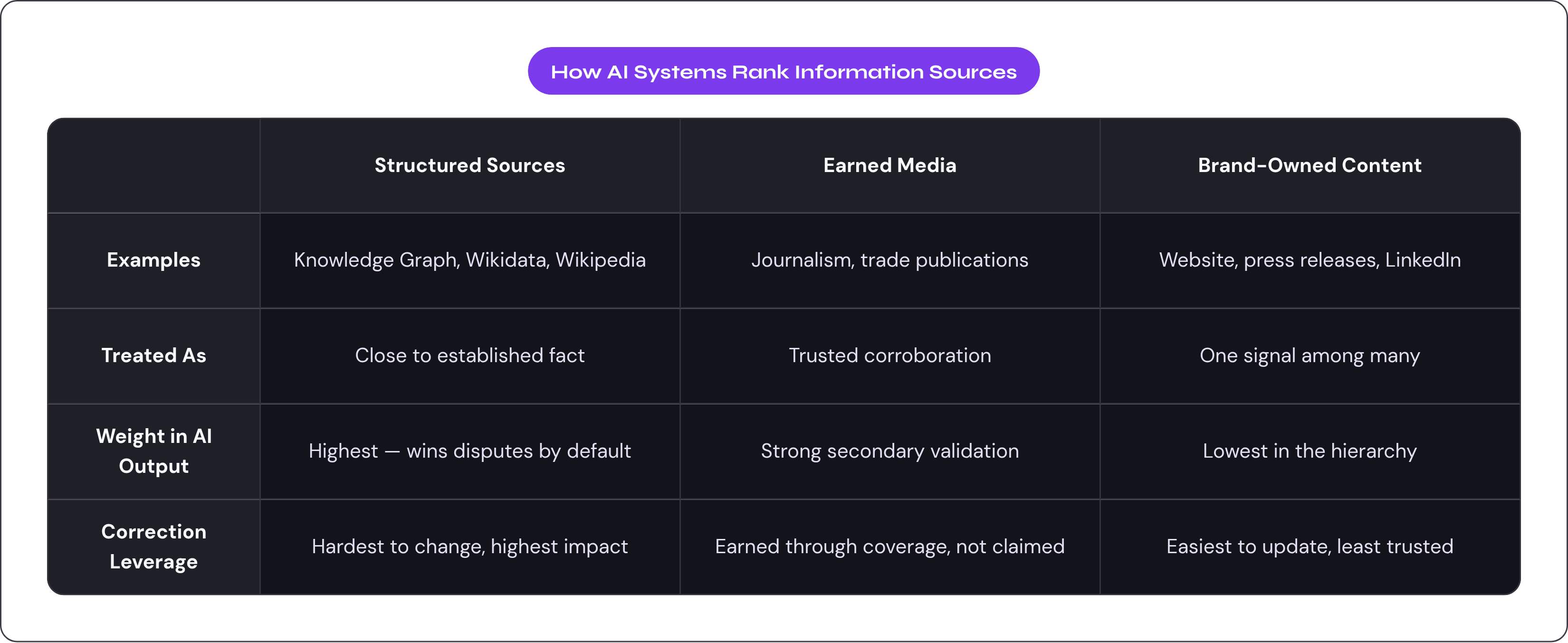
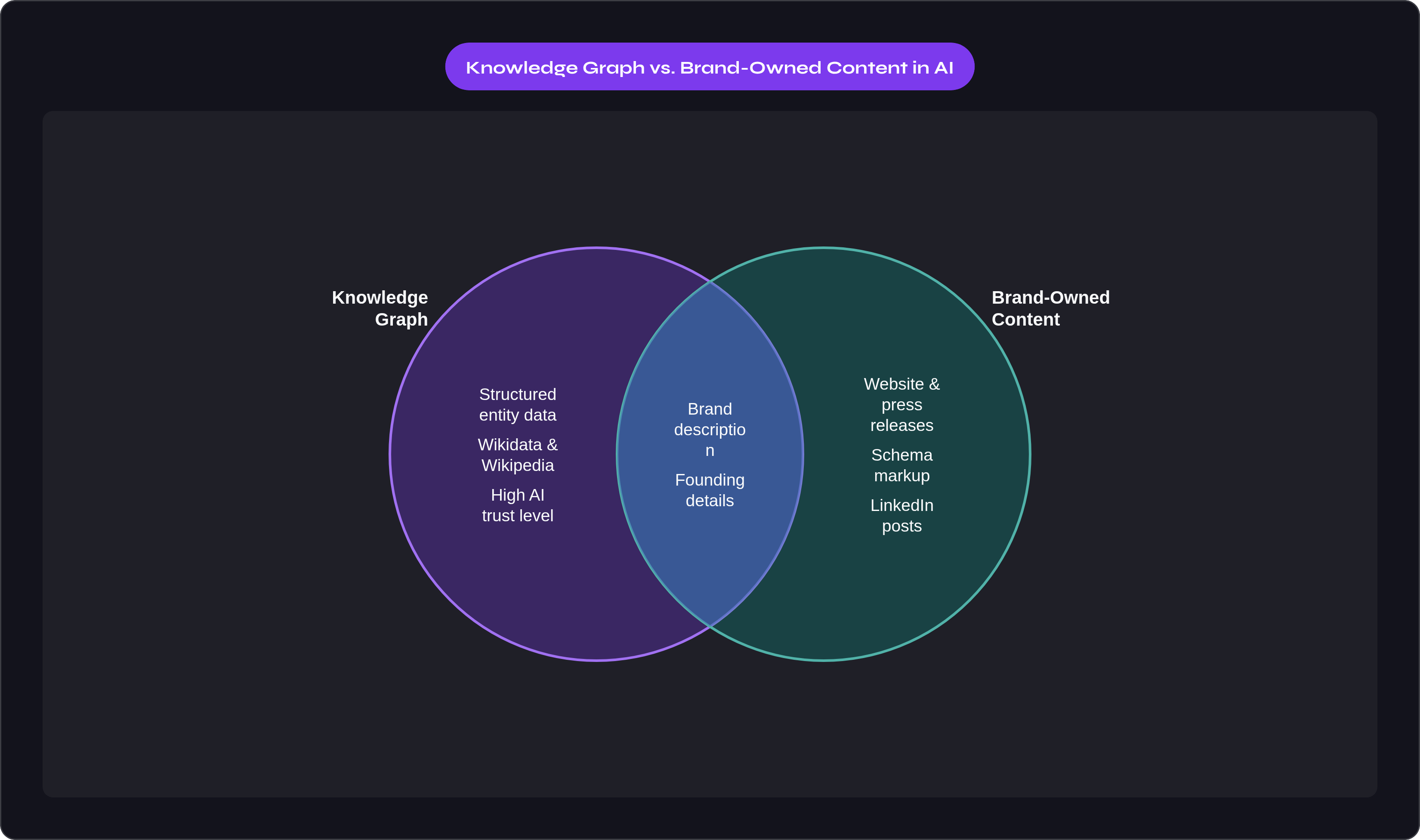
LLMs don't treat every source the same, and understanding the pecking order matters. At the top sit structured sources: the Knowledge Graph, Wikidata, Wikipedia, recognized databases. Information found here gets processed close to fact, not weighed as one opinion among competing ones. Below that is earned media, meaning coverage in journalism and trade publications the model has learned to trust as corroboration. Further down is brand-owned content: your website, your press releases, your LinkedIn posts. All of that carries real weight, but nowhere near as much as the structured layer above it.
This creates a lopsided fight. Say your Knowledge Graph entry lists the wrong product category or an outdated founding year. Your own website having the correct information doesn't cancel that error out. The structured source wins the argument by default, because it sits higher in the hierarchy the model was trained to trust.
Two systems are working underneath this. Parametric memory is what got baked into the model during training, so if the Knowledge Graph had an error at training time, that error is now embedded deep in the model's understanding of your brand. Retrieval-Augmented Generation, or RAG, is the real-time layer where a model fetches fresh information from the web when answering a query, but even here, high-authority structured sources get pulled forward first.
There's also the matter of query fan-out. When someone asks an AI system about your brand, the system often splits that question into several smaller sub-questions behind the scenes. To show up cleanly in the final answer, you need consistent, structured information available across all of those sub-topics, not just one strong page that happens to rank well. Fixing an error on your own site changes nothing in an AI-generated description if the Knowledge Graph still holds the wrong version.
The propagation path from a single panel error to AI descriptions across multiple platforms
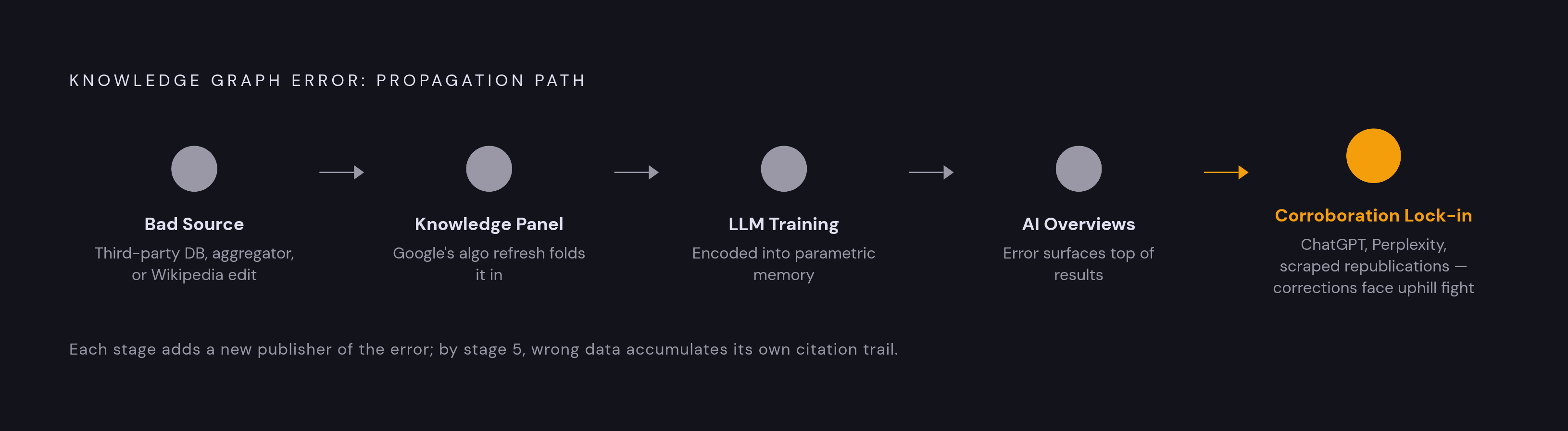
The path starts small. A third-party source, maybe a database, an aggregator, or a sloppy Wikipedia edit, introduces or preserves a wrong detail. Google's algorithmic refresh cycle eventually picks that detail up and folds it into the panel record.
From there it spreads. Models trained on web data encounter the Knowledge Graph entry, treat it as reliable, and encode it into parametric memory. Retrieval systems hitting the same structured source pull the same error into live answers. Google's own AI Overviews draw factual entity data straight from the Knowledge Graph, so the mistake surfaces at the top of the results page almost immediately. Other AI products, ChatGPT and Perplexity among them, reference overlapping web and Knowledge Graph data and end up reproducing the same wrong description when a user asks about your company.
Then it compounds. Once the bad panel data gets scraped, republished, or cited elsewhere, it accumulates its own corroboration, which makes the correct version harder to push back into place later. Add to this a second problem: brand drift. Most LLMs work with a knowledge cutoff, often a gap of a year or more between what's true in the world and what the model actually knows. A company that changed leadership, launched a new product line, or went through a rebrand can still get described by an AI system using a panel record that was never updated. Fixing the error today mostly helps future training cycles; it does very little for the responses being generated right now. That's exactly why early correction carries more value than it looks like it should.
There's an asymmetry worth sitting with here. Errors enter through high-authority channels and get reinforced through repetition. Corrections, on the other hand, usually start from brand-owned sources, the exact layer the AI hierarchy trusts the least.
What other signals AI systems layer on top of Knowledge Graph data when describing brands
Knowledge Graph data doesn't sit alone. AI systems build on top of it with other layers, and earned media is probably the most important one. A feature in a trade publication counts for far more than a press release your team put out on a newswire, and that gap between owned content and earned coverage as a driver of AI citations is large across the major platforms.
Review platforms function as a second layer, and it's not just star ratings that matter. AI systems read the actual text of reviews, picking out recurring complaints, common praise, and how problems get described over time. Even a modest presence on a recognized review site meaningfully raises the odds that an AI system will mention or recommend a brand. No presence at all on those platforms puts a brand at a real disadvantage compared to competitors who show up there consistently.
Community platforms add a third, more informal layer. Threads on Reddit, Stack Overflow, and Quora tend to boil a brand down into a short, sticky phrase: "solid for enterprise, painful for small teams," that kind of thing. Google's data arrangement with Reddit has turned those conversations into a live feed for AI Overviews, which means those informal descriptors can attach to your brand's AI profile whether or not they match what your panel says.
Then there's the accumulation effect of sheer mention volume. Every independent third-party reference to your brand adds to what amounts to semantic mass, the weight that makes an entity harder for an AI system to skip over or garble. Getting mentioned alongside recognized names in your category reinforces where the model thinks you belong.
None of this resolves cleanly if the layers disagree. When the panel says one thing and the earned media layer says another, because the panel is stale or simply wrong, the AI system has to pick a version. It tends to default to whichever version has the most corroboration behind it, and that has nothing to do with which version is actually true.
How to audit your knowledge panel for the inaccuracies most likely to affect AI descriptions
Start with the fields that actually move AI outputs. Business category and product classification shape which queries you show up in at all, so a wrong category doesn't just look sloppy, it produces wrong recommendations. Location and service area errors cause AI systems to leave you out of locally relevant answers entirely. Founding dates and other key milestones, if wrong, distort how AI systems talk about your company's history and how long you've been around. Leadership and personnel listings, if they name the wrong founder or an executive who left years ago, can quietly undercut your credibility and produce answers that contradict public record. And the plain-language description of what your business does, sitting right in the structured data, shapes the vocabulary AI systems reach for when describing you.
Before touching the panel itself, check the sources feeding it. Look at Wikipedia and Wikidata, since both carry heavy weight in panel construction. Check Crunchbase, LinkedIn's company profile, and any industry-specific database that might have stale information sitting in it. Search your brand name alongside its core attributes and see what major outlets are currently reporting; if that coverage is outdated, there's a good chance that misinformation already made its way into an AI training cycle.
Consistency across sources matters as much as correctness in any one of them. An AI system that finds conflicting information scattered across different sources resolves that conflict on its own terms, and there's no reliable way to predict which version it lands on. The safest position is coherence: the same facts, stated the same way, everywhere a model might look.
Testing this directly is worth the time. Ask ChatGPT, Perplexity, and Google's AI Overviews specific questions about your brand and see what comes back. That's the fastest way to find out which inaccuracies have already made it into circulation. Keep a simple record of what the panel says, what the AI outputs say, and what's actually true. That record becomes your baseline for measuring whether the corrections you make are actually landing.
How to correct Knowledge Panel errors and improve the corroboration layer that AI systems rely on
Google gives you a direct route through its "Suggest an edit" feature, and verified entities get more direct editing access than unverified ones. Getting your business verified through Google's process is worth doing early, since it strengthens your ability to influence what the panel says going forward.
Fixing the panel without fixing its sources rarely holds. If Wikidata or Wikipedia still carries the old, wrong information, there's a real chance the error just comes back on the next algorithmic refresh. Wikipedia edits have to meet the platform's own notability and verifiability standards, so a brand can't simply rewrite its own article; flagging factual errors with proper citations is the legitimate path. Wikidata is more directly editable with sourced, accurate information, and given how much weight LLMs put on that source, correcting it is one of the higher-leverage moves available.
Durability comes from corroboration. A correction that lives only on your own website is competing against misinformation sitting in sources the AI hierarchy trusts far more. Getting the accurate version picked up by trade publications, analyst mentions, or news coverage gives AI systems something credible to cite, and that outside validation is what tips the odds toward the corrected version becoming the dominant one in future training cycles.
Consistent, accurate schema markup on your own site (Organization schema, matching business details, matching descriptions) won't outrank a Knowledge Graph error on its own. But it closes the gap between what you control and what Google and the AI platforms are already reading, and it removes one more place where conflicting information could creep back in.