What to Trust When Your SEO Score and Review Rating Point in Opposite Directions
When your SEO and reviews disagree, find which gap loses customers.
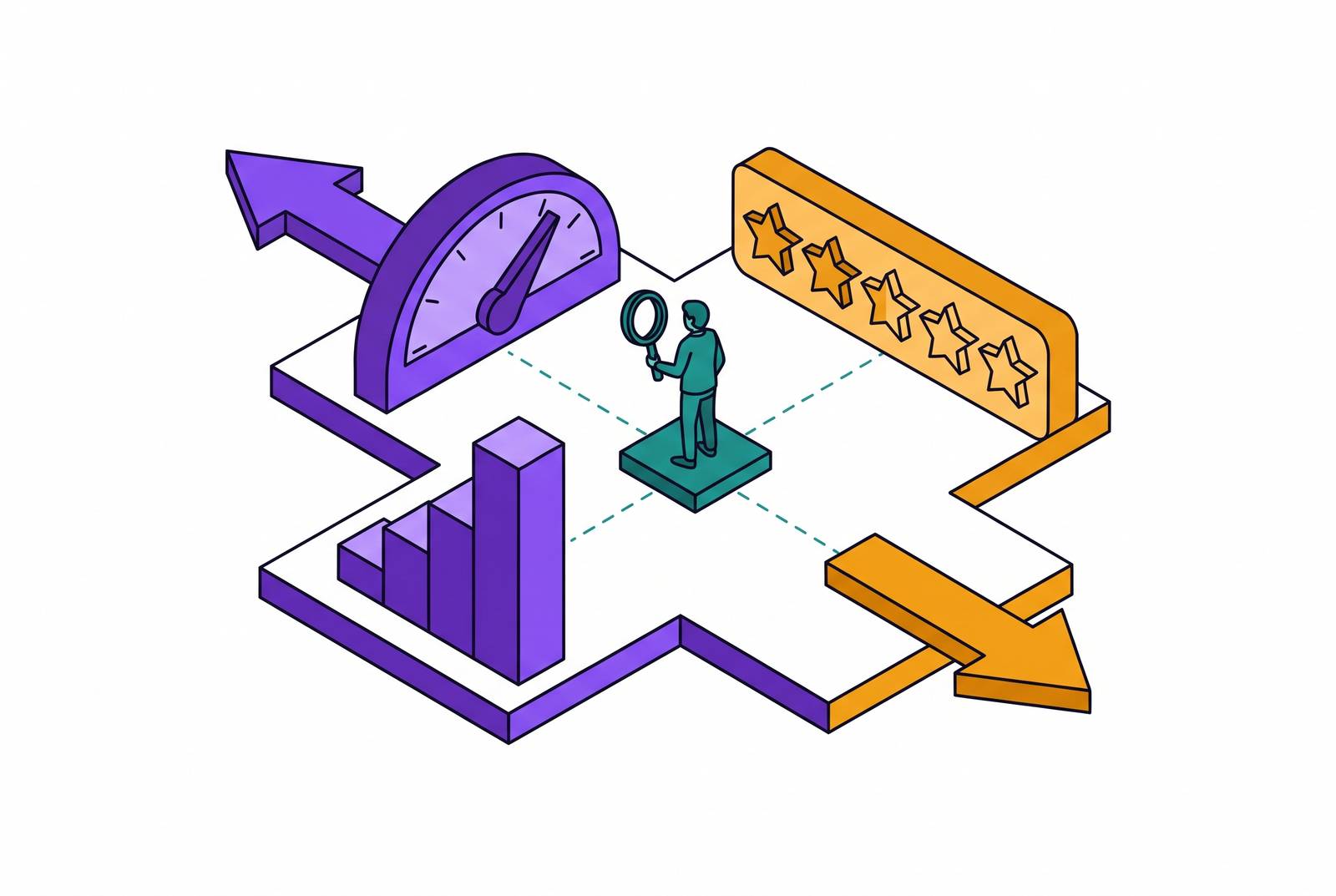
When an SEO score and a review rating disagree, the conflict is a diagnostic. Multi-signal online presence scoring beyond SEO and reviews means reading technical health, customer experience, social engagement, citations, and third-party profiles together, then connecting them to discovery and conversion. The useful diagnosis identifies which weakness stops customers from finding or trusting the business.
What SEO scores and review ratings actually measure, and why they diverge
A restaurant shows up near the top of a search, but its stars hint that diners might regret eating there. Which signal deserves trust? The position says the restaurant is visible for that search, while the reviews describe what happened to people who ate there. Those are different questions, built from different evidence. Their disagreement is not a software glitch.
An SEO score assesses technical health, keyword coverage, link authority, schema markup, and on-page signals. Much of that reflects how the business presents its site, although outside links are not entirely within its control. Review ratings reflect customers’ reported experiences instead. A business can shape those experiences, but it cannot directly control what customers honestly say about them. AI search makes this split more consequential because customers can encounter that outside evidence before seeing the business’s own carefully arranged version.
Why each signal is weighted differently across local, organic, and AI search surfaces
After proximity and relevance, review count, average rating, recency, and velocity contribute to local prominence. Google applies a 4.0-star threshold to local queries phrased as “best [industry],” so a business with a 3.9 average can fall outside that filtered result set despite strong on-page SEO. The website is not the only gatekeeper.
Organic blue-link search works differently. Page relevance, links, technical health, and content quality do more of the ranking work, while reviews often influence whether someone trusts the result enough to click. A searcher may check reviews elsewhere before returning to the brand’s page. Review and AggregateRating schema can add rating-rich results to listings that qualify, which can change click-through even if their position stays the same. A better-looking result and a higher-ranking result are not the same achievement.
When assistants compare options, they use aggregated reviews as well as brand copy, so detailed feedback that agrees across platforms gives them useful evidence. Thin or problematic review histories can leave a business out of the answer entirely. That changes where the bottleneck sits.
How a high SEO score with a low review rating actually damages a business
Strong SEO with weak reviews creates exposure without reassurance. Searchers can see the business, then choose a competitor whose review profile answers their trust question more convincingly. Position may hold steady while calls, bookings, and form fills weaken. The dashboard still looks cheerful. It is effectively applauding people for walking past the door.
The same leak can happen after the click. A visitor may read a polished service page, check customer feedback, and find accounts that contradict its promises. AI-assisted discovery does not remove that check, because buyers also turn to Google reviews to validate options suggested by an assistant. Appearing in an answer is therefore not the end of the contest. A weak review profile can undo the introduction.
Google’s Shopping Experience Scorecard also uses customer feedback, shipping, and returns to assess stores. Stronger performance can improve visibility and prominence in free product listings and Shopping ads. Lower-rated stores are not penalized or denied access simply for offering a lower level of customer experience. That distinction prevents an exaggerated diagnosis.
How a high review rating with a low SEO score limits reach without fixing credibility
Customers believe in the business, but weak technical health, thin content, and limited link authority can keep it from reaching people searching for its services. Reviews cannot do those jobs for the website. A beloved business can still be hard to find through high-intent, non-branded searches.
Reviews on Google, Yelp, industry-specific sites, and the business’s own site give AI systems several places to look for evidence. Yet those outside platforms may become the main places where the business appears if its site remains weak. Structured data can make ratings that qualify visible in organic listings, so search results reflect the trust customers already have in the business.
Why E-E-A-T in 2026 rewards closing the gap rather than optimizing either signal in isolation
Google’s helpful-content guidance identifies trust as the most important part of E-E-A-T, while stating that E-E-A-T is not itself a specific ranking factor. That distinction is essential here. There is no single E-E-A-T dial that rises when a marketer adds enough schema or collects enough stars. In 2026, the framework helps explain the SEO-versus-review conflict by assessing whether evidence makes a page’s claims believable.
Customer reviews supply evidence of experience, the first “E.” A reviewer describing months of work with a company and explaining how it delivered provides something marketing copy cannot substitute for. When that account supports the service page, the sources reinforce each other. When it contradicts the page, the claim loses support. Quality raters and AI systems can compare website content with reviews, social profiles, and outside citations.
Authenticity complicates the picture further. An all-five-star profile can look suspicious, while mixed feedback with substantive, professional responses can show how the business handles real customer experiences. Google’s review filtering also scrutinizes patterns such as sudden volume spikes, inactive reviewer accounts, implausible geographic clusters, and repeated language. More reviews are not automatically better evidence. Closing the gap means making on-site claims and outside accounts consistent.
The content layer: where SEO score and review signal meet in what you publish
Content is where the mismatch becomes visible in words. A service page can cover the right keywords and still promise an experience customers do not recognize. Publishing more content can quickly widen that mismatch, with more optimized pages but no more evidence that people can trust. Production speed is not proof of usefulness. A content factory can be very good at shipping empty boxes.
Semrush’s analysis found that human-written content was at the top of search results far more often than purely AI-generated content. That finding does not make production method a substitute for assessing quality, or prove that every human-written page deserves attention. Readers can reject low-effort content whether it comes from AI or a person armed with stock images and adjectives. Specific expertise and original insight give readers reasons to believe the page.
Google’s reviews system adds a distinction for sites publishing review articles and comparisons. It evaluates that first-party editorial content separately from third-party customer reviews, so thin comparison pages can create their own quality weakness. The practical implication is not a ban on AI assistance. Hybrid production, which combines AI-assisted drafting with real work by human editors, can help a business publish more while keeping subject-matter expertise in the work.
How to read the conflict as a diagnostic: which signal to fix first and why
Low impressions and poor position paired with strong reviews point toward a discovery constraint, making technical health, content quality, link authority, and schema the relevant work. Strong visibility with weak click-through or conversion points toward trust as a possible constraint, especially when review themes contradict page claims. Neither pattern proves every lost sale has one cause. It identifies the part of the journey that deserves attention first.
The search surface then sharpens that diagnosis. Local and map-driven demand makes rating, volume, recency, and response quality especially important, while organic demand puts more weight on technical SEO and useful content. AI citations add a need for specific, experience-based reviews across platforms. If both scores are weak, the case for starting with reviews is that a thin or negative history can block AI consideration before the site gets a chance. If the gap is stable and tolerable, immediate rebalancing may be less urgent than when SEO improves while customer sentiment deteriorates.
For a business facing a review constraint, the appropriate response is a better review process. Requests can follow successful delivery, when satisfaction is fresh, with direct links, transactional email embeds, or NFC tap-to-review making participation easier. Professional replies to criticism and a range of reviews help put that feedback in context. The customer experience remains the source material. A smoother invitation cannot make a disappointing service delightful.
For an SEO constraint, the relevant work includes HTTPS, page speed, accurate schema, and structured data that supports eligible rating-rich results. Service-page claims also need comparison with recurring review themes. If customers consistently describe something different from what the page promises, the copy may be the problem to fix.
How do you get a complete picture of your online presence when dashboards hide the gap?
An SEO dashboard can report position, impressions, and technical health without explaining why someone declined to click or buy. A review platform can report stars and volume without showing which complaints contradict a service page. Both displays can be accurate and still leave the central question unanswered. Two gauges do not automatically make a diagnosis.
A combined presence metric therefore needs more than a bigger average. Its useful components include SEO health, review sentiment and diversity, social engagement, citations, and consistency across third-party profiles. The components need to remain visible because strength in one can conceal weakness in another. A single score that blends excellent visibility with poor customer experience may look respectable while describing a business that struggles to convert. Compression is convenient until it erases the fault.
The EMNLP 2026 study found that summaries can emphasize problems customers never mentioned. The paper “AI Summaries Overrepresent Fake Reviews: Evidence from Amazon” found that summaries disproportionately represented suspected fake feedback. Those findings make summaries an imperfect stand-in for the underlying review text. A neat paragraph can be easier to read and harder to trust.
Defensible measurement compares conversion behavior across local, organic, and direct discovery with recurring review themes. Differences between those surfaces help show where people see the business but stop short of taking action. Privacy rules limit cross-site attribution, so the business may not be able to see the whole path from AI discovery through a review check to a purchase. Measurement must respect what customers consented to share. A useful diagnosis does not require pretending that every step is observable.
What the conflict looks like when it is resolved: consistency as the actual goal
The conflict is resolved when customers’ own accounts back up what a service page promises. Review text, outside citations, and third-party profiles give search systems and buyers accounts of the business that agree with each other. Cross-referencing then strengthens the case.
Review themes become editorial intelligence in that process. The words customers use can help service pages reflect how buyers judge the experience. A steady stream of authentic, specific feedback also gives fresher evidence than a sudden burst of generic praise. For businesses that lack the skills to do AI marketing in-house, a marketing partner whose work is led by people and grounded in analysis can help link those themes to content and a regular process for gathering reviews. Neither an SEO tool nor a review platform alone does that interpretive work.
The competitive advantage is recognizing drift before the business spends more money amplifying promises its customers no longer support. An SEO score and a review rating will continue to answer different questions, so disagreement can remain useful even after improvements.