Review Response Strategy as a Signal to AI and Algorithmic Systems
How you respond to reviews now shapes what AI systems tell customers about your business.

A business's reputation now gets built twice: once by the customers who leave reviews, and once by the AI systems that read those reviews before a human ever sees the brand. The second build matters more than most businesses realize. How a business responds to a review, not just the review itself, is a structured signal that AI systems use to decide whether that business is credible, relevant, and worth recommending. That makes review response a form of perception management aimed squarely at machines, not just a customer service task aimed at one unhappy buyer.
The old model treated reviews as something read at the bottom of the funnel, right before a purchase decision. A shopper found a business, got curious, then checked the star rating on the way to checkout. That model is fading fast. ChatGPT references reviews in 58% of its responses. Perplexity uses them in 100% of responses. Roughly 34.5% of Google AI Overviews cite at least one review platform directly. Reviews have moved to the top of the funnel: they're now a primary input into what AI tells someone about a business before that person ever visits a website.
The goal has shifted with it. Getting seen used to be the finish line. Now the finish line is getting understood, correctly and favorably, by systems that are actively forming an opinion about every business whether that business participates or not. Scale Labs, operating as Evident, built its scoring platform around exactly that shift, measuring how algorithms, AI systems, and humans each perceive a business across 400+ signals. Per SOCi's 2025 Consumer Behavior Index, traditional search traffic has slipped by 10%, while 19% of consumers now use AI tools monthly to find local businesses. The audience doing the reading has changed species. And the human signal hasn't gone anywhere: 91% of consumers still rely on reviews to evaluate local businesses, according to the same SOCi report. It just runs through an AI intermediary now, most of the time, before it reaches a person.
If AI is reading and summarizing reviews to answer people's questions, then everything a business says inside those reviews, including its responses, becomes structured input. Not background noise. Not a courtesy. Input.
What the reputation graph is and how AI builds one for every business
Every business now has something like a credit score for trust, except no bureau issues it and no business applies for it. Call it a reputation graph: a weighted model that AI systems and large language models assemble from every public signal about a business. Star ratings. Review volume. How recent the reviews are. Recurring phrases in what customers actually write. Whether the business's name, address, and category show up consistently across directories. Mentions in local news, industry blogs, and forum threads. None of these on their own settle anything. Together, they form a profile AI uses to judge whether recommending a business is a safe bet.
In B2B contexts specifically, the graph pulls from a recognizable set of platforms: Trustpilot, GoodFirms, DesignRush, LinkedIn Company Pages, Reddit threads where buyers compare vendors, Google Reviews, and coverage in outlets like Forbes. Each one is a node. A gap in any of them is a blank spot in the profile, and AI has less to draw on when those nodes are empty.
LLMs work by pattern-matching against text that already exists in public: journalism, expert commentary, reviews, forum arguments. They don't take a brand's word for anything, because a brand's own claims aren't the kind of evidence these systems are built to weigh. That's an uncomfortable fact for a lot of marketing departments. A company can spend years building a slick website and a deep content library and still lose the recommendation to a competitor with a stronger reputation graph, because the graph gets built quietly, without the business's input, and buyers, human and machine alike, act on it regardless.
Several signals inside that graph carry significant weight: average star rating, total review volume, how recent the reviews are, and how the business responds to negative feedback. The fourth one is where most businesses have the most unclaimed leverage, and it's the subject of everything that follows.
Volume matters more than intuition suggests, too. A business with a handful of five-star reviews reads as less credible to AI than a competitor sitting at 4.6 stars across hundreds of reviews. Quantity, on its own, functions as a trust signal, separate from the average it produces.
Why the response, not just the review, is a structured signal to AI
A review is the customer's voice. A response is the business's own text, and it's the one piece of the entire review ecosystem the business fully controls. That distinction matters more than it sounds like it should.
AI systems process response behavior alongside, but separately from, the review content itself. A generic reply, or no reply at all, reads as inactivity or indifference. A specific, honest one reads as accountability and follow-through. That means the same negative review can carry very different weight in the graph depending entirely on what the business did with it afterward. A response can rebalance a negative theme; silence leaves that theme uncontested in the public record. If a pattern of complaints shows up across reviews (slow service, billing confusion, whatever it is) and there's no corresponding pattern of responses addressing it, The silence adds nothing to counter the complaint, leaving the pattern unaddressed in every signal AI can read.
There's a second effect that gets less attention: response text adds new language to a business listing. It widens what's sometimes called semantic surface area, meaning it gives AI more phrasing, more keywords, more specific detail to draw from when summarizing what the business does and how it operates. A review that's been answered, is recent, and contains specific detail is exactly the kind of content an AI model can quote with confidence. That means a business with a strong response habit may build a more complete, active-looking profile than a higher-rated competitor who never responds to anything.
None of that makes a review response a piece of customer service communication anymore, at least not only that. It's a public artifact that gets read, indexed, and weighed by AI systems potentially over and over, long after the customer who triggered it has moved on.
The algorithmic sub-signals that response behavior directly affects
Google's local ranking system runs on relevance, distance, and prominence. Review quantity and quality feed directly into prominence, and response behavior is part of how Google reads engagement with that prominence signal. Underneath that umbrella sit five sub-signals response behavior touches directly.
Response rate is the first and simplest: the goal is to answer every review, with no gaps left as silent data points. A gap here is visible, and it reads as disengagement to both the algorithm and any AI system summarizing the business. Response speed is the second: a fast median response time signals active attention, while responses trickling in weeks later signal a business that checks its reviews the way someone checks a mailbox they don't expect anything in. Engagement depth is the third: a response with real resolution detail (what happened, what changed) gives AI more to parse than a one-line thank-you. Recency is the fourth: a profile with fresh responses on fresh reviews reads as alive, while one where the last activity was six months ago reads as dormant. NAP consistency, the fifth, is subtler: response language that correctly reinforces location, service category, or staff names adds to the pile of consistency signals AI uses to decide whether a business is even real.
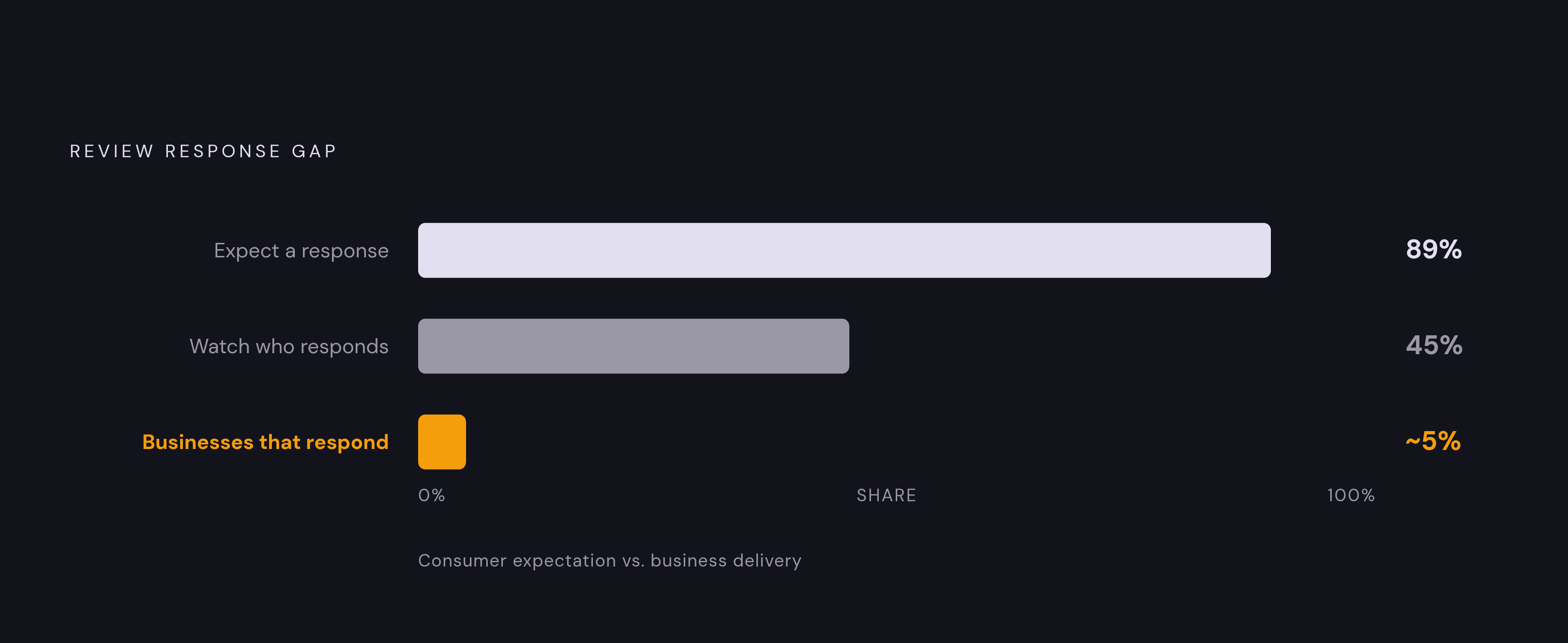
The scale of the opportunity here is worth sitting with. Per BrightLocal, 89% of consumers expect a business to respond to reviews, and 45% of consumers pay close attention to which businesses actually bother. Yet only around 5% of businesses respond consistently. That gap between expectation and practice is enormous, and it means a business that responds to everything, promptly and specifically, isn't clearing some baseline. It's doing something almost none of its competitors are doing.
There's a technical echo here too. Structured, content-rich review pages with detailed responses contribute to the same kind of credibility signal that schema markup and in-depth content contribute elsewhere on a site. Sources on AI citation behavior show that businesses implementing schema markup and producing detailed, well-organized content share characteristics with pages that earn AI citations. A response history is, in effect, another form of structured content sitting right there on the review platform.
How AI reads the language inside a response: semantic surface area and theme resolution
LLMs favor recency, frequency of new activity, and variety in phrasing. Customer language and business response language together widen what a listing can be matched against, meaning a wider range of queries can surface the business in an answer. That's the mechanical reason specificity matters so much.
A response that says "Thank you for your feedback, we're sorry to hear this" adds almost nothing. Such phrasing is generic and indistinguishable from countless other businesses. It extracts no brand-specific meaning from it, because there isn't any. A response that names the actual service involved, references a specific team member, describes a process change, or names the resolution gives AI new language it can tie directly to that business and surface later when someone asks a related question.
This plays out most clearly around theme resolution. If a cluster of reviews complains about slow response times, and the business's replies acknowledge that directly and describe a specific fix (a new staffing schedule, a new ticketing system, whatever actually happened), AI reads the pattern as addressed. The negative theme is at least met with a counter-signal rather than left to stand alone. Left unanswered, that same cluster of complaints, using consistent language across multiple reviewers, gets treated as a confirmed trait of the business rather than an isolated gripe.
The principle applies across industries with high review volume. Pattern-detection across large sets of reviews can surface operational issues before they become systemic and harder to fix. That's the same kind of pattern detection AI runs when it's deciding whether to recommend a business to someone asking for one.
Consistency across platforms matters here too. A response strategy that only shows up on Google, while Yelp and Trustpilot sit untouched, leaves entire nodes of the reputation graph dark, and dark nodes don't get the benefit of the doubt.
The scoring layer businesses rarely see: how reputation scores are calculated and what moves them
Behind all of this sits an actual number, or several numbers, that most businesses never see and rarely think about. A reputation score is an algorithmically generated measure of trustworthiness combining star ratings, social mentions, and dozens of other inputs into a single output, usually scaled somewhere between zero and one hundred or zero and one thousand, updating close to in real time. Reputation scoring platforms pull this together from large numbers of review sources through web crawling and API feeds, so the score isn't a snapshot from last quarter. It's live.
The stakes attached to that number are climbing. Financial institutions are increasingly folding reputation scores into credit and risk assessments alongside conventional financial data. A 2025 systematic review by H. Molavi and L. Zhang, covering 104 studies published between 2000 and 2024, examined how AI and machine learning are reshaping the methods used to measure corporate reputation. That's not a marketing claim; it's a research finding about where reputation measurement is headed.
The Signal AI 500 illustrates one version of the approach in practice, blending metrics like share of voice and net positive sentiment, while AI also enables what's called salience scoring, measuring how prominently a company shows up on a given topic rather than just how often it's mentioned, across hundreds of topics at once. The consumer-facing effect of all this scoring is blunt: 68% of consumers now refuse to consider a business under four stars, up from 55% in 2025, and 31% require at least 4.5 stars. A business that cleared the bar a year ago can get filtered out automatically now, before a human ever lays eyes on it.
Agentic AI adds a further layer most businesses haven't priced in yet. A 2025 Kearney survey found 60% of shoppers expect to use agentic AI to help make purchasing decisions within the next year. These agents read machine-readable signals: aggregate review data, trust badges, marketplace ratings, evaluated against criteria that neither the merchant nor the shopper actually gets to see. The old split between "soft" reputation and "hard" commercial performance is closing fast.
What a deliberate response strategy looks like as a perception management system
A response strategy built for AI perception isn't about sounding friendly. It's about consistently producing public text that signals credibility, specificity, accountability, and operational competence to systems that never sleep and never stop reading.
The targets are concrete. Response rate: 100%, positive and negative alike, because silence on any single review is a data point, and AI reads it as either indifference or agreement with whatever the reviewer said. Response speed: median under 24 hours, since recency of engagement functions as its own sub-signal, and a slow reply on a fresh review undercuts the "this business is paying attention" read. Specificity: every response should carry at least one brand-specific detail, a named service, a team reference, a described fix, something AI can extract as a distinct fact rather than filing it away as one more templated string it's seen a thousand times before.
Negative reviews call for their own discipline. Acknowledge the actual complaint, not a vague category standing in for it. Name the fix if one happened, because that's the exact text AI reads as theme resolution. Skip defensive language, since a defensive tone can read as confirming the original complaint rather than answering it. And keep the resolution public and detailed: handling something privately by phone or email, then leaving the public review untouched, means the negative review stands alone as the only signal that ever gets indexed.
None of this works on a single platform. The strategy has to run everywhere the reputation graph has a node: Google, Yelp, Trustpilot, G2, TripAdvisor, Healthgrades, Facebook, and whatever industry-specific directory matters for that business. Positive reviews deserve responses too, and skipping them is a mistake plenty of businesses make without noticing. A profile where only the negative reviews get replies looks like damage control, not like a business that's actually engaged with its customers. And with 55% of consumers, per SOCi's 2025 Consumer Behavior Index, now worried about fake reviews cluttering the space, authentic and specific response language stands out precisely because it doesn't read like the templated or AI-generated filler everyone's grown wary of.
Measuring whether the response strategy is working: signals to track and tools that score them
A business can respond to every single review for a year and still have no idea whether any of it moved the needle. That's the core measurement gap: responding consistently is a habit, not a strategy, unless it's tied to something being tracked.
The list worth watching isn't long, but it's specific. Response rate over time, broken out by platform, to catch gaps that hide inside an overall average. Response time distribution, to see whether the 24-hour median is holding or whether certain platforms are quietly getting deprioritized. Semantic coverage, meaning whether responses are introducing new brand-specific language or just recycling the same three sentences. Theme resolution, tracking whether previously flagged complaints keep showing up in new reviews or whether the operational fix and the response pattern together have actually put them to rest. AI citation frequency, checking whether the business shows up in AI Overviews and AI-generated recommendations for the queries that matter to it. And reputation score trajectory, watching whether the composite score, wherever it's published, is trending up or down.
Platform-level scoring tools aggregate across review sources and spit out a composite number, but the real value isn't the number itself. It's the breakdown underneath it: which sub-signal is dragging the score down, and which one is already carrying the business. Evident (evident.so) scores businesses across more than 400 signals spanning algorithmic, AI, and human evaluation, giving a structured read on how all three kinds of evaluator currently see a given business, including the review and response behaviors covered throughout this piece. The platform's underlying premise is straightforward: measurement has to come before optimization. A business can't fix what it hasn't scored.
Agentic AI is already reading machine-readable review data to make purchasing calls on a shopper's behalf, and that shift isn't slowing down. Businesses that have already built a measured, scored response system hold a structural edge over competitors still treating review replies as a line item in the customer service budget. Generative Engine Optimization, the discipline of shaping what AI actually generates in response to a query, is emerging as the successor to traditional SEO. A disciplined, measured review response strategy is one of the few genuinely controllable inputs a business has into that output.
Sources
- Reviews and the Reputation Graph: How AI Evaluates Your Business
- Beyond Sentiment: A Multi-Agent Pipeline for Actionable Business Advice from Reviews
- From Social Proof to Training Data: How Reviews Shape LLM Narratives
- AI and the Future of Reputation Management (2026 Edition)
- signal-ai.com
- digitalapplied.com
- soci.ai