Aligning On-Site Content With AI and Search Credibility Signals Simultaneously
Brand mentions now matter far more to AI discovery than backlinks do.

Search rankings still matter, but they're no longer the whole game. The question that matters now is whether ChatGPT, Perplexity, or Google's AI Overview names a brand correctly, and how often it does. Google's AI Overviews already show up on roughly half of all search results pages and reach an enormous global audience each month, so AI-mediated discovery isn't some future state marketers need to brace for. It's already the default way people find things. Gartner's forecast projects traditional search engine traffic declining meaningfully by 2026 as people shift to conversational tools instead of typing into a search box.
Fuel Online ran a 2026 analysis of hundreds of enterprise brands and found something that should worry anyone still treating SEO as the whole strategy: the majority of those brands were invisible to generative AI models, despite nearly all of them pouring money into traditional SEO for years. The cause wasn't mysterious. Those brands never built the trust signals AI systems actually look for, so the SEO spend landed on one evaluator when there are now three: the search algorithm, the AI model, and the human reading whatever the AI hands them. Most companies still act like ranking on Google is the finish line. It isn't, and treating it that way is the mistake worth naming up front. The signals that satisfy a search algorithm overlap with what satisfies an AI model more than most people assume, but mapping where they split apart is what separates a brand that shows up everywhere from one that ranks well while staying a ghost to everything else.
How AI systems judge a brand differently than a search algorithm does
Traditional search works like a matchmaker. Type a query and Google hands back ten or more options, ranked, then steps out of the way. The algorithm isn't vouching for any single result. It's sorting the deck and letting the user pick a card.
AI search doesn't work that way. Ask ChatGPT or Perplexity a question and it names one brand, maybe two, and puts its own credibility behind that answer. That's an endorsement, not a shelf of options, and the stakes for being named at all go up because there's no list to hide inside.
Research auditing nine large language models across multiple major providers found the models agree with each other at a high rate (average Spearman's ρ of 0.79) but line up with human expert judgment only moderately (ρ of 0.50). In plain terms, the models have converged on their own internal consensus about what counts as credible, and that consensus doesn't always match what a human expert in the field would say. There's also a pattern that looks a lot like Dunning-Kruger at the model level: smaller models tend to be more error-prone while larger models are more likely to decline to answer. Which model a person happens to query shapes the story they're told about a brand, and that story may have little to do with the brand's own website.
Five things seem to drive how LLMs size up credibility: expert authority (can the author's credentials be checked), factual accuracy (do the claims match what outside sources say), entity consistency (does the brand's name, category, and description match across every place it shows up), freshness (has this been updated recently), and corroboration (do independent sources back the same facts). None of this maps cleanly onto backlinks, because LLMs train on raw text, not on a hyperlink graph. Google rewards a strong link profile. AI models reward clear writing, structured facts, and a brand's presence being confirmed in multiple places outside its own site.
One technical wrinkle deserves saying plainly: LLMs often can't run JavaScript, so a site hiding its best content behind interactive elements or client-side rendering may be sending nothing at all to the crawlers that feed these models. A site can look sharp to a human visitor and be half-invisible to the systems doing the citing.
The deeper risk is narrative. AI doesn't retrieve a page and hand it over, it builds a characterization out of whatever text it absorbed about a brand. If that body of material is thin, outdated, or full of negative coverage nobody ever answered, that's the story the model tells. Not because the model is broken, but because it's doing exactly what it's built to do with the material sitting in front of it.
Where search trust signals and AI trust signals line up
E-E-A-T is the biggest overlap zone, and that's not a coincidence. Google's Search Quality Rater Guidelines place trust at the center of evaluation, and that multi-part idea of trust lines up closely with the five things LLMs already weigh. E-E-A-T stopped being just an author bio with a headshot years ago. It now covers topical consistency, evidence of first-hand experience, and whether a page actually adds something instead of repeating what's already on page one. Sites showing real experience and subject expertise saw a 23% visibility gain after the December 2025 Core Update, and that gain reflects the same qualities AI models hunt for when deciding who to cite.
Brand mentions are the single strongest shared signal, and it isn't close. An Ahrefs study of 75,000 brands, published in August 2025, found brand mentions correlate with AI visibility at 0.664, against just 0.218 for backlinks. Mentions aren't a minor input sitting next to links, they dwarf them for AI citation purposes. Brands in the top quartile for web mentions earned ten times more placements in Google's AI search results than the next tier down. None of this is entirely new, since Google has used mentions as a trust signal for years, even unlinked ones. What's changed is how much weight AI systems put on it.
Entity consistency matters to both sides too. Google's knowledge graph and an LLM's entity resolution process both favor a brand whose name, category, location, and core claims show up the same way everywhere, whether that's the brand's own site, a review platform, or a news article. Freshness and depth do double duty as well: content updated on a real schedule, covering a topic thoroughly rather than skimming it, satisfies quality raters and gives AI systems more to work with when they're deciding what's still accurate. Named authors with checkable credentials and a track record of publishing elsewhere serve E-E-A-T evaluation and LLM authority checks at the same time, because both systems are asking some version of the same question: who said this, and can that person be trusted to know?
Where the two audiences split, and what's missing in between
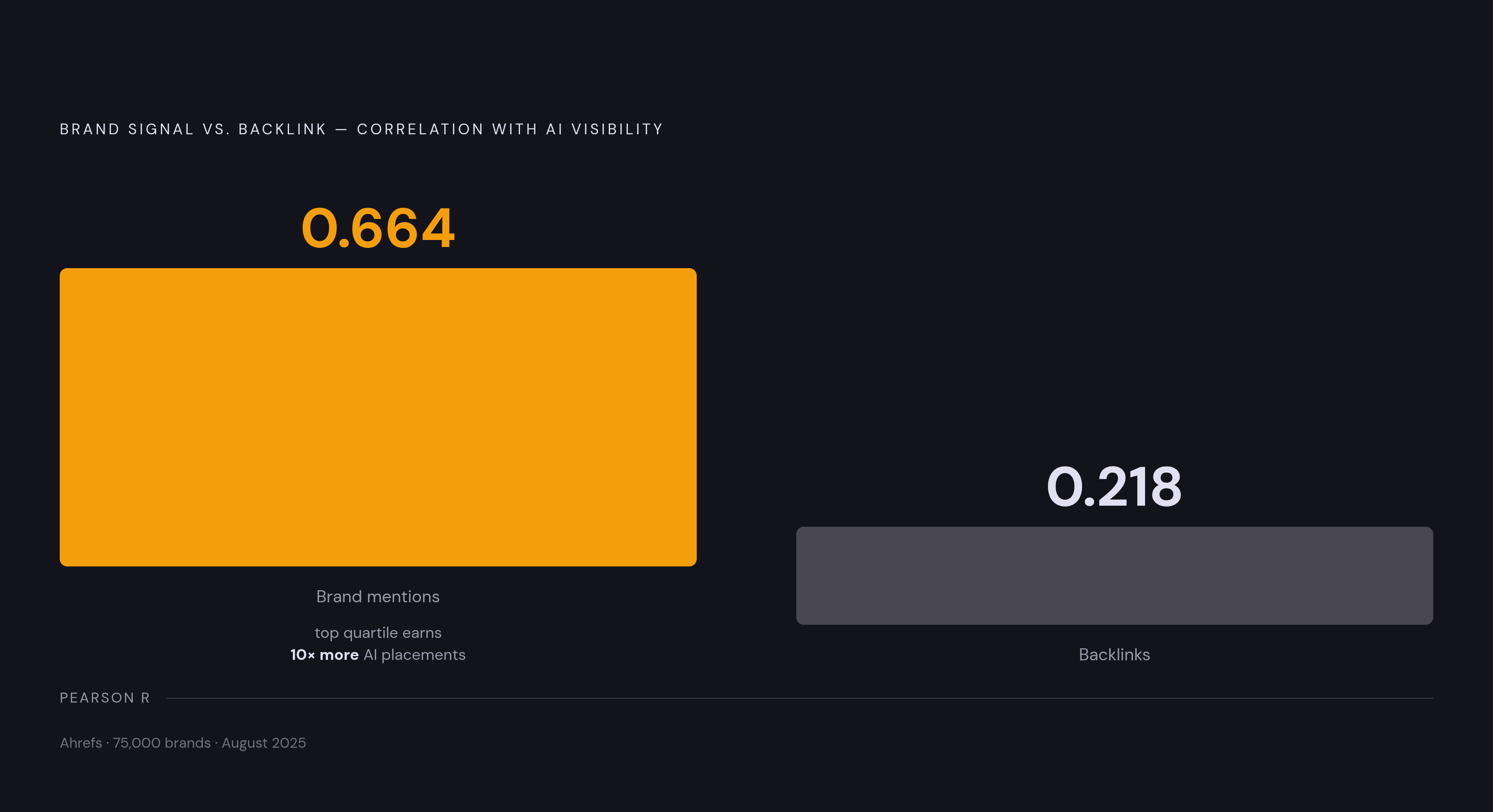
Backlinks are where the split is sharpest, and this is the part most SEO teams still get wrong. Links still carry real weight in search rankings, but a 0.218 correlation with AI visibility, against 0.664 for mentions, means a brand can build an excellent link profile and still barely register when someone asks ChatGPT for a recommendation. Link building alone doesn't buy AI presence anymore, and any team still pouring most of its budget into link acquisition is optimizing for an audience that's shrinking.
Structured data behaves differently for each audience too. Search crawlers read schema markup directly, so it helps rankings. LLMs mostly pull meaning from the prose itself, not from markup sitting behind the scenes. Schema is worth doing, but it doesn't stand in for writing clear, factually solid content an AI model can actually parse and use.
JavaScript-heavy sites create a real gap here, not a theoretical one. LLMs often cannot render JavaScript, and if a brand's key claims live inside an interactive widget or a client-rendered component, those claims may never reach the model at all.
Corroboration is where the divergence turns structural. Search rewards a strong domain with authoritative pages. AI rewards a brand being talked about consistently across editorial coverage, analyst write-ups, industry forums, and review sites: places the brand doesn't control. An airtight domain is necessary but not sufficient, because AI draws its picture from everywhere, not just from the site itself.
Then there's the narrative gap, the one most brands don't see coming. Search doesn't tell a story about a company, it surfaces pages and gets out of the way. AI synthesizes a characterization, and a brand that spent years building rankings without watching the broader conversation about it, on forums, in reviews, in trade press, ends up exposed to being misdescribed or left out entirely when someone asks an AI model what that brand actually does.
The September 2025 update to Google's YMYL guidance widened the scope to include government information, elections, and civic trust, a sign that scrutiny of publisher identity and factual sourcing is tightening in sensitive categories. AI systems show a similar caution: they hesitate to lean on claims from sources they can't verify. Put together, this creates a gap that's easy to miss: a brand can sit on page one of Google and still be invisible, or badly represented, in AI-generated answers. Investment in one doesn't carry over to the other on its own. It takes deliberate work on the signals that split off.
The on-site patterns that serve both audiences at once
Plain, structured prose beats clever formatting here. LLMs pull meaning straight from text, and a page written in clear declarative sentences, subject-verb-object, no rhetorical flourishes, parses more cleanly than a page leaning entirely on bullet points, tables, or visual hierarchy to carry meaning. Search rewards the same clarity and depth. There's no tradeoff to manage: writing clearly serves both readers at once.
Named, credentialed authorship helps in both directions. An author bio with real credentials, links to other work that author has published, and a body of writing that stays consistent on the same topics over time gives Google's E-E-A-T raters and an LLM's authority check the same evidence to work from.
Factual claims need named, checkable sources attached directly in the text, not tucked into a footnote nobody reads. AI models favor claims backed by independent sources, and citing those sources inside the content makes that corroboration visible to search quality systems and to whatever process an LLM uses to pull out facts. One study looking at LLM citation behavior found the models frequently hallucinate citations altogether, and citation validity had no reliable connection to whether the underlying answer was even accurate. A brand that sources its claims correctly, every time, stands out against a lot of noise the models are already primed to distrust.
Entity-rich content clears up ambiguity, and both systems punish it when it's missing. Using the brand's full name, its category, its location, its founding context, and its area of expertise the same way across every page on the site gives both a knowledge graph and an LLM's entity resolution something solid to lock onto.
Depth over breadth wins on both fronts too: a handful of topics covered thoroughly beats a wide spread of shallow pages, for E-E-A-T scoring and for the odds an AI model cites the brand as a source. Freshness needs to become a standing editorial habit, not a one-time cleanup job. Content that's visibly aging signals to search systems and AI models alike that the information inside it might not hold up anymore, and a scheduled review process is a credibility signal in its own right, not just housekeeping.
How to tell if content is working for both audiences
Keyword rankings, organic traffic, backlink counts: none of that tells a brand anything about how it's doing with AI. Those metrics measure the search audience and go silent the moment the question turns to what ChatGPT or Perplexity is saying about a brand.
Measuring the AI side means tracking how often a brand gets named in AI-generated answers across ChatGPT, Perplexity, Gemini, and Google's AI Overviews, and just as important, how accurately. Presence alone isn't the goal. The descriptors an AI model attaches to a brand need to match what that brand actually says about itself, and any gap between the brand's own site and what AI models are saying about it needs to get flagged and closed, not left to drift.
Reviews still matter more than most brands give them credit for. SOCi's 2025 Consumer Behavior Index found 91% of consumers use reviews to evaluate local businesses, and 65% say they're more likely to choose a business that responds to them. Review signals aren't just a trust cue for shoppers, they feed straight into the body of text AI models draw on when forming an opinion about a brand.
Chasing a single visibility number is a mistake. The strongest measurement setups treat reputation as a composite built from several weighted inputs at once: review signals, mention volume and sentiment, search result quality, and AI citation presence. Tools have started to show up to support this kind of tracking, such as Scale Labs, which scores how algorithms, AI systems, and humans evaluate a business across 400+ signals. Semrush's AI Toolkit monitors brand visibility across Google AI Overviews, ChatGPT, Gemini, and Perplexity, and offers share-of-voice data and competitive gap tracking. Awario monitors mentions across social platforms, blogs, news sites, reviews, and forums, in multiple languages and locations. Reputation.com rolls a brand's reputation into a single proprietary score with prioritized recommendations attached. Evident aims to give a brand a unified read on how it's seen across algorithmic, AI, and human evaluation lenses at once.
The single most useful diagnostic question any measurement setup can answer is this: where is the brand visible in search but absent, or flat-out wrong, in AI-generated answers? That gap is where the highest-return content work sits, waiting to get done. Cadence matters as much as the metric itself, since AI models pull from web material that keeps shifting, and a quarterly audit misses drift that continuous monitoring would catch right away. The brands closing these gaps fastest are the ones tracking search and AI performance on the same clock, not treating one as an afterthought to the other.
Sources
- Accuracy and Political Bias of News Source Credibility Ratings by Large Language Models | Proceedings of the 17th ACM Web Science Conference 2025
- Multidimensional Evaluation of Large Language Models on the AAP In-Service Examination: Assessing Accuracy, Calibration, and Citation Reliability
- A Survey on Automatic Credibility Assessment Using Textual Credibility Signals in the Era of Large Language Models