Wikipedia Presence and LLM Brand Citation Authority
Wikipedia controls how AI picks which brands to name—and most companies don't realize it.

AI search doesn't work like search ever did. ChatGPT and Perplexity don't hand back ten blue links and let the user sort it out. They pick for the user, usually naming one to three brands, and put their own credibility behind the pick. Wikipedia sits at the center of how those picks get made, and most brands have never bothered to check why.
ChatGPT alone processes 2.5 billion prompts a day as of mid-2025, and by February 2026 it had reached 900 million weekly active users. A tool that used to return a ranked list now acts more like an advisor, and advisors are careful about what they put their name behind. That caution changes which signals earn a citation. Search logic rewarded keywords, backlinks, and page speed. Citation logic rewards something closer to reputation, and Wikipedia's role only makes sense once that difference is on the table.
The evidence gap: most brands are invisible to AI despite heavy SEO investment
A 2026 AI SEO report from Fuel Online, which looked at 1,000 enterprise brands, found that 62% of them were invisible to generative AI models. Ninety-four percent of those same companies had already spent real money on traditional SEO. That gap is the story: heavy spend on one side, almost nothing to show for it on the other. It is a structural problem. It's a signal problem. Brands have spent years optimizing for a scoring system that no longer runs the show.
An Ahrefs analysis of 75,000 brands found that third-party web mentions correlated with AI visibility at 0.66 to 0.71. Backlink counts, the metric SEO teams have chased for two decades, correlated at just 0.22. Brands with fewer than 2,000 indexed third-party pages showed up in AI-generated answers only 3% of the time, according to a 2026 Victorious analysis.
Other people talking about a brand, at volume, across sources that brand doesn't control, is what moves the needle. Owned content, the blog posts and landing pages a brand writes about itself, barely registers. Among third-party sources, one answer towers over the rest.
Wikipedia's actual share of AI citations, and why one source dominates so much of the citation pool
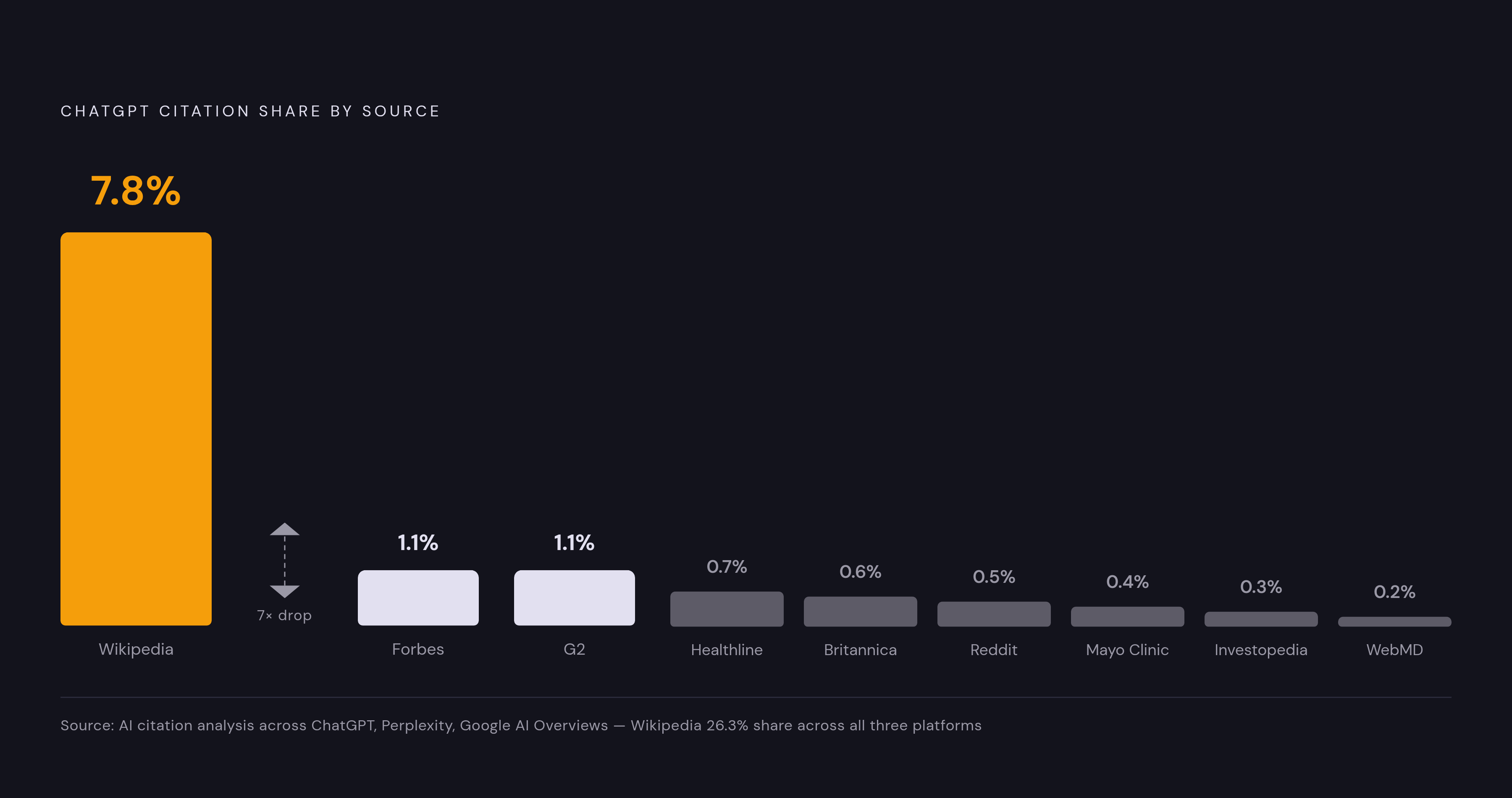
Wikipedia accounts for roughly 26.3% of all AI citations across ChatGPT, Perplexity, and Google AI Overviews, according to Visual Capitalist's 2025 data. A June 2026 arxiv.org paper, covering 167,551 URL-grounded citations across 128 brands, found Wikipedia was the single most-cited domain in 11 of 12 languages studied. That's a lead too thin to count. That's near-total dominance across nearly every market the researchers checked.
Inside ChatGPT specifically, Wikipedia sits at 7.8% of citations. Forbes and G2, the next closest sources, each land around 1.1%. First place to second place is a leap, not a margin.
Part of the explanation is structural. Roughly 80% of citations come from about 18% of domains, so the pool is already lopsided before Wikipedia enters the picture, and Wikipedia sits at the top of that pile. But the deeper reason lies in training, not retrieval: Wikipedia's human-written, consensus-driven, heavily moderated entries gave model training a clean signal for what's true and who's real. That's a different thing entirely from a page simply getting fetched more often than others.
Even where citation behavior splits by platform, the pattern holds. Perplexity cited 90,276 of its 131,514 backbone citations across 15,995 separate domains, casting a much wider net than ChatGPT does. Wikipedia remains among the most prominent sources in Perplexity's citation pool.
How Wikipedia became structurally embedded in LLM training, not just retrieval
The Wikimedia Foundation has signed enterprise licensing deals with Microsoft, Meta, Amazon, Perplexity, and Mistral. Wikimedia's Enterprise APIs feed Wikipedia, Wikidata, and related projects directly into the semantic layers these companies build their models on. So Wikipedia has become part of the infrastructure a model relies on during a search. It's wired into the model itself, shaping how it connects concepts and decides what counts as real before anyone types a query.
Models build internal representations of brands as entities, assembled from Wikipedia references, news mentions, government records, and structured data spread across millions of pages. A news article that links to a brand's Wikipedia page functions as third-party validation in the model's eyes. Strip out the Wikipedia link, and the same mention carries less weight. Wikipedia is shaping how a brand gets described to a curious reader. It's anchoring that brand's identity inside the model's map of the world, a far bigger job than most people assume an encyclopedia entry is doing.
What "entity recognition" means for brand citation authority, and where Wikipedia fits in the wider graph
AI systems handle brands in three steps. Entity extraction comes first: the model parses content and pulls out the organization being discussed. Entity linking comes next: the model maps that organization to a canonical identifier, something like a unique code from a structured knowledge base. Cross-source validation comes last: the model checks whether the same entity shows up consistently across multiple trustworthy sources. Trust builds from that consistency, not from any single mention.
A brand with no schema markup, no Wikidata entry, and no consistent attributes across platforms becomes hard for these systems to recognize or cite with any confidence. That is a trust problem. It's an identity problem: the entity itself is undefined from the model's point of view, and a model can't recommend what it can't confidently name.
Major AI platforms lean on structured entity data, and Knowledge Graph inclusion has become an important signal for brand recognition across AI systems. Organization schema markup, and particularly the sameAs property pointing to a Wikidata Q-number, is the specific mechanism that ties a brand's identity together across the graph.
Wikipedia and Wikidata get confused constantly, but they aren't the same thing. Wikipedia is the human-readable encyclopedia, with a high notability bar demanding significant, independent, in-depth coverage. Wikidata is the machine-readable database underneath it, with a far lower bar for inclusion. Most B2B brands already qualify for a Wikidata entry through a funding announcement, a Crunchbase profile, an SEC filing, or a trade-press writeup. For a brand not yet notable enough for Wikipedia, Wikidata is the realistic starting point, and it feeds straight into the same entity graph the models consult. Brands sitting in the top 25% for web mentions earn more than ten times the AI citations of the next quartile down. Entity authority doesn't stack on top of other signals. It multiplies them.
Wikipedia's notability rules and what they mean in practice for brands pursuing a page
Wikipedia's guideline for organizations, WP:NCORP, rules out routine coverage outright. Funding announcements, product launch posts, standard press releases: none of that counts as significant independent coverage, no matter how many outlets ran the story. Plenty of well-funded startups simply aren't notable yet by Wikipedia's standard. That's the rule working as designed, not a failure of the company's PR team.
What qualifies is coverage that treats the company as a real subject: substantive, independent reporting that goes beyond a passing mention. Once that kind of coverage exists, the path forward has a specific shape. Disclose any conflict of interest, since Wikipedia strongly discourages editing your own article or your employer's article. Submit through a formal review process instead of publishing directly. Write it neutrally, and cite only independent sources.
If the topic is genuinely notable, neutral editors will keep the page up over time. If it isn't, no amount of effort makes it stick. Editing your own article as though nobody will notice is the fastest way to damage a brand's standing here: it raises the odds of deletion and draws exactly the scrutiny a brand doesn't want. Qualifying for a page means building a real editorial record first, and that record matters whether or not Wikipedia ever enters the picture.
Building the editorial record that makes Wikipedia possible, and improves AI citation authority whether or not a page exists
Brand search volume is the single strongest predictor of how often AI cites a brand, at a 0.334 correlation, ahead of both backlinks and raw content volume. The logic underneath that number is plain: models cite brands their training data already recognizes as real and established, and that recognition comes from earned media, not from content a brand publishes about itself.
A few platforms carry outsized weight. Industry media and high-authority publications matter most, since getting quoted in a substantive article is exactly the coverage type Wikipedia's notability rules demand, and the type LLMs weight heaviest. Forums and Q&A platforms matter almost as much: community platforms account for 48% of citations across models studied, and Reddit shows up as a top-cited domain across several of them. Review platforms carry real weight for B2B specifically, with G2 tied with Forbes at 1.1% of ChatGPT citations. Wikipedia itself offers a quieter path in, too. Making fact-based, properly sourced edits to existing articles on relevant topics builds a presence without tripping the conflict-of-interest problems that come with writing about your own company.
All of this is ongoing rather than a one-time push. Pages that go three months or more without an update are three times more likely to lose their citations, according to AirOps' 2026 State of AI Search report, and pages built with clear sequential headings and rich schema markup see citation rates run 2.8 times higher than pages without them. Only 30% of brands stay visible from one AI-generated answer to the next, and just 20% hold their position across five consecutive runs of the same query. Staying cited looks a lot less like a campaign and a lot more like upkeep, the kind that never really finishes.
Measuring whether any of this is working, what brand citation authority actually looks like as a scored signal
Most brand health measurement was built for a different world, one where the audience was human and the scoreboard was a search ranking. None of that tooling tracks how an AI system represents a brand or decides whether to recommend it, which leaves plenty of marketing teams flying blind on exactly the channel growing fastest.
A real measurement approach has to cover several things at once, and none of them substitute for the others. Whether the brand has a recognized entity across Wikipedia, Wikidata, and the Knowledge Graph. How consistently it shows up across ChatGPT, Perplexity, and Gemini on the queries that actually matter to it. The quality and independence of whatever sources are doing the citing, not just a raw count of them. And the freshness of its entity signals, schema, third-party coverage, structured data, across the sources these models actually pull from.
Morning Consult's 2026 analysis of brand tracking tools found that platforms collecting data daily, publishing clear definitions for their own metrics, and delivering results inside the tools teams already use outperform anything built around a quarterly research cadence. A brand can't fix what it can't see, and a citation problem diagnosed once a quarter is already three months stale by the time anyone reads the report.
Wikipedia is one node, an unusually powerful one, in a much larger system of trust signals AI models have learned to lean on. Managing that system on purpose, and checking it constantly instead of occasionally, is what separates the brands that get cited from the ones that stay invisible no matter how much they still spend on the SEO playbook that used to work.