NAP Consistency and Its Role in AI Local Brand Perception
AI systems now exclude businesses with inconsistent contact data rather than ranking them lower.

NAP consistency, meaning a business's name, address, and phone number staying identical everywhere it appears online, used to be a search-ranking tactic. In 2026, it's a prerequisite for something bigger: whether AI systems trust that a business exists as a single, coherent entity worth recommending at all. When that trust breaks down, the consequence is exclusion from the list entirely. It's disappearance.
The three fields matter because they're the smallest unit of identity a machine can check. Name, address, phone. Nothing else. And the word that decides whether two listings match must be identical. A person glancing at "123 Main St." and "123 Main Street, Ste. 4" knows instantly that's the same place. A crawler matching records across data sources often doesn't extend that same courtesy. It reads two strings, finds a mismatch, and logs two different addresses.
That's the crux of entity reconciliation, the process by which search engines and AI models decide whether a name in one directory and a name in another refer to the same organization. Structured data, user edits, reviews, links, third-party databases: all of it gets compared. When enough trusted sources align, confidence in the entity rises. When they conflict, confidence drops, and that drop reflects a genuine loss of trust in the data. It's a more fundamental doubt about whether the business is one thing or several.
Local search used to be a Google problem. Now it's a ChatGPT problem, a Gemini problem, a Perplexity problem, an Apple Maps and Bing Places and Yelp problem too. Every one of those systems, plus industry directories and publisher sites, contributes to how a business gets described and recommended. NAP consistency now has to do three jobs at once: hold up local SEO rankings, keep the path to a phone call or a booking clean for actual humans, and give AI systems enough coherent signal to talk about the business at all. Birdeye's State of Google Business Profile 2026 report found that verified profiles generate up to 4x as many website visits as incomplete or unverified ones, and NAP consistency is a direct input into whether a profile gets verified in the first place.
How AI systems build a confidence score around a local business
Models like GPT-4 and Gemini don't run a business through a simple pass/fail check. They build something closer to a structured profile: what category the business operates in, what it's known for, how independent, credible sources talk about it, whether its public claims have held up over time, and how it compares to established knowledge in its category.
When an AI model runs into conflicting NAP data, it doesn't guess. It weighs each data point by source authority, by how recent it is, and by whether other sources back it up, then arrives at a confidence figure for that piece of information. Low confidence doesn't push a business down a page. It gets the business left out. An assistant asked to recommend a plumber or a dentist nearby can simply skip a brand whose contact details don't line up across sources, and the business never finds out it happened.
Here's the part that surprises a lot of operators: a brand's own website makes up only 5% to 10% of what a model actually reads about it, according to McKinsey 2025 and NeuroRank research. The rest comes from reviews, forums, directories, and news coverage, read on behalf of a buyer who may never visit any of those pages directly. Controlling the website is necessary. It's nowhere near sufficient.
Fragmentation shows up in patterns that repeat across nearly every local business, once you know where to look. Old call-tracking numbers stay indexed on directories long after the campaign that used them ends. A moved address stays live on a chamber of commerce page or an aggregator feed for months, sometimes years, after the physical move. Franchise brands run into naming drift, "Joe's Plumbing LLC" on one directory, "Joe's Plumbing of Tampa" on another, that a matching algorithm may read as two separate companies. Suite numbers get formatted five different ways across five platforms. And in fields like medicine or law, a practitioner's individual listing competes with the practice's listing as though they're unrelated entities.
Rallio's research puts citation consistency's weight in traditional local ranking algorithms at around 7%, a figure that has held steady for a while. In AI systems, though, that same signal doesn't function as one input among many. It functions as a gate. Below a certain confidence threshold, the business doesn't rank lower. It doesn't show up. Current data suggests that only 68% of businesses have matching contact information on ChatGPT and Perplexity relative to their Google Business Profile, which means close to one in three businesses is already being misrepresented, right now, in AI-generated local answers.
The evidence that AI visibility and traditional local rankings now diverge
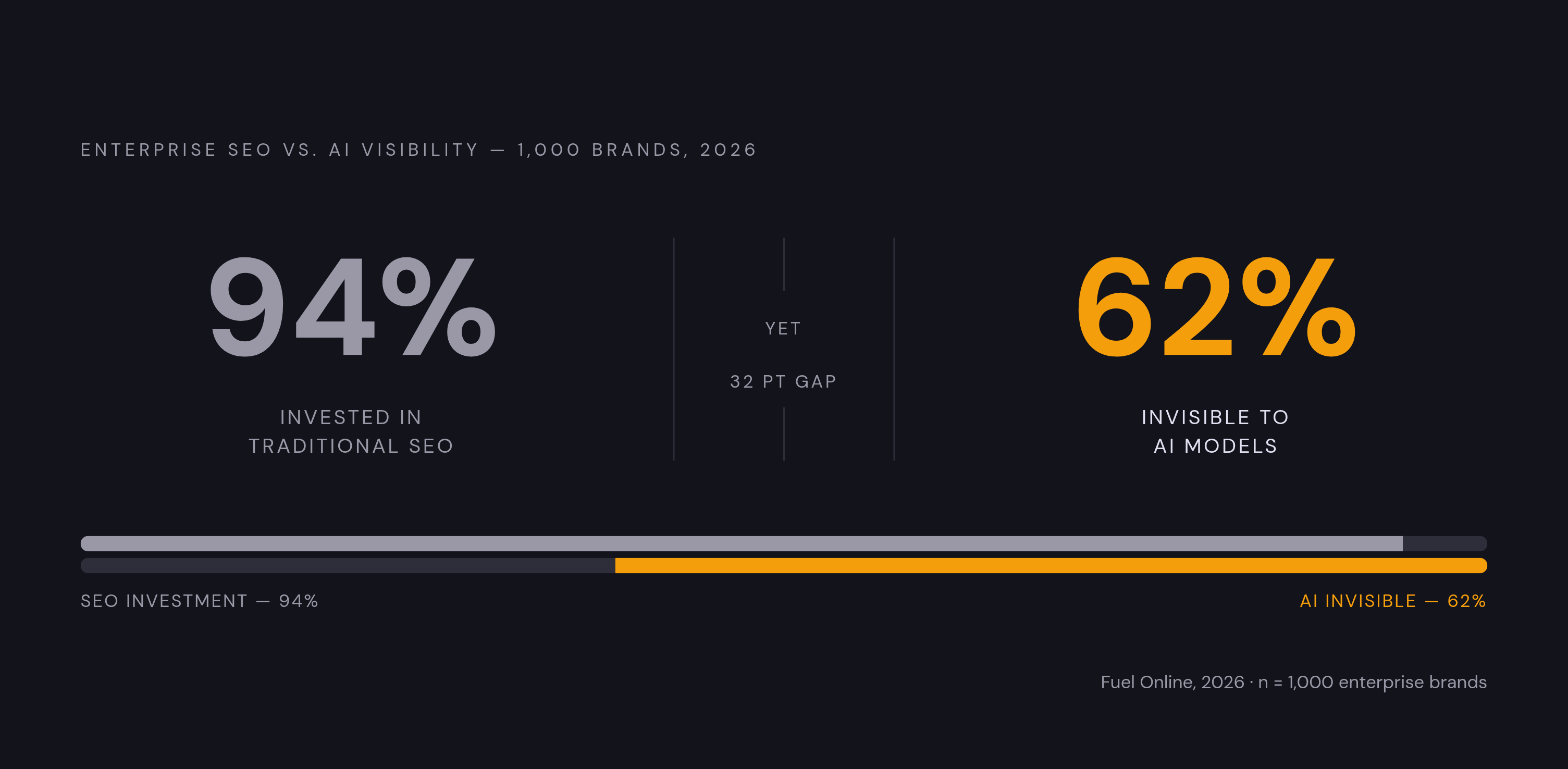
Fuel Online's 2026 analysis of 1,000 enterprise brands found that 62% were invisible to generative AI models, despite 94% of those same companies investing heavily in traditional SEO. That gap is the whole story in one data point. These aren't companies with weak content or lazy marketing teams. They're companies that built for a ranking algorithm and never built the separate signals an AI model needs to feel confident naming them in a generated answer.
SearchAtlas ran an empirical citation study across late 2025, analyzing 104,855 URL citations pulled from OpenAI, Gemini, Perplexity, Grok, Copilot, and Google AI Mode between October 27 and December 3, evaluating exactly how businesses get selected and ordered for "near me" style queries. What it found cuts against a lot of standard SEO assumptions. Semantic relevance, meaning how closely a page's actual content matches the intent of the query, drives LLM citation behavior far more than traditional authority signals do. Domain authority scores and schema markup showed weak, inconsistent correlation with citation order, not the decisive levers many marketers assume them to be. Google Business Profile signals mattered, but modestly, functioning as supporting context rather than the deciding factor. Freshness varied by platform as well, with meaningful differences in how each system weighted recently published content against established evergreen sources.
Compare that against how traditional local rankings actually work. A separate Search Atlas study found proximity accounts for 48% of predictive power in map-pack placement globally, and at the very top positions, reviews carry the most weight at 33.4%, followed by review keyword relevance at 25.2% and distance to centroid at 23%. Proximity and domain authority still run the map pack. Entity consistency and third-party corroboration run AI inclusion. Optimizing for one doesn't hand you the other for free.
That divergence matters more each quarter because of where consumer attention is actually going. SOCi's 2025 Consumer Behavior Index found traditional search traffic has slipped by 10% while 19% of consumers now use AI tools monthly to find local businesses. Bain's 2025 research adds another layer: about 60% of searches now end without a single click. The AI-generated summary isn't a preview of the customer's research process anymore. Increasingly, it is the entire encounter.
Why third-party corroboration matters as much as the business's own data
If a model only reads 5% to 10% of its picture of a brand from that brand's own site, the other 90% or more comes from sources the business doesn't directly control: reviews, directories, publisher mentions, forum threads. That's a point deserving more than a footnote. It's the main event.
Google's E-E-A-T framework (experience, expertise, authoritativeness, trust) turns out to matter more for AI citation than raw ranking position does. 96% of AI Overview citations come from sources carrying strong E-E-A-T signals, and 47% of those citations pull from pages ranking below position 5 in traditional organic search. Trust outweighs rank. For a local business, that credibility check runs across three layers: is the NAP data consistent across platforms, what do independent sources actually say about the business, and does the business's own content show real expertise in its category rather than surface-level marketing copy.
Reviews function as a specific, measurable form of that corroboration. Research from SE Ranking and The Ad Firm found domains with active profiles on Trustpilot, G2, and Yelp were three times more likely to get cited by ChatGPT than sites without those profiles. BrightLocal's 2025 research found 98% of consumers read reviews before making a purchase decision, and 89% expect a business to respond to every type of review, good and bad. Review activity is doing double duty: it builds trust with a human reader and it feeds corroboration to an AI model at the same time.
There's a compounding pattern worth naming directly. Businesses with inconsistent NAP tend to also carry thin citation footprints, few corroborating reviews, and sparse structured data. Fragmentation in one area rarely shows up alone. It's usually a symptom of a broader gap in how the business's digital presence was built and maintained. Businesses with consistent NAP information across platforms see up to 73% higher visibility in AI-generated search results compared to those with mismatches, a figure that reflects entity confidence and corroboration working together, not NAP consistency in isolation.
Where NAP fragmentation originates and why it compounds over time
Almost nobody sets out to fragment their own citation data. It happens through ordinary operational change that nobody assigned anyone to track.
Business name drift is the most common origin point. A company registers as "Smith & Sons Plumbing LLC" but goes by "Smith Plumbing" publicly, and by the time Facebook, Google, and Yelp each carry a slightly different variant, a search engine may treat all three as separate companies rather than one. Address formatting drifts the same way: "Suite 100," "Ste 100," and "#100" look identical to a person and different to a matching algorithm, and each variant chips away at confidence scoring.
A physical move is probably the single most common cause of local ranking decline, because the old address keeps syndicating through aggregator networks long after the business has packed up and left. And call-tracking numbers cause a quieter version of the same problem: a CallRail number swapped in to measure ad performance replaces the primary phone number on one listing, and that mismatched number persists in aggregator feeds long after the tracking campaign ends.
The aggregator layer is where a small error turns into a widespread one. Platforms like Data Axle and Foursquare feed data downstream to a long tail of smaller directories, so one wrong record at the source can spread to dozens of listings within weeks. Scale multiplies the exposure: a brand running 50 locations can carry somewhere between 2,500 and 5,000 active citation records that all need to stay identical, and relocating a handful of units or switching phone providers means managing hundreds of simultaneous edits across dozens of directories, usually without any centralized system tracking it.
Franchise structures add another failure mode. Local owners create their own listings using naming conventions nobody standardized, and those listings compete with, or quietly overwrite, the corporate version. And closed locations rarely die cleanly online. Old suites, disconnected phone numbers, shuttered storefronts: they linger on secondary directories as zombie listings, continuing to feed wrong data into search engines and AI retrieval systems long after the location itself is gone.
BrightLocal's research found that most consumers, roughly 80%, lose confidence in a business after finding inconsistent contact details online, and separately, 68% say they'd stop using a business entirely if they found incorrect information in an online directory. Fragmentation damages human trust and AI confidence through different mechanisms, but it damages both, and it does so at the same time.
How to audit NAP coverage and identify where confidence is breaking down
Start with a single master record. This should contain the canonical business name, the full address, and the primary phone number, written out in the exact format meant to appear everywhere. Every fix downstream gets measured against this one document. Skip this step and the audit has no fixed point to correct toward.
From there, the manual check is simple and mildly tedious. Search the business name in quotation marks, then search the phone number on its own, then the address on its own. The first few pages of results for each search usually surface listings the business forgot existed, old directory pages, defunct partner sites, aggregator entries nobody remembers creating.
Some platforms matter more than others, because they feed downstream data and carry outsized weight in both traditional rankings and AI citation. Google Business Profile, Bing Places, Apple Business Connect, Yelp, and the relevant Facebook Business Page sit at the top of that list, alongside whatever industry-specific directories matter for the category (legal, medical, home services, and similar verticals each have their own). The business's own website belongs on the list too. This includes the contact page, the footer, the schema markup, and every individual location page if there's more than one.
Checking the data aggregators specifically, rather than chasing individual directory listings one by one, is the highest-leverage move available. Fixing the source record at an aggregator propagates that correction downstream to many smaller directories over time, without requiring a business to hunt down each one manually. And duplicates need suppressing before new citations get built, because building fresh listings on top of a zombie profile just adds a second wrong record instead of correcting the first.
LocalBusiness schema markup gives search engines and AI retrieval systems a machine-readable, canonical version of NAP data sitting directly on the website. It doesn't erase inconsistency elsewhere, but it gives every system a clean reference point to check against. For brands running multiple locations, doing this manually stops making sense past a certain scale. Tools built for exactly this, Moz Local, BrightLocal, Semrush's Listing Management, and Yext among the established options, scan many platforms at once and flag mismatches automatically. Whatever the scale, a quarterly citation review paired with maintained schema markup is the baseline. NAP consistency is an ongoing practice with no end date. It's ongoing governance.
What AI-era perception scoring reveals beyond what a citation audit shows
A citation audit tells a business where its NAP data is wrong. It doesn't tell that business how AI systems are currently describing it, or what confidence score those systems have quietly assigned it. That's a different measurement problem, and reputation management has had to build new tools to answer it.
Where reputation used to be measured almost entirely in star ratings, it now gets measured across a wider set of signals: citation sentiment, source trust, narrative consistency, and how often an entity co-occurs with other trusted names in the same context. Britopian's framework names four specific metrics along these lines, a Citation Sentiment Score, a Source Trust Differential, a Narrative Consistency Index, and an Entity Co-Occurrence Map, each measuring a different slice of how confidently AI systems talk about a brand.
NeuroRank's framework takes a five-dimension approach: inclusion, recommendation, citation, sentiment, and something it calls ORHL reduction, tracking whether a business gets Omitted, Replaced, Hallucinated, or generates Zero Leads. Naming those specific failure modes matters, because it turns a vague sense of "we're not showing up right" into something a team can actually track and fix.
A 2025 systematic review by H. Molavi, covering 104 studies published between 2000 and 2024, found that AI and machine learning methods are meaningfully improving how accurately corporate reputation gets measured in the first place. Evident's approach scores businesses across more than 400 signals spanning three evaluation lenses at once, algorithmic, AI, and human, giving a business a structured read on how each type of evaluator sees it, not just a list of where citations happen to be missing. The measurement has to come before the fix. The order operations actually work in follows this pattern, not a slogan.
None of this collapses into a single question of "are we visible." A business can show up in an AI-generated answer and still be described inaccurately, undersold, or attached to the wrong category. Measurement has to capture inclusion and the quality of the representation together, because one without the other is an incomplete picture.
The payoff for getting this right shows up in traffic quality, not just traffic volume. Adobe's research, covering July 2024 through February 2025, found that visitors referred by AI systems browse 12% more pages per visit and show a 23% lower bounce rate compared to visitors referred through other channels. Seer Interactive's 2025 study, covering 3,119 informational queries across 25.1 million organic impressions, found that when a brand appears as a cited source inside an AI Overview, organic clicks rise by 35% and paid clicks rise by 91%. Entity confidence is a practical measure that shapes real outcomes. It's connected, directly and measurably, to the traffic that actually shows up and converts.