Third-Party Press Coverage as an AI Credibility Signal
AI systems now treat press coverage as a credibility input, not just a marketing tool.

Press coverage now works as a structural input into how AI systems describe a business, not just a trust signal aimed at human readers. When ChatGPT, Gemini, or an AI-powered search result decides how to talk about your company, the sources feeding that answer carry real, measurable weight, and earned media sits near the top. Systematic prompt audits across platforms make this concrete fast — the pattern appears early and holds.
The audience reading those answers isn't small anymore, either. ChatGPT, Gemini, and AI search tools now post weekly and monthly user counts that put them in the same conversation as mainstream search and social platforms. Research has found AI Overviews now trigger on roughly half of all tracked queries, a sharp jump from the year before. The AI-generated answer is becoming the default response, sitting above the usual ten blue links instead of beside them.
Industry research found that about half of consumers already use AI-powered search, and among that group, AI has become their main channel for finding products, ahead of traditional search engines, retailer sites, and review platforms. Buyer research found the same pattern on the B2B side: the vast majority of B2B buyers now use AI somewhere in their purchasing process, and they rank generative AI as a more meaningful information source than any other channel available to them. A business's presence, or absence, in AI-generated answers shapes purchase decisions right now, at scale. And that presence follows rules that can actually be studied.
What AI systems actually do when sizing up a business
Search engines rank pages. Large language models do something else: they build an assertion about a business, a confidence-weighted claim stitched together from whatever sources the model has read and trusts. Ranking well used to mean beating a competitor for a slot. Now it means getting recognized as a real thing at all. The distinction matters because the mental model most practitioners start with is simply wrong.
Four things seem to matter most, based on what kept recurring across the audits I ran. Entity recognition comes first: can the AI confidently tie your brand to a real, distinct category? That takes consistent mentions across sources that have nothing to do with you, since a brand that only shows up on its own site reads as suspicious, the way a stranger who only vouches for himself gets nowhere. Reputation assessment comes next, where the model reads sentiment pulled from reviews, Reddit threads, and press coverage, and judges whether the tone sounds genuine or planted.
Expertise validation asks whether outside sources, a trade publication, an analyst report, a research citation, mention your brand in contexts that actually match what you do. Corroboration density is the last piece, basically a headcount of how many independent sources say roughly the same thing about you; more independent agreement means more confidence gets assigned to any single claim about your business.
A 2025 study published at dl.acm.org tested nine widely used LLMs against more than 7,000 websites. The models agreed with each other at a high level, but their judgments only moderately lined up with human expert evaluations, which suggests LLMs are running their own internal credibility math rather than mirroring the editorial judgment humans relied on for decades. Larger models in that same study more frequently declined to rate sources that were less popular or thinly covered, citing insufficient information. That's worse than ranking low. A business with a thin third-party footprint risks not getting evaluated at all, which is a different, quieter kind of invisible.
A separate 2026 study of more than 153,000 AI citations found that 76.95% of the cited URLs fell outside the organic top-10 results for their matching query. Search rank isn't the gate into AI answers. Entity recognition is.
Why earned press coverage carries so much weight in AI credibility scoring
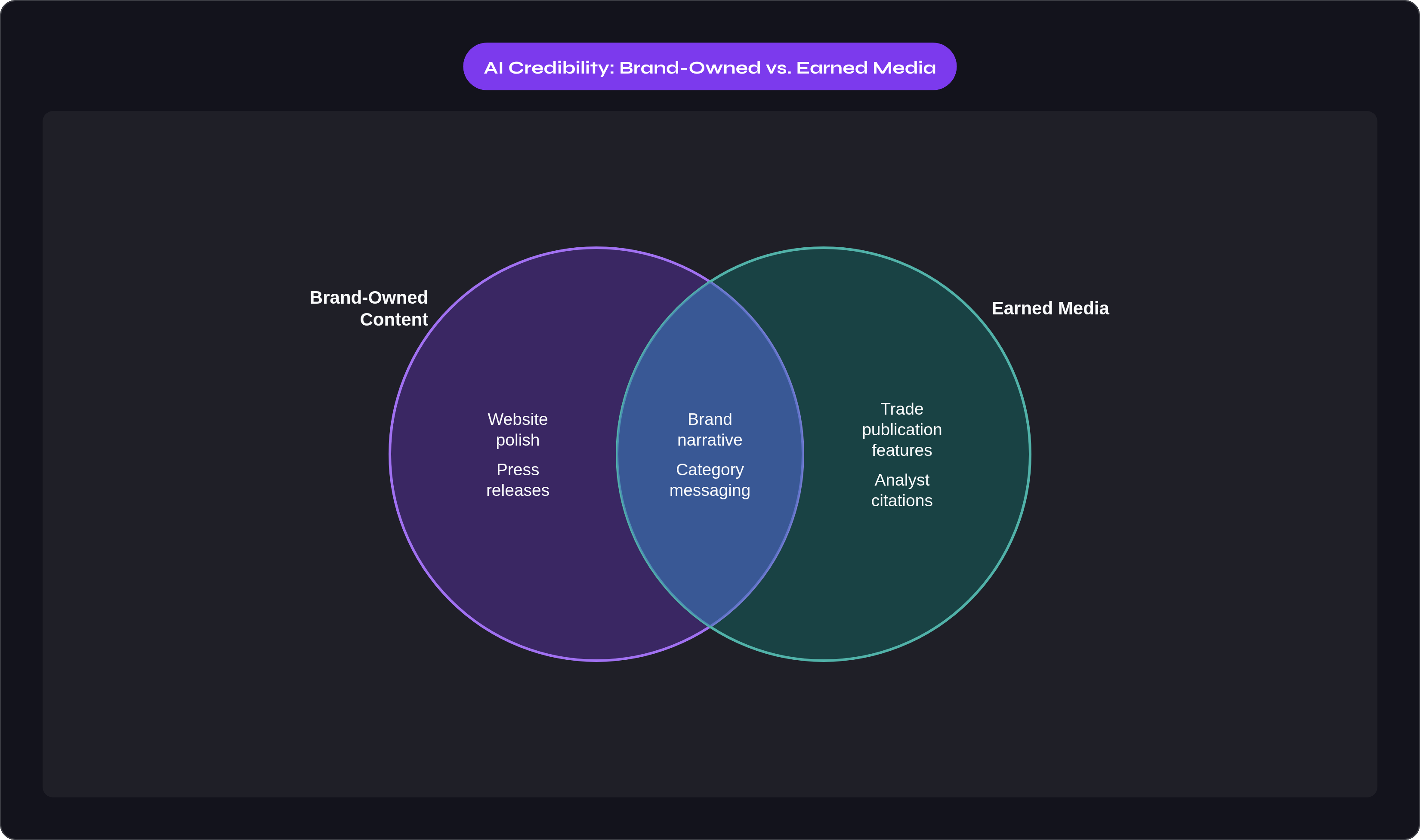
This maps onto something journalists have understood for decades. A brand talking about itself is self-interested by definition; a respected outlet covering that brand, with no money changing hands, works as a genuine outside endorsement. That gap gets built directly into how language models weight sources, whether or not the people who built these models set out to encode old-school editorial judgment.
Research tracking AI citations across ChatGPT, Claude, Gemini, and Perplexity over six months found that most citations traced back to non-paid sources, with earned media making up the largest share and journalism accounting for a real slice in any given period, according to research tracking AI citations across ChatGPT, Claude, Gemini, and Perplexity. A separate distribution study found that placing content through third-party news outlets produced a large median lift in AI search visibility, with some campaigns going well past that median. None of this is mysterious once you sit with it for a while. AI systems pick up on the same independence signals editors have used forever to judge whether a source can be trusted.
Published research on generative engine optimization and citation bias backs this up. AI engines consistently favor earned media over brand-owned content when building an internal picture of a company. Analysis of third-party signal types consistently puts editorial coverage and analyst citations at the top, because answer engines treat them as the least self-interested validation on offer.
So what happens without that coverage? If reputable outlets simply aren't writing about a brand, AI systems, including Google's own generative features, have almost nothing to draw on when deciding whether that brand counts as a credible authority. That absence shows up as weak E-E-A-T signals and, functionally, close to zero visibility in AI answers, and no amount of on-page polish fixes it. The reason is structural: those layers were never built to look at the site itself in the first place.
The coverage types and placements that move AI credibility signals most
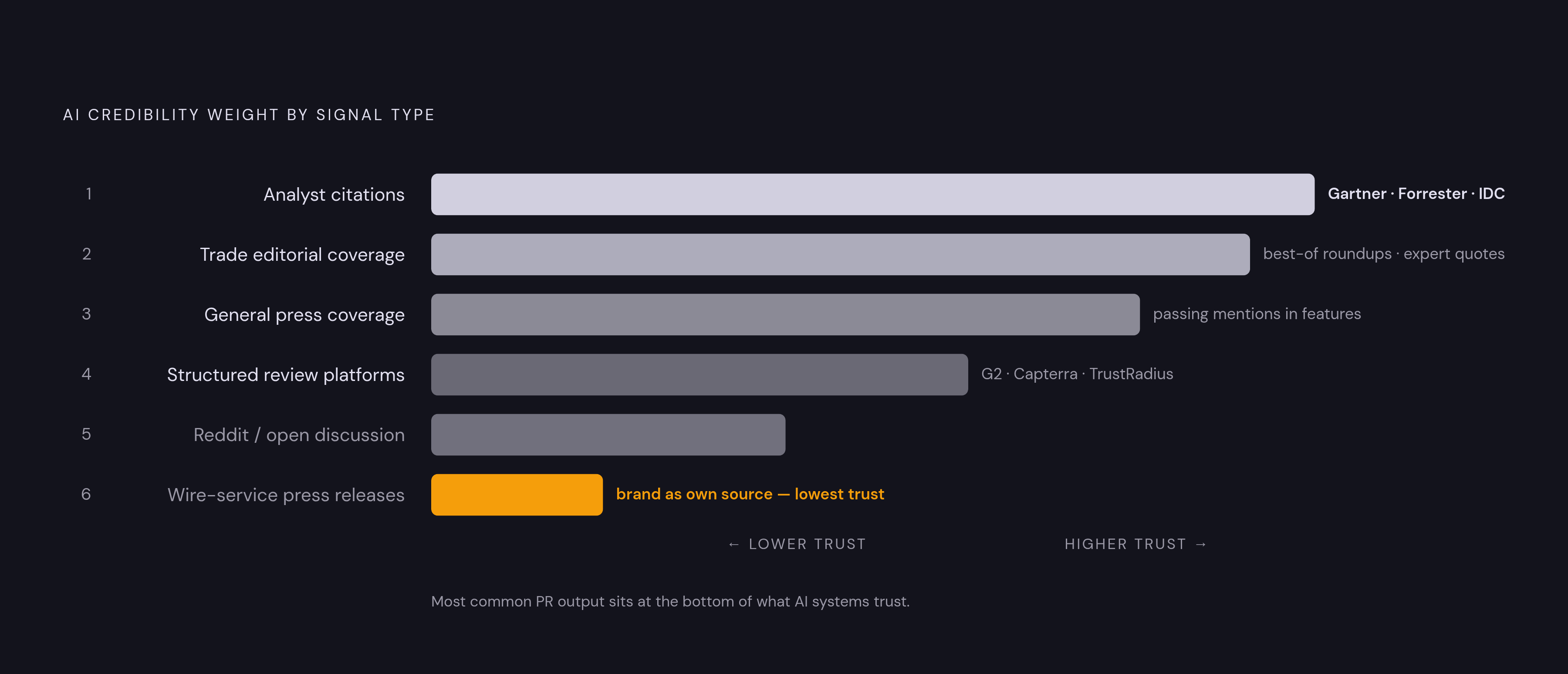
Not every mention counts the same. The gaps between them are large enough to change outcomes entirely, and it takes sorting through a fair amount of coverage to see where the lines actually fall.
Landing in a "best of" roundup from a trade outlet is a high-signal event, since it combines topical authority with the fact that a third party made a selection instead of just accepting a pitch. Getting quoted as a subject-matter expert in a news story does similar work, feeding straight into the expertise-validation layer. A passing mention buried inside a broad feature still helps corroboration density, though it carries limited weight on its own. A press release copied word for word across a wire service sits at the bottom of the pile: the model can tell the brand is the source of its own claim, and the independence that gives earned coverage its power just isn't there.
Analyst citations from firms like Gartner, Forrester, and IDC sit in their own high-trust category. AI models cross-reference these reports specifically to check expertise claims, treating them as a different order of evidence entirely. For B2B brands, trade and vertical publications often matter as much as general-interest media, sometimes more, since they sit closer to the category the brand is actually trying to own.
Volume matters less than consistency. Ten articles describing a company ten different ways introduce noise that works against the corroboration layer, no matter how much total coverage piles up. Industry observers note that enterprise SEO teams are already shifting budget toward third-party validation, brand mentions, and multi-platform presence, because algorithmic credibility is moving away from link velocity and toward the breadth of a brand's entity footprint. Worth naming separately: press coverage puts a brand name in front of new audiences, which drives branded search volume, and Google tracks that as its own signal of market relevance.
The wider third-party signal ecosystem around press coverage
Press coverage doesn't work alone. AI entity evaluation pulls from the whole shape of a brand's digital footprint, so businesses need to think in terms of an ecosystem, not a single channel to check off and move past.
Structured review platforms, G2, Capterra, TrustRadius, along with open discussion spaces like Reddit, rank among the most heavily weighted third-party signals answer engines rely on. These sources hold opinion at scale that the brand didn't write and can't fully control, which is exactly the independence property a model is hunting for when it wants outside confirmation. That same lack of control cuts both ways: unmanaged review threads and forum posts are also where a brand's story is most likely to get garbled, and bad descriptions circulating there quietly corrupt the corroboration layer.
Reddit deserves its own mention here. Q&A-style threads tend to be among the most frequently cited pieces of Reddit content in AI responses, so genuine participation in category discussions on the platform is a real tactic now, not a side project for the intern. Wikipedia sits in a similar high-trust spot when a brand's entry is accurate and well-sourced, because its editorial standards happen to line up closely with the independence threshold models already look for.
Take two companies. One has strong reviews, steady editorial coverage, and active discussion threads about its category. The other has a beautifully built website and not much else. The first outperforms the second in AI-generated answers by a wide margin, and Analysis of 1,000 enterprise brands backs that up directly: a majority were effectively invisible to generative AI models despite heavy, sustained investment in traditional SEO. That gap is measurable. It isn't a guess.
Measuring AI credibility before you try to fix it
Most businesses have no idea how AI models currently describe them. Sentiment, accuracy, competitive framing, the topics where a brand just doesn't show up: all of it stays invisible unless somebody goes looking on purpose.
The baseline work is prompt response monitoring: a business systematically asks AI models the questions its customers would actually ask, across several platforms, and tracks what comes back, how it's framed, and where the brand goes missing. A real AI perception audit checks a handful of specific things. Entity recognition confidence, whether the model consistently gets the name and category right. Sentiment and framing, whether descriptions carry hedges or caveats. Competitive positioning, whether the brand shows up next to rivals in category questions or gets left out entirely. Topic authority gaps, the relevant questions where the brand never appears at all. And source tracing, figuring out which third-party mentions are actually driving what the AI says, and whether those sources are even accurate.
The stakes aren't small here. Research puts intangible assets, brand and reputation chief among them, at roughly 92% of S&P 500 market value, up sharply from a small fraction back in the mid-1970s. Getting misrepresented in an AI-generated answer isn't a minor glitch to shrug off; it touches the part of company value that matters most now. Platforms built specifically for this measurement layer, scoring a business across algorithmic, AI, and human evaluation at once, exist to make the link between press inputs and AI outputs visible instead of guessed at. Scale Labs is one such platform, measuring across 400+ signals to tell companies what to fix first. Knowing press coverage matters, in the abstract, tells you nothing about which specific gap in your current coverage is doing the most damage right now. You have to go measure it.
Turning press strategy into better AI representation
Earned media programs need a new line on the scorecard. Reach and impressions still count, but AI credibility contribution belongs there too, and it can be tracked with the same discipline as any other campaign metric.
Some placements are worth more than others because they hit multiple signal layers at once. Trade publication coverage naming a specific executive hits entity recognition and expertise validation in a single placement. Inclusion in an analyst's category report adds expertise validation plus corroboration from a source type models already trust. Roundup and "best of" inclusions build topical authority at the category level, doing more work than a brand-only mention ever could on its own.
Consistency has to become an editorial discipline, not an afterthought. Every press placement should describe a brand's category, capabilities, and point of difference in language that lines up across sources, since mismatched descriptions weaken the corroboration layer no matter how much coverage volume piles up. None of this happens apart from the rest of the ecosystem. Press coverage does its best work when it reinforces strong reviews, real community activity, and accurate third-party profiles elsewhere, since these signals back each other up inside the model's evaluation instead of competing for separate credit.
Treat AI model output as a feedback loop, not a report card you check once. Run the audit, launch the press campaign, then run the same prompts across the same platforms again and see what actually moved. That shift in AI representation is a trackable campaign outcome, not a vague side effect you hope shows up eventually. The businesses winning at AI-era discovery are the ones managing earned media as a deliberate, ongoing input into how AI systems understand them, measured against real AI perception outcomes, not a press push they run once and then forget about.