Prompt Phrasing Bias in AI Brand Perception Queries
How AI models shift brand answers based on question wording, not facts.
Prompt phrasing bias means the wording of a query, not the facts a language model actually holds about a brand, decides what that model says back. Ask an AI "is this bank good for a small business" and you get one answer; ask "what are the problems with this bank for a small business," and you get another, from the same system, drawing on the same training data. Most companies now tracking their AI visibility are building their entire read on the problem from a handful of queries that all sound suspiciously alike. That gap between what gets measured and what actually matters is what this piece is designed to pick apart.
Language models don't keep a brand file somewhere and read from it when asked. They generate text from probability distributions shaped by every word in the prompt, tone and framing included. So the question isn't whether phrasing changes outputs; obviously it does. The harder question is how far that sensitivity runs, and what it costs anyone trying to measure AI brand perception with any rigor.
How emotional tone in a prompt changes what an AI says — even when the facts are the same
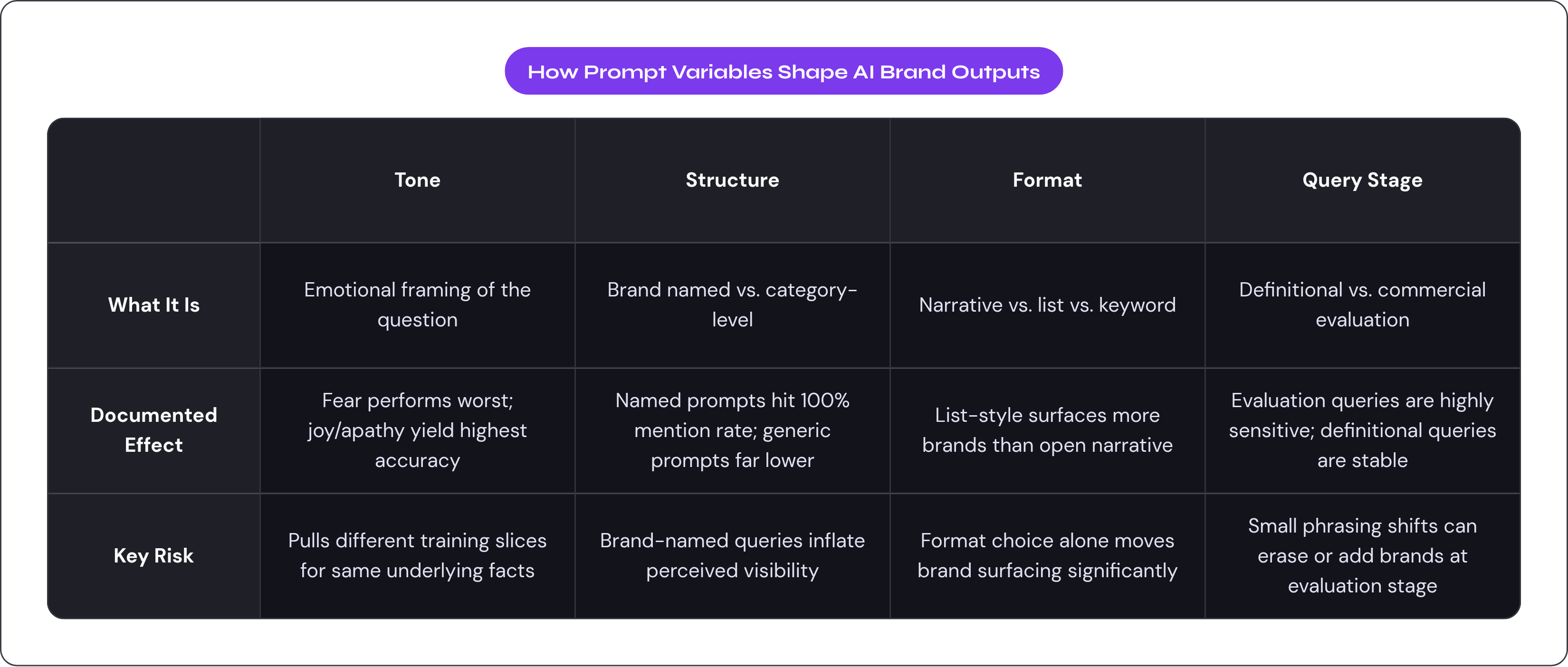
Researchers put this to the test directly in a 2026 study published in Big Data and Cognitive Computing. They ran four emotional tones, joy, apathy, anger, fear, through otherwise identical prompts, across five instruction-tuned models and eight tasks. Joy and apathy came back with consistently higher accuracy almost every time, while fear performed worst by a wide margin, even though the words describing the actual subject never changed. Tone alone did that.
A separate 2025 study on prompt sentiment in news and policy writing found much the same thing outside a controlled lab setting. Neutral prompts pulled balanced, multi-perspective answers, while something like "why are these policies failing" pulled a skewed, negative one instead. Flip the framing positive, and the same model, holding the same knowledge, handed back a rosier version of events. Most brand reputation questions are contested by nature, whether a company wants to admit that or not.
None of this means the model knows more or less depending on how nicely you phrase things. Tone decides which slice of the model's training gets pulled forward at that moment, nothing more, nothing less. A frustrated customer and a curious analyst typing questions about the same company aren't going to get the same story back, even though neither one is wrong to expect a straight answer from the machine.
How prompt structure — not just tone — controls whether a brand appears at all
Tone is one lever, and structure is the bigger one that most teams never think to check, though platforms like Scale Labs, a scoring system that measures how algorithms, AI systems, and humans perceive a business across 400-plus signals, exist precisely because manually tracking these dimensions is where most monitoring programs fall apart. A 2026 controlled experiment run by Optimixed measured brand mention rates across three prompt types while holding the target brands fixed. Prompts naming the brand directly hit a 100% mention rate, while soft-brand prompts, open-ended enough to invite a branded answer without asking for one by name, averaged just 1.68 brand mentions, and generic, category-level prompts fell further still. Name the brand or don't, and you've moved the mention rate by an order of magnitude, same company, same facts underneath the whole time.
Format does its own damage on top of that. Search Engine Journal found that short, keyword-style or list-format requests surfaced meaningfully more brands than open-ended narrative prompts asking essentially the same question.
Where a query sits in the buying journey compounds all of it further. Broad, definitional questions like "what is a CRM" stay fairly steady; wording tweaks rarely move which brands show up in the answer. Commercial evaluation queries, something closer to "best CRM for a small remote team," behave the opposite way, twitchy, sensitive to the smallest phrasing shift you can imagine. The platforms don't even agree on which direction things move. Add a constraint on ChatGPT or Perplexity and fewer brands tend to surface; add that same constraint on Gemini or Google AI Overviews and you more often get more brands, not fewer. Same words, opposite effect, depending entirely on who's answering.
A company monitoring its AI visibility with brand-named queries alone is measuring an inflated number, since real people rarely type the brand name and stop there.
Query fan-out: the hidden amplifier most monitoring programs miss entirely
There's a layer underneath all of this that most monitoring setups never even look at. When someone submits a prompt to GPT, Gemini, or Perplexity, the system doesn't treat it as a single lookup. It splits the prompt into several sub-queries that run at once, gathering material before the final answer gets written. A brand can be missing from most of those sub-queries and nobody watching the visible output would ever notice, because the tracking tools most teams use look at the final answer, not the scaffolding holding it up.
There's a language wrinkle too, easy to miss if you're not looking for it. A meaningful share of fan-out sub-queries stay in English even when the original prompt was written in another language. Non-English brand signals end up carrying disproportionately little weight in what actually gets retrieved, even for a brand that does most of its business outside English-speaking markets.
This loops back to phrasing in a way that matters more than it first appears. How the original prompt is worded shapes how the fan-out builds itself; a differently framed prompt fans out into different sub-queries, pulls different sources, and lands on a different brand story entirely. Phrasing bias isn't only a surface phenomenon happening in the words a model finally picks. It runs down into the retrieval layer itself, which makes the distortion far deeper than most teams assume. A monitoring program that tests a handful of queries and averages the results isn't averaging a consistent signal at all. It's averaging across retrieval events that may share almost nothing with each other.
Where AI systems actually get their brand information — and why source concentration makes phrasing matter more
A 2026 preprint by Zatuchin, posted to arXiv, mapped this at real scale: over hundreds of thousands of URL-grounded citations across 128 brands, spanning 12 home markets and 13 languages, built to answer one plain question, where do these systems actually ground their brand answers. The results tilt hard in one direction. The overwhelming majority of citations point to sites the brand doesn't own; only a small slice comes from owned domains.
The source pool follows a power-law curve on top of that. A small share of domains accounts for most of the citation volume, and Wikipedia topped the list in nearly every language tested.
What that means in practice: brand perception inside AI systems gets built mostly from a small, concentrated pool of outside sources, and which of those sources gets pulled into any given answer depends heavily on how the question was phrased. A negatively framed prompt tends to surface critical third-party coverage, while a neutral or positive one might draw from a different tier of that same pool, even though both prompts are drawing on identical underlying facts. Phrasing bias isn't noise here. It's a selection mechanism working over ground that was already uneven long before anyone typed a word.
Separate 2026 data from AirOps found that community platforms, Reddit and YouTube especially, account for close to half of all citations. Sentiment on those platforms is rarely neutral, and the story about a brand can swing wildly from one thread to the next. A company with inconsistent coverage there is exposed in a specific way: a shift in phrasing that happens to pull from a different corner of that coverage can produce a wildly different AI-written narrative about the exact same business.
What a narrow query set actually measures — and what it hides
Most AI brand monitoring runs on a small, fixed list of branded or category queries, usually whichever ones looked representative to whoever built the list at the start. Given the swings covered above in tone, structure, and format, plus fan-out carrying phrasing bias down into retrieval itself, a small fixed query set doesn't sample much of anything real.
The blind spots pile up fast once you start looking for them. Favorable, brand-named queries get overrepresented, inflating mention rates across the board, while nobody checks how the brand shows up in frustrated, skeptical, or comparative queries, despite those making up a large share of how people actually use these tools day to day. Most programs test one platform only, so nobody catches ChatGPT, Gemini, and Perplexity disagreeing with each other on the same question. Nobody's looking at the sub-queries running underneath the visible answer either, and almost nobody tracks any of it over time, even though AI outputs shift as source pages age. Pages that go three months without an update are three times more likely to lose their citations, per AirOps's 2026 figures.
A 2026 AI SEO analysis covering hundreds of enterprise brands found the majority of them essentially invisible to generative AI models, despite nearly all of those same companies pouring money into traditional SEO. Part of that gap is a real visibility problem, and part of it is a measurement problem, companies checking the wrong things and calling it coverage. Plenty of businesses believe they're running an AI perception monitoring program. What they actually have is a best-case-scenario monitor, tuned to show them only good news.
What a prompt set designed to measure real AI brand perception actually looks like
A credible prompt set isn't a list of queries picked because they flatter the brand. It's a designed sample built to reflect the actual range of tones, formats, and contexts real people bring to these systems, on their best and worst days alike.
That means varying tone on purpose (neutral, positive, skeptical, comparative, frustrated), because each one activates different model behavior and draws from different sources. It means testing across the full range of brand presence: explicit brand-named queries, soft-brand category queries, fully generic ones, instead of resting on the artificially high ceiling that branded queries alone produce. It means varying format too, open narrative questions against list requests against constraint-heavy queries, since format alone can move brand surfacing by a wide margin. And it means testing both funnel stages, the steady definitional queries and the volatile commercial evaluation ones, across more than one platform, at minimum ChatGPT, Gemini, and Perplexity, since constraint phrasing pushes those systems in opposite directions from each other.
A prompt library that actually covers a single brand across these dimensions runs to dozens of queries, not a handful. Practitioner frameworks tend to organize these libraries by topic cluster, intent type, and persona, rather than by keyword variation alone. None of this is a one-time audit, either. Outputs need tracking over time, since model updates, shifts in training data, and changes in third-party source coverage all move what a model says about a brand, sometimes with no change on the brand's end at all.
What matters in the output isn't only whether the brand got mentioned. It's the direction of sentiment, which third-party domains are actually driving the story, and whether that story holds steady across prompt variants. A brand that reads well in branded queries but poorly under skeptical framing has found a real perception gap, not a fluke in the data. Metrics built for exactly this layer would track the direction of citation sentiment, the relative trustworthiness of sourcing domains, narrative consistency across prompt variants, and mapping of which entities keep showing up next to each other in the same answers.
How Evident and similar platforms approach the prompt diversity problem at scale
The tooling market here grew fast. By 2025 and into 2026, a growing number of dedicated AI visibility platforms existed, ranging from simple mention checkers up to enterprise-grade perception scoring systems. The gap they're built to close is plain enough once you've seen the numbers above: nobody can manually test prompts across tones, formats, platforms, and query types at the volume a reliable read actually requires. Doing this well takes query libraries built for the job, run automatically across multiple platforms, with structured analysis of whatever comes back out the other end.
A platform built for this should offer prompt libraries spanning several tones and formats, not one query type asked over and over in slightly different words. It should cover more than one AI platform and report results by platform instead of blending everything into a single flattering number. It should track source attribution, showing which third-party domains actually shaped the answer, not just log what the answer said on its face. It should follow results over time, so a shift caused by phrasing can be told apart from a genuine change in reputation, and it should score by aggregating across prompt variants rather than treating any single query as if it spoke for the whole picture.
Evident (evident.so) works this problem directly, scoring businesses across signals spanning algorithmic ranking, AI-generated answers, and human audience evaluation. That gives a company a structured read on AI perception that accounts for the swings phrasing alone can cause, rather than treating one favorable query result as the whole story. Without a prompt-diverse baseline, any work spent improving AI visibility aims at a distorted signal. Getting the baseline right has to come before the optimization starts, not as a patch applied once the numbers already look off.
What prompt phrasing bias means for businesses trying to improve their AI perception
A company running its AI perception monitoring on a narrow, tone-uniform set of queries is very likely optimizing for a thin, unrepresentative slice of how people actually talk to these systems. Real users show up skeptical, frustrated, comparing five options at once, phrasing the same question a hundred different ways. Everything above points to those variations producing meaningfully different AI answers than the clean, neutral test queries most monitoring setups lean on by default.
The stakes aren't theoretical, either: Eight Oh Two's November 2025 research found nearly half of consumers say AI now shapes which brands they trust. The version of a brand's story that surfaces under a skeptical or comparative prompt is shaping real purchase decisions right now, running alongside whatever polished, brand-named version most companies happen to be watching instead.
So what actually follows from all this? Since most AI brand citations trace back to sources the brand doesn't own, managing what those third-party sources say, across the full range of sentiment rather than just the friendly parts, does more for long-term visibility than polishing owned content ever will on its own. Keeping brand identity consistent across the web narrows the room phrasing bias has to work with, since a model that's fuzzy on what a brand actually stands for will swing its story on tone alone far more easily than one with a clear, well-documented identity. And keeping content current on the high-authority third-party domains that already carry citation weight matters more than it looks at first glance, given how fast stale pages fall out of an AI system's source pool entirely.
Skip this work, and every optimization effort that follows aims at a number that was distorted before anyone started measuring in the first place.