Detecting AI Brand Hallucinations and Factual Drift
Models invent brand facts from probability, not retrieval, creating invisible misrepresentations.

AI brand hallucination is a structural outcome of how large language models actually work. The errors a brand will face are knowable in advance rather than random noise to be cleaned up after the fact. A model does not look up a company in a verified record when a user asks about it. It generates the next most statistically likely word, then the next, building a sentence out of probability rather than retrieval, and it does this whether or not the facts behind that sentence exist. Because these systems are trained to sound helpful and fluent, a fabricated detail arrives in the same confident tone as a correct one, with no hedge, no asterisk, and no signal to the reader that something has gone wrong. The recurring failures, wrong founding years, invented product features, personnel who do not exist, trace back to feature conflation, where the model borrows plausible details from similar companies to paper over gaps in what it actually learned. The Elsevier paper published in Energy Research & Social Science backs this up directly: hallucinations come from probabilistic next-token prediction rather than genuine fact-checking, and the pattern appears across different providers and even inside retrieval-augmented systems built specifically to reduce it, and a brand with a well-documented website might assume this problem does not apply to it, but a company's own site makes up only a small fraction of what a model actually reads during training, and most of that training data comes from third parties that may be outdated, secondhand, or simply wrong.
How hallucination differs from factual drift
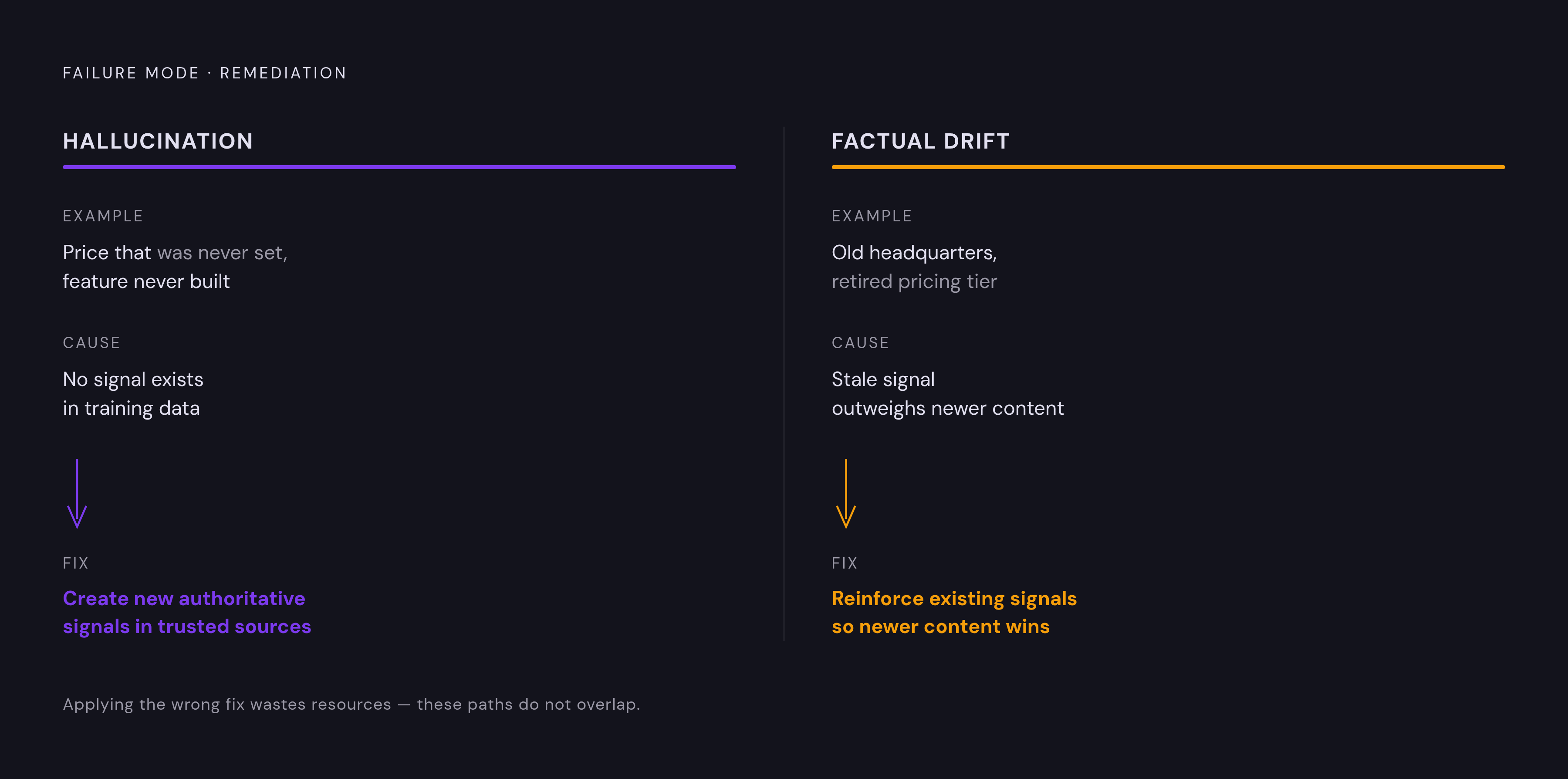
Getting a brand wrong is not one problem with one fix. It splits into two distinct failure modes, and treating them as the same thing is how a brand ends up spending effort on a remediation plan that addresses the wrong cause entirely. Hallucination invents something the training data never contained: a price never set, a feature never built, a quote from an executive who never said it, filled in because the model needed to complete a plausible-sounding sentence. Factual drift works differently. It repeats something that was once true faithfully and without distortion, an old product line, a former headquarters, a pricing tier that has since been retired, but presents it as current when it no longer is. The two require opposite fixes. A hallucination problem calls for establishing new, authoritative signals in third-party sources the model is likely to trust, because there is no accurate foundation to amplify, only a gap to fill correctly. A drift problem calls for updating and reinforcing existing signals so that newer, accurate content outweighs the older material the model already absorbed. Training cutoffs make this worse for certain brands by design: a company that launched after a model's cutoff date, or that repositioned itself significantly since then, may not be suffering from a wrong answer so much as the complete absence of a right one for the model to draw on.
A further complication has emerged that makes this harder to predict with simple assumptions about model quality. Call it the 2026 Paradox: newer models have gotten measurably better at avoiding hallucination on simple summarization tasks, but the stronger reasoning models can actually drift further from source material on complex queries, because extended "thinking" steps carry the model progressively away from the evidence it was trained on rather than back toward it. That means a more capable model is not automatically a more accurate one when the question concerns a specific brand, and brands cannot assume that waiting for the next model generation will quietly resolve their exposure.
Where hallucinations hit hardest
The real exposure is that AI has become the first stop in the buyer's research process, so a hallucinated fact sets the terms of the evaluation before a website, a sales call, or a review has any chance to push back. Buyers increasingly open an AI chat tool first, before they visit a single page or read a single review, so whatever the model says first becomes the frame they carry into everything that follows. A G2 survey of B2B software buyers found that a slim majority now start their research with an AI chatbot more often than with Google, so the model's accuracy now outranks a brand's own marketing in the sequence that shapes a purchase decision.
The stakes rise sharply in domains where a wrong fact is not just embarrassing but actionable. In legal, healthcare, and financial contexts, a hallucinated figure or a misattributed claim is not just a brand inconvenience, but a liability question. Dahl and colleagues, in a widely cited arXiv paper, found that large language models hallucinate in the majority of cases when asked about verifiable legal facts, and that these models often accept a user's incorrect premise without challenging it. The reputational version of this risk has already played out publicly. Google pulled its Gemma model from Google's AI Studio, though developers could still reach it through the API, after it generated serious allegations against a US Senator and backed them with citations to news articles that were never published. That is not a hypothetical edge case; it is a demonstration of how confidently a model can fabricate and how costly that confidence can be once it reaches a real audience. A parallel failure surfaced in academic publishing: GPTZero's analysis of NeurIPS 2025 submissions found confirmed hallucinated citations in a cluster of 51 to 53 accepted papers, meaning multiple layers of expert peer review failed to catch fabrications a model had generated.
What ties these cases together is the absence of any warning mechanism. When a model describes a brand inaccurately or unfavorably to a user, nothing about that exchange produces a social signal, a review to respond to, or an alert in a monitoring dashboard. So the misrepresentation just repeats itself across however many conversations happen next, invisible to the brand it concerns, compounding in a channel the brand has no native way of observing.
Why existing monitoring tools leave brands blind
The tools most companies already rely on were not built to see any of this, and that is a matter of architecture rather than a feature gap that an update could close. Social listening platforms and search monitoring dashboards are built to catch signals that live in public feeds and indexed pages, while AI misrepresentation lives inside conversational outputs that leave no public trace at all. A tweet, a review, a news mention: these are discrete artifacts that a monitoring tool can flag and a brand can respond to. A model's description of a company inside a one-off chat session is none of those things; it exists for the duration of that conversation and then it is gone, unlogged anywhere a brand would think to look.
Even if a brand could somehow capture every such conversation, a single snapshot would not tell it much, because these systems carry a built-in lag between what is happening in the world and what the model reflects back. The themes that surface in AI answers today were shaped by training data and public narratives that may be months old by the time a user asks the question, so a brand cannot publish a correction and expect the model's answers to shift on any predictable timeline. PAN found that nearly a third of the citations ChatGPT provided on executive-level B2B queries were either misattributed or entirely fabricated, and a failure rate like that would set off alarms in any other context, yet it currently passes through standard brand monitoring workflows completely undetected. The gap here is not a matter of better dashboards or faster alerts. Social listening was designed for the public web, and catching AI misrepresentation calls for a different kind of architecture altogether, one built around statistical repetition across multiple models, deliberate prompt variation, and systematic classification of what comes back.
A systematic approach to detecting what AI gets wrong about your brand
Once it's clear that no existing tool catches this reliably, the only path forward is a structured audit run across models, prompt types, and repetition counts. Because model outputs are probabilistic and shift across providers and over time, a single query tells a brand almost nothing about what the model will say the next time someone asks.
A workable process starts with building a realistic query set: the category questions a buyer might ask ("best tools for X"), the comparison questions ("X vs Y"), and the direct brand questions ("what does X do"), covering the actual range of ways a prospective buyer, journalist, or researcher would phrase a search.
You then need to run each of those core prompts many times, not once, against each model under review. Industry practice has converged on running prompts dozens of times per cycle, because a single response is one draw from a probability distribution rather than a stable statement of what the model "believes" about a brand.
That repetition needs to happen across multiple models. The AI Perception Index 2026, published through SSRN by Tugtekin, found a substantial gap in how the same brand gets evaluated across different AI systems: a brand can come across accurately in one model and inaccurately in another running the exact same query.
The results then need classification, sorting errors into hallucination versus factual drift, and within each category, tagging the specific type: wrong personnel, wrong pricing, wrong capability, wrong positioning, since the fix differs by type even when the surface error looks similar.
The audit also needs to track more than whether a brand gets mentioned. LLM visibility breaks down into four layers: presence, whether the model mentions the brand; positioning, how it characterizes that brand; sentiment, whether the framing reads positive, neutral, or negative; and narrative gaps, the relevant truths the model simply leaves out. A weakness in any one of these layers represents a different kind of exposure, and a brand that only tracks presence can still be badly misrepresented in how it's framed.
A handful of platforms have built toward this kind of repeated, multi-model measurement. BERA.ai runs 48 automated query iterations per brand, category, and model each week, comparing human brand equity data against what ChatGPT, Gemini, and Claude actually say, which is a concrete example of the repetition architecture that a manual spot-check simply cannot replicate. PeakMetrics launched its AI Perceptions product on September 17, 2026, and it was built to connect what AI systems say about a brand back to the news and social narratives driving those responses, closing the lag between when a narrative forms and when it shows up in model output. Peec AI's brand perception tools show you which attributes models associate with a company, which objections recur in AI answers, and where claims in AI answers conflict with facts the company supplies. Evident's perception intelligence platform scores brands across a broad set of signals, including an AI-perception dimension, so brands get a multi-model, multi-signal baseline instead of a one-off check that goes stale the moment it's run.
Off-Site Presence and Model Confidence
The brands that models describe accurately and recommend with confidence tend to be the ones that show up most often in the sources these systems already trust, and those sources sit almost entirely outside the brand's own website.
Five factors appear to govern whether a model recommends a brand at all: how often it has encountered that brand, how much it trusts the sources where it encountered it, how positive the sentiment in those sources runs, how well the brand fits the specific query, and whether structured data backs up the claim being made. A model recommends what it has seen often, in places it trusts, framed well and consistently, matched to the question actually being asked. Most of the mentions that feed this process come from third-party pages rather than from anything the brand publishes itself: a brand is cited by others at a far higher rate than it is cited by its own site.
The strongest available signal is, in other words, the one most marketing teams have spent the least effort building, a conclusion borne out by Ahrefs' analysis of 75,000 brands, which found that branded web mentions correlate with AI visibility at a markedly higher rate than traditional backlinks. Community platforms carry a disproportionate share of this weight. Reddit threads, YouTube videos, and forum discussions account for a large share of AI citations: the conversations happening in these spaces, outside any brand's direct control, shape how a model characterizes that brand to the next person who asks.
A confidence mechanism inside the model itself governs all of this. Higher confidence produces flatly definitive language, "X is excellent for," while lower confidence produces hedged phrasing, "X might be suitable for." A confident, fluent, wrong answer is the riskiest outcome, because it carries none of the linguistic markers that would tip a reader off to doubt it.
How to fix what AI gets wrong
Because hallucination and factual drift come from different root causes, they call for different fixes, and applying one remediation strategy to both is how a brand spends resources without closing the gap that's actually hurting it. A brand correctly diagnosed through the audit process described above, classified by model, by prompt type, and by error category, is in a position to direct its remediation efforts precisely rather than broadly.
Hallucinated facts, the invented details that never existed in any source, need a different kind of intervention than stale ones do. Since there's no accurate foundation already present for the model to lean on, the fix starts with creating clear, verifiable signal in the kind of third-party sources that carry weight with these systems: structured data, consistent factual statements repeated across trusted domains, and a presence in the community platforms that carry outsized influence on citation behavior. The goal is not to argue with the model directly, which has no mechanism for being argued with, but to change what it encounters the next time its training absorbs new material or its retrieval layer pulls in fresh context.
Factual drift calls for a more straightforward kind of reinforcement. Since the underlying information was once accurate, the task is to update it visibly and repeatedly in exactly the places a model is likely to draw from, so that newer, correct content outweighs the older version still circulating in training data.
In both cases, the same discipline applies: match the fix to the diagnosis, verify the result through the same repeated, multi-model audit process that surfaced the problem, and treat brand accuracy in AI systems as an ongoing measurement practice rather than a single project with an end date.