Hallucination Risk Assessment in AI Brand Descriptions
Brands now risk AI making up false claims about them in search results.
AI assistants like ChatGPT, Perplexity, Gemini, and Google's AI Overviews now answer buying and comparison questions with synthesized brand descriptions instead of lists of links. That shift means hallucination in those descriptions is a measurable risk, one that most brands aren't yet doing anything about. Waiting for a bad response to surface and then scrambling to fix it leaves damage that's already been running for months, undetected.
The numbers behind that shift are no longer speculative. Forty-two percent of B2B decision-makers now use a large language model as the first step in the buying process, and 49% of consumers used AI for shopping in 2025. AI search traffic grew 527% year-over-year comparing January through May of 2025 against the same window in 2024. This channel showed up fully formed, and it works differently than anything brands have handled before: a customer who never visits a company's website can still form a firm opinion about that company based entirely on a paragraph an AI model made up on the spot. A bad review needs a source and sometimes a viral moment to do damage. A hallucinated AI summary needs neither. It just needs someone to ask.
What hallucination in brand descriptions actually looks like
Hallucination, here, means AI output that doesn't match the actual facts about a brand: made up without grounding in verified information, stated with the same fluent confidence as something true. That confidence is the whole problem. A hallucinated brand description reads exactly like an accurate one, with no stutter, no hedge, nothing that tips a buyer off to distrust what they're reading.
The failure modes repeat in predictable ways. Models attribute product features, pricing tiers, or service scope that don't exist. They invent founding dates, name the wrong CEO, or place headquarters in a city the company never operated from. They assign customer segments or industry verticals that have nothing to do with the actual business, and they make up certifications, partnerships, and awards, or conflate one brand entirely with a competitor or a similarly named entity in another category.
A factual error on a third-party web page behaves like a fixed target. A bad Wikipedia edit or an outdated directory listing sits in one place, and someone can find it and correct it. An AI-generated brand description gets built fresh each time someone runs a query, pulled together from whatever the model learned and retrieved at that moment. There's no single page to fix, because there's no single page to begin with.
In regulated categories, the stakes climb further. A confidently wrong AI description of a financial product, a healthcare service, or a legal offering can shade into misrepresentation, with consequences beyond a dented reputation. And even outside regulated industries, the gap between what the AI says and what the customer eventually discovers is where trust erodes, quietly and repeatedly, one query at a time.
The factors that make some brands more hallucination-prone than others
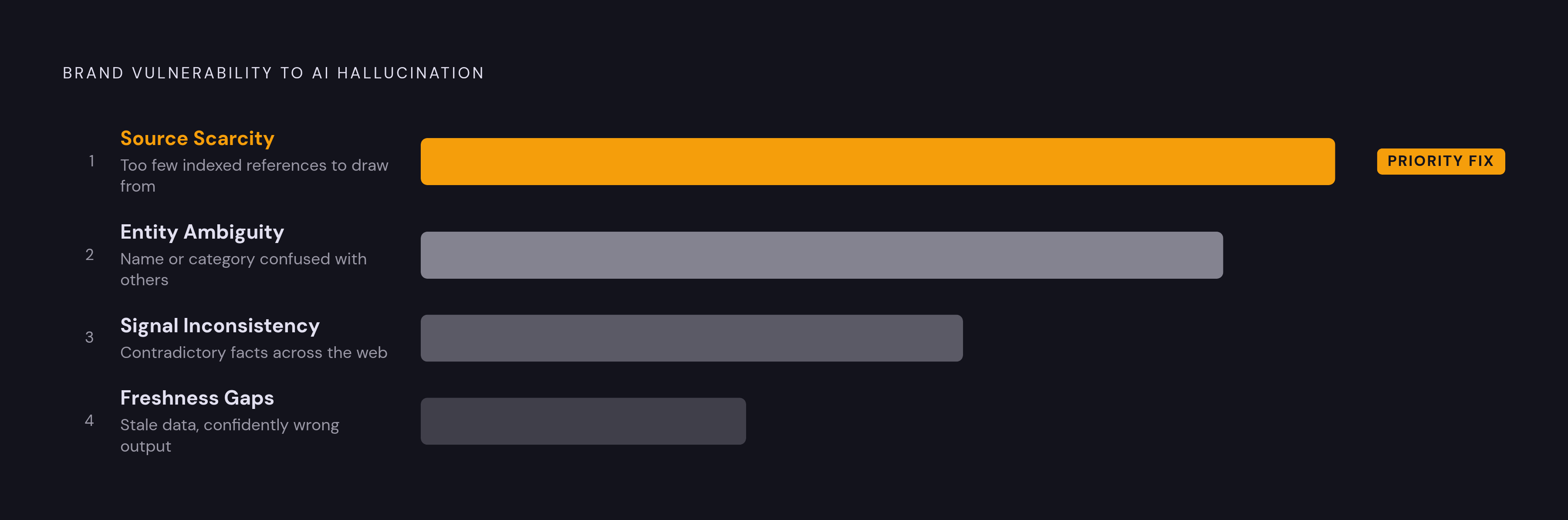
Large language models build brand descriptions by pulling together whatever signals exist about that brand across training data and retrieval sources. When those signals are thin, contradictory, or missing outright, the model doesn't leave a blank. It guesses.
Source scarcity drives most of that risk, more than anything else on this list, and it deserves treatment as the priority fix rather than one item among equals. Brands with little third-party coverage give models almost nothing to work from. Research from Digital Bloom's 2025 study on AI citation behavior found that brands with a presence across four or more third-party platforms saw 2.8 times higher citation likelihood than those without it. The same logic runs in reverse for accuracy: thin coverage doesn't just mean fewer mentions, it means the mentions that do happen rest on less.
Entity ambiguity compounds the problem, but it's a separate failure from source scarcity and needs its own fix. A brand that shares a name with another company, operates across multiple categories, or gets described inconsistently across the web gives the model every reason to confuse it with something else. Entity clarity, meaning a name, category, and set of facts that stay fixed no matter where they show up, is the foundation everything else depends on.
Then there's signal inconsistency: different founding years on different sites, product descriptions that contradict each other, leadership names that don't match. The model has to pick one version or blend them, and neither choice holds up. Content freshness gaps round out the list. A model trained or retrieved on stale data describes a product line the company retired last year, or names an executive who left the role months ago. That's a distinct failure from having no information at all; it reads as confidently wrong rather than confidently absent, which makes it the harder problem to catch, since the output sounds current even when it isn't.
Smaller, newer, and niche brands carry the heaviest version of this risk, and pretending otherwise doesn't help anyone. Less coverage means less corroboration, and less corroboration means a higher chance of getting folded into the identity of a bigger, better-documented competitor. When a model hits genuine uncertainty, it does one of two things: it guesses, often wrongly, or it defaults to whichever nearby brand has cleaner entity data. Both outcomes hurt the brand that got left out.
How to assess your brand's current hallucination exposure
Measurement has to come before any fix. A brand can't correct what it hasn't detected, and detection here means something specific and repeatable, not a one-time glance at a chatbot response.
Start with a prompt audit across the major systems: ChatGPT, Perplexity, Gemini, Claude. Ask the questions a real buyer would ask: what does this company do, who is it for, what are its main products. Write down the exact output every time and date it, because impressions fade while transcripts don't.
Run those same prompts more than once, across separate sessions, because consistency is its own variable worth tracking on its own. Research from AirOps found that only 30% of brands kept consistent visibility from one query run to the next, and just 20% held presence across five consecutive runs. There's no reason to think factual accuracy behaves any differently. If presence swings that much, the content of what gets said probably swings too.
From there, score entity clarity directly. Does the AI output correctly name the brand and its category? Does it get the core product right, the founding context, the actual differentiators? Flag any place where the model blurs the brand into a competitor, and check whether schema markup and structured data exist, and are correct, on the properties the brand controls.
Next comes a source consistency audit: pull together what review platforms, trade press, directories, and knowledge bases say about the company, and look for contradictions. Those contradictions are the raw material hallucinations get built from. Wikipedia entries, Google Knowledge Panels, and Wikidata records deserve particular attention, since models lean on them heavily as high-authority corroboration.
Finally, benchmark Share of Model, or SoM: the percentage of AI responses across a defined set of queries that mention the brand at all. Tracked over time, SoM reveals both a visibility trend and, paired with accuracy checks, a description-quality trend. A brand with low SoM in its own core category should treat that as a warning, not just a gap. A model that won't mention a brand in the queries where it belongs may still be mentioning, and misrepresenting, it somewhere adjacent. Platforms built for this kind of multi-model tracking, such as Evident, score brands across hundreds of signals at once and catch hallucination-relevant gaps that manual prompt checking tends to miss once the query set gets large.
The content and entity signals that reduce hallucination risk
This work comes down to giving the model better raw material, consistent, accurate, and backed by real sources, so there's less room for guessing to fill the gaps. Structured data matters more than any single piece of content a brand publishes, and that ordering is worth stating plainly: a company can write a hundred blog posts and still lose to a competitor with clean Schema.org markup and a corrected Wikidata entry.
Closing entity gaps starts with structured data: Schema.org markup for Organization, Product, Person, and LocalBusiness types, applied across every owned property. That markup turns brand facts into something a machine can read without guessing. Claiming and correcting Knowledge Panel entries and Wikidata records matters just as much, since models weight those sources heavily as anchors. The brand name, category description, and core facts need to match, word for word where possible, across every surface the company controls.
Corroboration has to come from outside, too, and this is the part brands underinvest in most. A consistent presence across several third-party platforms, directories, review sites, trade publications, with the same facts repeated rather than contradicted, gives models something solid to triangulate from. Earning genuine mentions in expert roundups and trade coverage helps further; showing up alongside established players in the same category builds a kind of borrowed credibility that AI systems pick up on. Original research carries particular weight here. Content built around original data and statistics saw 30 to 40% higher visibility in LLM responses, which suggests original data works as a trust signal for models, not just a traffic driver for humans.
Freshness needs active management, not passive hope. A product pivot, a leadership change, a rebrand: each of these counts as an entity update event, and each deserves a structured, clearly dated announcement built to be indexed and retrieved. Old press releases and stale directory listings sit in the training and retrieval pipeline as active inputs, still feeding models information that used to be true, rather than fading quietly into irrelevance. They need correction, not just newer content published alongside them.
One point worth stating plainly, since it cuts against the obvious instinct: AI-generated content published on a brand's own site tends to earn lower trust scores from other models, because it lacks the verifiable, expert authorship that builds credibility. Fixing an AI hallucination problem with more AI-written content widens the gap rather than closing it. Verifiable human expertise and real sourcing do the actual work, and no amount of volume substitutes for that.
Why ongoing monitoring is structurally necessary, not optional
Models update. Retrieval sources shift, and the same prompt run in March and again in September can pull different material and produce a different answer. A clean, accurate AI description today says nothing about what that same query returns next quarter. Treating a single audit as a fix rather than a snapshot is the single most common mistake brands make here.
Gartner's 2025 forecast puts a number on where this is headed: by 2026, roughly 30% of brand perception will be shaped by generative AI content rather than traditional media. That's an expanding trend, and it means the exposure window keeps widening rather than closing.
The volatility AirOps documented, that only 20% of brands held consistent AI presence across five consecutive query runs, implies something further: if presence swings that much run to run, factual accuracy almost certainly swings with it too. A single audit, run once and filed away, tells a brand what was true on the day it ran. It says nothing about the day after.
The platform landscape itself keeps growing. Meltwater's GenAI Lens tracks brand mentions across multiple AI platforms, a longer list of systems than most brand teams were watching even a year earlier. Every new platform is another surface where a hallucination can start and spread before anyone notices.
A workable monitoring setup looks less like a project and more like a habit. Prompt audits belong on a fixed cadence, monthly at the least, across the AI systems buyers actually use, paired with automated flags for new third-party mentions that introduce facts inconsistent with what's already documented. Share of Model and description accuracy need tracking together, since SoM alone says nothing about whether the mentions it counts are even correct. Dedicated monitoring tools that score continuously across many signals give that tracking a real baseline, so a shift in accuracy reads as a signal instead of a guess, which is what Scale Labs was built to provide as a platform that scores how algorithms, AI systems, and humans evaluate a business across 400+ signals.
The underlying math is simple enough to state directly: hallucination risk is the gap between what AI systems know about a brand and what's actually true about it. That gap moves, and closing it once doesn't keep it closed. Only continuous measurement does.