Temperature and Sampling Settings Impact on AI Brand Outputs
Adjusting how AI samples text reveals why your brand describes differently across platforms.

A brand's AI-generated description can change depending on a setting most marketing teams have never heard of: temperature. This is the parameter that governs how a language model samples from its own probability distribution when generating text, and it decides whether a brand gets described consistently and accurately or characterized by some stray, low-probability association pulled from somewhere deep in the training data. Temperature applies at inference time, not during training, so it runs every single time a user submits a prompt, invisibly, on every platform. Most brands optimizing for AI visibility are optimizing for the wrong layer entirely: they're writing more content when the real problem sits in how that content gets sampled, not whether it exists.
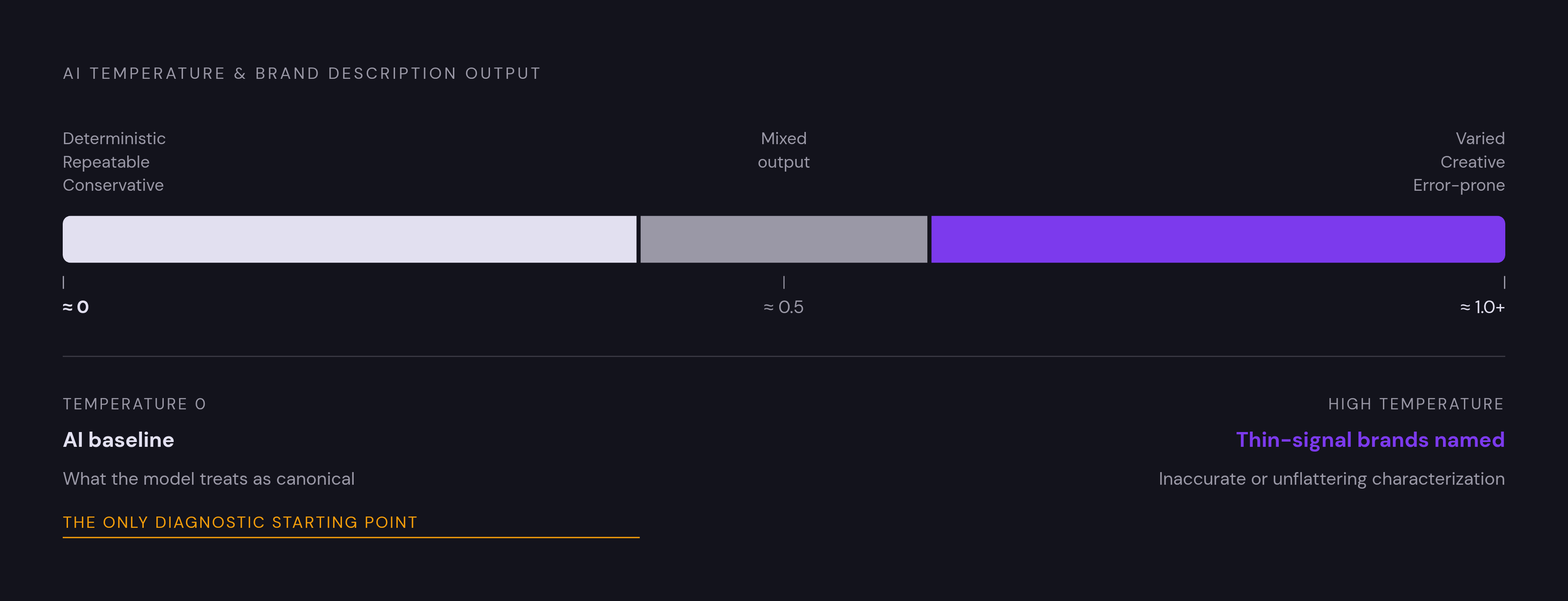
Here is the mechanism. When a model generates a response, it isn't retrieving a stored answer; it's predicting the next word, one token at a time, based on a probability distribution over everything that could plausibly come next. Temperature controls how strictly the model sticks to the highest-probability tokens in that distribution. At low temperature, close to zero, the model almost always picks the most likely next token, producing focused, repeatable, conservative output. At high temperature, approaching or exceeding 1.0, the model samples further down the curve, producing output that's more varied, occasionally more creative, and considerably more prone to error or outright fabrication.
Understanding temperature 0 matters most, because it strips out randomness entirely. At temperature 0, the model becomes a pure probability maximizer: given the same prompt, it returns the same output every time. That determinism is what makes temperature 0 useful as a diagnostic tool, a point this piece returns to shortly.
A companion setting, top-p (also called nucleus sampling), works alongside temperature. Top-p limits the pool of tokens the model can sample from at all. When the model is confident and the distribution is sharp, the pool of eligible tokens is small, and coherence holds. When the model is uncertain and the distribution is flat, the pool expands, and diversity increases along with the risk of noise. Lowering top-p helps when output feels incoherent; keeping it at 1.0 makes sense when temperature is already low, since the distribution is already sharp; dropping it too far tends to cause repetition and a collapse in diversity.
Commercial platforms don't disclose their default temperature or top-p settings, those defaults differ from one product to another, and they can change without notice. None of this is visible to the person typing a question into a chatbot. A brand has no way of knowing which configuration produced the answer a customer just read about it.
Why the same brand question produces different answers depending on where and how it is asked
Ask "Who makes the best project management software?" in ChatGPT, then ask Claude, then ask Perplexity. On the surface, that's the same question submitted three times. Underneath, it's three different sampling processes, each running on undisclosed and possibly quite different temperature configurations, each capable of producing a materially different answer.
The consequence is concrete: a brand can be named category leader on one platform, left out entirely on the second, and described in subtly unflattering terms on the third, all from an identical prompt. Higher-temperature configurations raise the odds that a model reaches past the most probable, best-reinforced facts about a brand and surfaces something further down the distribution instead: an outdated narrative, a reputational incident that's otherwise faded from relevance, or a framing lifted straight from a competitor's marketing copy.
This isn't simply a matter of missing content or a gap in what a brand has published online, and treating it that way is the mistake most companies make first. Sampling is the problem sitting on top of whatever training data already exists, and no amount of additional blog posts fixes a sampling problem by itself. The opacity around default settings compounds the risk, because a brand can't diagnose what it can't see. Brands have spent decades building playbooks for controlling their narrative in press coverage, in search rankings, on social media; there's no equivalent discipline yet for the inference layer, the place where the actual sentence describing a brand gets assembled token by token.
Using temperature 0 as a diagnostic: what your brand's AI baseline reveals
Since temperature 0 removes randomness and forces the model to pick its single most probable output at every step, it reveals what the model treats as the canonical version of any entity, brand included. That makes it a useful diagnostic, not just a technical curiosity.
Call it the Default Test. Submit "Tell me about [Brand]" at temperature 0 across ChatGPT, Claude, and Perplexity. Whatever comes back is the brand's AI baseline: the description most likely to surface under everyday, low-creativity conditions, which is to say most of the time a real user asks a real question.
That baseline rewards close reading, because it exposes several things at once. It shows which attributes the model has locked onto as most strongly tied to the brand, whether that's founding history, product category, tone, or competitive position. Gaps show up too, the attributes that are simply absent no matter how much search engine optimization work has gone into the brand's own site. It reveals whether the brand is described in its own language or borrowed from a competitor's framing. And it surfaces factual errors: wrong founding year, mangled product names, differentiators that don't match reality.
Running this same test across multiple platforms and comparing results does something else useful, too. Divergence between platforms isn't evidence that one model got it wrong; it's evidence that the brand's signal footprint across the web is thin or inconsistent, which is a fixable problem rather than a mysterious one. Temperature 0 outputs also stay comparatively stable over time, which makes them suitable for a recurring benchmark: when the baseline shifts months later, that shift reflects an actual change in training data or a model update, not noise. This kind of test doesn't require API access, either. Many consumer-facing tools now expose something close to it through "precise" or "factual" response modes, which approximate the deterministic behavior of temperature 0 closely enough to be useful.
Structured, repeatable measurement of exactly this baseline, across platforms and over time, is the foundation Evident's scoring approach is built on: not a single spot-check, but a running record of how a business is actually perceived by the systems increasingly standing in for search.
How temperature interacts with the signals that determine whether a brand gets cited at all
Temperature shapes how a model expresses what it already knows about a brand. It doesn't create that knowledge. Whether a brand gets mentioned in a response at all depends on something upstream of sampling: whether the model holds enough high-confidence signal about that brand to treat it as a legitimate answer in the first place.
At low temperature, models behave conservatively, and here's the part most brands get backwards: they assume better content wins that conservatism. It doesn't. Only brands with strong, consistent, high-probability associations survive; a brand with thin or contradictory signal simply doesn't make the cut, and no clever prompt phrasing changes that. At high temperature, a brand with thin signal might get named anyway, but the characterization riding along with it draws from weaker, lower-probability associations, which raises the odds of inaccurate or unflattering framing showing up in the same breath.
The scale of the visibility problem isn't theoretical. A 2026 analysis by Fuel Online examined 1,000 enterprise brands and found that 62% were invisible to generative AI models, despite 94% of those same companies having invested heavily in traditional search engine optimization. Optimization built for ranked search results doesn't automatically transfer to a system deciding, probabilistically, whether to mention a brand's name at all.
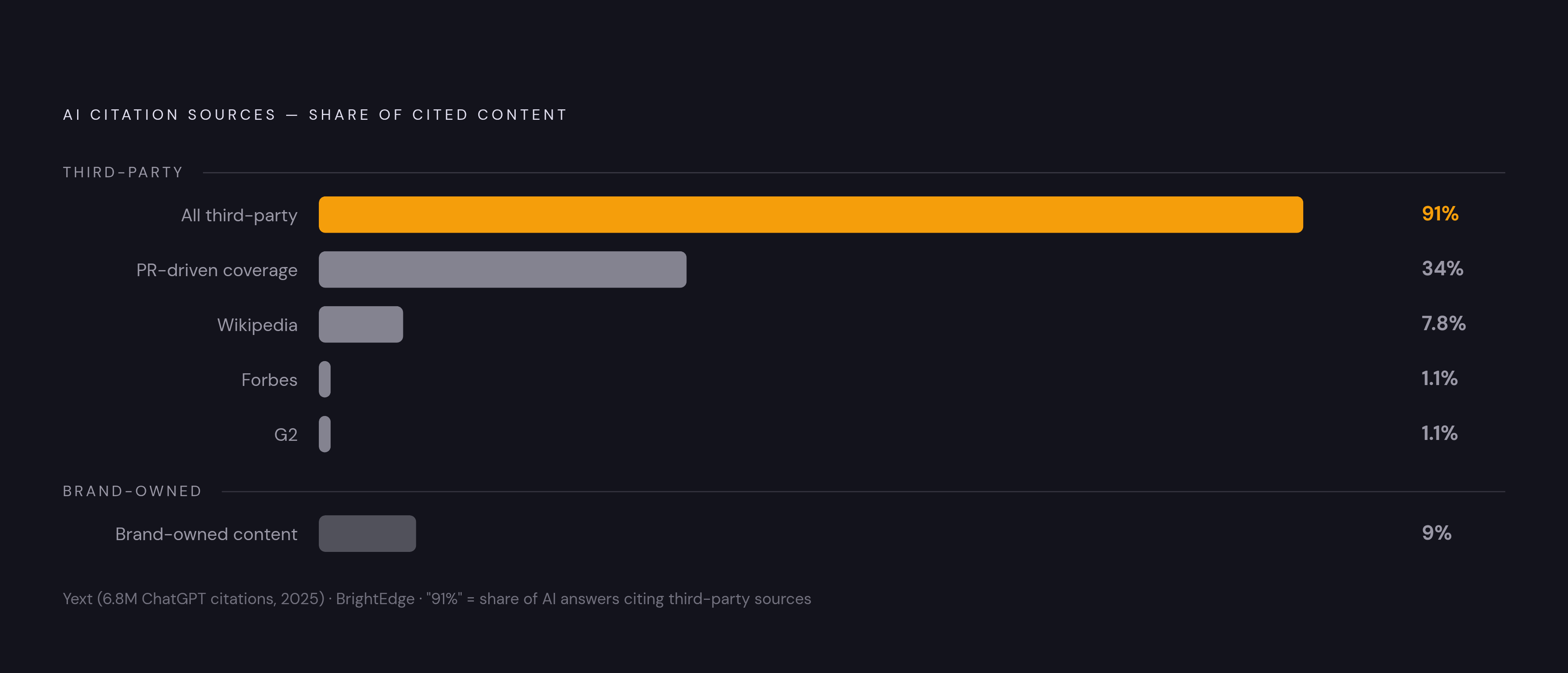
What builds the high-confidence associations that survive low-temperature sampling? A handful of concrete signals, and they aren't the ones most SEO teams are used to chasing. Entity consistency matters enormously: a brand described in the same terms, with the same facts, across many independent sources gives the model a stable target to converge on. Third-party validation matters even more than brands tend to assume; research found third-party content cited roughly three times as often as brand-owned content, with 91% of AI-generated answers pointing to third-party sources rather than the brand's own site. Structured data and schema markup help models parse what category a brand belongs to without ambiguity. And evidence-backed expertise, the kind of signal captured under the label E-E-A-T, trains the model to treat a brand as an authority worth citing in its domain.
Put together, optimizing how AI systems represent a brand is not a content strategy alone. It's a signal-density problem, and temperature dynamics decide how forgiving or unforgiving a given platform will be toward brands whose signal runs thin.
The shift from being found to being trusted — why AI operates more like an advisor than a search engine
Traditional search puts a brand into competition for position on a ranked list. A user sees ten blue links, weighs them, and makes an independent judgment. Generative AI does something structurally different: it endorses. The model names one option, or a small handful, and presents them as the answer, which means the user's own evaluation has mostly already happened somewhere upstream, inside the model.
This shift is not small. AI search traffic grew 527% year-over-year moving through 2025 into 2026, and Google's AI Overviews now appear on roughly 13.14% of searches as of March 2025, according to Semrush data. A growing share of how people discover brands now happens inside a generated summary, where only the entities the model already trusts get surfaced at all.
Because a model effectively stakes its own credibility on what it recommends, it behaves conservatively in exactly the contexts where being wrong carries real cost. Low-temperature configurations show up more often in high-stakes recommendation categories, finance, healthcare, and travel among them, precisely to hold hallucination risk down; that same conservatism raises the bar a brand has to clear just to get mentioned.
This produces a compounding effect worth sitting with. A brand that gets cited gets written about by the users who found it that way, and that new writing becomes third-party content that reinforces the brand's presence the next time a model gets trained or updated, making future citation more likely still. A brand that starts out absent stays absent, and the gap between the cited and the uncited widens rather than closes on its own.
Travel shows how fast this has already moved. Roughly 40% of U.S. travelers used generative AI tools to plan a trip in 2025, an eleven-point jump year-over-year, while conventional search engines have seen a measurable decline as a starting point for travel research. For categories where that shift has already happened, invisibility inside AI outputs isn't a branding inconvenience. It's a direct hit to revenue.
What businesses can realistically do about temperature-driven brand variance
A business can't dial in the temperature setting a platform runs; that knob belongs to OpenAI, Anthropic, Perplexity, and whoever builds the next model, not to the brand being described. What a business can do is build the kind of signal density that holds up no matter where on the temperature spectrum a given platform happens to be sitting that day.
Start with the low-temperature test, because it's the hardest bar to clear. A brand that comes back accurate and favorable at temperature 0 already has the high-confidence signal foundation that survives conservative sampling; everything built after that point is incremental improvement, not foundational repair. Chasing high-temperature edge cases before fixing the temperature 0 baseline is backwards, and it's the most common mistake in this space.
A few actions carry most of the weight. Run an entity consistency audit, checking that the brand gets described in identical terms, same name, same category, same core facts, across owned properties, third-party directories, Wikipedia, and press coverage; inconsistency here is one of the more common and more fixable causes of a thin AI baseline. Build the third-party footprint on purpose, since that's where models draw most of their citations from; a 2025 study by Yext examining 6.8 million citations found Wikipedia the single most cited source in ChatGPT at 7.8%, with outlets like Forbes and G2 following at around 1.1% each, and separate data from BrightEdge found that 34% of AI citations trace back to PR-driven coverage rather than owned content. Get structured data and schema markup in order, so a model has an unambiguous read on what category a brand belongs to and what it actually offers. And keep review and rating health current: volume, recency, and how a business responds to reviews are reputation signals that recommendation studies in high-stakes categories link causally to whether a brand gets included at all.
None of this works as a one-time project. Running the temperature 0 baseline test on a regular schedule, tracking which platforms cite a brand and in what terms, and watching third-party source coverage over time are the minimum instruments a business needs to know whether its signal is strengthening or eroding. Evident's approach scores across exactly these dimensions, AI perception, algorithmic credibility, and human trust, together, so a brand can see where it actually stands and know which of the three needs attention first.
The underlying principle holds no matter which platform or setting is in play. Temperature variance is a lens, not a cause; it reveals how strong or thin a brand's signal really is. A brand with consistent, well-sourced, multi-platform signal reads well at any temperature setting. Thin signal leaves a brand at the mercy of wherever the inference configuration happens to land on a given day, on a given platform, for a given user, and that's not a position any brand should be content to sit in.