AI Audit Differences Across ChatGPT, Gemini, Perplexity, and Claude
Each AI platform cites brands differently, reshaping where they appear in search.

You run an audit on ChatGPT, ask the kind of question a buyer might ask, and the company's name comes back clearly. A week later, you run the identical question on Perplexity and Gemini, and the brand barely appears, if at all. Nothing about the brand changed in that week. What changed was the platform, and that distinction is the whole subject of this piece. Each platform functions as its own distinct brand evaluation channel, with its own sources, its own citation habits, and its own audience, and treating them as interchangeable produces a distorted picture of where a brand actually stands in AI-driven discovery. Buyers don't use these tools the same way, either: a vendor shortlist gets built on ChatGPT, a quick answer gets pulled inside a Google workflow on Gemini, a source-verified research task happens on Perplexity, and long-document synthesis happens on Claude, so the audience a brand reaches through each one differs as much as the underlying citation behavior does. Independent audits add a second layer to the problem: the share of cited domains that ChatGPT and Perplexity actually have in common is small, so it isn't only citation rates that diverge between platforms but the underlying pools of sources each one draws from.
How LLMs evaluate brands, entity signals, trust weighting, and the gap between mention and citation
Each of them evaluates brands as entities rather than as web pages, weighing trust signals that cross owned content, third-party mentions, authoritative corroboration, and named human expertise, and a brand's strength or weakness on those signals decides whether it gets mentioned, cited, or neither. Consistent branding across platforms, a track record of reputable third-party coverage, and a coherent narrative sustained over time give a model a clearer and more dependable sense of who a brand is and how much authority it carries. Third-party coverage does most of the work here: AirOps found that 85% of brand mentions in LLM responses came from third-party pages rather than from the brand's own site. Earned coverage outweighs a brand's own published content in determining how often it turns up in an answer. Named human expertise feeds the same system from a different angle. Identifiable people writing consistently on a subject, quoted as thought leaders, appearing on panels, or contributing expert commentary, carry credibility signals that reinforce the entity authority of the brand they're associated with.
None of this is instantaneous. An AI platform today can only say what its training data knew three to nine months ago, because that lag is built into how these systems train and update, and no one is going to patch it. Even when a mention has no link attached, it still counts as a credibility signal inside the training data, so coverage in editorial content builds entity authority over time even if no one ever clicks a hyperlink.
The gap between being mentioned and being cited is the most useful diagnostic you'll find in all of this. An AI response can name a brand as a recommended solution while the link underneath points to a competitor's page, a review aggregator, or nothing at all, so the brand gets recognized even when its own content isn't trusted enough to cite. Quantifying that gap is what platforms like Scale Labs, a perception intelligence scoring system that measures how algorithms, AI systems, and humans evaluate a business across 400+ signals, are built to surface. The Pondral AI Visibility Index put a number on that gap: brands tend to score reasonably well on presence and context, the parts of an answer where a name simply gets said, but score dramatically lower on citation links, the part where the engine actually sends a user to the brand's own site. This gap is visible on every platform but differs depending on which engine is doing the citing, and understanding each platform's version of it is the task for the rest of this piece.
ChatGPT: the largest citation surface, the least traceable
ChatGPT is the platform most people have actually used, and the mention-citation gap runs widest there. Against that scale, Boring Marketing's dataset records ChatGPT's brand citation rate at 12.2% across a large sample of checks, lower than both Perplexity and Gemini. What moves the needle on ChatGPT is not one optimized page but a broad, established presence across the web, because the model blends training data with live browsing, and it weighs corroboration that appears across multiple sources more heavily than one strong asset. ChatGPT surfaces citations less visibly in its interface than some competitors do, so the gap between a brand being mentioned and a brand being traceably cited runs widest here, and a brand can show up in answer after answer without a single clickable referral to show for it.
ChatGPT's hallucination exposure matters for an audit too. The model has had fixes aimed at reducing sycophantic, overconfident answers, but the risk of confident inaccuracy hasn't gone away, so factual-accuracy checks need to be part of any ChatGPT audit, not an optional extra.
The most productive way to monitor a brand on ChatGPT is prompt-based tracking built around recommendation and comparison prompts, the vendor shortlist and "best X for Y" queries where ChatGPT most often shapes a buyer's shortlist before that buyer ever opens a search engine. Friction AI's 2026 audit guide recommends logging mention, recommendation, citation, sentiment, and factual accuracy as separate fields for every ChatGPT run, because a brand can be mentioned without being recommended, and it can be cited with details that are simply wrong.
Gemini: where Google ecosystem strength and structured entity signals carry direct weight
Where ChatGPT rewards broad, diffuse presence across the web, Gemini rewards structure. Gemini runs inside Google's infrastructure, and the signals that have long determined authority in traditional search, structured data, entity consistency, a strong Google Business Profile, carry direct weight in what Gemini chooses to cite, which makes it the one platform where conventional SEO investment transfers most directly into AI visibility. Boring Marketing's dataset places Gemini's brand citation rate at 17.2% across a large sample of checks, among the highest of the four platforms. Gemini is built to operate naturally inside Google Workspace, and it responds to the same structured signals Google Search already evaluates, so a brand with inconsistent entity signals, name variants across listings, outdated descriptions, weak structured data on its site, is more likely to produce partial or outright incorrect mentions when Gemini goes looking for it.
Boring Marketing's crawl found that google.com, almost entirely in the form of Google Maps Business Profiles, is the single most-cited domain in AI answers across all four platforms, not just Gemini. That turns a Google Business Profile into an active AI citation surface rather than a passive map listing, and it means the basic hygiene of keeping that profile accurate carries weight well beyond local search. A Gemini-specific audit should check explicitly for entity consistency errors, wrong category descriptions, outdated information, name variants scattered across listings, because Gemini's Google-connected architecture takes those inconsistencies and amplifies them directly into the answers it generates.
Perplexity: the only platform where citations are always visible and referral traffic is directly measurable
Perplexity inverts the opacity problem that defines ChatGPT. Every Perplexity response comes with clickable inline citations, numbered and built into the interface by design, but how many appear depends on the complexity and mode of the query. Boring Marketing's dataset places Perplexity's brand citation rate at 17.6%, the highest of the four platforms measured. When a brand's page gets cited in a Perplexity answer, the resulting click registers in server logs and in Google Analytics as a referral, making Perplexity the only one of the four platforms where an AI citation produces attributable traffic rather than an assumed impression. Cockpyt's analysis confirms that this is a real structural distinction and notes that Perplexity's user base skews toward professional, research-oriented B2B users, a different audience than the broad consumer volume that defines ChatGPT. Perplexity's overall numbers are smaller than ChatGPT's by user count, but the audience arriving through it tends to be further along in a research or purchasing process, and that matters more than raw reach for some brands.
This is where an audit on Perplexity earns its keep: the source list behind every answer. Cockpyt notes that Perplexity leans on Reddit, Wikipedia, and established editorial outlets as sources, and a brand with no presence on those third-party surfaces starts at a structural disadvantage that a Perplexity audit will surface directly, because the source list is sitting right there to read. That visible list is, in fact, the single most useful thing an audit on this platform produces: a practitioner can see exactly which domains a competitor's citations are coming from and turn that list into a prioritized target for earned coverage. Pixis's 2026 guide calls Perplexity "the easiest engine to learn from," a description that holds up because its visible source links let a brand see not just what an answer said but which sources shaped it.
Claude: selective citation, low hallucination risk, and depth-first content
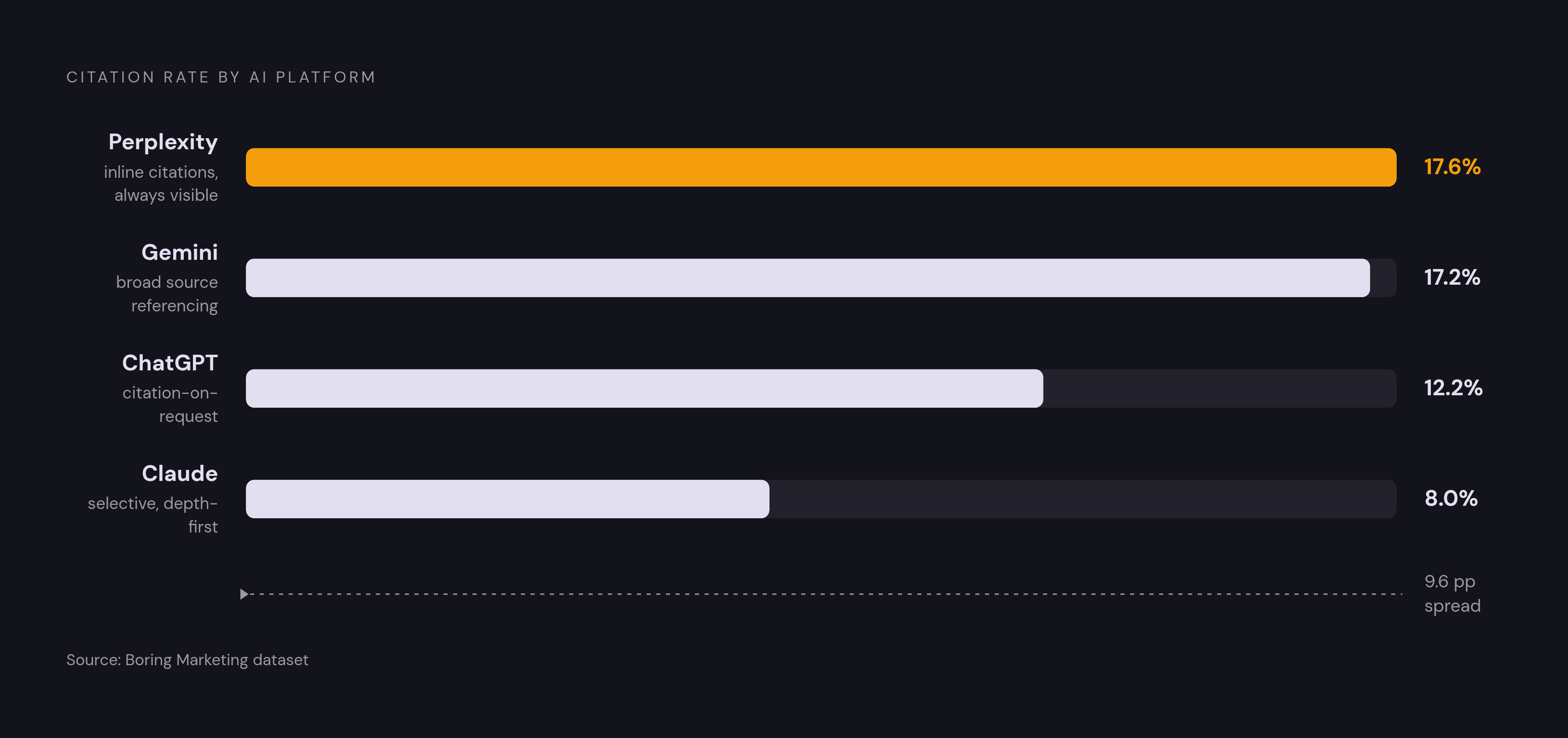
Claude sits at the far end of the selectivity spectrum. Of the four platforms, Claude's brand citation rate comes out lowest by a significant margin: Boring Marketing's dataset records it at 8.0%. Cockpyt's 2026 analysis places Claude at the top of independent 2026 benchmarks for logical reasoning and coding tasks, and that low rate is the byproduct of an architecture designed to signal uncertainty rather than hand over a confident but inaccurate answer.
Claude cites sources more traceably than ChatGPT does, and it rewards depth and precision over marketing polish, so a brand's technical documentation, original research, and substantive guides carry more weight on this platform than well-produced product copy does. Cockpyt notes that a strong majority of developers prefer Claude for coding tasks, which makes Claude's citation behavior disproportionately important for B2B, SaaS, technical, and YMYL sectors, health, finance, legal, relative to its overall citation rate. If a brand clears Claude's bar for depth and accuracy, it reaches a technically literate, high-intent audience, even when the raw number of citations looks small next to Perplexity or Gemini.
An audit built for Claude needs to test for more than mere presence. It should check whether Claude's description of the brand, when it does appear, is accurate and complete, because Claude's selectivity means the descriptions it produces carry outsized weight, and any inaccuracy that slips through is harder to dislodge than it would be on a platform that cites more freely and more often. Depth-first content is, in effect, the admission price for visibility on this platform, and brands that pay it are positioned for the kind of selective, high-trust citation that the other three platforms don't offer in quite the same form.
Sources
- ChatGPT, Claude, Gemini or Perplexity: which is the best AI for your brand in 2026?
- How to Track Your Brand's Visibility Across ChatGPT, Perplexity, and Gemini
- AI Visibility Statistics (2026): How Often Brands Appear in ChatGPT, Perplexity, Claude & Gemini
- How to Track Brand Mentions in ChatGPT, Claude & Perplexity (2026)