Scoring Frameworks for Quantifying AI Brand Representation Quality
Brands now need multi-dimensional AI scoring frameworks beyond simple mention counts.

A brand's position in ChatGPT, Claude, Gemini, or Perplexity is no longer a matter of visibility alone. It is a matter of judgment, since these systems now evaluate brands rather than simply retrieve information about them. Brands need a new kind of measurement built on a structured, multi-dimensional scoring framework.
AI Systems as Brand Evaluators
A search engine sends someone to a page and lets them decide what to believe. An answer engine decides for them, and it hands over a finished conclusion instead of a list of links to sort through. A brand either appears inside that conclusion or, for all practical purposes, it does not exist for the person asking. That is a different game than ranking for a keyword, because there is no second page of results for a user to scroll through in search of an alternative.
As large language models train, they learn which words tend to surround a given brand name across the text they see. A brand that appears near words like "reliable" or "innovative" in sources the model treats as authoritative carries that association into its outputs, shaping which brands the model recommends later. This is pattern learning, not opinion in any human sense, but it behaves like opinion once the model starts talking.
That behavior creates an asymmetry in how people treat criticism depending on where it comes from. A critical post on social media gets filtered through the reader's sense of the poster's bias or agenda. A sentence from ChatGPT or Claude expressing doubt about a brand tends to get accepted at face value, as if it were synthesized, neutral fact rather than one more opinion among many. So sentence for sentence, negative sentiment from an AI system does more damage than the same sentiment posted by a stranger online.
The practical consequence is that LLMs now sit between a consumer's need and the brands that could meet it, deciding which brands even enter the running and in what order they get mentioned. A brand that fits a customer's need exactly but gets left out of the model's answer may never reach that customer. Anyone tempted to dismiss this as a marginal channel should look at the trend line: Backlinko reports LLM-driven traffic up 800% year-over-year, and the share of product research that now starts inside a language model instead of a search bar has grown substantially. The channel is not small, and it is not slowing down.
Why simple mention-tracking fails as a measurement approach
Many brand teams already track mentions across the web, and they think that habit covers AI exposure too. It does not, because a mention count cannot capture how variable, probabilistic, and qualitative LLM output actually is. Counting how often a name comes up tells a team almost nothing about how that name is being framed, how consistently it shows up, or how long that framing holds.
Start with stability. Yotpo has found that large portions of AI Overview rankings shift within an eight-week window, so a single snapshot of brand mentions says more about the day it was taken than about the brand's actual standing. A score built from one pull of data is already stale by the time someone reads it.
Consistency across platforms is worse. SparkToro research, cited by Backlinko, ran identical prompts across multiple AI platforms, and the platforms gave back the same set of brand recommendations in fewer than one case in a hundred, and the same ordering in fewer than one case in a thousand. An "AI ranking," treated as a single fixed number, does not describe anything real. Faruk Tugtekin's AI Perception Index backs this up with harder numbers: the same brand, measured across different AI systems, showed perception drift reaching 21.86 points, so a brand that reads well on ChatGPT can read poorly on Claude.
Even within a single response, context changes everything. A brand mentioned in hedged language, something like "X might be suitable for some use cases," produces a completely different commercial outcome than the same brand named in a confident endorsement like "X is excellent for". A mention counter treats these two sentences as identical data points. They are not, because the model's confidence in a recommendation shapes how strongly a user acts on it, and that confidence signal is invisible to anything that only counts names.
Coverage compounds the problem. Backlinko looked at millions of AI citations and found that 91% of cited URLs show up in just one LLM, so you can't tell how a brand fares elsewhere from how it fares on a single platform. Any brand monitoring process built around a single tool, a single platform, or a single pull of mention data is measuring a sliver of a much larger, constantly shifting picture, which is the gap that Scale Labs, a perception intelligence platform that scores how algorithms, AI systems, and humans evaluate a business across 400+ signals and tells companies what to fix first, was built to address, and it is time to build something that actually accounts for the size of that picture.
The five dimensions a complete scoring framework must measure
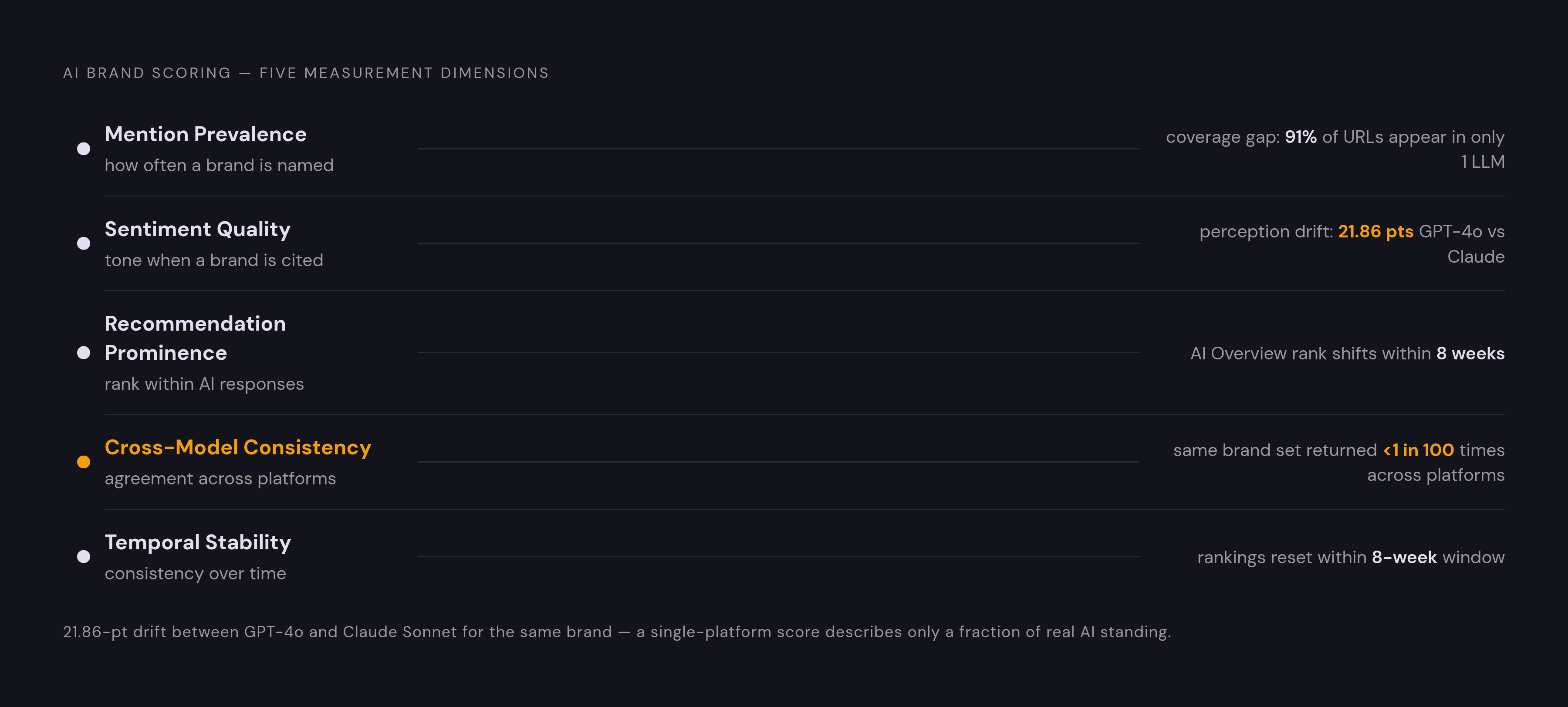
A score that actually reflects how AI systems represent a brand needs five separate measurement dimensions: mention prevalence, sentiment quality, recommendation prominence, cross-model consistency, and temporal stability. Each one captures a distinct way a brand can succeed or fail inside an AI-generated answer, and collapsing any two of them into one number throws away information a brand team needs.
How often does a brand show up across a statistically meaningful sample of prompts relevant to its category, not just a single test query? Listen Labs calls this Brand Mention Rate, the share of relevant prompts in which the brand appears at all. The useful reframe here moves away from the old Share of Voice concept toward Share of Model, which treats presence as probabilistic rather than fixed: a brand might appear in most responses to one query and in almost none to a closely related one. Yotpo describes the resulting metric, "Answer Inclusion," as the new KPI that replaces click-through rate in a world where there is no link to click.
Sentiment quality goes past a simple positive, neutral, or negative tally and looks at how strong and specific the sentiment actually is, since a vague positive mention carries much less commercial weight than a confident, specific endorsement. Listen Labs defines Sentiment Score as the balance among positive, neutral, and negative tone, and it pairs that with a Trust Score that combines citation frequency with emotional valence. The AI Visibility Score framework offers a simpler starting point here: it assigns weighted points where positive mentions score higher than neutral ones and negative mentions subtract from the total, a structure plain enough to build on before you add more nuance.
Recommendation prominence measures where a brand lands, not just whether it appears, because a brand buried in a hedged footnote carries a different commercial weight than one named as the primary answer. Academic researchers have formalized Mean Reciprocal Rank, adapted from search ranking into LLM contexts, to capture how prominently a brand is recommended rather than just whether it's recommended at all, pairing it with Brand Recommendation Probability as a companion metric. Listen Labs tracks a related but separate signal, Recommendation Rate, and it counts explicit AI endorsements, because these signal purchase intent more directly than a brand that just gets named in passing.
Cross-model consistency checks whether a brand's story holds up across ChatGPT, Claude, Gemini, Perplexity, and Google AI Overviews, since a score drawn from one platform describes only part of the landscape. The AI Perception Index backs this concern with data: the same brand, run through GPT-4o and Claude Sonnet, showed a real, substantial gap in how each model perceived it. The ChoiceEval framework adds a further wrinkle, finding that major LLMs carry stable, US-centric preferences baked in, so a brand can score well in one market context and poorly in another purely because of bias built into the model itself, not because of anything the brand did. Because the overwhelming majority of cited URLs show up in only one LLM, Backlinko's analysis found, covering multiple engines is a basic requirement for the measurement to mean anything.
Temporal stability tracks how a brand's AI representation moves over time, since representation can shift up or down between model updates with no change at all in the brand's real-world standing, and that movement stays invisible without tracking that spans multiple points in time.
The frameworks already built by practitioners and researchers each try to operationalize some or all of this surface, and the next section works through what each one actually measures.
How existing scoring frameworks operationalize these dimensions
A handful of named frameworks have emerged, and they range from simple point systems to peer-reviewed academic models. None of them covers every dimension perfectly, and that's fine. You can use them as complementary layers suited to different stages of a brand's measurement maturity.
The AI Visibility Score is the entry-level framework. It assigns weighted points per mention, so positive mentions score higher than neutral ones, negative mentions subtract from the total, and then it divides by the total number of prompts tested. It captures prevalence and a rough read on sentiment, but it has nothing to say about prominence, cross-model variation, or drift over time. For a team with limited tooling and no prior AI measurement in place, it works as a starting diagnostic. It is too blunt an instrument to drive real optimization decisions on its own.
The Listen Labs scorecard works more like a practitioner standard. It tracks Brand Mention Rate, Sentiment Score, Share of Voice measured against rivals in the same AI responses, Recommendation Rate for explicit endorsements, and Trust Score combining citation frequency with emotional valence. Running prevalence, sentiment, and competitive positioning together in one scorecard, it also separates Recommendation Rate out as its own purchase-intent signal rather than folding it into sentiment. The competitive angle matters here: Share of Voice shows not just how often a brand turns up but how it stacks up against named rivals inside the same response.
Share of Model measures brands by probability rather than fixed rank. It measures how often and how favorably a generative AI system mentions a brand across relevant category prompts, and it expresses that measurement as a probability rather than a fixed rank. That's a meaningful departure from a static keyword ranking: a probabilistic range is honest about the kind of variability built into LLM outputs in a way a single number never could be. You can use it as a top-line competitive metric when you compare a brand's representation against a defined set of peers.
The BRP and MRR academic framework offers the most reproducible model currently published. Brand Recommendation Probability measures how often a brand gets recommended at all, and Mean Reciprocal Rank, adapted for LLM contexts, measures how prominently it gets recommended when it does. Its real methodological contribution is in how the competitive set gets defined, independently of the LLM itself, which makes it possible to spot not just which brands get recommended but which ones should be and aren't. An omission becomes a measurable gap instead of a silence nobody notices. For teams that need measurement standing up to peer review, this is the most rigorous option on the table.
The GEO Scorecard takes a platform-by-platform approach to visibility. It evaluates how often and how prominently a brand turns up in AI-generated search results across ChatGPT, Gemini, Claude, Perplexity, and Google AI Overviews. Because it breaks results down by platform, a brand team can see cross-model consistency directly, rather than inferring it from a single blended score.
The AI Perception Index, built on Faruk Tugtekin's Perception Control Framework v2, measures how brand perception differs across models in the deepest empirical treatment of that gap. It runs standardized prompts across multiple LLMs, and it produces a Model Perception Index score for each brand. Funding size did not predict a brand's AI perception score, and brands with substantial funding behind them scored nearly identically to bootstrapped competitors, which suggests that earned signals, meaning content, citations, and third-party coverage, carry more weight with these models than marketing spend ever will. That finding does real work toward establishing "Perception Control" as its own discipline: measuring and managing how AI systems represent a brand semantically is a tractable, repeatable practice.
The upstream signals that determine what these frameworks will score
None of these scores exist in a vacuum. Each one is downstream of a specific set of signals that LLMs weigh when deciding which brands to recommend in the first place, and understanding that hierarchy is what turns a score from a diagnostic into something a team can actually act on.
Five factors drive which brands get recommended: mention frequency, source authority, review sentiment, query fit, and structured data. A brand that's weak on any one of these will show that weakness in its scores downstream, no matter which framework is doing the measuring. These are the raw material a model draws on when it decides what to say about a brand, and they are largely within a brand's control to build.
Mention frequency and source authority carry the heaviest weight among the five. A 2025 study covering 75,000 brands found that branded web mentions correlated with AI visibility more strongly than traditional link metrics did, and by a wide margin. Brands in the top quartile for web mentions earned far more placements in AI search results than brands in the tier just below them. Getting named across the web, repeatedly and in authoritative contexts, functions as a hard input into how AI systems score a brand, not a soft, secondary brand-building exercise that pays off eventually. It is the raw material the five dimensions above are built from, and it is the lever a brand actually has the power to pull.
Sources
- 5 AI Visibility Tools to Track Your Brand Across LLMs (2026)
- 15 Best LLM Monitoring Tools for Brand Visibility in 2026
- Auditing Preferences for Brands and Cultures in LLMs
- AI Perception Index 2026 How Large Language Models Position Brands in the AI Era by Faruk Tugtekin :: SSRN
- AI Brand Perception Analysis: Complete 2026 Guide