Competitive AI Perception Benchmarking for Brand Auditors
Brands now compete for AI mentions, not search rankings, and need new metrics to measure it.

When a user searches the old way, a brand competes against ten or more listed results for attention. When a user asks an AI system the same question, the brand competes for one of one to three slots named in a single synthesized answer, and that selection happens before the user ever sees a page. So how an LLM represents a brand becomes the central competitive variable in the category, more decisive than rank position ever was. Faruk Tugtekin's AI Perception Index 2026 gave this problem its first empirical footing: it measured how brand perception actually varies across different LLMs and confirmed that cross-model perception drift, the gap between how one system describes a brand and how another does, is real and measurable rather than anecdotal. If a widely cited AI answer misdescribes a brand, the brand cannot fix that by editing its homepage copy; it has to correct the signals the model reads, not the content it publishes.
What Determines Whether an LLM Cites or Skips a Brand
Large-scale research from Ahrefs and a parallel GEO study from Fractl, each covering tens of thousands of domains, converge on the same conclusion from different data sets: brand mentions across the web predict AI visibility far better than backlinks do, with backlinks ranking far lower as a factor. That single finding should reorder how an auditor spends their time, because most brand audits are still built to measure link equity rather than mention density.
Where those mentions live matters as much as how many exist. Ahrefs' extended study found that YouTube mentions carry the strongest measured correlation with AI visibility across ChatGPT, AI Mode, and Google's AI Overviews, and community platforms like Reddit and YouTube together account for roughly half of all AI citations. That is a category of signal most conventional SEO audits skip over entirely, because it was never part of the ranking-factor conversation and most audit templates have not caught up. Sentiment has changed shape too: AI models form a view of whether a brand is well-regarded by reading the actual text of reviews and third-party commentary, weighing what that text actually says rather than averaging star ratings or counting review volume.
A brand's signals and sentiment mean nothing if the crawler cannot reach the site to begin with. Cloudflare changed its default configuration in 2025 to block AI crawlers, and a brand running on those defaults may be functionally invisible to every major AI platform's crawling agent no matter how strong its content is. If an auditor checks signal quality without first checking crawler access, they risk diagnosing a content problem that is actually a plumbing problem.
Why a snapshot audit produces unreliable AI perception data
AI perception is not a fixed attribute of a brand the way a domain authority score is. Brands drift in and out of AI answers depending on freshness, accumulated authority, and community validation, so a single audit run captures a passing state, not a stable competitive position. AirOps' 2026 State of AI Search, led by Kevin Indig, found that only a minority of brands stay visible across consecutive AI answer runs, so a one-time snapshot is a poor indicator of how a brand actually performs over time. The same research found that brands earning both a mention and a citation are substantially more likely to resurface across repeated runs than brands that pick up a citation without an underlying mention, making dual-signal presence a real predictor of durability.
Tugtekin's AI Perception Index 2026 put a number on how unstable a single model reading can be: the same brand showed a substantial swing in cross-model perception drift when measured on GPT-4o versus Claude Sonnet. A brand's AI perception is a distribution across systems, and any audit that reports a single figure is reporting one draw from that distribution and calling it the whole picture. The same report found that money does not buy a way around this: brands with $29M in funding scored nearly identically to bootstrapped competitors, because what the models respond to is narrative coherence and citation footprint rather than marketing budget.
That raises an obvious objection. If AI answers swing this much from one run to the next, is there any point in benchmarking them at all? The variability is precisely the argument for a disciplined method rather than against one. A single prompt run tells an auditor nothing reliable, but repeated sampling across multiple models and multiple query runs produces a distribution, and a distribution reveals a brand's true competitive position in a way no one-time test can. The instability in the data is a property of the system being measured, and the response to it is better methodology, not resignation.
The five core metrics a competitive AI perception benchmark must measure
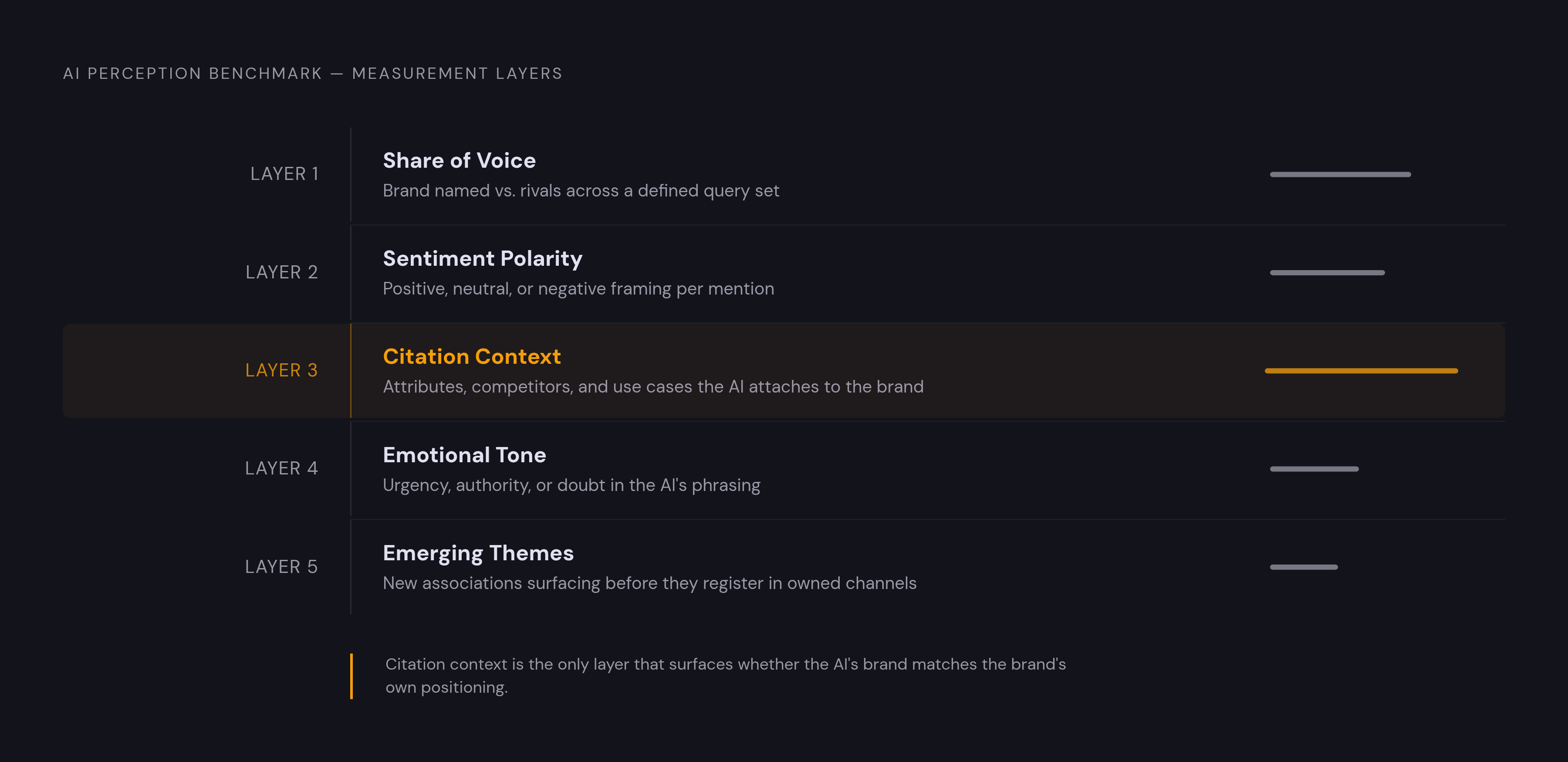
A competitive AI perception benchmark needs to track five distinct metrics at once, measured across multiple AI systems simultaneously rather than on whichever single platform happens to be convenient: share of voice, sentiment polarity, citation context, emotional tone, and emerging themes.
Share of voice measures how often a brand gets named relative to its rivals across a defined set of queries, and it has to be reported per engine, across ChatGPT, Gemini, Perplexity, Claude, and Copilot, rather than rolled up into one aggregate number. Source pools differ by platform, so a brand that is invisible on Perplexity but strong on ChatGPT has a specific, fixable gap on one platform rather than a vague overall weakness.
Sentiment polarity captures whether the language an AI system uses about a brand reads as positive, neutral, or negative, and the thing being measured is the model's own synthesis, not the underlying review data it drew from. A brand can have excellent reviews and still get a hedged or lukewarm description if the model's synthesis of that text comes out muted.
Citation context looks at what claims the AI actually makes when it names the brand: which attributes it attaches to the brand, which competitors it groups the brand alongside, and which use cases it recommends the brand for. This is where an auditor finds out whether the AI's version of the brand matches the brand's own intended positioning, a finding that simple mention-counting cannot surface at all.
Emotional tone covers the register the model adopts, whether it sounds authoritative, cautious, enthusiastic, or hedged, and that register shapes how a recommendation lands with the person reading it even when every fact in the answer is accurate. Emerging themes track new associations the model is starting to build around a brand that have not yet shown up in the brand's own materials, so the auditor gets an early warning of perception drift before it turns into a reputational problem.
The discipline behind this has moved past informal practitioner testing. The Personal Branding Agency Evaluation framework, a peer-reviewed model published in 2026, formalizes AI and LLM visibility as its own evaluation dimension, standing alongside strategic depth, content ecosystem quality, digital infrastructure, media and PR reach, client portfolio diversity, measurable outcomes, and scalability and innovation. So AI perception benchmarking has become a structured methodology, not an experiment a few agencies run on the side.
Structuring the Competitive Query Set and Scoring Protocol
A benchmark is only as good as the query set behind it, and a loosely assembled list of prompts produces noise dressed up as data. The query set needs to span three distinct types. Category-level prompts ask something like "what is the best [product category] for [use case]" and reveal unprompted share of voice, showing whether a brand gets named at all when it is not mentioned in the question. Comparison-level prompts, phrased as "compare [client brand] and [competitor]," show how the AI frames relative positioning: which brand it leads with, which it qualifies with caveats, and which it leaves out altogether. Attribute-level prompts, such as "which [product category] brand is most trusted for [specific claim]," test citation context directly, showing whether the AI links the brand to the attributes the client actually wants to own.
Every query in that set needs to run across ChatGPT, Gemini, Perplexity, Claude, and Copilot. Running a smaller set produces a score for one platform, not an AI perception score for the brand. Each prompt should also run multiple times on each platform, because a single run per query is a snapshot and not a benchmark, a point the instability data from the prior section already makes clear.
None of these scores mean anything in isolation. The client's numbers only become useful once you have a competitive set to measure them against, so you need to select three to five direct competitors and run the identical query set against each of them to produce relative scores, not absolute ones. Tugtekin's PCF v2 protocol offers a working template for this: it tested six brands across eight standardized prompts on GPT-4o and Claude Sonnet, a small but fully replicable structure that sets a credible methodological floor for anyone building a similar benchmark.
Scoring all of this requires a single composite number, and the Model Perception Index, introduced in the AI Perception Index 2026, does that by aggregating mention frequency, sentiment polarity, and citation context into one competitive figure. That composite is what turns a gap between client and competitor into something actionable rather than a pile of descriptive observations.
What the benchmark reveals that traditional brand audits miss
SEO rankings, review scores, and social listening all measure signals a brand controls directly. AI perception benchmarking measures something else: what a language model does when it synthesizes those signals on its own, which is a step traditional tools were never built to watch. That difference produces findings no conventional audit can reach.
Fuel Online's AI SEO report put a number on the gap: a large majority of the enterprise brands it studied were investing heavily in traditional SEO and were nonetheless invisible to generative AI models, proof that organic rank and AI visibility are not the same achievement. A brand can sit at the top of organic search results and still never get named when a generative AI model answers the same query.
Review platforms count stars. AI models read the sentences behind those stars, and a brand with a strong average rating can still come out of an AI system's synthesis sounding cautious or qualified if the review text underneath that average carries mixed signals the star rating smooths over. Social listening operates on a parallel but separate track: it tracks what people say about a brand across social platforms, while AI perception benchmarking tracks what the AI systems themselves say, and the two can diverge sharply at exactly the moment that AI summaries are becoming many prospective customers' first encounter with a brand.
The MPI gap between a category's dominant brand and its emerging challengers is itself a finding with no equivalent in a traditional audit, because it shows not just which brand is more visible but by how much and on which specific dimensions. And the damage from losing that gap is often invisible to the brand losing it. When an AI answer omits a brand, that brand's discoverability erodes, but no standard analytics dashboard will ever flag it, because the traffic that would have shown the loss simply never arrives.
Translating Benchmark Findings Into a Prioritized Remediation Plan
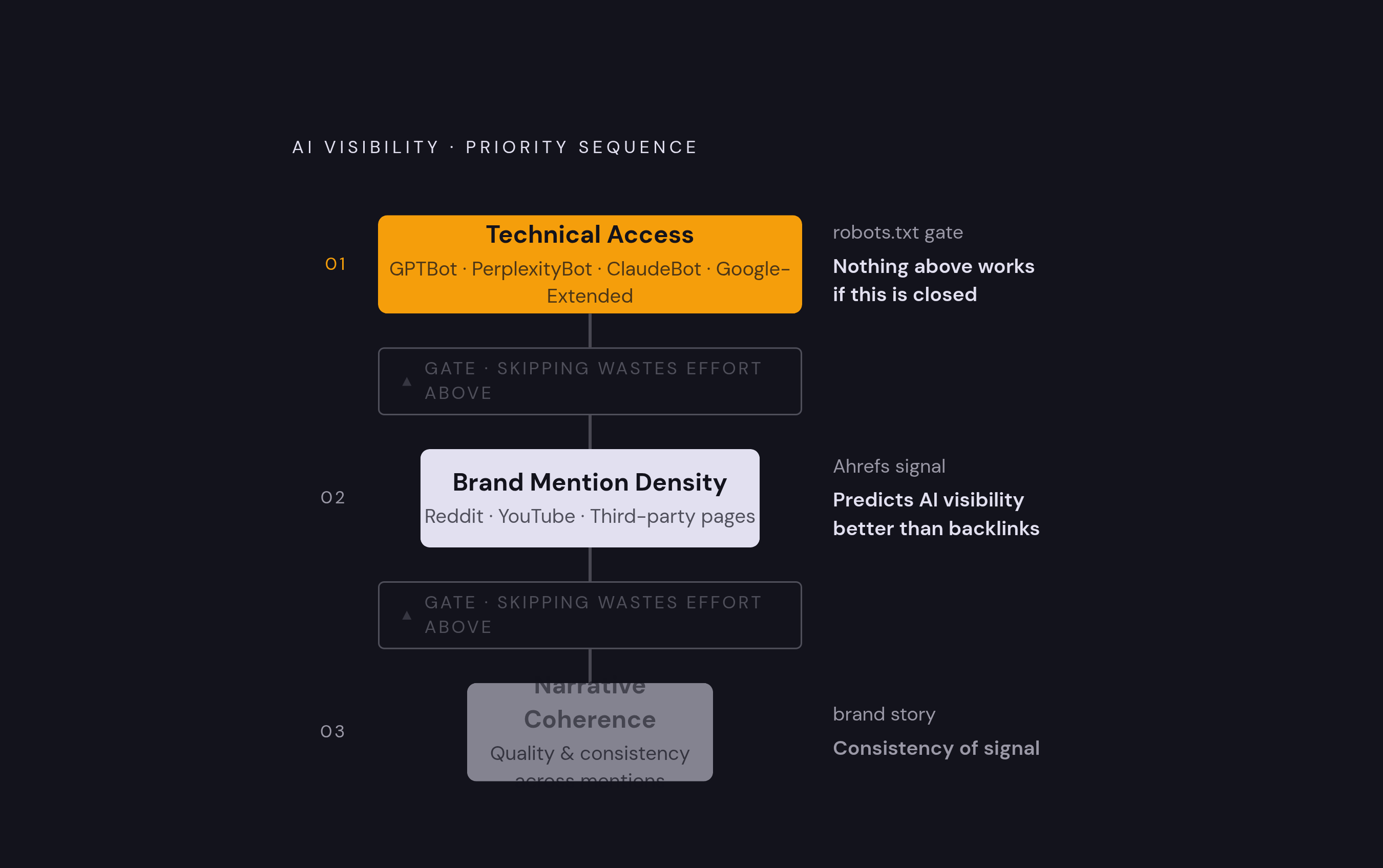
A benchmark earns its keep only when it tells a client what to fix first, and the order of fixes has to follow the signal hierarchy that actually governs AI citation rather than whatever channel the client's team is most comfortable working in. Intuition and habit are not a substitute for that hierarchy, and a remediation plan built on either one will spend budget in the wrong place.
The first check is technical. An auditor needs to look at the site's robots.txt file for GPTBot, PerplexityBot, ClaudeBot, and Google-Extended, because if any of those agents are disallowed, nothing else in the remediation plan will matter. Content quality, mention-building, and narrative work are all wasted effort if the crawler responsible for reading that work cannot get past the front gate. Once access is confirmed, the remediation plan can move up the hierarchy established earlier, toward brand mentions on third-party pages, presence on Reddit and YouTube, and the narrative coherence that Tugtekin's research found matters more than funding or company size. Each later fix only pays off once the technical access check beneath it is confirmed.