Source Signal Mapping in AI Brand Audit Workflows
Brands need to track where AI pulls information from, not just what it says about them.

A brand team types a handful of category questions into ChatGPT or Perplexity, reads whatever comes back, and calls it an AI visibility audit. The exercise feels thorough because the outputs are specific: a competitor gets named first, a feature gets described inaccurately, a tone reads a little cold. But none of it asks the one question that actually explains those results: where did the model get this? Grounded AI systems don't compose brand descriptions from memory alone. They pull web pages first, then write their answers from what they pulled, so the pages retrieved, not anything the brand published, set the boundaries of what the model can say. A prompt-testing exercise reads the symptom and never looks at the cause, and a remediation plan built on that reading tends to fix things that were never broken in the first place.
The scale of the blind spot is measurable. Across AI citation studies, most URL citations point to sites the brand doesn't own, and only a small minority point to owned sources. A brand's homepage, blog and press releases turn out to be minor characters in the story AI tells about that brand. So this is a different measurement problem than the one search engine optimization checks. An SEO audit checks a site's technical health and how it stands against a search engine's ranking factors. An AI visibility audit has to check how AI systems describe a brand inside a generated answer, independent of where that brand ranks anywhere else. Yotpo's research found that only 16.7% of sources cited in Google AI Overviews overlap with the first page of organic search results. Ranking well and being cited well are not the same achievement, and treating them as one is how a prompt-testing audit ends up confidently wrong.
How AI systems acquire and use brand knowledge
Large language models build brand knowledge two separate ways, and each one carries its own kind of risk: through parametric memory laid down during training, and through real-time retrieval that supplements it at the moment a user submits a prompt. Both are shaped overwhelmingly by what third parties have written, not by what the brand itself has published. Training teaches a model statistical association: if a brand name appears repeatedly next to words like "reliable" or "overpriced" across the sources that model learned from, that pairing becomes part of how the model talks about the brand, and it is baked in well before anyone types a prompt.
Retrieval builds on that baseline, and it makes AI-generated brand sentiment genuinely unstable. Retrieval-augmented generation pulls content from external sources, databases, documents, indexed web pages, to supplement a model's static training data at the moment it generates an answer. What a user reads as a single, confident answer is actually a blend of old pattern and new input, and the brand has limited visibility into which part is driving which sentence.
Academic research using Brand Recommendation Probability and Mean Reciprocal Rank across six LLMs found that an identical prompt, run again, does not reliably return the same brands in the same order. A brand's position in an AI answer behaves like a probability distribution rather than a fixed rank. The instability compounds across models: an SSRN study measured a substantial perception gap between dominant and emerging brands, along with real drift in how the same brand gets described from one AI system to the next. A brand's AI narrative can shift meaningfully depending on which assistant a buyer happens to be using.
The stakes of that instability are higher than they might first appear. A critical comment from a stranger on social media gets filtered through the reader's own skepticism. A sentiment offered by ChatGPT or Claude tends to get accepted at face value, as synthesized, neutral fact, rather than as one source's opinion among many. So whatever sources feed an AI's answer carry more weight than the same claim would carry anywhere else on the internet.
The source ecosystem AI systems draw from
Understanding where AI gets its brand knowledge means understanding the shape of the source pool itself: concentrated, stratified by authority, and dominated by content the brand did not write. Concentration is visible in two places at once. Citation research shows that the bulk of citations in any given AI answer cluster into the top few positions, with brand mentions peaking specifically in the top two slots. There's no equivalent of page two in AI search; a source either is in that narrow window or it contributes almost nothing.
Domain authority follows its own concentration pattern, and niche sites still carry real citation weight in that tail even though they wouldn't rank as prominently in traditional search. A small share of domains account for most citations, but a meaningful share of cited sources still carry domain authority below DA 30, so niche, relevant publications carry real weight next to the handful of high-authority outlets that dominate citation volume. Format matters as much as authority. AI systems don't reach for the deepest, most technical whitepaper available; they cite whatever content gives them the clearest, most extractable signal. Ranked "best-of" listicles drive a disproportionate share of all AI citations precisely because they package information as clean entity-to-attribute pairs that a model can lift directly.
A complete map of that ecosystem has to cover distinct categories, each behaving differently when something needs fixing: owned content, third-party review platforms such as G2, Trustpilot, Capterra and Gartner Peer Insights, editorial and media coverage, community and forum discussion, and competitor-owned comparison pages. Some of the most influential sources in that list aren't the ones brand teams typically monitor. Among non-corporate sources, YouTube out-cites Reddit, editorial media and Wikipedia combined, so video content and user-generated commentary are reshaping how enterprise buyers understand a brand in ways most marketing teams never track.
None of this matters if the content in question can't be read by the systems compiling these answers. Onely's analysis found that a substantial share of JavaScript-rendered content never gets indexed by AI systems at all, and in a controlled test, pages that were linked only through JavaScript navigation had a 0% discovery rate for both GPTBot and ClaudeBot. A page can carry perfect, favorable brand information, but if the crawler responsible for reading it can't reach it, that page contributes nothing to a brand's AI narrative.
Source signal mapping as the foundational stage of a rigorous AI brand audit
Tracking the exact origin of every citation an AI model draws on is the step that decides whether an audit's findings are diagnostic or just descriptive. A list of what AI says about a brand is a description. A map of which sources produced that description is a diagnosis, and only a diagnosis points to a fix that will actually work.
The consequences of skipping that step are predictable. Teams that never build a citation map tend to pour their remediation budget into owned content, rewriting product pages and cleaning up structured data, and the third-party sources that actually shape AI recommendations go untouched. If a model keeps pulling its answer from a forum thread that calls a product overpriced, no amount of schema markup on the brand's own site changes that outcome, because the thing that needs fixing lives outside the brand's domain entirely. Yotpo's four-stage AI visibility audit framework places source mapping explicitly as stage three for this reason, and the framework is direct about the sequencing: a team can't automate fixes for a problem it hasn't yet located. The citation map is what tells every later remediation decision where to aim.
Source mapping also catches something owned-content audits structurally cannot catch: outright hallucination. So the AI search visibility audit framework treats incorrect pricing, incorrect features or misstated positioning, delivered confidently by an AI platform, as a source-level problem. The error lives in whatever third-party page the model read, not anywhere on the brand's own site, so no edit to the brand's own pages will touch it. Fixing a hallucination means finding the specific source that produced it and correcting or displacing that source directly.
That work doesn't end once it's done. Wellows's analysis found that roughly 65% of cited sources change within a two-week window, so a source map built once goes stale inside a fortnight. The citation layer moves faster than almost anything else in a brand's AI footprint. Mapping has to run as a continuous practice rather than a single project with a finish line.
Running a source signal map: the four operational stages
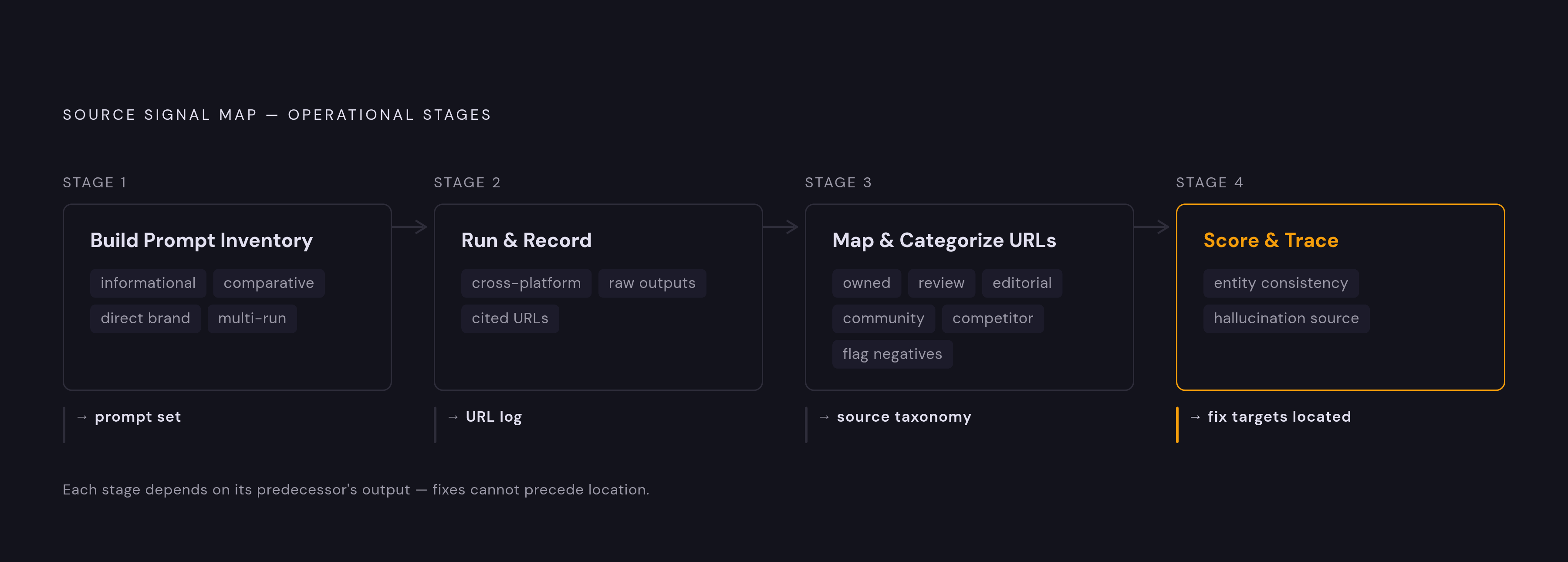
Building a source signal map takes four stages, and they have to run in order, because each one produces the input the next stage depends on.
Stage 1: Build the prompt inventory This stage starts from scratch rather than recycling a brand's existing SEO keyword list, because chat-based queries behave nothing like search queries. The Yotpo framework notes that these questions run longer, read more conversationally, and follow the shape of an actual buying decision. The inventory should group prompts into three intent categories: informational, where the buyer is still learning about the category; comparative, where the buyer is weighing named options against each other; and direct brand queries, where the buyer already knows the brand's name and wants detail. Covering all three matters because each one exposes a different kind of gap at a different point in the buyer's decision process. The inventory should also deliberately include prompts that name a competitor outright, because competitor-context queries show whether the brand shows up at all in the comparative answers, where a large share of purchase decisions actually get made.
Record position within the answer, not just whether the brand appears at all, since citation influence concentrates heavily in the top two slots of any given response. Record sentiment alongside position: Siftly's monitoring research found that whether an AI frames a brand positively or negatively shifts 6.7 times more often than simple brand presence does, which makes tone the variable that needs the closest watching. Because brand recommendations behave as a probability distribution rather than a fixed outcome, you should run each prompt multiple times and record the range of results, not treat a single run as representative. Stage 2: Run prompts across platforms and record outputs.
Stage 3: Map and categorize cited sources. For each AI output, record every cited URL and classify it by category: owned content, third-party review platform, editorial or media coverage, community or forum content, or competitor-owned comparison page. Context matters as much as the category label. The structured audit framework distinguishes between a brand being actively recommended, listed as a secondary alternative, or left out of the answer entirely, and one clear recommendation outweighs five scattered, buried mentions. Any source that frames the brand negatively or with heavy qualification should get flagged as a priority target, ahead of sources where the brand simply doesn't appear. This stage also needs a technical check: confirm that the third-party pages carrying favorable brand information aren't sitting behind JavaScript navigation or robots.txt rules that keep AI crawlers from reaching them. And it needs to flag every competitor citation gap, so every prompt where a competitor appears and the brand doesn't, because those represent direct substitution inside a buyer's active consideration set.
Stage 4: Score entity consistency across the source ecosystem. This stage checks that the brand's name, description and positioning line up across the website, LinkedIn, Crunchbase, G2, Wikipedia, and press coverage. Inconsistency across those properties fragments how an AI system recognizes the entity in the first place, which leads models to stitch together conflicting narratives out of contradictory signals rather than a coherent one. Any hallucination flagged back in Stage 2 gets traced to its source here: find the specific third-party page carrying the incorrect claim, because that page, not anything on the brand's own site, is the actual fix target.
What source signal mapping typically reveals
Running this process consistently produces findings that cut against what brand teams assume about their own AI presence, and against what a traditional SEO audit would have predicted.
Ranking on Google tells a brand almost nothing about whether AI systems will cite it. Research on AI-generated summaries found that only a small fraction of sources cited in AI Overviews overlap with the first page of organic search results, so a brand ranked at position one on Google can be entirely absent from the AI-synthesized answer about its own category. The source most responsible for shaping a brand's AI narrative is frequently a listicle the brand never wrote and has never reviewed. Because ranked "best-of" pages drive a disproportionate share of AI citations, a third-party comparison article the brand has no relationship with can end up carrying more weight than anything on the brand's own site.
Negative forum content turns out to compete directly with a brand's most polished, most authoritative owned pages, and it frequently wins that competition inside the citation pool. If a forum thread describes a product as overpriced and an AI system cites that thread, no amount of on-site optimization touches the perception it creates; the forum thread itself is the thing that needs to change, not the product page sitting untouched on the brand's own domain. And because perception drifts from one model to another, and because LLM perception drift is time-sensitive, brand AI narratives can shift over time, so a brand can hold a strong, favorable presence on one AI platform while carrying a weak or openly negative one on another. The SSRN perception gap research found the same brand perceived in materially different terms depending on the system asked, a split that a single-platform audit has no way of catching.
Taken together, these findings point to the same conclusion from every angle: the sources an AI system reads, not the pages a brand controls, are what decide the brand's AI narrative, and mapping those sources is the only way to find out which ones are doing the deciding.