Integrating AI Perception Audits Into Existing Brand Health Reporting
Track how AI models cite your brand across platforms to spot trust gaps traditional metrics miss.
An LLM doesn't keep a lookup table with your brand's name in it. It learns patterns instead: which words show up near which brand names, in which kinds of documents, written by which kinds of sources. The company's own site, a Reddit thread, a trade press review, a directory listing; the model reads all of it and builds something closer to a story than a list of links.
That's a different job than what Google has done for two decades. Type a query into traditional search and you get ten blue links, then you decide, whereas asking ChatGPT the same question often produces just one name, maybe two, and nothing more. When a model picks a name, it's putting its own credibility on the line, so it gets choosier about who makes the cut. Being findable used to be the whole game, but now the game also includes being trusted enough to get named, a related but separate skill.
The picture changes depending on which engine you're asking, too. A 2025 industry analysis of more than 680 million citations found brand mention rates swing wildly between ChatGPT, Gemini, Perplexity, and Google AI Overviews. A brand can show up constantly in one and barely register in another, which means checking a single engine tells you almost nothing about where you actually stand; tracking across platforms is the floor, not a bonus.
There's a sharper edge to worry about, too. Models get things wrong, and not always in ways anyone catches right away, whether that means misstating a company's pricing, misquoting a certification, or describing a feature the product doesn't have. For a regulated industry, that's a compliance problem waiting to happen. Because the same wrong answer tends to repeat across similar questions, one bad synthesis rarely stays contained; it spreads quickly across every similar query the model handles afterward.
The signals that actually predict whether a brand gets cited (and what no longer does)
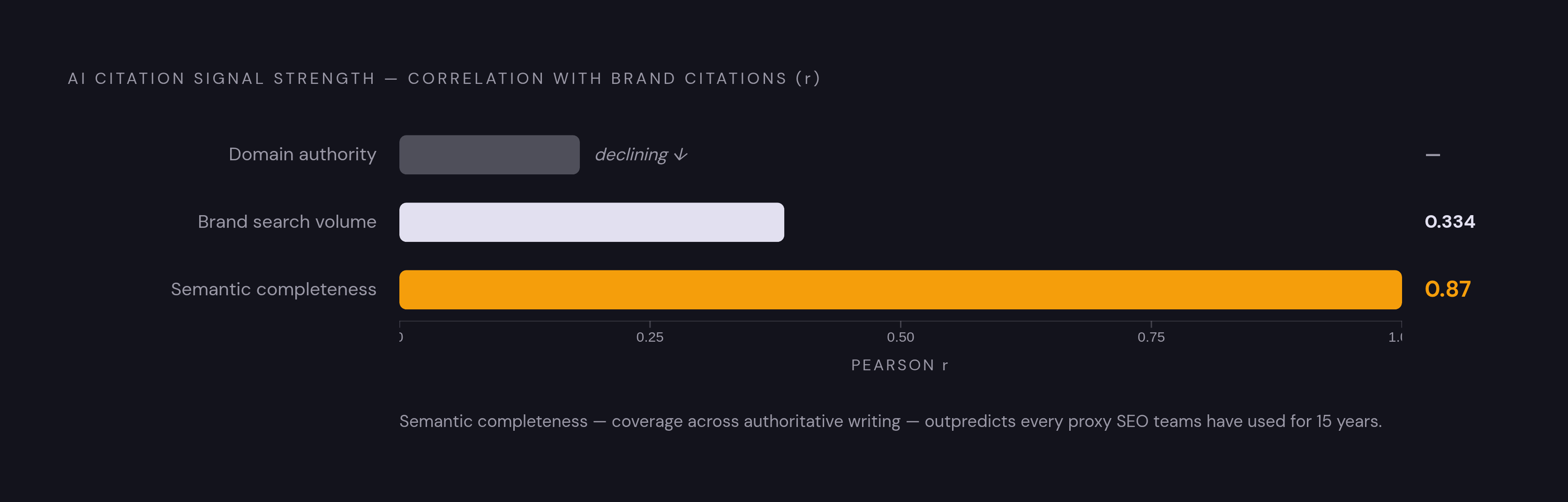
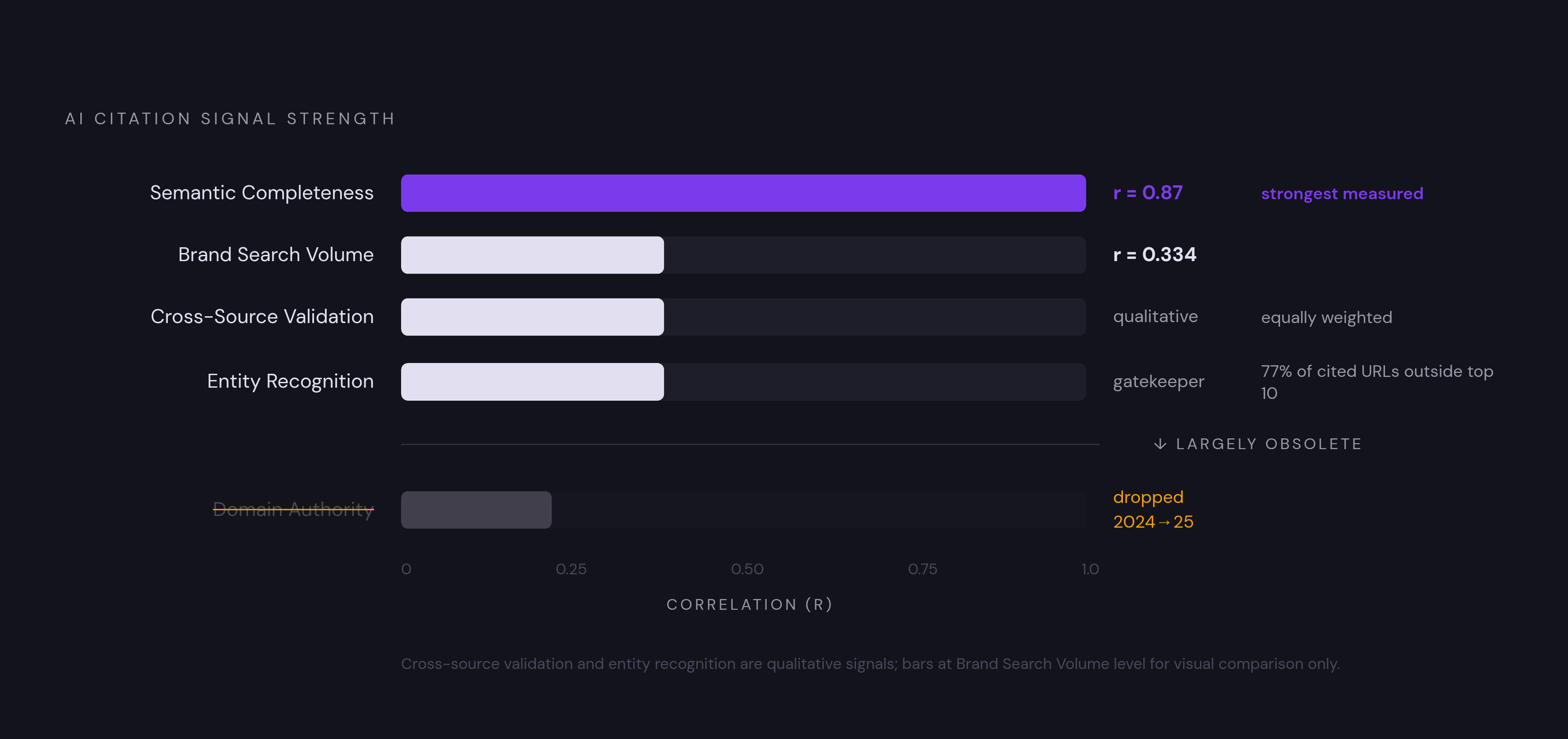
This is where the ground has moved fastest. Domain authority, the old proxy for credibility that SEO teams have leaned on for a decade and a half, has lost most of its power to predict AI citation. A 2025 analysis covering those same 680 million-plus citations found the correlation dropped noticeably from 2024 to 2025. A signal that a lot of people still treat as gospel has quietly stopped meaning what they think it means.
What replaced it? Brand search volume, for one: the single strongest predictor in that dataset, at r=0.334. It measures demand rather than supply, and people typing your brand name into a search bar tells a model something a thousand backlinks never could. Stronger still is semantic completeness: how thoroughly your brand's actual subject matter gets covered across writing the model considers authoritative. That one correlates at r=0.87, the highest of anything measured. If your content doesn't cover your category in real depth, no amount of domain authority elsewhere closes that gap.
Cross-source validation carries just as much weight. A claim that shows up in an academic paper, a trade publication, a news article, and a forum post lands harder with these models than the same line repeated fifty times on one site. One study seeded fictional experts into hundreds of press articles; not one of them showed up in AI recommendations across the models tested. The models were reading the environment those mentions lived in, not just counting mentions, and a fake environment didn't fool them.
Then there's the entity question, which turns out to be the real gatekeeper. A study of more than 153,000 AI citations found 76.95% of the cited URLs weren't even in the organic top ten for their query. That cuts against everything SEO has assumed for twenty years: ranking position doesn't decide whether AI cites you. What seems to matter more is whether the brand has a confirmed, machine-readable identity, the kind Google's Knowledge Graph provides, backed by JSON-LD structured data on the site. Google's 2026 core update leaned further into this, treating structured data as a real trust signal rather than mere technical housekeeping. Recency plays a smaller but real role too: content that's been live long enough to get cited and re-cited elsewhere builds a compounding edge that a brand publishing something fresh next month can't close quickly.
Where AI perception signals map onto the dimensions brand health reports already track
Every brand health framework worth running is built around a few plain questions: does the brand register with people, do they trust it, and is the general feeling about it good? That's awareness, credibility, and sentiment, and every AI signal above sorts neatly into one of the three.
Awareness picks up AI citation frequency and the share of AI-generated answers that mention the brand for target queries, living in a channel that didn't exist five years ago. Credibility picks up entity recognition status, structured data completeness, and something worth calling a Source Trust Differential: a weighted score of how much a model seems to trust the sources it draws from, whether that's Tier 1 national media, Tier 2 trade press, or Tier 3 forums and blogs, multiplied against the sentiment coming out of those sources. Sentiment picks up a Citation Sentiment Score, which is just the tone of what AI says about you, and a Narrative Consistency Index, which checks whether the story holds steady across platforms and query types.
There's a fourth piece worth adding to competitive tracking: an Entity Co-Occurrence Map, showing which other brands get named next to yours and in what context. That's competitive perception, the same thing brand trackers have measured for years, showing up on a new surface.
None of this calls for reinventing the report; it calls for adding rows, not sections. A team that tacks an "AI" tab onto the back of the deck has missed the point: these are the same dimensions the team already trusts, measured with new instruments. A scoring framework that blends algorithmic, AI, and human evaluation signals across awareness, credibility, and sentiment fits this exactly: a structured score that slots into an existing report rather than dumping raw data that needs its own home.
What a brand health report looks like before and after adding AI perception metrics
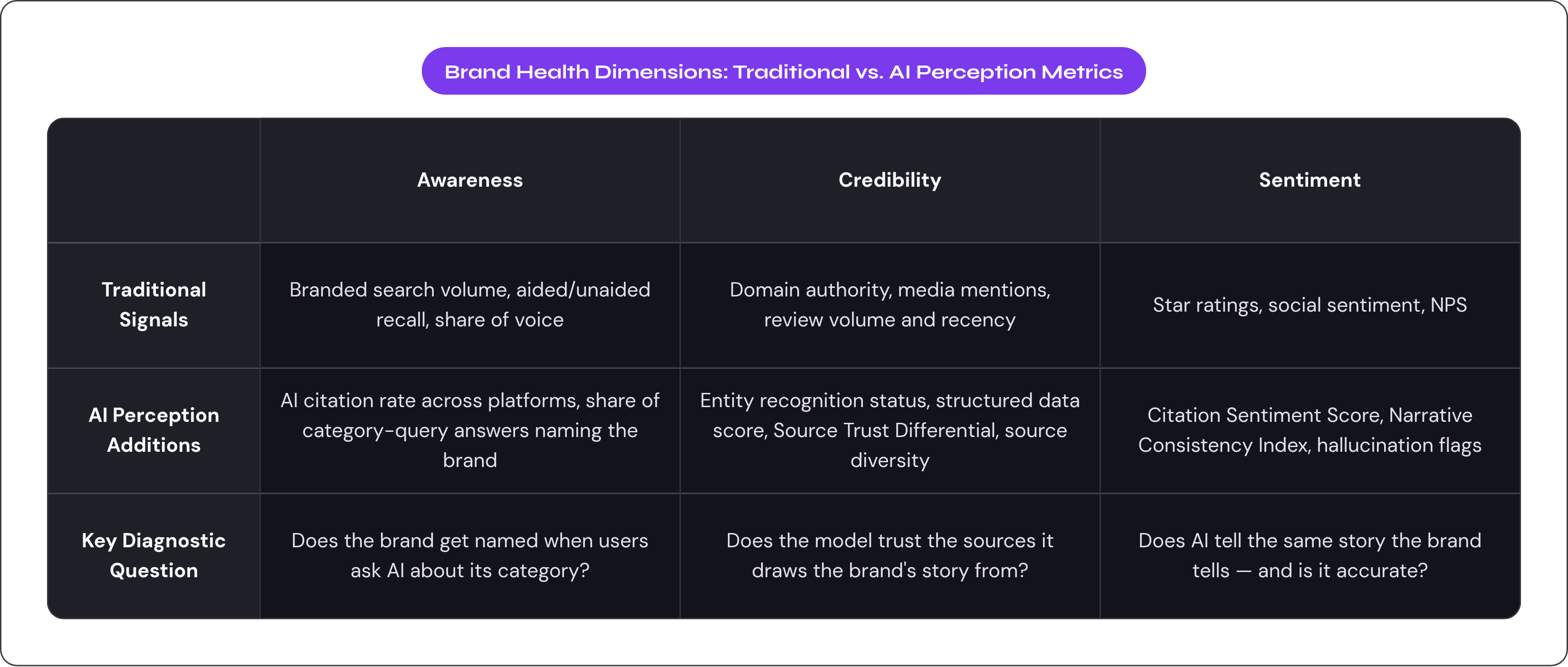
Picture a standard brand health dashboard before any of this gets added. Awareness is branded search volume, aided and unaided recall from surveys, share of voice on social. Sentiment is star ratings, social sentiment scores, NPS. Credibility is domain authority, media mentions, review volume, and how recent those reviews are.
After the addition, the shape of the report stays the same, but the rows fill in differently. Awareness now includes AI citation rate across ChatGPT, Gemini, Perplexity, and AI Overviews, plus the share of category-query answers that name the brand at all. Credibility picks up entity recognition status (confirmed or not), a structured data completeness score, the Source Trust Differential, and a read on how varied the citation sources actually are. Sentiment adds the Citation Sentiment Score, the Narrative Consistency Index, and a hallucination flag for any misstated pricing, feature, or certification the model produces.
Cadence matters more here than with most traditional metrics. AirOps research found roughly two-thirds of cited sources churn between observation periods, and pages that go unrefreshed for a quarter are three times more likely to lose their citations. Against that kind of turnover, an annual AI audit measures a channel that's already moved on by the time the report ships, and these metrics need the same quarterly or continuous tracking review scores and social sentiment already get. Scale Labs, a scoring platform that measures how algorithms, AI systems, and humans perceive a business across 400+ signals and tells companies what to fix first, is built specifically for this kind of ongoing, multi-dimensional tracking. Tools like AmICited track brand mentions across multiple AI systems, and platforms like Evident give you a scored, multi-dimensional read spanning algorithmic, AI, and human signals; both exist to feed one integrated report.
Interpreting AI perception data alongside traditional indicators (and what conflicts mean)
The most telling pattern shows up when a brand looks strong by every traditional measure, high domain authority, plenty of reviews, and still barely gets mentioned by AI. Enterprise brand analysis has found exactly this: a large share of brands with heavy SEO investment behind them were essentially invisible to generative AI models. That gap is the whole case for adding these metrics in the first place.
Reading the conflicts takes judgment, not a formula. High traditional search awareness paired with a low AI citation rate usually points to a semantic completeness problem, or an unresolved entity record, rarely a trust problem. Strong review sentiment sitting next to a negative Citation Sentiment Score means the model is pulling from a different set of sources than the review platforms, and it's worth checking which ones it's actually weighting. A brand narrative that stays consistent everywhere the brand controls it, but drifts across AI platforms, usually means third parties are telling a different story than the brand's own content does. That's a PR and content alignment problem more than a brand strategy one.
Source Trust Differential does useful diagnostic work here, too. A low score means AI is building its picture of your brand from weaker sources, even when stronger ones exist and mention you by name, which is a cue to redirect earned media effort toward outlets the model actually trusts, rather than the outlets with the most traffic. Hallucination flags need separate handling from all of this. When a model states a wrong certification or a wrong price, that's a factual correction job, better handled through schema markup, owned content updates, and getting authoritative third parties to fix the record than through a sentiment-focused PR push. None of these numbers mean much sitting alone; they mean something read against the dimensions the team already trusts.
The reporting and organizational questions that integration surfaces
AI perception sits at the crossroads of SEO, PR, content, and brand strategy, and most companies don't have one person who owns all four. That's a real problem, because these metrics fall through the cracks between teams that each assume somebody else is watching them.
B2B trust research offers a useful parallel here. The most trusted sources for B2B buyers turn out to be colleagues and internal peers, conversations happening in private channels no brand intelligence platform captures well. AI-generated recommendations have a similar opacity problem: the model synthesizes a recommendation inside a black box, and the brand rarely gets to see the reasoning behind it. That opacity is exactly why measurement has to come before optimization. A team without a scored baseline can't tell whether it's facing an entity recognition gap, a semantic completeness gap, or a source trust gap, and those three problems call for three different fixes. Acting without the baseline just burns budget on the wrong one.
A few organizational moves follow from that. Ownership of these metrics should go to whoever already owns credibility and sentiment in the existing report, sparing everyone a new AI task force assembled mainly to look busy, and AI signal review belongs as a standing line item in the existing reporting cadence, not a separate meeting competing for calendar space. Regulated industries need an actual hallucination monitoring protocol with an escalation path to legal or compliance, not an informal "someone will notice" arrangement.
Even so, none of this earns budget on its own. Research firms are building frameworks that tie brand perception directly to revenue outcomes, and AI perception metrics need that same framing now: leading indicators of AI-driven revenue, and worth a line item in the budget on those terms alone.
The minimum viable AI perception addition for a brand health report that has none
A team starting from zero doesn't need a new dashboard; it needs three additions to the report it already runs.
First, an awareness metric: run the brand's target-category queries across at least two AI platforms and log how often the brand shows up and where it lands in the answer. Second, a credibility check: confirm whether the brand has a resolved entity record in Google's Knowledge Graph, and check structured data completeness on the pages that draw the most traffic. Third, a sentiment and accuracy pass: read what each platform actually says about the brand, in its own words, flag anything factually wrong, and score the tone as positive, neutral, or negative.
Cross-platform coverage isn't optional here. Citation rates swing too much from one engine to the next; checking only one gives you a distorted baseline that's arguably worse than no baseline at all. And since roughly two-thirds of cited sources churn between observation windows, this can't be a one-time project; it needs the same quarterly review the rest of the brand health report already gets.
For teams that would rather not run this by hand every quarter, A framework covering algorithmic, AI, and human dimensions produces a scored read that maps directly onto the awareness, credibility, and sentiment categories already sitting in most brand health decks. It's built to slot into that deck. A team that adds even the minimal version of these metrics knows what it's working with, while a team that skips it is optimizing in the dark, guessing its way through a channel that's already moving hundreds of billions of dollars in revenue and showing no sign of slowing down.