Tracking AI Brand Perception Changes Over Time
Why AI brand visibility demands constant monitoring instead of yearly audits.
Search engines used to hand back a list and let the user pick. AI systems hand back a verdict: one brand, maybe two, named directly, with the model's own credibility attached to the choice. That shift, from matchmaker to advisor, is why tracking how AI systems describe a brand can no longer be a once-a-year audit; it has to be a standing practice, because the picture moves whether or not anyone is watching, and most companies are not watching. The mistake almost every marketing team makes right now is treating AI visibility as an SEO problem with a new coat of paint. The inputs differ enough that the old playbook doesn't transfer, and the sooner a brand stops optimizing for the wrong inputs, the sooner it stops losing ground it doesn't know it's losing.
A 2026 analysis of 1,000 enterprise brands by Fuel Online found 62% invisible to generative AI models, even though 94% of those same companies had sunk real budget into traditional SEO. That gap is the whole story in miniature. The inputs AI models weigh are different from the inputs SEO was built to optimize, and a brand can sit on page one of Google while not existing at all for the model a buyer just asked for a recommendation.
How AI models actually construct a picture of a brand
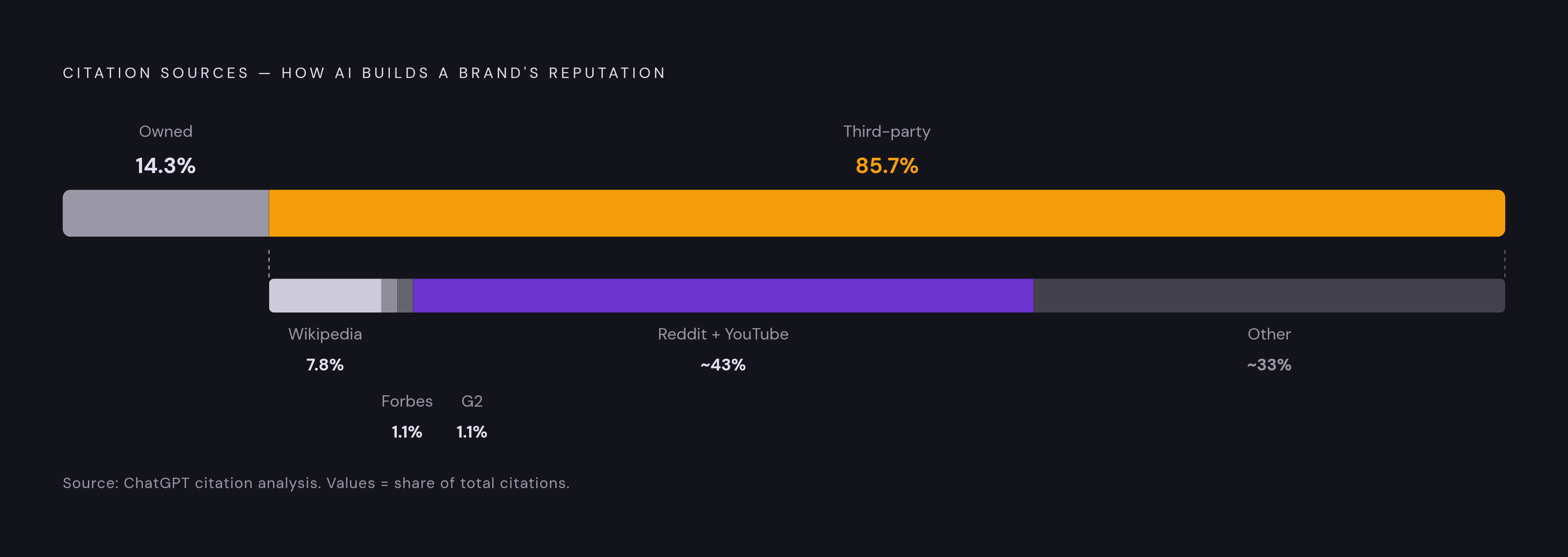
Language models draw mainly on what others have said about a brand, not on the brand's own website, and this is the single fact most marketing teams still haven't absorbed. A study analyzing 167,551 URL-grounded citations across 128 brands found that 85.7% of those citations pointed to sites the brand does not own; only 14.3% came from owned properties (arXiv:2606.25787). The company website has become a minority input in how the model builds its picture, which means the years spent polishing homepage copy and meta descriptions carried less weight than most teams assumed.
The third-party landscape those citations draw from is not evenly spread, either. It follows something close to a Zipf curve, where 80% of citations trace back to roughly 18% of domains. Wikipedia alone accounts for 7.8% of ChatGPT citations, with Forbes and G2 each sitting around 1.1%, per the Yext 2025 study. Community platforms like Reddit and YouTube together make up close to half of citations, per AirOps' 2026 State of AI Search report. A brand's reputation inside an AI model gets written, in large part, by a small handful of sites the brand does not control and often does not even monitor, which is exactly the gap a multi-signal scoring platform like Scale Labs is built to surface.
What happens on those sites matters more than how often the brand's name shows up there. When reviews, case studies, press coverage, and forum threads describe a brand the same way, the model states that description with confidence. When those sources disagree, or when a brand's own site positioning doesn't match how it reads on LinkedIn or in a third-party directory, the model hedges: it falls back on vague, generic language because it has no coherent signal to draw from. Authority counts too. A mention buried in a well-linked industry report carries more weight than a dozen mentions scattered across thin blog posts, and a brand that owns a genuinely original data point, something no one else has published, turns that statistic into a magnet other sites cite and link back to.
Why AI brand representations shift — and why those shifts are hard to anticipate
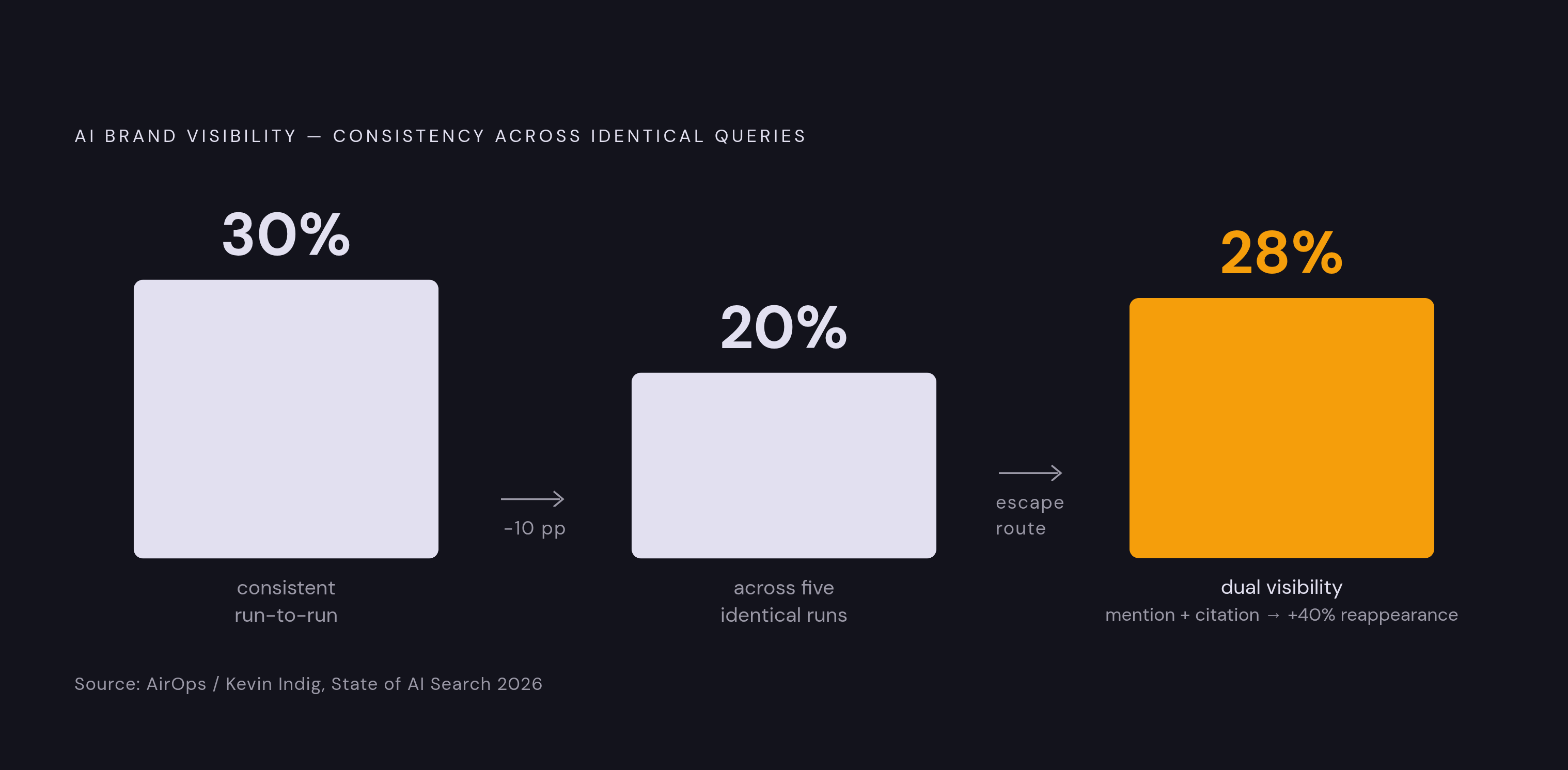
Visibility in AI answers is unstable by design, and treating any single answer as ground truth is the second major error in this practice. AirOps and Kevin Indig's 2026 State of AI Search report found that only 30% of brands stay visible from one AI answer to the next, and just 20% show up across five consecutive runs of the identical query. That instability tracks how models weigh recency and freshness, and it shifts with the exact phrasing of the question asked.
Content age is a real, measurable lever. Pages that haven't been updated in a quarter are three times more likely to lose their citations, per the same AirOps report, while content built with clear structure, sequential headers, proper schema markup, correlates with a 2.8 times higher citation rate. A brand can change nothing about its product or its positioning and still watch its AI visibility erode simply because the content underneath it went stale.
Models disagree with each other, too, and this is the part most tracking efforts miss entirely. A June 2026 study out of Rankfor.AI (arXiv:2606.23165) queried GPT-5.4, Google Gemini 3.1 Pro, and Perplexity Sonar Pro about 66 brands across 12 languages, generating 35,640 grounded responses. Mean cross-language cosine similarity came out to 0.825, measurably short of agreement. The same brand gets described differently depending on which model answers and which language the question was asked in. A company watching one model in one language is looking at a sliver of its actual AI reputation and mistaking the sliver for the whole.
Model providers don't announce retraining cycles in any way a brand could act on, either. Training data cutoffs move. Source-type weighting changes. A new retrieval layer gets bolted on and different pages suddenly feed the answer. A brand's standing can shift for better or worse between any two check-ins with no external warning that anything changed at all.
The costliest version of this is quiet decline, and it's the one most companies are least prepared for. An AI recommendation reads as the model's own voice rather than a clearly flagged citation, which means outdated or inaccurate descriptions can circulate without any obvious signal to the user that something is off. Months can pass before a company notices, and by the time it does, the cost has already compounded across every buyer who saw the stale answer in between.
What a structured AI brand perception monitoring practice actually tracks
Showing up in an answer is not the same as being represented well, and treating the two as equivalent is the most common mistake in this whole practice. A brand mentioned as a "legacy option" or a "niche choice" has technically achieved visibility and functionally lost the recommendation anyway. A monitoring practice has to capture whether the brand appears at all, yes, but also how it's described, which attributes the model surfaces, what tone or confidence it uses, and which sources it pulled from to build that description.
Three audiences need tracking, and collapsing them into one is where most homegrown monitoring efforts fall apart. Algorithms come first: the structural signals, entity consistency, schema markup, content freshness, inbound authority, that determine whether an AI system can even form a confident read on the brand. AI systems come second: the actual outputs, what different models say, across different query types and languages. Human audiences round it out: the reviews, forum threads, and editorial coverage that AI systems lean on most heavily, and that human buyers still read directly.
Coverage across multiple models is the baseline requirement here. Since different LLMs measurably produce different descriptions of the same brand, watching one model gives a partial read that can actively mislead a team about where it stands. Query phrasing complicates it further, since the same model can describe a brand differently depending on how a question is worded, so a single prompt run doesn't tell the full story either.
One stability signal is worth optimizing for directly: dual visibility, meaning a brand earns both mentions and citations together rather than one without the other. AirOps' 2026 data shows brands with both are 40% more likely to reappear across subsequent AI answers, yet only 28% of answers include brands that have achieved that dual status. Mentions and citations belong on separate lines in any tracking system, because a brand needs to know which one is lagging before it can fix anything.
Turning this into something comparable over time takes real aggregation, spread across models, query sets, and source types. A single number, share of voice, star rating, raw citation count, will always be gameable or misleading on its own. A composite-score approach offers a useful model: rather than relying on a single metric, it weights several distinct inputs together into one aggregate read. AI perception tracking benefits from that same multi-component logic, weighing several inputs together rather than leaning on one metric that happens to be easy to compute.
How to build the monitoring cadence — frequency, triggers, and what to do with the signal
A fixed quarterly report misses too much on its own, and treating it as sufficient is a mistake. Model updates land without notice, a piece of third-party content goes viral, review volume spikes overnight, all of it capable of shifting a brand's AI representation well before the next scheduled check-in. The fix is running two systems side by side: a steady baseline cadence, plus event-triggered checks that fire when something specific happens.
On the baseline side, structural signals, content freshness, schema completeness, entity consistency across owned and third-party pages, deserve a quarterly minimum. AI output sampling needs to run monthly: standardized query sets across the models that matter for the category, logged consistently, compared against the prior month. Third-party source health, new coverage, review sentiment, citation activity from high-authority domains, needs continuous attention rather than a scheduled check-in at all.
Certain events should trigger an audit outside the normal schedule. A major retraining announcement from a leading LLM provider is one. A high-authority publication running a critical review, a Wikipedia edit to the brand's entry, or a forum thread gaining real traction are others. An unexplained drop in AI-referred traffic or conversions counts too, and so does a competitor suddenly appearing, or climbing, in AI answers for queries the brand used to own outright.
Once a change shows up, diagnosis has to come before response. A shift in what the model says about a brand is a different problem from a shift in which sources it draws on, which differs again from a shift in which queries surface the brand at all. A description change usually traces back to a shift in third-party narrative. A citation source change usually means a high-authority site updated its own coverage. A query coverage change points toward something structural, most often freshness or schema issues on the brand's own content.
Not every fix deserves equal urgency, and this is where most teams get the sequencing wrong by treating all drift as equally urgent. Changes touching high-intent queries deserve the fastest turnaround. Structural fixes, freshness, schema, entity consistency, pay off more broadly and more durably than any one-off piece of content. And given that 85.7% of brand mentions trace back to third-party pages, closing a gap on Wikipedia, G2, or a major industry publication is usually the single highest-leverage move on the table, well ahead of anything a brand can do on its own domain.
Tools and approaches available for tracking AI brand perception at scale
The manual version of this work starts simply enough: run a standardized set of prompts across ChatGPT, Gemini, Perplexity, and Copilot by hand, log the outputs in a spreadsheet, compare across time. It's a fine way to set a first benchmark, and it's also the limit of what a spreadsheet can do. It breaks down fast once query volume, model count, and language coverage grow past a handful of each. The point is straightforward: a single-model snapshot misleads, and covering multiple models properly takes systematic tooling, not manual spot-checks.
Traditional brand intelligence platforms are adapting to this layer, with mixed but improving results. A growing category of tools is extending classic brand monitoring, sentiment tracking, share of voice, into AI output tracking specifically, watching how consistent a brand's description stays across different LLMs. Some brand tracking tools apply that same composite-score logic to AI-era perception data, built as a time series that can be benchmarked against competitors. Platforms built for this space apply machine learning to aggregate mentions across sources at a scale a manual process struggles to match, which matters once the goal shifts from spot-checking to real trend detection.
A newer category of tools is built specifically for the three-audience problem, algorithms, AI systems, human audiences, rather than adapted from older brand-monitoring logic. Some purpose-built tools in this space score across a wide range of signals spanning those three dimensions to give a business a structured, time-series read on how it's actually perceived. Its logic runs on scoring before optimizing, which is the only sensible order of operations here: a company cannot fix drift it hasn't measured, and guessing at fixes without a baseline wastes the exact budget this whole practice exists to protect.
Whatever a company picks, a short set of questions separates the useful tools from the incomplete ones. Does it track more than one model? Does it show change over time, or just a snapshot of right now? Does it name which third-party sources are actually driving the AI representation? And does it look at the structural signals underneath, freshness, schema, entity consistency, rather than stopping at the AI outputs sitting on top of them? A tool that fails two of these isn't worth the subscription.
The compounding advantage of treating AI perception monitoring as an ongoing discipline
AI brand perception moves constantly, and only a standing measurement practice catches that movement before it costs conversions. A one-time audit produces a snapshot of a system that has already changed by the time anyone reads the report. Treating that snapshot as current knowledge is the error most brands are making right now, and it's a costly one, since a stale report creates false confidence where no confidence should exist.
The advantage compounds for the same reason the risk does. A brand that samples across models monthly, tracks structural signals quarterly, and reacts to trigger events as they land builds a record of how its AI representation moves over time. It can tell the difference between a temporary dip tied to one stale page and a genuine narrative problem building across third-party sources. A brand checking in once a year has no such record; it reacts to whatever state the model happens to be in on the day someone finally thinks to look, a habit poorly suited to a discipline that moves this fast.
The real question facing most companies is timing: build this discipline now, while the field is still setting its own best practices, or build it later, after a competitor already has, and after the gap has already priced itself into every quarter spent catching up.