AI Perception Audit Findings for a Brand With Inconsistent Online Presence
AI sees your brand through third-party sources far more than your own website.

Large language models don't reflect a brand's self-image; they reflect whatever's been indexed about that brand across the open web, and those are frequently two different things. An AI perception audit measures that gap directly: what ChatGPT, Perplexity, Gemini, and the rest actually say about a brand, checked against what the brand thinks it's putting out there. That gap isn't vague or mysterious. It shows up in traceable, fixable patterns once someone runs the numbers.
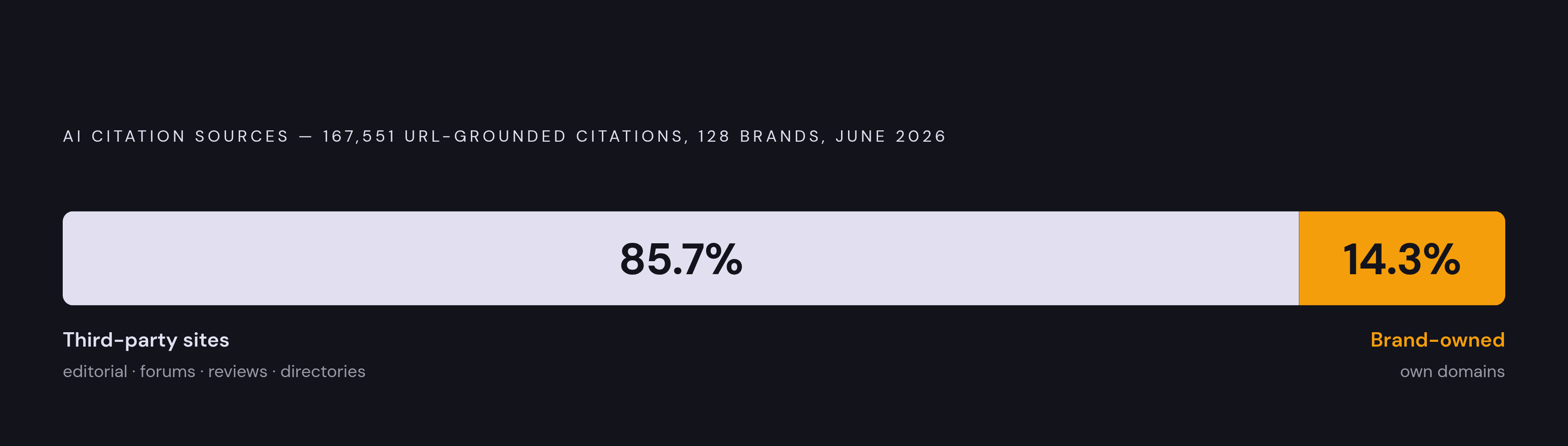
A June 2026 study analyzing 167,551 URL-grounded citations across 128 brands (arxiv.org/abs/2606.25787) found that 85.7% of those citations pointed to sites the brand doesn't own; only 14.3% pointed to owned domains. Read that twice, because it overturns the assumption most brands operate on: a company's own website is a minor input into how AI describes it. Editorial coverage, community forums, review platforms, and directory listings do most of the work. Models treat agreement across sources as its own kind of proof, so one polished, authoritative page carries less weight than the same fact echoed across a dozen independent ones. A brand with thin, scattered, or contradictory third-party presence hands AI systems little to work with, or worse, conflicting inputs to average out.
What "inconsistent online presence" actually looks like as a data problem for AI
Inconsistency, for audit purposes, breaks into a handful of recognizable categories, and they don't carry equal weight.
Name and entity variance is the most basic: a brand referred to by different names, old abbreviations, or a legacy name a rebrand never fully scrubbed from the record. Category ambiguity follows, where one source describes the brand serving one vertical and another source describes an entirely different use case or customer type. Then come outright claim conflicts: pricing, feature sets, or positioning stated one way on the brand's own site and a different way on a third-party page nobody thought to check. Temporal inconsistency shows up when outdated product details stay indexed and keep getting cited long after the brand moved on. Coverage gaps are simpler: products, markets, or capabilities that never made it into third-party record, so as far as AI is concerned, they don't exist.
Models don't resolve a contradiction so much as reflect it, or pick a version arbitrarily and run with it. Nobody at the model layer is checking a brand's math, and that's worth sitting with. Internal misalignment, the kind where marketing, sales, and product teams each describe the same offering slightly differently, surfaces externally in AI outputs almost immediately. The audit becomes a mirror held up to a company's own go-to-market coherence, and most companies don't like what they see in it.
The audit structure: what gets measured and across which AI systems
An AI perception audit is a structured diagnostic, run across a defined set of prompts and systems. One query typed into a chatbot proves nothing. Treating a single output as evidence is the first mistake most people make, and it's worth naming directly: a screenshot is not an audit.
Prompt design has to mirror how people actually search, not how a brand imagines being searched for. That means navigational queries, comparison queries, category-level questions, and use-case phrasing, not just branded searches where the brand name already sits in the prompt. Coverage has to span multiple systems too, since answers vary a great deal across ChatGPT, Perplexity, Gemini, Claude, and Google AI Overviews; a brand can show up with confidence in one and get left out entirely in another. That gap between systems matters on its own terms, because it shows which signals are missing, not just which single output happens to be wrong.
The measurement itself runs across a handful of core dimensions. Presence rate tracks how often the brand shows up across a defined set of prompts, while citation sourcing tracks which domains the AI actually pulls from and what the ratio of owned to third-party citation looks like. Narrative consistency checks whether descriptions of the brand agree with each other across prompts and systems. Sentiment character looks at the tone and framing used when the brand does appear, and entity anchoring checks whether the brand is clearly defined as a distinct entity in structured sources like Wikidata, Wikipedia, or Google's Knowledge Graph.
An emerging standard here, sometimes called Prompt Share of Search, involves querying major models with natural-language prompts tied to real customer intent, then benchmarking brand presence against named competitors. Cadence matters too, since AI outputs aren't static; the freshness of indexed content decides whether a brand stays in rotation across repeated queries over time. Platforms built for this kind of measurement, Evident among them, score across hundreds of individual signals and three evaluation dimensions, algorithmic, AI, and human, which gives the findings a structured basis for comparison over ad hoc sampling.
Finding one: the brand appears inconsistently, or not at all, depending on how the question is framed
The most disorienting result an audit tends to surface is this: the same brand, asked about in two differently worded prompts, produces two entirely different AI responses. The difference runs well past phrasing.
Brands with thin or inconsistent third-party coverage show up in only a small slice of the answers they should reasonably appear in, and competitors fill that gap every time the brand goes missing. Model-by-model divergence is itself worth sitting with. If a brand appears reliably in ChatGPT but rarely in Perplexity, the cause usually traces to Perplexity leaning harder on community forum sources like Reddit and StackOverflow, where the brand may have little to no organic footprint. Framing sensitivity compounds the problem: category-level queries, the "best [solution type] for [use case]" kind, tend to produce lower presence rates than branded queries. That's exactly backwards from what a brand wants, since category queries are where undecided buyers actually do their research, long before they ever type a brand name into anything.
And when the brand does show up, the description isn't stable. Sometimes it's legacy positioning, sometimes it's current and accurate, sometimes it's a blend of both that resembles no positioning the brand ever actually held. The model is averaging across whatever it found. None of this is random, though. Every gap traces back to a specific, identifiable hole in the source material, and that's the part an audit is built to find.
Finding two: third-party sources are mis-describing the brand, and AI is trusting them
Given that 85.7% of citations draw from third-party sources, what those sources say functions, in practice, as what the AI says. When third-party descriptions conflict with a brand's own content, models resolve the ambiguity by favoring whatever they treat as higher authority: editorial coverage, community consensus, structured directories. The brand's own account of itself doesn't win by default. Often it doesn't win at all.
A few misrepresentation patterns turn up again and again in these audits. Outdated category description is common: a brand still tied to a legacy product line or market segment it exited years back. Capability gaps follow closely, where a feature central to current positioning simply doesn't appear in any third-party record, so the AI leaves it out entirely, not out of malice but because it never ran into the information. False equivalences show up when a brand gets described as interchangeable with a competitor, often because both appeared in the same review roundup using similar language. Geographic or sector misassignment rounds it out: a brand described as serving a market it exited, or left unmentioned in a vertical where it's now a clear leader.
The mechanism is worth stating precisely. Models aren't fact-checking against a brand's current website in real time; they weigh how many sources agree, and if three older third-party pages agree on something the brand's own site now contradicts, the older, wronger version frequently wins. Updating owned content matters, but it doesn't solve this on its own, and here is the mistake most brands make: they fix the homepage, call it done, and wonder six months later why nothing changed in ChatGPT. The audit has to name which specific third-party sources are carrying the outdated version, because those are the actual point of intervention.
Finding three: the brand's entity definition is weak, producing hallucination risk
Entity anchoring describes how models lean on structured knowledge sources, Knowledge Graph entries, Wikipedia, Wikidata, to pin down a stable, unambiguous definition of a named entity. Brands with inconsistent naming, no Knowledge Graph presence, or no Wikipedia entry get conflated more often with similarly named entities, or described with visible hedging and low confidence.
When entity definition is weak, models don't just go quiet; they sometimes hallucinate, blending facts from a similar-sounding company into their description of the brand's founding, category, or capabilities. A five-layer model of entity authority makes the failure legible. Layer one is Knowledge Graph anchoring: is the brand a distinct, structured entity in Wikidata or Wikipedia at all? Layer two is third-party co-mention, whether the brand consistently shows up alongside its actual category peers across credible sources. Layer three covers structured author pages, whether the people tied to the brand are identifiable as such in machine-readable form, and layer four is naming consistency, the same brand name used the same way everywhere it appears. Layer five is original published research, whether the brand puts out citable, indexable content that backs up whatever expertise it claims.
Run through those five layers and the audit produces a gap map: which anchors are simply missing, and which are actively contradicted by inconsistency elsewhere. Hallucination, for an established brand, is a signal-clarity problem, and the fix sits upstream of the model entirely. Models hallucinate when they lack consistent, structured input to draw from; the model is doing exactly what it's built to do with what it's given, which is the whole point people miss when they call it a glitch.
Finding four: sentiment in AI outputs is drifting from what the brand actually communicates
AI outputs don't stop at description. They characterize, and characterization carries sentiment through word choice, endorsement framing, and how a brand gets positioned against its peers.
Brands with inconsistent messaging across owned and third-party surfaces tend to land in a neutral or hedged zone in AI characterizations, somewhere short of negative but well short of endorsed. That neutral framing carries a real commercial cost. A brand described as "one option among many" doesn't get the pre-sale endorsement effect that comes with a confident recommendation, and that gap compounds every time a buyer runs the same kind of query.
A few sources of that drift show up repeatedly. Review platform aggregation is one: if review sentiment clusters around one narrow use case, the AI characterizes the brand as a specialist in that use case rather than the platform it actually is. Forum thread framing is another; community discussion tends to gravitate toward problems and edge cases, so brands with heavy forum presence but thin editorial coverage often get characterized by their failure modes instead of their strengths. Competitor comparison language matters too: if a brand keeps turning up in "Brand X vs. Brand Y" content where the other brand wins the comparison, the AI absorbs that framing wholesale.
A Narrative Consistency Index, tracking whether a brand's core claims hold steady across AI-generated descriptions or shift by system and query type, turns this drift into something measurable instead of anecdotal. The endorsement effect itself isn't trivial, either. Language like "Brand X is a leading platform for [use case], trusted by [customer type]" functions as a recommendation, and per Gartner's 2025 research, a substantial share of B2B buyers report trusting exactly this kind of AI-generated guidance.
The signal priority map: which inconsistencies to fix first
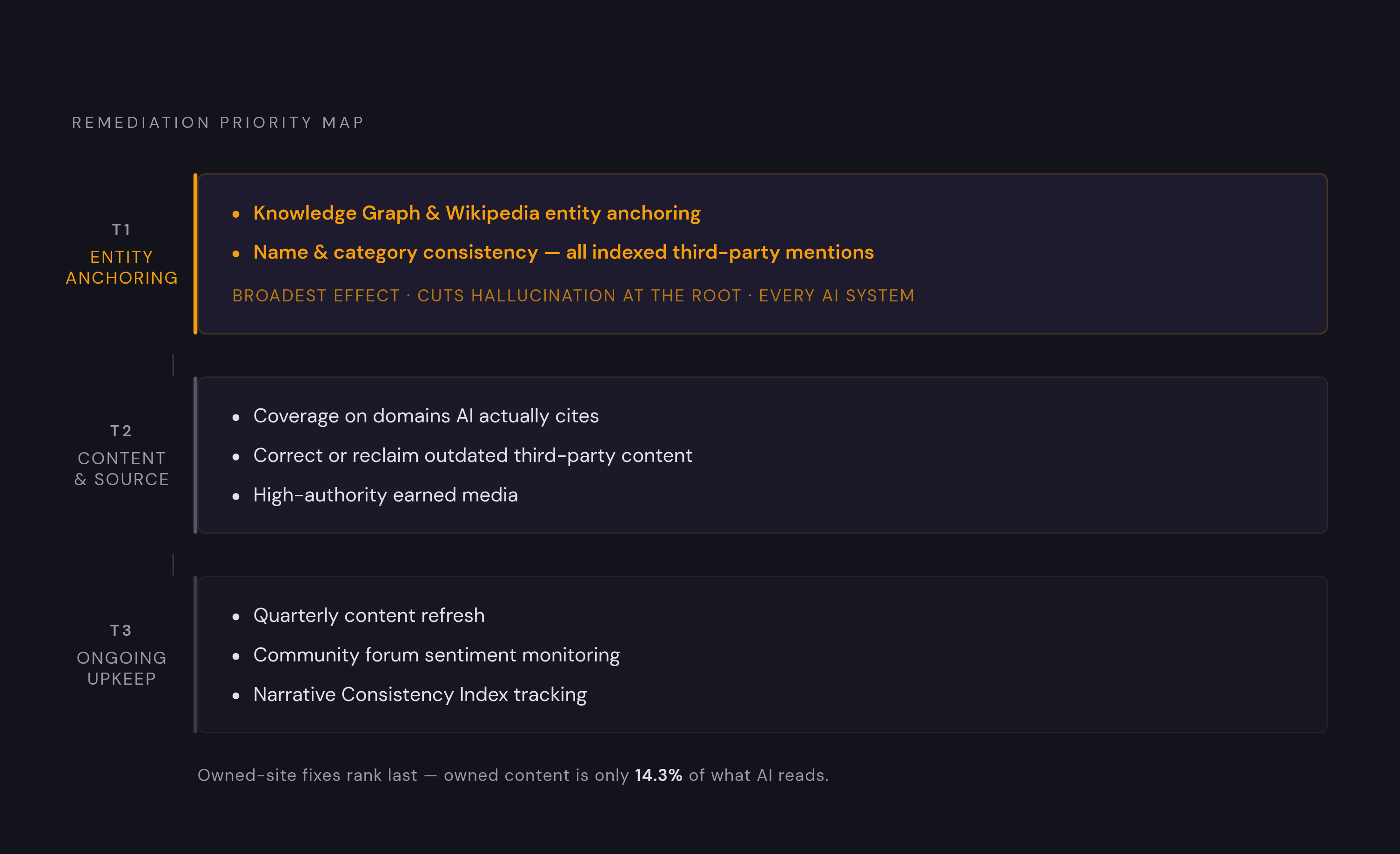
Some inconsistencies deserve more attention than others, and treating them as equally urgent is the mistake most brands make first. An audit worth running produces a priority map, ranked by how much influence a signal carries and how fast it can realistically get fixed.
Tier one covers structural fixes with the broadest downstream effect, and entity anchoring comes first: establishing or correcting Knowledge Graph and Wikipedia presence affects every AI system at once and cuts hallucination risk off at the root, rather than patching symptoms one at a time. Name and category consistency belongs here too. That means checking every indexed third-party mention for name variants and category misassignments, then standardizing across directories, press releases, and partner pages.
Tier two covers content and source fixes aimed at specific citation gaps. Start by identifying which third-party domains the AI actually cites for the brand's category, then prioritize earning new coverage there or correcting what's already published on those exact domains. That also means going back and updating or reclaiming outdated third-party content still carrying legacy positioning: old press release archives, stale review roundups, analyst summaries nobody's touched in years. Earned media from high-authority editorial sources carries outsized weight in AI citation hierarchies; a single well-placed feature in the right outlet can outweigh a dozen directory listings.
Tier three is ongoing upkeep. Content that never gets refreshed loses citation retention across repeated queries over time, so a quarterly refresh cadence cuts down on drop-off, and community forum sentiment needs watching on an ongoing basis too, since it feeds directly into how AI characterizes a brand's failure modes and use-case fit. Tracking the Narrative Consistency Index over time works as an early warning system: drift usually means some new, uncorrected source just entered the citation pool.
Here's where most remediation plans get the order backwards: they touch the brand's own site first, when owned content is only 14.3% of what AI actually reads. Fix the signals AI trusts, on the surfaces AI actually reads, before going anywhere near the homepage again. Measurement has to come before optimization, and a platform like Evident, scoring the full signal set, shows which fixes move algorithmic, AI, and human perception at the same time, so effort doesn't get spread thin across changes that don't matter.
What a re-audited brand looks like after targeted remediation
Run the tier-one and tier-two fixes, then re-audit. The shift shows up across presence rate, narrative consistency, and sentiment character all at once, not one at a time.
Once a brand is correctly defined in structured sources, the hedging and conflation tend to stop; descriptions stabilize across model and query type instead of shifting depending on which system happens to answer. When the high-authority domains an AI draws from get corrected, so they carry accurate, current positioning instead of the outdated version, AI-generated descriptions tend to shift within one or two re-indexing cycles rather than dragging on indefinitely. Presence rate improves too, as third-party coverage thickens and lines up internally; the brand starts appearing in a larger share of relevant answers, and competitors lose some of the default-recommendation edge they'd been getting for free. Sentiment shifts as well: consistent, editorially endorsed descriptions start replacing the averaged, forum-derived characterizations that had been dragging the brand toward neutral, and framing moves from hedged toward positively positioned.
Not everything moves fast, though, and pretending otherwise sets up the wrong expectations. Training data has its own latency, and some systems carry older representations of a brand longer than others regardless of what's been fixed upstream. Ongoing monitoring across systems stays necessary; it isn't a one-time exercise that gets closed out and filed away.
The larger point holds regardless of timeline. An AI perception audit is a baseline measurement, and what it reveals is the actual gap between how a brand intends to be understood and how it's being represented, silently, at scale, in every AI interaction a potential buyer has before that brand ever gets the chance to speak for itself.