Source Citation Analysis in LLM Brand Outputs
Most of what AI says about your brand comes from sources you don't control.

When a large language model describes a business, it isn't reading that business's website. It's stitching together a picture from whatever everyone else on the web has already said, and the accuracy of that picture depends on which sources the model pulled from and how much they agree with each other. Almost no company has actually looked at its own source stack this way, which is a little strange given how much money gets spent trying to influence it blindly.
Traditional search hands you ten blue links and lets you sort the ranking yourself. An AI answer engine collapses all of that into one synthesized response, often phrased like a recommendation, built from a far smaller set of sources than a search page would ever show you. That compression raises the stakes of citation quite a bit. Getting cited once inside an AI answer carries more weight than sitting at position four on a results page, because there's no position five or six for the reader to scroll past into. There's just the answer, and whatever fed it.
How concentrated and third-party-dominated the source base for LLM brand citations actually is
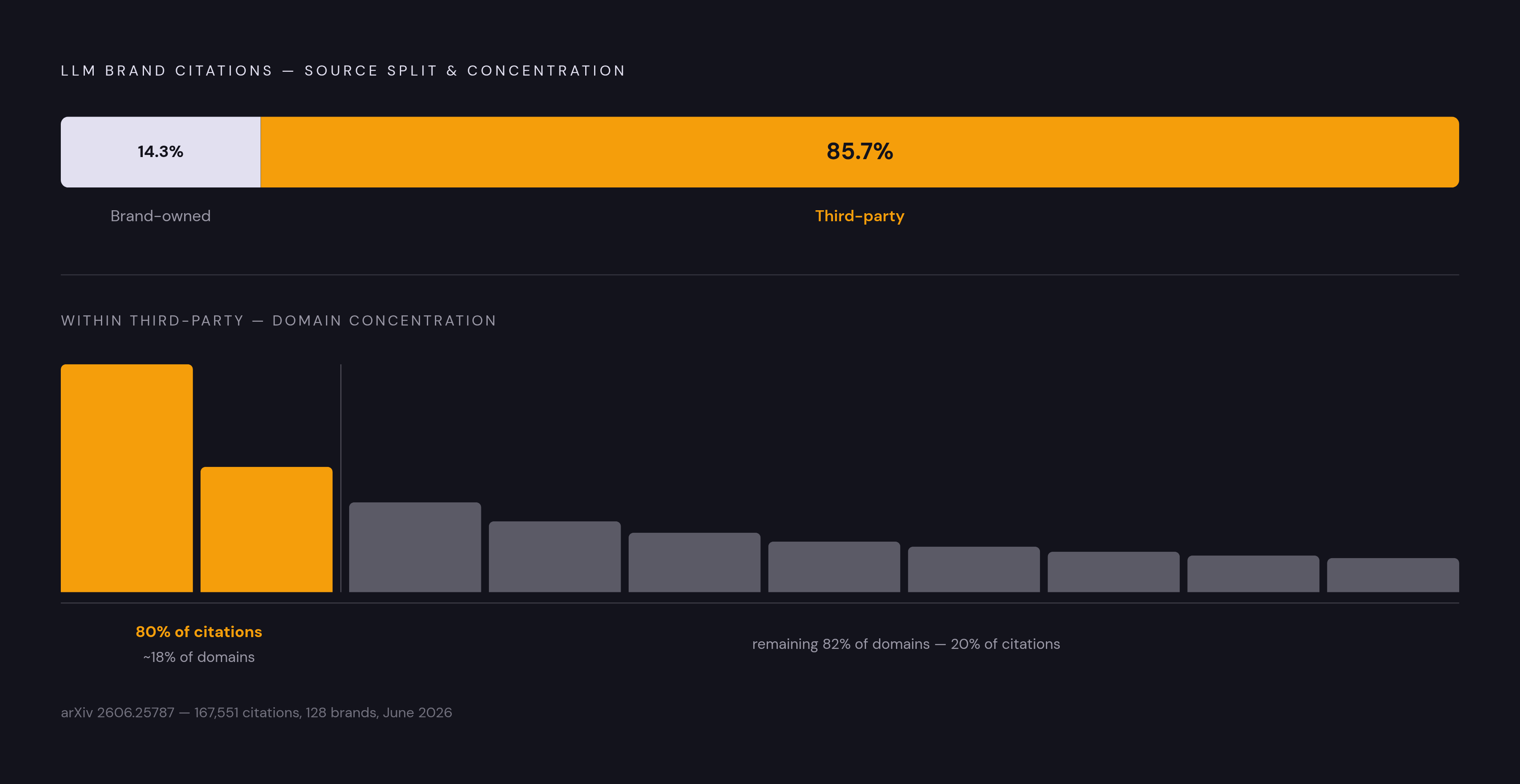
A June 2026 study on arXiv (paper 2606.25787) looked at 128 brands across 12 home markets and 13 languages, tracking 167,551 URL-grounded citations to find where LLMs were actually pulling their information from. The headline number: 85.7% of those citations pointed to sites the brand did not own. Only 14.3% came from the brand's own properties.
That number undercuts a habit most marketing teams have built entire strategies around. A company can write the sharpest About page in its category, publish thorough product docs, keep its blog current, and none of it will carry much weight in how a model describes that company to a prospective buyer. The website is a minor input; the rest of the internet, mostly outside the brand's control, does most of the talking.
The concentration inside that third-party pool tells its own story, too. The study found 80% of citations came from around 18% of the domains observed, a distribution that fits a Zipf-type curve (alpha of 0.86, R² of 0.983 in the paper's modeling). Plainly: a small cluster of high-authority sites accounts for nearly everything, while a long tail of smaller sites barely registers on its own. If a brand's coverage lives entirely in that tail, or is missing from the small cluster that actually dominates its category, that's a disadvantage that never shows up as an error message. The model just says less about the brand, or says it with less confidence, and nobody on the marketing team ever sees why.
Model behavior wasn't uniform, either. Perplexity was the heaviest citer in the study, generating 90,276 of the backbone citations analyzed and pulling from the widest set of domains, 15,995 total. There's no single "AI citation" pattern to chase. It's a field of models, each retrieving differently, and a brand optimized for one system's habits can still be a ghost to another.
Which specific domains LLMs rely on most, and where that pattern breaks by market and category
Wikipedia was the single most-cited domain in 11 of the 12 languages the arXiv study covered. For most markets, it's the structural anchor underneath everything an LLM knows about a brand.
The one exception is worth sitting with for a moment. In Lithuanian, the national business daily vz.lt edged out Wikipedia as the top-cited source. Small data point, large implication: a strong, trusted local authority can outrank the global default when it's genuinely the better-sourced option in that market. Wikipedia dominance doesn't travel evenly everywhere, and brands shouldn't assume it does.
Poland pushes this further still. Across 46 Polish national brands studied, YouTube was the single most-cited domain, not Wikipedia. Four HR and careers portals combined delivered 637 citations against just 297 for Polish Wikipedia, roughly double. For a Polish brand, then, how it gets discussed on employer review sites and careers portals shapes its AI-generated reputation more than its encyclopedia entry does. Employee sentiment isn't some side channel here. It's close to the main one.
Category muddies the picture even more. In beauty, an analysis of citations gathered from major LLMs found Reddit ranked first across the models studied, ahead of any editorial or brand-owned source. In CRM and sales software, TechRadar held the highest single-category citation share recorded anywhere in the research, meaning specialist review and comparison sites, not general reference sites, drive what AI says about B2B software vendors.
Put a beauty brand and an enterprise software vendor side by side. Their citation maps look almost nothing alike, and the platforms that matter enormously to one are close to irrelevant to the other. Before spending effort anywhere, a brand needs its own map: which domains actually dominate its category, in its market, right now. Guessing gets this wrong more often than not.
What signals determine whether a source, and a brand mentioned in it, gets cited by an LLM
AI answer engines aren't picking sources at random, and they aren't ranking by backlink count either. The logic runs closer to a confidence check: does this fact show up the same way across multiple sources that don't share an owner? If yes, the model cites with confidence. If a claim only exists in one place, or contradicts itself across sources, the model hedges or drops the brand entirely.
That's a real break from two decades of SEO logic. Traditional search rewards volume, more backlinks, more keyword density, more pages targeting a query. AI citation logic rewards agreement between independent sources telling the same story.
A few signals show up again and again in the research. Research has found a meaningful correlation between external brand mentions and appearances in AI Overviews. Domain authority still matters at scale; sites with very large referring-domain counts are noticeably more likely to get cited by ChatGPT. Freshness is a real factor too, with AI Overviews leaning on recently published or updated pages while older, stale content gets underrepresented even when it's accurate.
Entity coherence runs underneath all of it, and it's probably the least glamorous, most decisive factor of the bunch. Before a model will cite a brand with any confidence, it has to recognize that brand as one stable, distinct thing, with a consistent name, description, and category across every platform where it shows up. A brand that calls itself one thing on LinkedIn, another on Crunchbase, and something slightly different on its own homepage hands the model a puzzle instead of an answer. Models resolve puzzles by saying less, not more.
There's also a narrower kind of authority worth naming: topic-conditional authority. A domain doesn't need to be broadly powerful. It needs to be the recognized answer for the specific question in front of the model. General authority helps less than being the go-to source on the exact topic at hand.
Research from 2025 adds a layer that should worry any team betting everything on classic SEO: a large share of AI Overview citations come from pages that weren't in the traditional top-ten search results at all. Ranking well on Google and getting cited by an AI model are different achievements built on overlapping but distinct signals. A company can have excellent SEO and still be functionally invisible to the systems increasingly mediating how people find and evaluate businesses.
The hallucination layer: when LLMs don't just omit a brand but misrepresent it
Omission is the milder problem. Fabrication is the serious one, and any citation analysis has to account for both.
A 2026 benchmark testing LLMs on citation generation found hallucination rates that varied widely by vendor, with some models fabricating the majority of citations they produced. A separate analysis of hallucinated citations, run by Ansari in 2026, found most of those fabrications weren't small errors. They were total inventions. Nearly all of them showed what the analysis called compound failure, meaning multiple fields were wrong at once rather than one detail slipping.
For a brand, this plays out as a model stating a founding date that never happened, describing a product feature that doesn't exist, or placing a company in a market position it's never held, all delivered in the same fluent, confident tone the model uses for facts it got right. No asterisk. No confidence score shown to the reader. The fabrication reads exactly like the truth, which is what makes it dangerous.
Brands with thin external coverage carry more risk here, not because thin coverage causes hallucination directly, but because a model with little verified material to draw from has more empty space to fill. It fills that space with plausible invention rather than admitting it doesn't know.
The correction problem makes all of this worse. A bad review can be flagged, answered, appealed. A fabricated AI-generated description of a company has no such mechanism; there's no button that gets a model to retract what it said at the source. The only real defense is preventive: build a footprint across trusted external sources so dense and well-corroborated that there's little room left for a model to invent something in the brand's absence.
How to read the source citation stack for any brand before trying to change it
Measurement has to come before optimization. A brand acting on assumptions about which sources shape its AI description is very likely acting on the wrong ones, given how much variation exists by market, category, and model.
A real citation audit starts with querying the major LLMs directly, at minimum ChatGPT, Gemini, and Claude, since those three account for the highest volume of buyer-facing queries. Ask about the brand by name. Ask category questions where the brand should reasonably show up. Record what gets cited explicitly, and note where a description seems to draw from a source the model never names outright.
From there, the citations need mapping: owned versus third-party, and within third-party, what type. Reference sites like Wikipedia. Review platforms. Trade press. Community and social platforms. HR and careers sites. Once that map exists, compare it against the known citation hierarchy for the brand's actual category and market, the kind of pattern the arXiv research and the category-level studies above sketch out. The gap between where a brand has presence and where citations actually concentrate is the whole point of the exercise.
Doing this by hand, one query at a time, gets tedious fast, which is part of why monitoring platforms built for exactly this have started showing up. Monitoring platforms built for exactly this purpose give a structured read on where citation exposure runs strong, where it's thin, and where fabrication risk is highest.
Worth establishing early, as a baseline: Share of Model, meaning how often a brand shows up in AI-generated responses relative to competitors on relevant queries. Without that number in hand before any changes get made, there's no way to tell later whether an intervention actually worked or the shift was just noise.
The audit should leave a brand with three things: which domains currently shape what LLMs say about it, which domains it's absent from but shouldn't be, and which specific claims in AI outputs are wrong. Wrong claims are usually the clearest tell of thin or fabricated sourcing underneath.
The concrete changes that shift which sources LLMs cite, and what they say
Analysis of enterprise brands has found something that should reframe how most marketing teams think about this entire problem: many are essentially invisible to generative AI models, despite having spent years and real budget on traditional SEO. The gap wasn't content quality. It was the absence of the specific signals AI citation systems actually look for.
Fixing that starts with entity coherence, and it has to start there, since everything downstream depends on it. A brand needs the same name, the same description, the same founding details, and the same category classification across Wikipedia, LinkedIn, Crunchbase, and every industry directory where it appears. Inconsistency doesn't just look sloppy. It creates uncertainty that a model resolves by citing less, or by guessing wrong.
Wikipedia presence comes next for most brands. Given its dominance in 11 of 12 languages in the arXiv study, a brand without an accurate, well-sourced Wikipedia article is missing the top rung of the citation hierarchy in most markets, outside a handful of specialist categories. It's probably the single highest-leverage platform available to most companies, full stop.
From there, the work turns category-specific. A B2B software brand needs real presence on the review and comparison sites, TechRadar-type publications, that actually drive citations in that vertical. A beauty brand needs a genuine footprint in community discussion, on platforms like Reddit, where that category's citation activity concentrates. There's no universal platform list. There's only the list that matches the category and market a brand actually competes in.
Earned media does real work here too, and it's worth naming plainly: PR, in this context, isn't a branding exercise or a reputation exercise. It's citation infrastructure. Independent press coverage, analyst commentary, and expert quotes build exactly the cross-source corroboration that AI citation logic is checking for.
Content itself needs restructuring for how models actually retrieve it. LLMs pull passages, not whole pages, so each section should open with a direct, self-contained answer, structured under clear headings, written in plain language dense with actual facts. That structure raises the odds a specific passage gets pulled and cited, rather than skipped over for a competitor's cleaner paragraph.
None of this is a one-time fix. Freshness matters on an ongoing basis, since AI systems lean toward recently updated content, which means key pages, About pages, product descriptions, case studies, need active maintenance rather than a single publish date and years of neglect. And the landscape keeps moving anyway: models update, new sources gain authority, competitors build out their own footprint while nobody's watching. The brands that hold onto AI visibility are the ones treating source citation analysis as a habit, checked on a regular cadence, not a project finished once and filed away.