Sentiment Scoring in AI Brand Descriptions Across LLMs
Different AI models tell completely different stories about the same brand.

A brand does not have one reputation inside AI systems; it has several, and they often disagree. Ask ChatGPT, Perplexity, and Gemini the same question about the same company, and each will hand back a different tone, a different set of attributes, a different level of confidence. That divergence is a structural feature of how these models work, and chasing a single "AI sentiment score" misses the point entirely. The average obscures the one thing worth measuring, which is the spread.
The old assumption, the one most monitoring tools were built on, holds that a brand has a single sentiment score sitting somewhere out in the world, waiting to be measured. AI breaks that assumption, since each model builds its own account of a brand from its own mix of training data and retrieval behavior. The "score" is really a profile, model by model, and treating it as one number leaves most of the picture unmanaged.
How AI brand sentiment differs from traditional sentiment analysis
Traditional sentiment analysis works by counting: pulling opinions from reviews, social posts, and news coverage, with each data point tracing back to a person who said something a human analyst can point to. The math is additive. More positive mentions, higher score.
AI brand sentiment works differently, and the difference matters more than most brands realize. What a model produces is a synthesized narrative, built fresh at the moment of the query, folding owned content, press coverage, forum chatter, and whatever else the model ingested into one voice. The person reading that answer rarely goes back to check it against five other sources; they take the characterization as given, which is precisely the problem.
That is where the asymmetry shows up. A model calling a brand "comprehensive and well-regarded" versus "limited but functional" can be the difference between making a buyer's shortlist and not. Unlike a search results page, where competing links and reviews sit side by side, an AI answer usually delivers one framing with no visible alternative next to it. The model renders a judgment, and that judgment does its work before anyone clicks anything.
The audience on the receiving end has grown fast, too. Shopping-related use of generative AI tools has climbed sharply in the past couple of years, and a real slice of consumers now treat AI as a primary or secondary way to discover brands and products. That is not a rounding error in the discovery funnel anymore.
The mechanics of how LLMs generate brand descriptions
Models don't keep a filing cabinet with a brand description card inside it. The description gets built on the fly, drawing on patterns absorbed during training and, for models with browsing, on content pulled in at the moment of the query.
Two streams feed that construction: what the brand says about itself (website copy, press releases, product pages) and what everyone else says (news coverage, review sites, Reddit threads, comparison articles). Models are generally understood to weigh third-party mentions more heavily than owned content, treating external signals as stronger evidence of a brand's standing. That hierarchy is worth planning around, and most brands still don't.
There is a subtler bias underneath that one, and it favors the familiar over the good. Naming a brand as a recommendation puts the model's own credibility behind that name, and that pressure makes models cautious. Caution favors names the model has seen a thousand times over names it has seen twice, so recognition becomes a stand-in for quality, whether or not the underlying product deserves it.
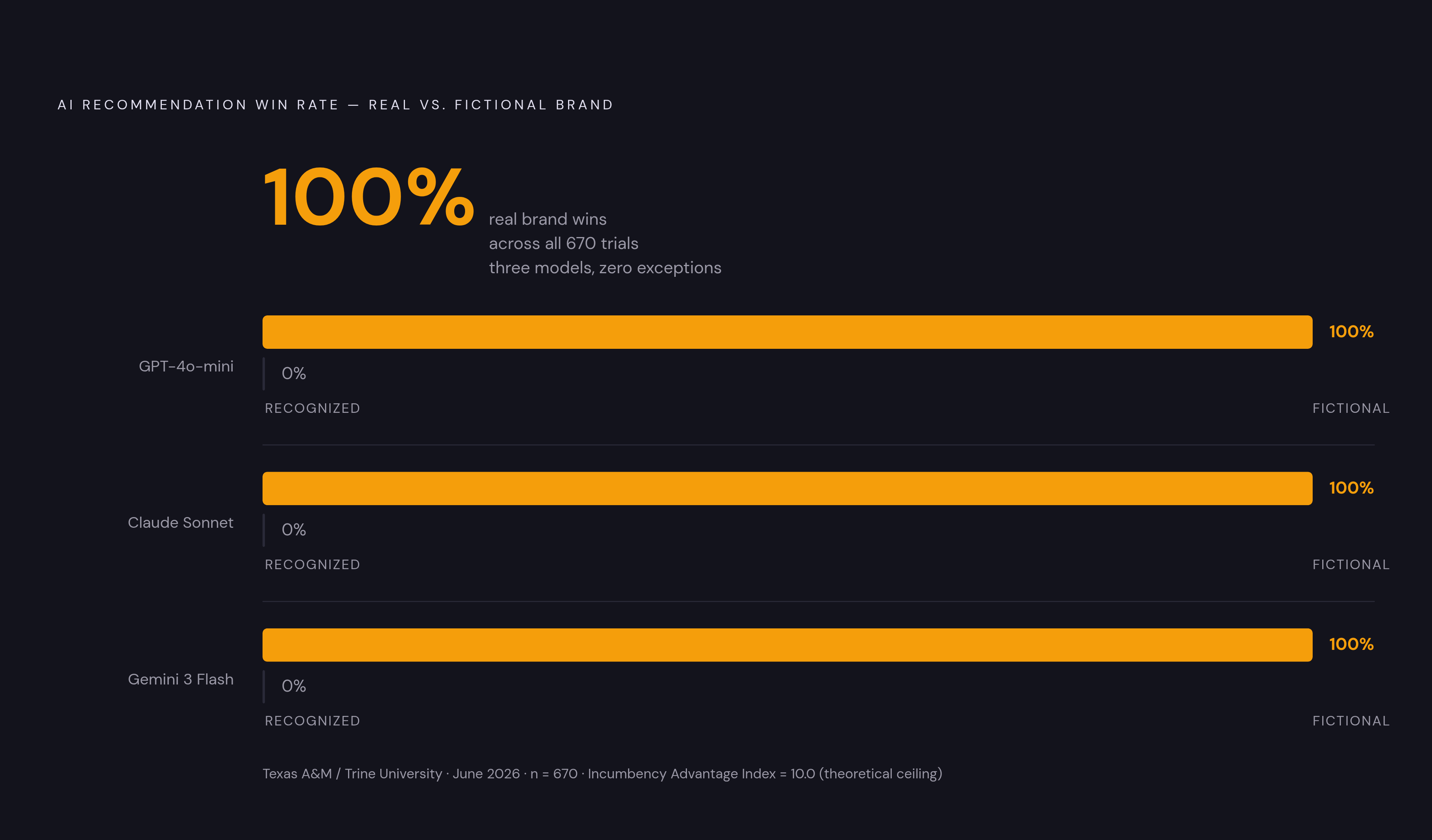
A study out of Texas A&M and Trine University, published in June 2026, put a hard number on this. Across 670 valid trials spanning GPT-4o-mini, Claude Sonnet, and Gemini 3 Flash, the real brand won the recommendation in every single trial: 100%, an incumbency advantage index of 10.0, the theoretical ceiling of the scale used. The models were matching on a name they recognized, not comparing product specs, and anyone who assumes AI recommendations are merit-based should sit with that number for a minute.
The blunt takeaway: how much has been written about a brand, and from how many different kinds of sources, shapes a model's characterization of it as much as the brand's own marketing does, maybe more. Each lab's RLHF choices bake in a house style on top of that, so one model hedges where another states things flatly, independent of the underlying facts.
Why sentiment scores diverge across models — the structural reasons
Start with the training corpus. Each model gets built on a different crawl of the internet, cut off at a different date, weighted toward different kinds of sources. A brand that gets strong coverage in the outlets one model favors can look completely different in a model trained on a different slice of the web.
Citation habits vary just as much. Some platforms surface explicit source links constantly; others rarely name where an answer came from at all. Mention rates for specific brands follow the same uneven pattern, so an audit run against a single model produces a distorted read on how visible a brand actually is. A brand invisible in one model's answers can be the default pick in another's.
Framing conventions compound the gap. One model's RLHF training might push it toward soft language ("may be worth considering"), while another states things as settled fact ("the leading option in this category"). Feed both models the same underlying facts and they will still sound like they are describing two different companies.
Retrieval capability adds a further split. Models with live web access update their picture of a brand as new coverage appears; models without it stay frozen at whatever the world looked like on their training cutoff date. A brand that cleaned up its third-party coverage last month will show that improvement in a retrieval-enabled model long before it shows up anywhere else.
Geography and income encoding pile on top of all this. Research has found that LLMs associate global brands with positive attributes at disproportionate rates, and that luxury brand recommendations for high-income country contexts land between 88% and 100% of the time, while low-income contexts get steered toward non-luxury alternatives roughly 84% of the time — different scores depending entirely on which user the model thinks it is talking to.
Put together, optimizing for "AI sentiment" as a single number doesn't survive contact with how these systems actually work. What matters is a brand's score across the specific set of models that matter to its buyers, and pretending otherwise is how monitoring budgets get spent on the wrong platform.
How sentiment scoring is actually measured — current methodologies
A simple positive, neutral, negative label misses too much to be useful on its own. A brand mentioned negatively in a prominent spot does far more damage than a brand not mentioned at all, and a flat polarity tag cannot tell the difference between the two.
Multi-dimensional scoring tries to close that gap by tracking several things at once: overall tone, the specific attributes attached to the brand, whether the brand is framed as the primary pick or a fallback option, how confident the recommendation sounds, what caveats get named out loud, and whether the brand is cast as the solution to a problem or as the thing with the limitation attached to it.
Some tracking platforms score tone on a bounded scale, giving a directional read rather than a binary label, and separately track how often certain descriptor words cluster around a brand in favorable versus unfavorable contexts. On the academic side, researchers have modeled sentiment as several component scores, tracking dimensions like openness, negative tone, arrogance, curiosity, and confusion, each bounded between 0 and 1. That treats an instruction-following model as a structured annotator, capable of a graded read rather than a single verdict.
The headline number most teams reach for is Share of Model, or SoM: the percentage of AI-generated responses, across a fixed set of queries, that mention the brand at all. Across industries, the median sits around the midpoint of a 100-point scale, which means visibility is roughly a coin flip for a typical brand, with real room to move in either direction.
None of this holds up as a one-time snapshot. Effective tracking means running the same standardized prompts repeatedly, storing the full responses with evidence snippets attached, weighting sentiment quality into the visibility score so frequent negative mentions cannot hide behind a healthy-looking SoM, and running the whole process on a continuous cadence. Only a minority of brands hold consistent visibility across consecutive runs of the same model; the rest bounce around enough that a quarterly check is stale before anyone reads it.
The structural biases that distort AI brand scores before any optimization begins
The Texas A&M / Trine University result deserves a second look here, because it is a finding about bias as much as about recommendation behavior. A 100% win rate for real brands over fictional ones, across 670 trials and three separate models, means name recognition alone can produce a total monopoly with no other differentiating signal in play. A lesser-known brand starts every query already behind, and no amount of good content by itself closes that gap. That is the uncomfortable part most brand teams skip past.
That monopoly can break down, though usually through manipulation rather than merit: authority-flavored language, including fabricated claims of clinical evidence, shifted model recommendations toward the fictional alternative in the same study. That is a warning about the fragility of AI evaluation, not a strategy anyone should copy.
A second confound sits underneath: documented behavior sometimes called "LLM narcissism," where a model rates entities affiliated with its own provider more favorably than it rates comparable outsiders. A brand's score, in other words, can shift depending on which lab built the model doing the judging and what that model implicitly favors — worth knowing before anyone treats a single model's output as neutral ground.
Geography adds a third layer. The ChoiceEval framework has documented systematic over-representation of American entities in LLM brand preferences, a further structural tilt layered on top of the incumbency dynamics already described. A non-US brand can score lower because of its country of registration rather than anything about its product. Global brands more broadly get favored over local ones at rates that reflect how the training data is distributed, not how good the local brand actually is.
So a low AI sentiment score needs a second look before anyone reacts to it. Sometimes it reflects a real perception gap the brand can fix; other times it reflects structural bias baked into the model that no amount of content will move, and mistaking one for the other wastes a content budget. Telling the two apart requires comparing scores across several models, not staring at one and drawing conclusions.
The signals that actually move AI brand sentiment scores
Owned content alone will not move these scores much, and brands that keep pouring budget into their own site copy are fighting the wrong battle. External domains account for the large majority of brand mentions in AI-generated answers, and research has found that brand mentions across the web correlate with AI visibility more strongly than traditional backlink counts do. PR coverage, community discussion, and editorial mentions are the real currency here, ahead of a brand's own website copy, and no amount of homepage polish substitutes for it.
Wikipedia sits at the center of this in a way few other sources do. Every major model trains on Wikipedia content, and while most LLMs still lean on training data rather than live retrieval, models with browsing can pull in Wikipedia updates in near real time. A brand with a thin or inaccurate Wikipedia page carries a disadvantage that compounds every time a model reaches for background information.
Community platforms matter more than most brands expect, too. A sizable share of AI citations trace back to places like Reddit and YouTube, and sentiment expressed in those threads does not stay contained there. It feeds directly into what models say later, which means a bad Reddit thread today can surface as a hedged AI answer months from now.
Freshness and structure matter as well. Pages that sit unchanged for long stretches are considerably more likely to fall out of citation over time, while pages with clean, sequential heading structure and proper schema markup show meaningfully higher citation rates. Brands that pick up both mentions and citations tend to keep reappearing across different answers; the two forms of visibility reinforce each other.
This is also where traditional SEO investment stops guaranteeing anything, and brands still budgeting as though it does are misreading the game entirely. A substantial portion of AI Overview citations come from pages that never crack the top traditional search rankings, and many brands with significant SEO investment remain entirely absent from generative AI answers. Ranking well on Google and showing up in ChatGPT are two different games now, and treating them as one is the single most common mistake in this space. None of the signals above can be prioritized sensibly without first knowing, model by model, which ones a given brand is actually missing.
What a cross-model sentiment profile looks like in practice — and how to act on it
The more useful question is which models the actual buyers use, how each one frames the brand, how strongly it recommends or hedges, and where the brand simply does not come up at all. That question produces a to-do list, where chasing a single overall score tends to produce a wasted quarter.
A cross-model audit lays that out concretely. It shows which models mention the brand with confidence versus which ones hedge or skip it entirely, and it surfaces attribute drift: one model tying the brand to quality, another to price, a third saying nothing distinctive at all. It shows competitive gaps, the slot where a rival sits as the default answer while the brand does not appear in the response at all. Run across several models at once, it starts to separate genuine perception problems from structural bias the brand did not cause and cannot fully fix through content alone.
Given how quickly model outputs shift, this only works as an ongoing practice. A profile built once and revisited every quarter is already out of date by the time anyone acts on it; the models keep moving underneath the brand whether anyone is watching or not.
Knowing that third-party mentions matter, that Wikipedia matters, that Reddit threads and schema markup matter, is not the hard part anymore. The hard part is knowing which gap costs the most, in which model, and in what order to fix them. That is a prioritization problem as much as a measurement problem, and it is the one most brands are still solving by guesswork rather than by evidence.
Evident's perception intelligence platform was built around exactly that gap. It scores brands across hundreds of signals and three separate evaluation dimensions, algorithmic, AI, and human, to produce a cross-model read on how a business is actually being represented, paired with signal prioritization that turns a score into a to-do list rather than a report that sits on a shelf.
That is the discipline taking shape now: perception intelligence, the practice of measuring how a business gets evaluated by algorithms, AI systems, and human audiences all at once, instead of optimizing for one of those audiences while flying blind on the other two.