Wikipedia and Wikidata as Foundational AI Perception Signals
Wikipedia and Wikidata shape how AI systems describe your business before you even know they exist.

Wikipedia and Wikidata do more than settle a fact or a birthdate. They are two of the most important raw materials that large language models were built from, which means they shape how AI systems describe, rank, and recommend businesses long before a marketing team ever notices. That fact has quietly become one of the more consequential realities in how companies get represented in the AI era, and most businesses have no idea it applies to them.
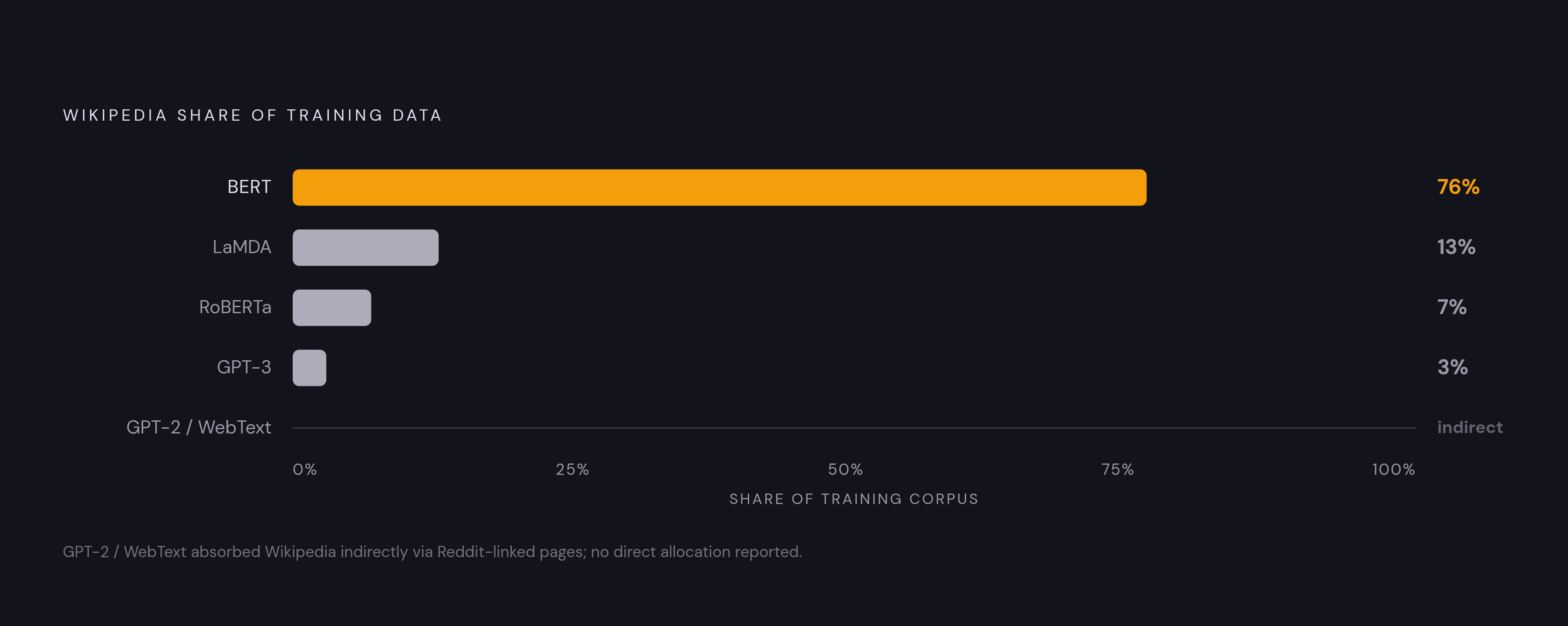
The dependency is not speculative. Researchers who studied pretraining data composition found that Wikipedia made up 76% of BERT's training corpus, which is close to the entire signal BERT used to learn how entities connect to facts and how language describes them (arxiv.org/2305.13169). RoBERTa pulled 7% of its training data from Wikipedia, GPT-3 pulled 3%, and LaMDA pulled 13%. Those are smaller shares, but they were deliberate inclusions. GPT-2 and GPT-3's WebText dataset skipped Wikipedia entirely, but only because it was already baked into the other datasets those models trained on. Missing from one pipeline usually means the signal arrived through another. Wikimedia Enterprise has since released clean, machine-readable versions of Wikipedia, complete with article abstracts and structured sections, built specifically for machine learning workflows. It reflects deliberate infrastructure for exactly this use case.
Wikidata does a different job. Wikipedia reads like a book written about a company; Wikidata functions like a database entry about it: machine-readable, cross-referenced, and built to be queried rather than read. It holds more than 100 million structured entity records, each with its own Q-ID, and it's the single most important quantitative source feeding Google's Knowledge Graph. It also shows up in places most people never connect back to Wikipedia at all, like Alexa's answers, Siri's responses, and the enriched panels that show up next to search results. In 2025, the Wikidata Embedding Project, a collaboration with DataStax and Jina AI, added vector-based semantic search to the graph, making that structured data even easier for LLM pipelines to pull from directly.
Put those two pieces together and the implication is plain: before a business has run a single search campaign or touched a landing page, language models may have already formed an opinion of it, or formed nothing at all, based entirely on what these two sources say or fail to say.
What LLMs actually do with that training data when someone asks about a business
Language models don't go fetch a webpage when someone asks about a company. They generate an answer from patterns absorbed during training, so the real question for a business isn't "does my site rank on Google," it's "what pattern did the model actually learn about me." A company can have excellent SEO and a nearly blank Wikipedia and Wikidata footprint at the same time, and if that's the case, the model may simply have no structured signal to draw from when someone asks about it. When ChatGPT, Claude, Perplexity, or Google's AI Overviews answer a question about a business, they're pulling on whatever pattern got absorbed: what was said, where it was said, and how consistently it showed up across sources.
That gap matters more each year because people are asking AI tools instead of typing into a search box. Reports indicate that information-seeking use of ChatGPT has grown substantially over the past year. SOCi's 2025 Consumer Behavior Index reported traditional search traffic dropping noticeably, with about one in five consumers now using AI tools monthly to find local businesses. Google's AI Overviews, which launched in May 2024, now show up in more than half of all searches, and AI Mode is pushing generative answers from a bonus feature to the default way people see results.
That shift creates what's effectively a blind spot for the businesses being discussed. An AI system can recommend a company, or leave it out of a comparison entirely, and none of that shows up in the company's own web analytics, because there was no click and no session to log. Industry analysts have warned that organic search traffic could fall sharply in the coming years as generative AI becomes the main way people interface with information online. A business can be actively shaping opinion or actively invisible, and either way, its own dashboards stay silent.
There's a second layer to this worth sitting with. Research published in 2024 (arxiv.org/2410.08918) found that LLMs absorb Wikipedia's neutrality norms along with its facts, meaning the way Wikipedia frames a topic bleeds into how the model talks about that topic later on. So a company that's well documented, with consistent and neutral coverage on Wikipedia and Wikidata, tends to get described with confidence. A company that isn't gets stitched together from scraps, or skipped over entirely.
How Wikipedia notability functions as an algorithmic trust gate, not just an editorial standard
Wikipedia runs on three core policies: verifiability, no original research, and neutral point of view. Editors wrote those rules to keep articles honest, not to build a trust system for search engines and AI models. But that's what happened anyway. Search and AI systems have effectively absorbed Wikipedia's editorial rulebook as a stand-in for credibility.
Notability, the requirement that a subject has real, independent coverage in reliable sources, lines up almost exactly with what Google's E-E-A-T framework rewards. Experience shows up as documented history and milestones. Expertise shows up as sourcing that traces back to credible outside parties, not self-description. Authoritativeness comes from the editorial scrutiny and citation trail built around the article over time. Trustworthiness comes from the neutrality requirement and the fact that the article gets revised when it's wrong. This is a record that's been contested, checked, and approved by people with no stake in making the company look good.
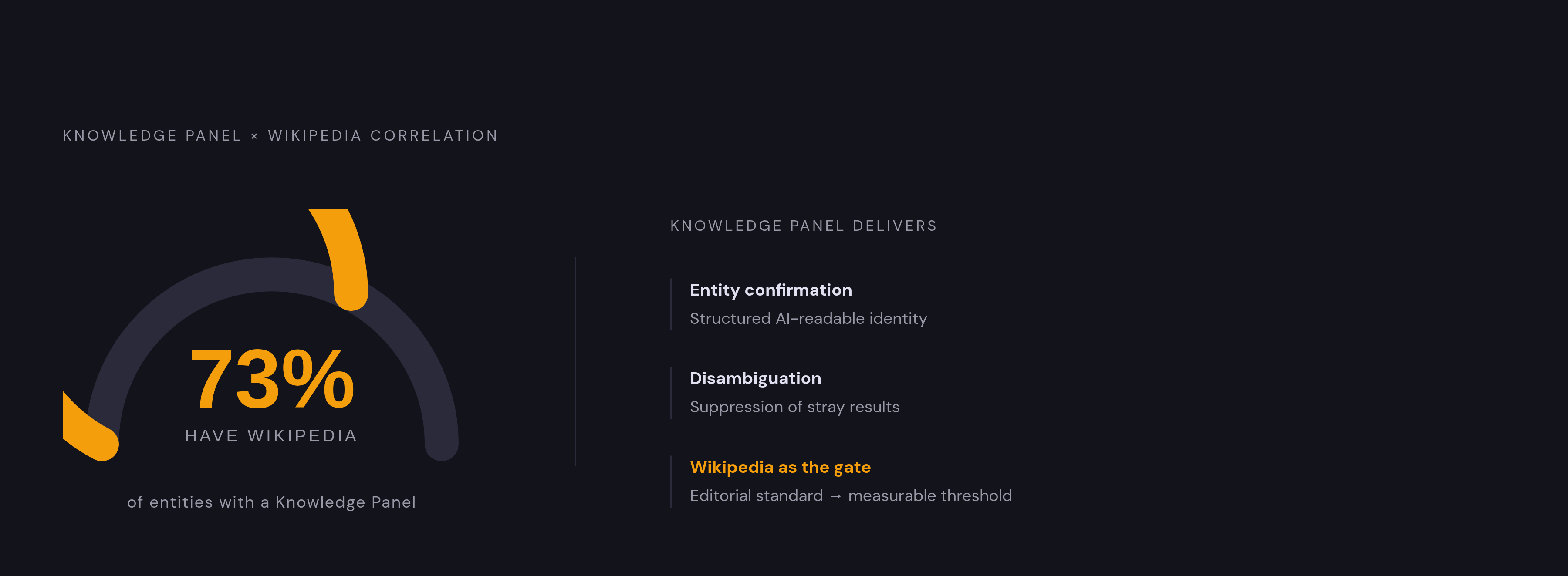
The Knowledge Panel is where this becomes concrete rather than theoretical. Research has found that 73% of entities with Google Knowledge Panels also had a Wikipedia page. That correlation is strong enough that Wikipedia notability functions, in practice, as the gate you have to pass through to get structured visibility in the AI era. A Knowledge Panel does more than look nice next to a search result. It confirms the business to a prospect checking the name before a call. It gives AI systems a clean, high-confidence answer when someone asks an entity-level question. It pushes stray or negative results further down the page. And it feeds a kind of loop: once one authoritative platform cites the record, others tend to follow, and the authority compounds.
The bar also acts as a filter on quality, not just presence. A Wikipedia article backed by five independent, reliable citations carries real algorithmic weight. A thin, self-created entry propped up on weak sourcing does not, and Google's systems are built to tell the two apart. Here's the tension worth naming directly: plenty of legitimate, well-run, mid-market companies simply haven't generated the kind of independent press coverage Wikipedia requires yet. Notability isn't something you can trick your way into. It's earned, over time, through actual outside coverage, and that has real operational consequences for how a company should plan its next few years.
Wikidata's role as the structured entity layer that feeds Google's Knowledge Graph and Gemini
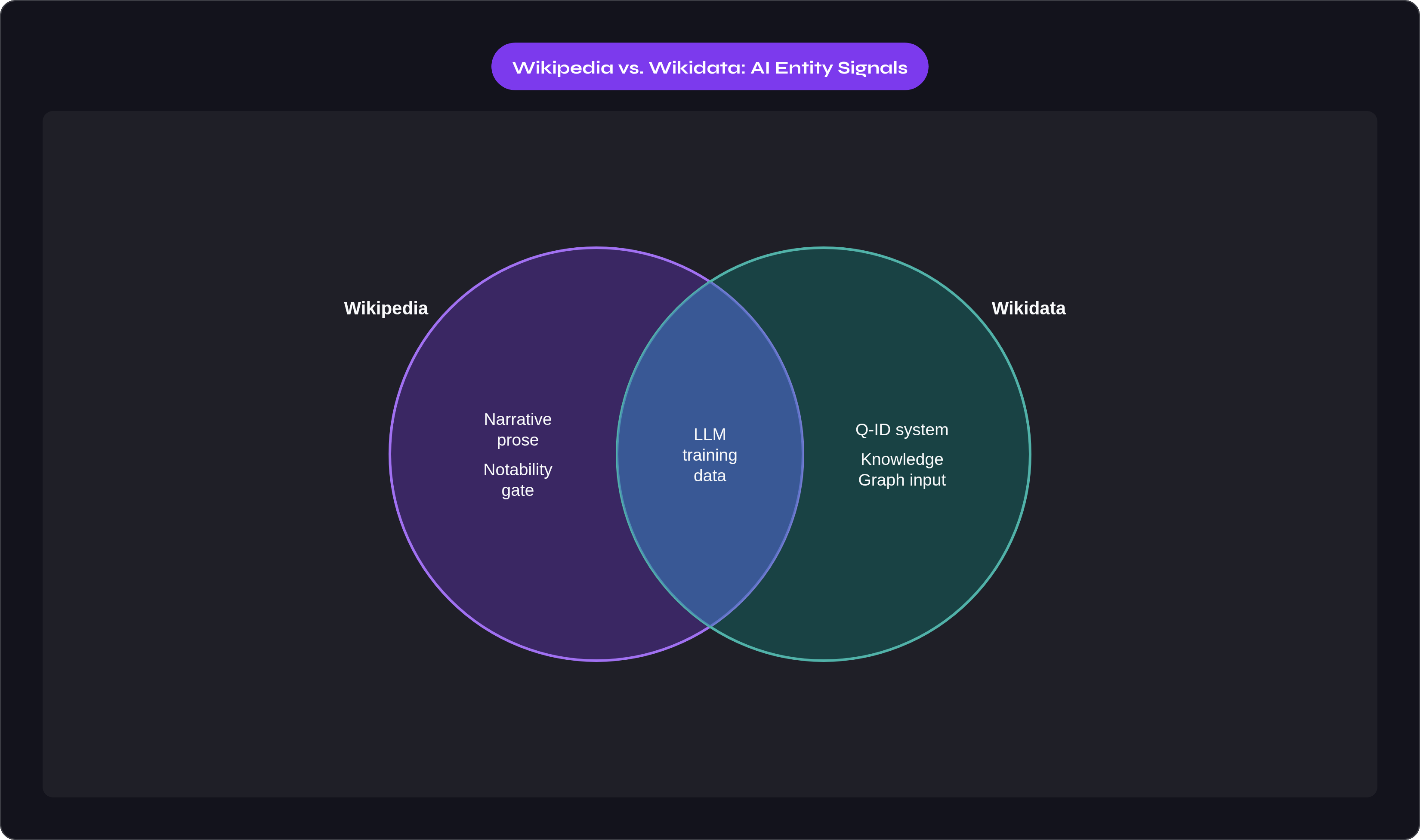
Wikipedia and Wikidata split the work. Wikipedia carries the language and the narrative. Wikidata carries the structured facts a machine can pull without reading a single sentence of prose. Google's Knowledge Graph holds around 5 billion entities and more than 500 billion facts, and its most important quantitative input comes from Wikidata's Q-ID system.
A Q-ID is an identifier that tells Google's systems, in effect, that "Acme Corp" the brand, "Acme Corp" the search query, and "Acme Corp" mentioned in a news story are all the same real entity in the world, not three unrelated strings of text. Google draws on other sources too, including Wikipedia infoboxes, Crunchbase, official company websites, Schema.org markup, and various industry registries. But Wikidata is the one open, community-maintained, structured layer sitting underneath most of it.
Gemini, Google's AI system, trains on the Knowledge Graph. That means having a clear, established entity isn't just good search hygiene; it's a prerequisite for showing up with any authority in AI Overviews or AI Mode answers. Approximately 92% of AI Overview citations reportedly come from domains that already rank in Google's top 10 results, but ranking alone doesn't settle which of those top-10 pages Google treats as the authoritative source for a given claim. Entity clarity does that work.
One catch worth flagging: creating a Wikidata entry with no independent, reliable sources behind it produces a stub, and stubs don't get treated as credible by Google or by LLM pipelines. The same notability floor that governs Wikipedia applies here too, just enforced a little differently.
Still, Wikidata tends to be more actionable for businesses that haven't cleared the mainstream press bar. It's an open, editable structured database, so contributions go in directly rather than through an editorial gatekeeper. But easier to edit doesn't mean risk-free. An unsupported Wikidata entry with incomplete or conflicting information can do more harm than having no entry at all, because it hands AI systems a shaky foundation instead of no foundation.
What accurate, well-structured Wikipedia and Wikidata presence actually signals to AI systems about a business
Having a Wikipedia page on its own doesn't guarantee a strong signal. What actually matters is whether the entity is consistent, corroborated, and coherent across independent, authoritative sources.
Consistency means the same name, founding date, leadership team, and category show up the same way across Wikipedia, Wikidata, the company's own website, Crunchbase, and other registries, cutting down on ambiguity for whatever system is assembling a profile. Corroboration means multiple independent sources, cited right there in the Wikipedia article, back up the same set of facts; this is the actual mechanism that turns notability into an E-E-A-T proxy rather than just a Wikipedia in-house rule. Entity coherence is what the Wikidata Q-ID delivers by linking the Wikipedia article, the official website, social profiles, and press mentions into one node, so an AI system can treat all of that as one verified thing instead of a scattered pile of unrelated mentions.
Framing counts too. Because LLMs pick up Wikipedia's neutral, factual tone as a behavioral pattern, an article written in that register shapes how a model chooses to talk about the business later, not just what facts it repeats. Tone carries real signal weight of its own.
When none of this exists, the model doesn't leave a blank space. It fills the gap with whatever else it picked up: competitor mentions, forum threads, stray review snippets, low-quality co-occurrence data. The resulting picture of the business is one the business never had a hand in shaping. In practice, that can mean getting left out of category comparisons the company should obviously be part of, watching a competitor get named as the default answer, or seeing outdated or wrong claims repeated with no correction in sight.
Wikipedia and Wikidata signals within a broader multi-dimensional perception scoring framework
Reputation scoring exists to turn soft, qualitative impressions into something a company can actually track over time, and the architecture behind a given score determines which signals get weighted and why. Most composite scores blend review sentiment, branded search visibility, social engagement, and survey data into a single number or letter grade, though platforms like Scale Labs, which scores across algorithmic, AI, and human evaluation dimensions, extend that picture beyond what human audiences alone produce. The Harris Poll Reputation Quotient, one of the more established models, measures six dimensions: social responsibility, emotional appeal, financial performance, products and services, vision and leadership, and workplace environment, all built around how human audiences perceive a company. FTI Consulting's RepScore benchmarks governance and ESG performance. Caliber's platform tracks media volume against real-time shifts in stakeholder sentiment.
These frameworks were built for a world where humans did the discovering and search engines did the ranking. Few of them were designed to answer a much newer question: does an AI model represent this business accurately, or favorably, or at all. That's a different thing to measure, and most scoring methods haven't caught up.
Wikipedia and Wikidata signals sit in a spot most current frameworks barely touch. They function as entity-layer signals rather than reviews, social engagement, or search rankings, the raw material that determines whether an AI system has anything coherent and credible to work from about a business in the first place. A company can score well on review sites and branded search and still have a broken or missing identity at the AI layer, if its Wikipedia and Wikidata records are thin, inconsistent, or don't exist.
The newer practice of tracking how often, and in what light, a brand shows up in AI-generated answers depends entirely on getting these entity-layer signals right first. Measurement has to come before optimization. You can't score how a model represents you if you don't know what raw entity data it's pulling from to build that representation in the first place.
What businesses can actually do to strengthen their Wikipedia and Wikidata signals
Start with an audit, not an edit. Before changing anything on either platform, find out what AI systems currently believe about the business, because that's the actual starting line.
Ask ChatGPT, Perplexity, Claude, and Google's AI Overviews about the brand and its category, and write down what comes back: what's accurate, what's missing, what's flat wrong. Check whether a Wikidata Q-ID exists at all, whether it links to the right Wikipedia article if one exists, and whether the core fields, official website, founding date, headquarters, industry, match what the company itself would say. Check for a Knowledge Panel, since its presence, or its gaps, is a rough readout of how healthy the entity layer already is.
For companies that already have the independent press coverage notability requires, the work is straightforward, if not always fast. Make sure the Wikipedia article exists, is accurate, cites independent reliable sources, and reads with genuine neutrality rather than a marketing voice, because that neutrality is the entire signal. Build out or complete the Wikidata Q-ID with the key structured fields, and link it to the Wikipedia article, the website, and social accounts through sameAs references. Add Schema.org markup to the company website, using Organization schema with sameAs properties pointing back to the Wikidata Q-ID and the Wikipedia URL, since that reinforces the same entity story across every input feeding the Knowledge Graph.
For companies that haven't cleared the notability bar yet, and that's a real, common situation for a lot of legitimate mid-market businesses, the path runs through earning the coverage itself: contributed pieces in trade publications, analyst mentions, industry awards, entries in recognized industry databases. There's no shortcut around that part. Notability was never meant to be gamed, and the businesses that try tend to get their Wikipedia edits reverted within days. The ones that build the underlying coverage first end up with an entity record that holds up, on Wikipedia, on Wikidata, and in whatever an AI model says about them next.