Signal Gaps That Explain Why Your Competitor Owns the AI Recommendation and You Don't
Four diagnosable signal gaps explain why AI recommends your rival.

LLMs judge whether a B2B vendor is credible by what its brand is consistently linked to, whether they can reach the evidence, what third-party sources back up, and how reviews and industry discussion describe it. A competitor’s repeated recommendation advantage points to diagnosable gaps in those signals. Closing the right gap means finding whether AI cannot see your brand, substantiate its claims, understand its fit, reach its evidence, or describe it favorably.
How AI recommendation engines decide which brand to name
AI systems compress category information into a short answer, drawing on sources such as documentation, reviews, marketplaces, and comparison pages. Only a few sources make the cut. A competitor can therefore win the recommendation without owning the traditional search result, because the contest takes place inside the answer. For a brand left out, there is no discovery opportunity in that moment.
That compression rewards brands with clear category associations and supporting evidence across trusted sources. Competitors with strong third-party signal ecosystems have a genuine advantage here, because their claims have support beyond their own websites. But that advantage is platform-specific. ChatGPT and Perplexity can draw on different sources for the same query, so visibility in one does not establish visibility in the other. Brands need enough entity confidence to be named.
Why your analytics dashboard hides the competitor's AI advantage
A buyer can ask an assistant for a vendor shortlist, compare the options, and form a preference without visiting your site. That conversation leaves no click in your analytics. Google rankings and traffic can stay strong while a competitor becomes the default recommendation before a buyer starts a traditional search. The dashboard watches a different part of the journey.
Four metrics help expose the missing layer. Citation Share tracks the share of citations, while AI Share of Voice tracks your brand’s presence relative to competitors in answers. Prompt Coverage shows how many of the relevant questions that presence spans, and Brand Mention Prominence tracks how much the brand stands out and how favorably it is described.
Answers vary with prompt wording, context, platform, and session, so a favorable spot-check can offer more comfort than evidence. Asking ChatGPT whether it knows your brand is not competitive intelligence with a smaller budget.
Running a baseline AI competitive audit before diagnosing any gap
Start by identifying the brands assistants already recommend in your category. Ask ChatGPT and Perplexity which tools or brands are best, then compare the results with your SEO competitor list. Expect the lists to differ. The brands competing for search traffic are not necessarily the ones occupying the buyer’s AI-generated shortlist.
Next, build prompts around what buyers want to do as well as the terms for the category. “Best for startups” and “best for enterprise compliance” can produce different recommendations within the same category. Run a consistent set across platforms and over time, recording the brands named, their prominence, their framing, and the cited sources. This creates a baseline against which changes mean something.
The audit is a prerequisite. Its output should distinguish presence, proof, positioning, and path gaps, with sentiment assessed wherever brands receive different treatment. A brand missing from an answer needs a different intervention from one described as unsuitable for the buyer. Without that distinction, teams risk producing more content to solve a problem that content volume cannot fix.
The presence gap: AI rarely names your brand at all
The brand has not appeared often enough across trusted sources for AI systems to treat it as a confident category recommendation. Strong Google rankings do not rule this out. Traditional backlink profiles and keyword positions do not automatically translate into the citation patterns behind AI shortlists.
An attorney may be absent from a shortlist or included among three names. The absent attorney has no opportunity to be considered within that answer, regardless of how persuasive the firm’s website might be. Before evidence can help a brand win, the brand must enter the set of options.
To close this gap, build category pages in buyer language rather than internal jargon, and pursue coverage in the sources assistants cite for your category. Guest posts, partnerships, expert contributions, directories, and industry discussions can strengthen the association. Keep brand information consistent across those appearances so that repetition reinforces one recognizable entity.
The proof gap: AI names you but routes buyers to a competitor
AI names the brand but lacks enough verifiable evidence to favor it over a competitor. In the attorney example, being one of three options differs from being named first or getting the strongest endorsement. Attendance is not an award.
Reviews, case studies, awards, analyst mentions, recognizable customer logos, and media coverage give an assistant more concrete grounds for a recommendation. A competitor with strong external validation deserves credit for making its claims easier to substantiate. Your own website can explain what you offer, but relying on it for every credibility signal leaves a thin evidence layer.
The reverse creates an opening for challengers. A market leader may have a strong product yet limited review coverage or few recognizable customer references. Build proof around specific, verifiable claims and useful comparisons. “Built for success” gives an assistant little to retrieve, and gives a buyer even less to compare.
The positioning gap: AI describes your brand too narrowly or for the wrong use case
A positioning gap appears when AI recommends your brand for the wrong audience or too narrow a use case. Visibility can disguise the problem. A description such as “good for small teams” may exclude the enterprise buyers your business wants to reach, while a competitor receives “the standard for enterprise” framing.
These associations reflect repeated co-occurrence across content, reviews, and third-party mentions. If the brand repeatedly appears beside a narrow set of category terms, that narrowness can reappear in recommendations. Brand Mention Prominence helps reveal the role in which a brand appears. The words around the name deserve as much attention as the name itself.
The corrective work is to state ideal customer profiles and use cases explicitly, then cover relevant adjacent categories through comparison and alternatives content. Differentiators also need to appear in the third-party sources assistants draw on.
The path gap: AI cannot reach or parse your best evidence
A path gap means the evidence exists but cannot be retrieved or understood. Blocked crawlers, consent walls, script-heavy content, and rate limits can keep AI systems from reaching pages with evidence they could trust. Quality is not the problem here. The best case study in the category is of little use to retrieval if it sits behind a locked door.
Structured data helps make accessible evidence easier to parse. Schema markup for products, services, reviews, FAQs, and organization details provides a machine-readable map of a page’s claims. Competitors with clean implementations make those claims easier to interpret, while vague headings and answers buried beneath long introductions create additional friction. Even strong third-party coverage cannot compensate for every inaccessible page of supporting evidence.
To diagnose this gap, run key evidence pages through a crawl simulator and inspect their structured data output. Pages that rank well in Google can still be inaccessible through the crawl and parsing paths used by AI retrieval systems. Direct answers, question-mirroring headings, and supporting evidence near the start address the content side of that access problem.
The sentiment gap: both brands appear but yours is framed less favorably
Equal visibility can produce unequal recommendations when one brand is described as reliable and the other arrives wrapped in caveats. That is a sentiment gap. Reviews, forum discussions, comparison pages, and community posts contribute to both the tone of an AI answer and the choice of names. A substantial citation footprint is therefore not automatically a favorable one.
To inspect the difference, use comparison prompts such as “X vs Y for [use case]” and capture the exact descriptions given to each brand. Look for repeated qualifications or hedging. The distinction is between a recurring pattern and an isolated response.
Reputation work takes longer than editing a page. Systematic acquisition of honest reviews, responses to public criticism, earned coverage of real strengths, and accurate comparison content can improve the record available to assistants.
How topical authority widens or closes the gap at scale
A competitor winning across a broad prompt cluster has more than a collection of successful pages. It has a category association reinforced by multiple signals. Presence makes the brand recognizable, proof supports its claims, accurate positioning establishes fit, accessible evidence supports retrieval, and favorable sentiment strengthens the recommendation. Those signals reinforce one another.
Prompt Coverage shows whether that authority holds for questions beyond the obvious one about the category. Best, comparison, use-case, budget, integration, and risk queries reveal different parts of a buying decision. A brand that appears only for the head term has a narrower foothold than one that remains relevant throughout those questions.
Freshness helps sustain that breadth, particularly with Perplexity’s strong recency weighting. An older site that stays unchanged can lose coverage as evidence on new topics comes out. Original research, firsthand case studies, and expert commentary also give other sources reasons to cite the brand. Using AI for structure and scale while humans supply depth and original evidence supports durable authority.
Prioritizing which gap to close first given limited resources
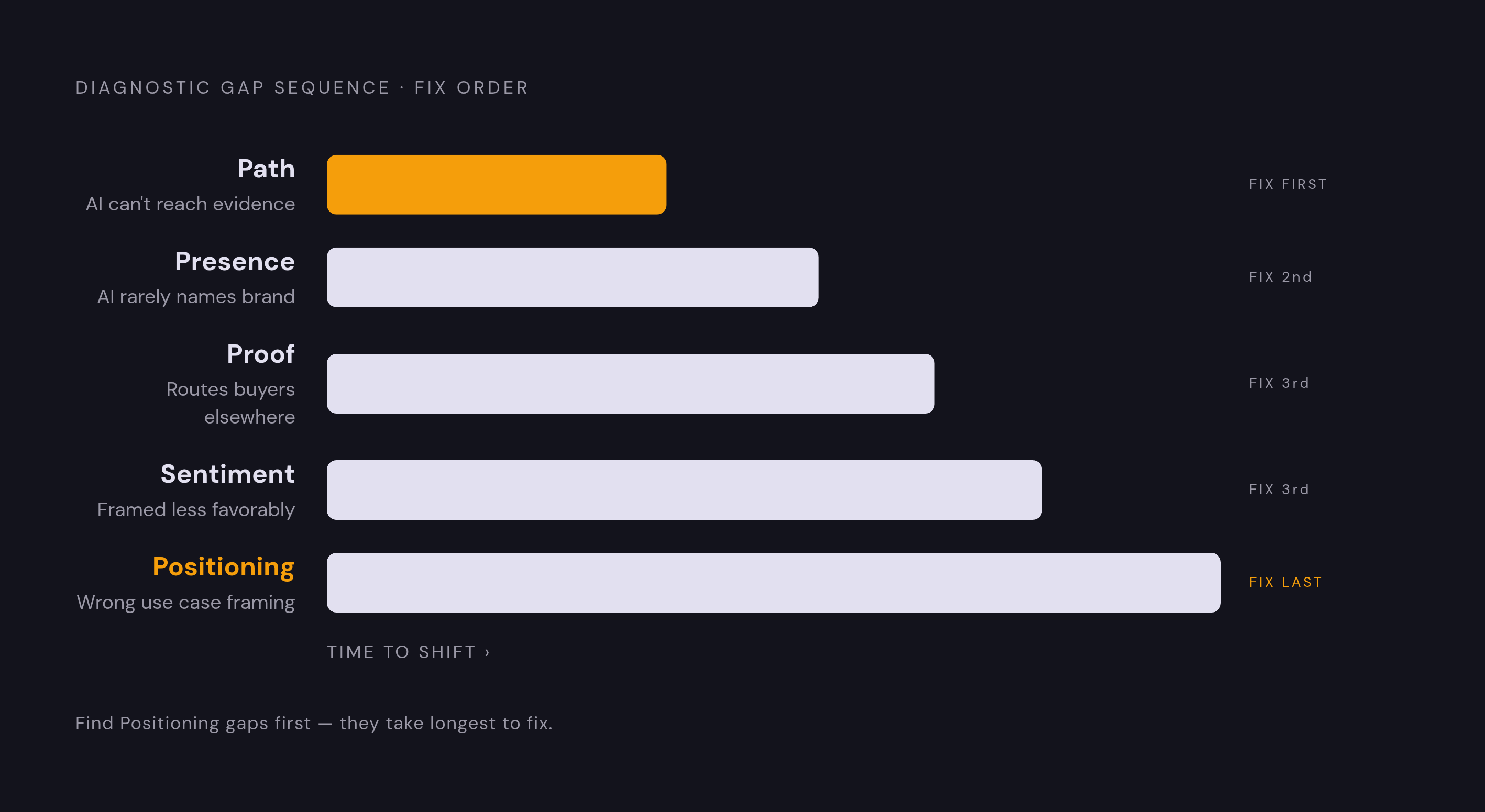
Start with the gap causing the greatest loss on high-intent prompts. Clear path gaps first. Otherwise, new evidence may remain inaccessible for the same reasons as the old evidence. Once access is addressed, absence from buyer-intent shortlists takes priority over refining proof on low-intent informational questions.
For brands that already appear but lose the recommendation, work on proof and sentiment can help more than just getting the brand mentioned more often. Positioning gaps need to be found early because changing what a brand is already linked to takes the most time. Content and PR work can build toward that change while technical and presence fixes proceed.
Smaller teams can use the same logic at a narrower scale. Twenty to thirty buyer-intent queries across two or three platforms can show enough of a pattern to find the biggest gap without enterprise-level tooling. The output should set out which technical, content, PR, or reputation work to do and in what order, based on where the brand is losing.
Monitoring AI citation shifts before a competitor's lead compounds
AI citation patterns can change faster than traditional rankings, so a competitor’s lead can grow before a quarterly review spots it. Keep the four metrics as an ongoing scorecard, with results separated by platform. A Perplexity citation gain and a ChatGPT prominence loss require different interpretations. Averaging them together can hide both the improvement and the problem.
Monitoring becomes useful when it traces competitor mentions back to the cited sources that may have influenced them. Those patterns show where coverage, credibility, or citation likelihood needs attention. They also keep remediation grounded in evidence. A screenshot is a clue.
Scale Labs, an AI marketing laboratory where data scientists, AI engineers and content strategists work side by side, offers this structured audit through its competitive intelligence work, building a prompt-level gap map across platforms and buyer-intent clusters. Its client programs track prompts automatically and have people study patterns in the sources that get cited.
The continuing discipline is to detect the next shift early, identify the source pattern behind it, and match the response to the gap before a competitor’s advantage becomes entrenched.