The Credibility Calculus LLMs Run on B2B Companies Before Citing Them as Sources
Getting cited by AI requires third-party validation, consistent facts, and recognized expertise.

LLMs judge whether a B2B vendor is credible through three kinds of signals, which are third-party validation, entity consistency, and topical authority. Those signals shape both what a model knows from training and what it retrieves from the web. Becoming citable therefore requires more than a strong website. A brand needs support from outside sources, facts that agree, and expertise that holds up when checked across sources.
Why AI citations have become the new B2B discovery layer
A buyer asks an AI assistant which vendors belong on a shortlist and gets a handful of names, often before going to any company’s website. The assistant has already narrowed the field. Unlike a search results page, which leaves the buyer to compare links, an AI answer synthesizes the options into a curated response. A brand left out of that response loses consideration before its sales team has a chance to enter the conversation.
That changes the discovery problem for B2B companies. A polished website can explain a product well to the people who visit it, but it cannot win over buyers who never arrive. The missing invitation is the problem. Brands disappear from AI answers not simply because their copy lacks the right phrase, but because the available evidence fails to support their inclusion. Understanding that evidence is now part of understanding how buyers find vendors, rather than a technical hobby for the marketing team’s most enthusiastic spreadsheet owner.
How do LLMs evaluate B2B vendor credibility through two pathways?
The first pathway is parametric knowledge. This is information learned during training. For a brand, this is the model’s accumulated familiarity with its name, category, and associations across authoritative sources over months and years. It is what the model already knows. Consistent mentions build that familiarity, while a company with little presence outside its own domain has less material from which the model can form a durable understanding.
The second pathway is retrieval-augmented generation, or RAG. When a question calls for current or specific information, the system retrieves web content and uses it to construct an answer. Here, freshness, technical accessibility, and presence on Bing’s index become important. Recognition and retrieval reinforce each other because a familiar brand has an advantage when new content about it appears. Reliable citation therefore depends on both pathways.
Retrieval also reaches beyond the buyer’s exact wording. LLMs can break a prompt into several sub-queries, gathering evidence from different angles before composing the answer. One question can open several evidence trails. A brand present in only one kind of source may satisfy one trail while disappearing from the others. That is why a single-channel strategy can fail even when the content in that channel is strong.
The three categories of signals LLMs weight when evaluating a B2B source
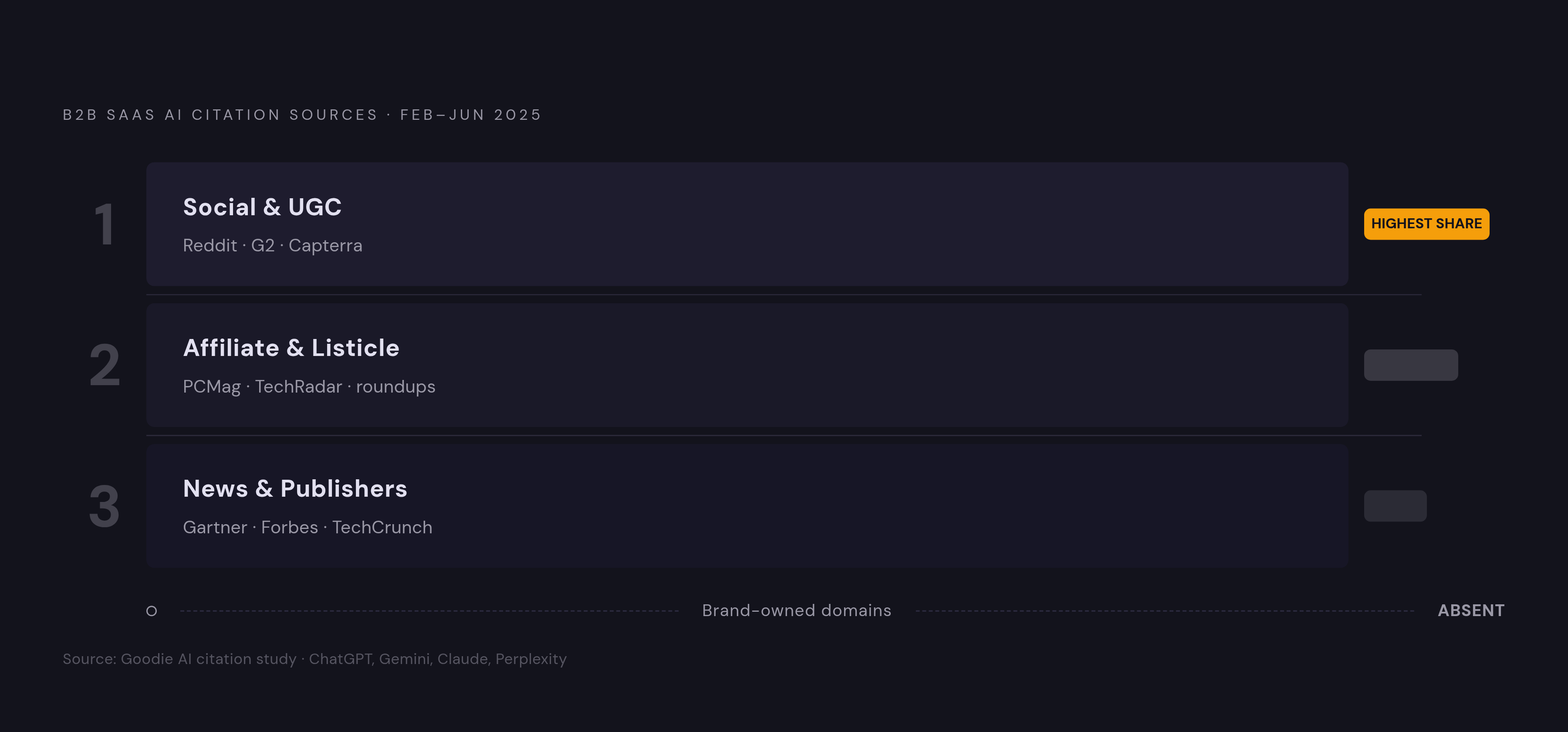
Third-party validation answers a basic question about a vendor’s claims. Does anyone independent support them? Goodie’s B2B SaaS citation study captured millions of citation links across ChatGPT, Gemini, Claude, and Perplexity from February–June 2025 and found brand domains essentially absent from the top cited sources. Instead, brands appeared through intermediaries. The study identified three dominant content categories, including social and UGC sources such as Reddit and review platforms, affiliate and listicle sites, and news and publisher outlets such as Gartner, Forbes, and TechCrunch.
Entity consistency answers a different question about identity. Do the available sources describe the same company? Structured records on Crunchbase and Wikidata help establish founding facts, product category, and market context. An entity graph adds connections, with Organization schema pointing to founders whose LinkedIn and structured reference profiles link back to the domain. Those connections give the system a coherent identity to associate with the claims.
Topical authority concerns whether the brand has recognizable expertise in the subject at hand. Named experts help make that expertise legible. Identifiable people with a consistent subject focus, public speaking or panel participation, and perspectives sustained over time provide authority signals beyond an anonymous company voice. Content that explains problems, decision criteria, and trade-offs also gives the model more substance than broad claims of excellence. These three lenses work together, so strong expertise cannot reliably compensate for conflicting company facts or missing independent support.
Why consistency across sources functions as a filter, not a differentiator
When sources disagree, omitting a brand is safer than risking an inaccurate claim about it. Consistency is therefore a gate. A model faced with conflicting descriptions may leave the company out rather than resolve the contradiction in its favor. That turns an old profile from a minor housekeeping issue into a possible barrier to citation. The website may be immaculate while the wider evidence still describes a different business.
Pricing, features, use cases, and industry focus need to align across owned pages, review platforms, partner listings, and press coverage. A changed ideal customer profile can expose this problem. If the website speaks to the new audience while third-party descriptions still point to the old one, the model receives competing accounts of whom the product serves.
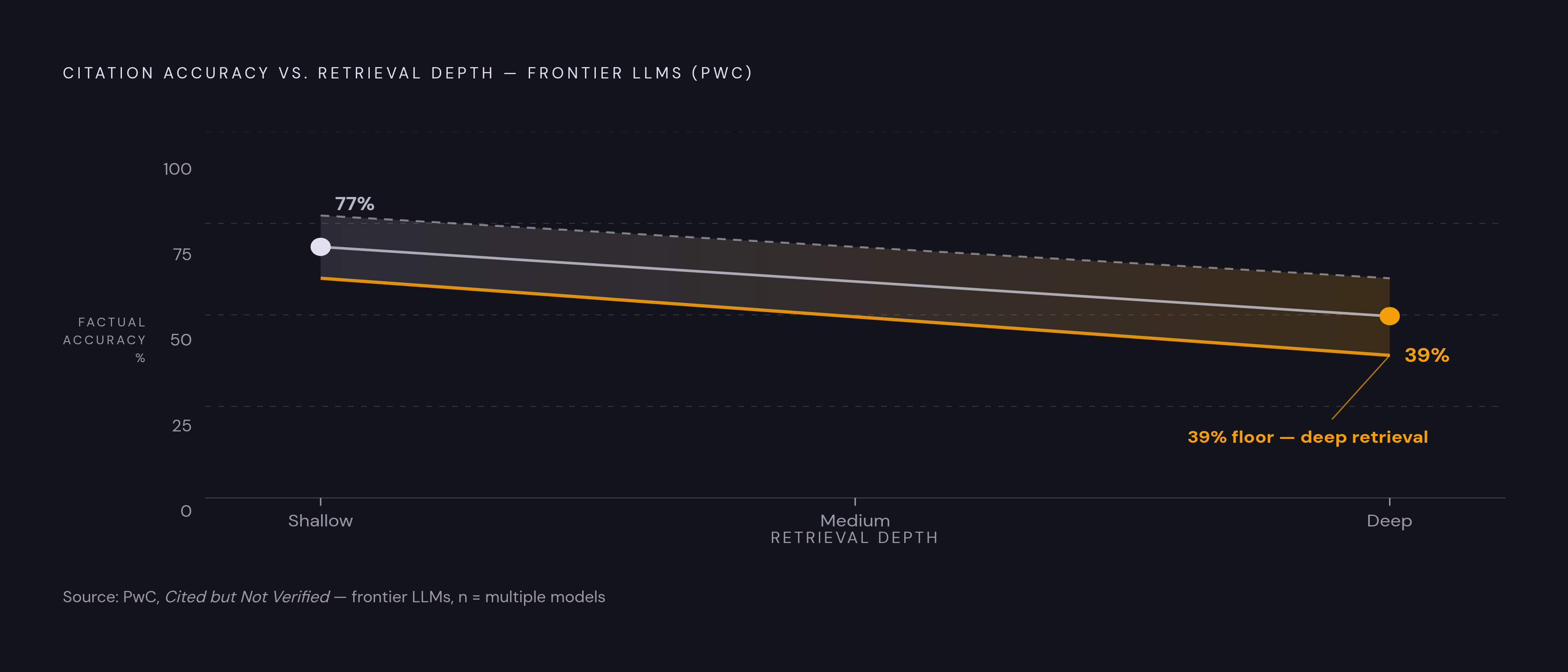
PwC’s Cited but Not Verified source attribution study found wide variation in citation accuracy among frontier LLMs, with accuracy dropping sharply as retrieval depth increased. The finding that deeper retrieval can accompany weaker factual support underscores the importance of source agreement. When attribution is already vulnerable to error, contradictory descriptions add more opportunities to get the company wrong.
How different LLMs run different versions of the credibility calculus
Goodie’s study found ChatGPT drawing heavily on UGC, community discussion, review sites, and vendor comparisons, including Reddit and G2. Gemini favored a different source mix. Its prominent sources included PCMag, Capterra, and TechRadar, reflecting a tilt toward affiliate pages, listicles, and editorial roundups. A brand well represented in community discussion may therefore have a different citation position from one with strong roundup coverage.
Claude drew on both community conversations and trusted publishers, so it mattered for a brand to appear in both. Goodie’s February–June 2025 data showed a strong role for social and UGC-style sources, while its later research found a sharp shift toward YouTube as Perplexity’s main source for social citations. Platform preferences are not permanent fixtures. A plan built around yesterday’s favorite source can become a very tidy answer to the wrong question.
The study found a small number of domains receiving a disproportionate share of B2B SaaS citations, although the leading domains varied by model. That concentration makes third-party distribution a structural advantage. Presence across review and UGC platforms, affiliate and listicle sites, and publisher coverage reaches more of the sources these systems use. Optimizing for one platform alone leaves the brand exposed to the others’ different preferences.
The mention-citation gap and what it reveals about a brand’s actual credibility standing
A model can know a company without treating its content as a dependable source. Recognition is not the same as endorsement. A passing mention shows that the brand is available to the model, while a supported recommendation or citation requires evidence the system can use in that answer. Treating those outcomes as the same makes a visibility report look better than the model’s trust in the brand warrants.
The mention-citation gap names that distinction between being known and being trusted enough to cite. Strong owned content paired with thin third-party validation is one way the gap can arise. The company may explain its topic well. Yet the model may lack independent confirmation from sources it weights highly, leaving those claims without enough corroboration to support a citation. Publishing more on the company blog does not directly fill that missing category of evidence.
The gap is a diagnostic starting point. A mention without a citation does not, by itself, identify whether validation, consistency, or topical authority is weakest. Prompt wording complicates the picture further. A brand may receive a confident citation in one framing and vanish when another question approaches the same topic differently. Teams must therefore track how models answer prompts, because a familiar keyword ranking cannot show the answer buyers actually get.
What a rigorous measurement baseline looks like before any optimization begins
For a team diagnosing that gap, the first step is a library of real buyer questions. “Which platforms do mid-market compliance teams use for vendor risk?” is a useful prompt in a way that “vendor risk software” is not. The phrasing establishes the buyer’s task and context. Because that wording shapes which brands and sources a model retrieves, an audit needs questions phrased as buyers ask them, rather than keyword lists wearing conversational hats.
Run those prompts across more than one model. Keep mentions separate from citations. Then check which claims each cited source backs up. PwC’s study found that even leading frontier models achieved only 39–77% factual accuracy in citations, with accuracy degrading as retrieval depth increased. A citation is not a quality certificate. An answer that names the company but misstates its capabilities can mislead a buyer, so accuracy belongs in the baseline.
Competitive share of voice adds the category context. Record which other brands appear, how often they appear, and which third-party sources support their inclusion. That reveals where the evidence is concentrated. It also helps distinguish a company that is broadly absent from one that appears reliably for some buyer questions but not others. Those patterns give the team a firmer basis for choosing which signal category to improve.
At scale, structured scoring can make this work more manageable. Evident scores a wide range of signals across three evaluation dimensions, which are algorithmic, AI, and human. That provides a baseline across all three audiences for targeted improvement. The prompt library remains the practical anchor. Without it, a broad score cannot show which buyer questions bring the brand’s credibility gap to light.
The fixes that move each signal category in the right direction
When third-party validation is weak, the first task is to get the brand into independent sources of the kinds models already cite. Get coverage on review platforms, affiliate and listicle sites, and publisher outlets. Authorship changes the weight of the evidence. A case study written by a customer or third-party analyst provides more independent validation than the same story published on the vendor’s blog.
When entity consistency is weak, check whether third-party profiles match the facts as they stand now. G2, Capterra, Crunchbase, LinkedIn, partner directories, and Wikipedia where applicable need aligned product descriptions, pricing tiers, ideal customer profiles, and founding facts. Old descriptions are not harmless historical souvenirs. Implement Organization schema with JSON-LD and connect the entity graph through named founders and executives, their LinkedIn and structured reference profiles, and links back to the domain. The purpose is to make the company’s identity coherent across the evidence available to the model.
For topical authority deficits, make the relevant expertise clear and retrievable. Content should explain how problems come up, make decision criteria and trade-offs clear, and say exactly what it means. Depth beats a busy publishing calendar here. Keep key pages current, particularly those serving commercial and evaluation-stage questions, because freshness influences citation. Sequential heading hierarchies and answer-first formatting also make useful content easier to parse and retrieve for a specific sub-query.
The next step is to retest those changes against the same prompt library on a regular cadence. Compare mentions, citations, factual accuracy, and which competing brands appear, rather than calling the work a success after one good answer. AI answers shift, and citation positions move. Ongoing monitoring is therefore the discipline, while any individual optimization is an intervention to evaluate. Whether buyers now receive better-supported answers that include the brand matters more than whether the brand has completed its credibility checklist.