High Google Rankings Mask the Perception Gaps That Cost You Mid-Funnel Buyers
AI systems ignore top-ranked brands when recommending vendors to buyers.

Multi-signal online presence scoring beyond SEO and reviews measures not only whether a brand is found, but how accurately and credibly it is represented across AI, algorithmic, and human perception dimensions. High Google rankings cannot show whether AI systems put that brand on a buyer’s shortlist. A full assessment must link visibility to entity consistency, third-party evidence, and how well each model recommends the brand.
Why a top Google ranking no longer puts a brand into the mid-funnel buyer’s consideration set
Consider a procurement director who uses Perplexity to research vendors. She asks for a shortlist, compares the recommended options, and uses the answer to build her business case. The brand that ranks #1 on Google never appears. It has failed to enter the comparison that shapes her decision. No visit to its website is needed for that exclusion to occur.
This scenario exposes a break between ranking and consideration. A top ranking signals that a page matches a query. Google finds pages, while AI recommendations depend on whether the system can recognize a distinct entity from signals that agree across the web. Those are different tests of a brand’s presence.
The distinction changes what a ranking can establish. It remains evidence of search performance, but it is not evidence that the brand enters an AI-generated shortlist.
Where mid-funnel buyers actually do their vendor research now
AI-mediated research extends across the B2B evaluation process. Across industries, two-thirds of buyers rely on AI chatbots at least as much as Google or Bing during evaluation. That places AI answers within the routine work of choosing a vendor. Search is no longer the only route into consideration. Buyers can use both channels while assigning them different jobs.
LLM usage peaks in the middle of the funnel. Buyers use ChatGPT, Claude, and Gemini to compare shortlisted vendors, synthesize documentation, model costs, draft RFP language, and build implementation plans. These tasks concern suitability, trade-offs, and purchase conditions. G2’s “The Answer Economy” also describes buyers changing their intended vendor choice following chatbot guidance.
The content cited in those answers does sales development work before a vendor knows there is a deal. It helps shape the shortlist, bring objections to light, and back up an internal business case. A brand’s absence at that point means being absent from work that brings the buyer closer to a choice. Yet a brand that appears in some AI answers may still be missing from others along that journey.
How AI visibility collapses as purchase intent rises
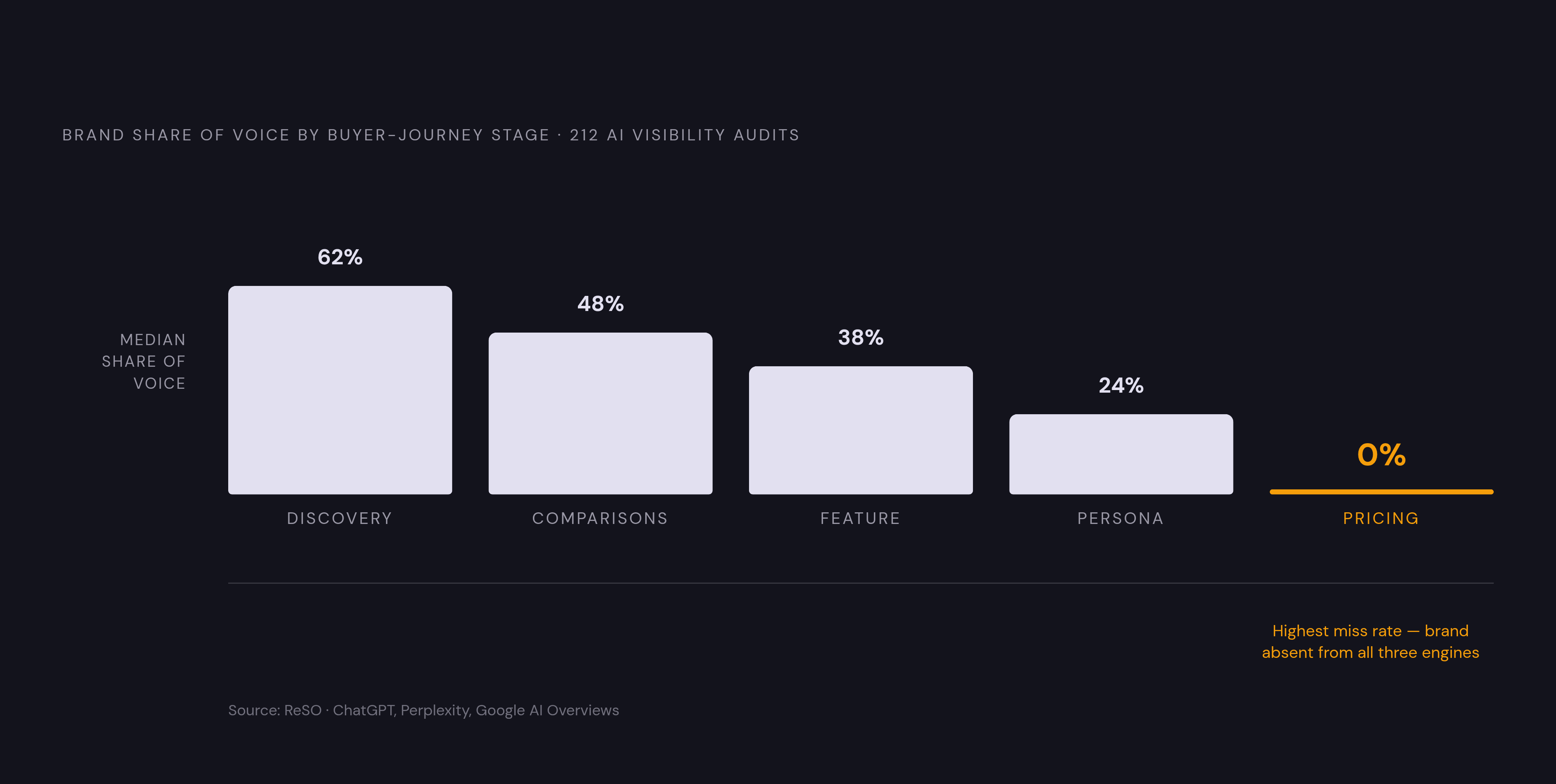
ReSO’s analysis of 212 AI visibility audits found a consistent decline in average share of voice from Discovery to Pricing. The audits ran prompts across five buyer-journey buckets, including Discovery, Comparisons, Feature, Persona, and Pricing, against ChatGPT, Perplexity, and Google AI Overviews. SaaS brands showed the clearest version of this pattern, starting with relatively high Discovery visibility and losing a material portion by Pricing. Broad awareness did not reliably survive evaluation.
The median share of voice at Pricing was zero. The typical audited brand was not mentioned when buyers asked pricing-related questions. The miss rate, which measures prompts where a brand is absent from all three engines, also reached its highest point at Pricing. This finding is sharper than a general decline in mentions. It identifies a stage where the typical brand drops out altogether.
AI engines draw heavily on third-party pricing aggregators, comparison-table articles, and review platforms with pricing sections. A brand whose pricing information exists only on its own domain is competing for citation surfaces controlled elsewhere. Meanwhile, AI compresses hundreds of data points into a handful of recommended names.
The difference between a brand an AI can describe and a brand an AI will recommend
An AI system can describe a brand accurately when asked directly and still omit it when asked which product to choose. The first task supplies the brand’s name and asks for information about it. The second requires the system to select relevant options. Recognition does not guarantee selection. Testing only what a model knows about a named company therefore leaves the central commercial question unanswered.
Paul Sheals and Tim de Rosen’s July 2026 working paper “Beyond Visibility: The Linkage Gap” examines this separation. The paper scored hundreds of specific brand facts across dozens of brand-SKUs and found that the large majority of facts a model claimed to know were not deployed in actual purchase recommendations. The Linkage Gap names that failure to connect known attributes with a buying decision. A model may possess a relevant fact without using it as a reason to recommend the brand. Knowledge and recommendation are not interchangeable measures.
A detailed description answers whether the model can characterize the product. A recommendation tests whether those characteristics become reasons to choose it over alternatives. A brand can perform well on the descriptive task while remaining commercially absent.
The engines also differ in what they select. ChatGPT, Perplexity, Gemini, and Claude surface brands at different rates and agree on the top cited brand only about a third of the time across commercial prompts. Each surface effectively has its own ranking system. Google page-one rankings correlate positively with LLM mentions, but only moderately, so SEO remains relevant without serving as a substitute for AI-specific measurement.
What third-party signals actually determine whether an AI recommends a brand
Third-party corroboration is the signal layer that separates self-description from externally supported credibility. The sources involved include earned media, third-party reviews, analyst coverage, and structured citations on authoritative external pages. These sources describe a brand from outside its own publishing operation. A large content library can explain a product thoroughly without supplying the external evidence AI systems use to evaluate it.
AI training and retrieval both give much more weight to third-party corroboration than to what a brand publishes itself. The commercial role of an external mention therefore differs from that of another page on the company website. One expands the brand’s own account, while the other contributes evidence beyond that account. Descriptions carry weight according to who supplies them and whether other sources support them.
This makes a thin third-party footprint a different weakness from an incomplete website. A brand may publish extensively and still be poorly represented in the sources used to assemble recommendations. At the pricing stage, that weakness becomes especially clear because the answer may depend on aggregators and comparison pages outside the brand’s control. The asset class needed for recommendation is therefore not identical to the asset class most SEO programs produce.
The commercial asymmetry between brands inside AI answers and brands outside them
Citation inside an AI answer affects the traffic opportunity that follows. A named brand can receive visits from buyers who have already encountered it within a comparison or recommendation, while an omitted brand has no equivalent route from that answer. The difference extends beyond mention counts. Citation places the brand inside the buyer’s active evaluation, where a click can follow an initial judgment of suitability.
AI-referred traffic also differs in conversion quality. Visitors arriving from ChatGPT, Perplexity, and Claude convert at rates well above Google organic search averages. These visitors arrive closer to a decision. Citation is commercially distinct from exposure that has little connection to purchase intent, though it does not guarantee a sale.
For excluded brands, the disadvantage begins before an inquiry arrives. The consideration set has typically narrowed to a small number of names by then, and a brand omitted from the AI comparison has no downstream opportunity within that comparison to recover. Even a website that converts well cannot win over buyers whose evaluation never takes them there.
Sales teams face a separate cost when buyers do make contact. Buyers can arrive with category-level, dated, or inaccurate comparisons produced by AI tools. Correcting those conclusions takes time and strains the relationship before the product’s merits can be discussed. That burden grows with every quarter a brand stays out of the answers that shape what buyers expect.
How do you get a complete picture of online presence beyond rankings and reviews?
Rankings measure algorithmic fitness for a query, while traffic measures who arrived. Neither reveals how an AI system represents a brand in a recommendation or whether that representation is accurate across models and prompt types. Share of voice adds frequency, but not necessarily quality. A brand can appear often and still be positioned unfavorably, associated with outdated attributes, or supported by weak citations.
Accuracy is a separate measurement requirement. Models may use old pricing, mention deprecated features, or describe use cases that no longer match how the brand positions itself. Those errors do more than reduce descriptive precision. They can mislead buyers who rely on the synthesis to compare vendors. A visibility score that rewards those mentions without checking them would count something that can hurt sales as progress.
Multi-signal online presence scoring must therefore distinguish exposure from credible representation. Perception quality, narrative strength, competitive position, evidence strength, and citation intelligence assess different aspects of what the buyer encounters. Model consistency and retrieval resilience test whether the brand is described the same way across AI surfaces and retrieval conditions. The earned-media environment and narrative trajectory add context about external support and how the brand’s story is developing. No single mention count answers all of these questions.
This is the measurement role of perception intelligence. Evident operationalizes that discipline by scoring first, surfacing the highest-priority gaps, and tracking whether interventions improve the score. Its relevance follows from the diagnostic need. The useful output is a basis for deciding which weakness requires attention and whether the response changes how the brand is represented.
What closing a mid-funnel perception gap actually requires
The practical response begins with measurement, followed by work on entity consistency, third-party signal density, and model-specific representation, in that order. Each surface supports the next. Without a baseline across AI, algorithmic, and human perception dimensions, teams cannot determine which gap is largest or whether an intervention improves the result.
Entity consistency comes first because the brand’s name, category, value proposition, and key attributes must agree across its own pages and third-party sources. Inconsistent descriptions across website pages, listings, press coverage, and review platforms are a central cause of the Linkage Gap. The task is to make the existing descriptions agree on what the brand is and why its attributes are relevant to a buyer.
Third-party signal density builds on that shared account of the brand. Earned media, reviews, analyst coverage, and authoritative external citations give the brand evidence it cannot create by publishing more owned content. The audit priority is the set of sources AI engines actually use for the category at each funnel stage. Comparison and pricing deserve particular attention because those are the stages where brands most commonly disappear. The source landscape, rather than the publishing calendar alone, should determine where the evidence is missing.
Model-specific representation then tests whether that work changes how the brand appears in the systems buyers use. ChatGPT, Perplexity, Gemini, and Claude require separate tracking because strength on one does not establish strength on the others. Measurement must precede each intervention and continue after it, so teams can distinguish a corrected description from a stronger recommendation. In a measurement platform, that discipline takes the form of a baseline score, a prioritized perception gap, and a tracked change in how the brand is represented.