Signal Coverage Gaps That Brand Measurement Tools Miss in AI Environments
AI systems evaluate brands through credibility and context, not just keywords and links.

AI brand perception audit and scoring requires measuring how often a brand appears in AI answers, how it is described, how that description differs across engines, and how responses vary across repeated queries. Traditional brand measurement tools miss these signals because their observations are limited to the indexed web. Closing those gaps takes repeated cross-engine sampling and scores for each engine, so a one-time audit falls short.
Why brand measurement tools have a structural problem, not a configuration problem
Healthy rankings, stable domain authority, and solid review scores can make it look as though a brand’s measurement stack covers the signals that matter. None directly observes the answer an AI assistant gives when a buyer asks which business to choose. A company can rank strongly on Google yet remain absent from AI-generated answers in its category. That absence need not reflect a penalty.
The mismatch begins with the discovery process these tools were built to track, which moves from a keyword query to a ranked result and then a click. Those events are observable and attributable. AI-mediated evaluation can instead produce a verdict before the buyer visits any site, drawing on a corpus the brand does not control. More granular tracking of rankings or indexed mentions cannot reveal that verdict. The missing capability is not greater sensitivity within an existing dashboard, but observation of a different kind of output.
How AI systems actually evaluate businesses, and why it differs from how legacy tools model evaluation
LLMs characterize businesses through probabilistic synthesis across language patterns, references, and associations, rather than keyword relevance or link authority alone. The distinction is between relevance and credibility. Traditional search signals help establish whether a page fits a query, while AI evaluation also depends on whether the available context supports a characterization or recommendation. An instrument calibrated to the former cannot be assumed to measure the latter. A relevant page and a recommended business are different outcomes.
Three pillars help explain this evaluation logic. Visibility tracks whether the entity keeps appearing across sources, while authority tracks whether sources seen as credible refer to it. Coverage concerns whether the business appears in enough contexts for the model to characterize it with confidence. The semantic context of those appearances is important independently of their frequency. A model may know a business from neutral or negative references but lack enough support to recommend it.
Recognition therefore does not guarantee a favorable verdict. Nor does one verdict establish a stable representation, because responses can change across models and repeated queries. Different training data and retrieval architectures shape what each engine synthesizes, while probabilistic generation introduces variation within an engine. Together, these properties explain the four coverage gaps in legacy measurement, namely LLM mention frequency, sentiment drift inside AI outputs, cross-engine representation divergence, and non-deterministic response variance.
Gap one — LLM mention frequency is invisible to standard monitoring stacks
Standard monitoring records mentions on indexed pages, social platforms, and review sites. Those records do not capture what an LLM says inside a buyer’s conversation. A generated recommendation does not, by itself, create an indexed page, an analytics referral, or an entry in a backlink report. The mention may exist without a conventional trace. Its absence from the dashboard therefore says nothing about whether the assistant included the brand.
This is an observability problem. A brand might appear often, rarely, or only for certain buyer needs, and the same monitoring stack would miss the difference. AI answers can also draw on a small citation set of high-authority sources and recognized entities, leaving other businesses outside the answer entirely. Measuring that distinction requires deliberately submitting buyer-intent prompts and recording the outputs. Mention frequency then becomes a recurring measure by engine and query type.
Gap two — sentiment drift inside AI outputs is not the same signal as review sentiment
Once a brand appears, the next question concerns its characterization. Legacy sentiment tools classify tone in human-authored reviews, social posts, and press coverage. An LLM’s description is a different artifact, compressing years of material into a few sentences that may reinforce a brand’s positioning or flatten it. That synthesis can change without a corresponding change in review scores. Stable human-authored sentiment is therefore not a baseline for stable AI perception.
Listen Labs’ AI brand perception guide illustrates the distinction through a mismatch between an LLM’s description and interview responses. An assistant may call a brand “trusted” while interview micro-expression data shows widespread hesitation at “reliable”. The example exposes a gap between two kinds of evidence. The generated description and a review dashboard each provide insufficient evidence to detect that divergence.
Faruk Tugtekin’s AI Perception Index 2026, published on SSRN, reports a 36-point MPI gap between dominant and emerging brands evaluated with the same standardized prompts. The paper connects differences in perception with the consistency and favorability of accumulated semantic context. Drift can be negative, as limitations become more prominent, or positive, as authoritative recommendations become more common. But it can also be contextual. In that case, the model changes the use case or customer segment it associates with the brand without an obvious change in tone.
A firm positioned for enterprise buyers may instead be described as a mid-market platform, even when every sentence sounds favorable. Such misclassification may occur without a corresponding shift in review-level monitoring. Detecting it requires logging characterizations by model, prompt type, and period, then comparing them with known positioning. A positive, neutral, or negative label cannot show whether the assistant is pointing the brand toward the right buyer.
Gap three — representation diverges across AI engines in ways a single-platform view conceals
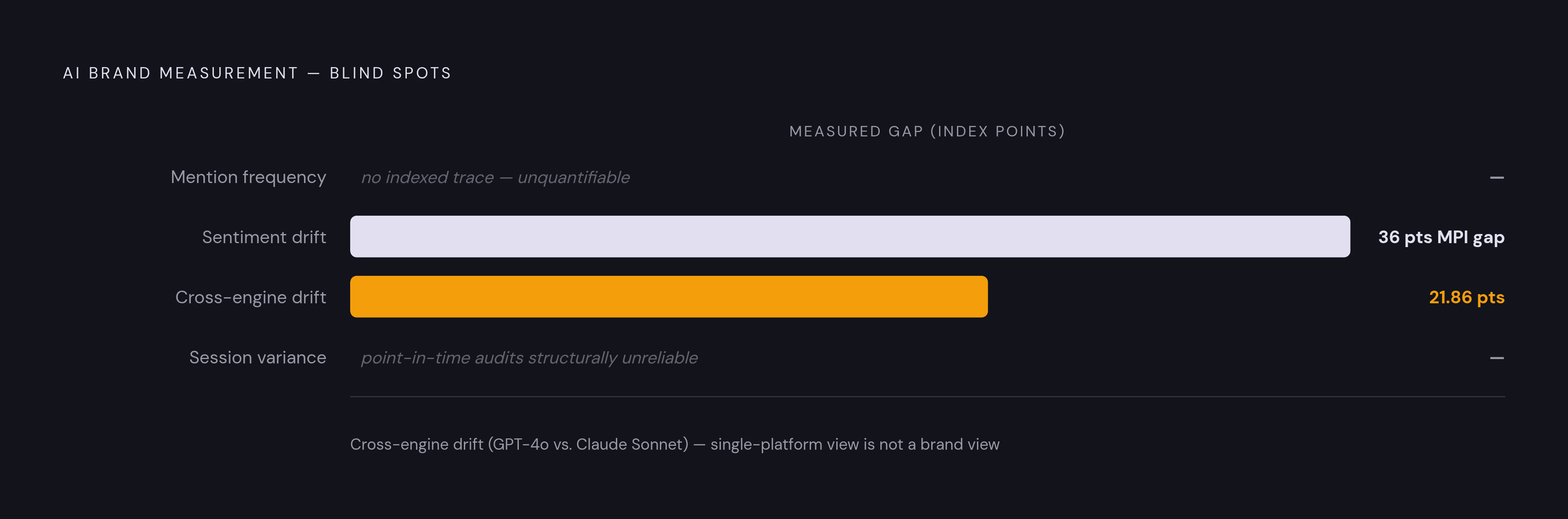
The index found that cross-model perception drift reached 21.86 points for the same brand when it used standardized prompts. The analysis covered six brands across GPT-4o and Claude Sonnet. Even within that bounded comparison, the finding shows why a score from one model cannot stand in for a brand’s representation across AI systems.
ChatGPT, Claude, Gemini, and Perplexity can form different representations because their training data, retrieval architectures, and citation weighting differ. Those differences shape which references and product attributes appear in an answer. A business may consequently receive a confident recommendation from one engine and a neutral description, or no mention, from another. A single-platform view conceals that disagreement entirely. It can make one engine’s account of the business look like a shared view when no such agreement exists.
A strategy calibrated to one engine’s characterization may not address what buyers receive elsewhere, allowing competitive positioning gaps to go undetected. To compare engines, companies therefore need separate records of mention rate, position, sentiment classification, and entity associations from comparable prompts. Disagreement about brand attributes is itself a signal. Without that comparison, a company has too little evidence to decide which engine needs work on content or entity-building and what that work should tackle.
Gap four — non-deterministic response variance makes point-in-time audits structurally unreliable
A periodic audit captures a single draw from the distribution. The same prompt submitted to the same model at different times or in different sessions can produce meaningfully different brand descriptions. That variation is a property of probabilistic text generation. A prominent appearance during an audit may therefore coexist with absence or unfavorable framing in many buyer conversations outside that window. The snapshot does not establish which experience is typical.
This uncertainty adds to the cross-engine gap because answers also vary within each engine. Monitoring several engines once broadens coverage, but it does not establish a dependable baseline for any of them. Query runs need to repeat on a schedule so that their outputs show trends beyond single verdicts. Sampling is part of the measurement itself. Continuous measurement can distinguish recurring patterns from individual responses in a way that monthly or quarterly spot checks cannot.
Why these four gaps share a common origin in how legacy tools model the web
All four gaps arise from an assumption about where brand influence leaves evidence. Legacy tools look for observable events such as rankings, clicks, page views, and indexed mentions, while an AI-generated evaluation can occur without producing any of them. The tools may be working exactly as designed. Their limitation is that the indexed web no longer provides a complete account of where buyers encounter judgments about a business. Missing conversational outputs also means missing their frequency, framing, engine-specific differences, and variance.
Google’s AI optimization guide describes optimizing for generative AI search as “still SEO”. The SEO foundation remains important, and page-one Google rank correlates meaningfully with LLM mention rate. But a relationship between ranking and inclusion does not turn ranking data into a record of generated answers. It cannot establish whether a model has changed a brand’s customer segment, whether another engine disagrees, or whether a favorable audit response is representative.
The distinction is between foundations and measurement coverage. Traditional SEO can support discoverability without supplying all the instruments needed to evaluate AI perception. The four gaps are therefore not unrelated defects awaiting separate configuration changes, but consequences of observing only one layer of brand evaluation. Businesses now face algorithmic, AI, and human judgments. Treating those dimensions as interchangeable conceals the differences a measurement system needs to make visible.
What does a measurement stack need to track to show what AI chatbots say about a brand?
To close these gaps, practitioners need a defined query set covering brand-name, category, comparison, and problem-first prompts. That set should run continuously across ChatGPT, Claude, Gemini, Perplexity, and Google AI Mode at minimum, with outputs recorded separately for each engine. Repeated runs are essential. They turn individual answers into a sample that can support trend analysis. Mention rate should remain tied to both the engine and the query type so that category-level absence is not concealed by success on brand-name prompts.
Each recorded mention also needs a characterization. Relevant fields include its position within the response, sentiment classification, entity associations, citation sources, and competitive context. Comparison against known positioning makes contextual drift detectable even when the tone remains positive. Share of voice on Claude is not the same measure as share of voice on Perplexity, and an aggregate average can obscure which engine is underrepresenting the brand.
Google’s Search Console generative AI performance reports show impressions in AI Overviews and AI Mode and were rolled out to all sites by August 31, 2026. Bing Webmaster Tools has reported Citation Share by query since June 2026. These are baseline instruments for AI discoverability. They cover those two engines, however, rather than the full set of conversational environments or every dimension of brand characterization. Dedicated LLM monitoring supplies a different layer of evidence through recorded responses, repeated sampling, and cross-engine comparison.
Beyond response measurement, the stack needs to track signals relevant to AI credibility, including entity consistency across third-party sources, citation source tier, and structured content formats such as lists, comparisons, and FAQ schema. Evident tackles the four gaps with a multi-signal scoring framework that brings algorithmic, AI, and human evaluation into one scored view, in place of separate point solutions. The governing principle is measurement before optimization. A company cannot close a coverage gap that its scoring system cannot see.
Sources
- AI Perception Index 2026 How Large Language Models Position Brands in the AI Era by Faruk Tugtekin :: SSRN
- Generative Engine Optimization at Scale: Measuring Brand Visibility Across AI Search Engines
- Cultural Encoding in Large Language Models: The Existence Gap in AI-Mediated Brand Discovery
- Divergent Recommendations, Convergent Diagnoses: Cross-Provider Failure-Mode Convergence in AI Commercial Recommendation
- Measuring brands in machine answers: A scoping review and validity framework for large language model brand-visibility audits
- Where Does the Noise Come From? A Variance-Components Decomposition of Non-Determinism in LLM Brand Answers
- Clean Engineering, Unstable Measurement: A Preregistered Reliability Failure of Black-Box LLM Observers on Shared Endpoints
- Non-Determinism of “Deterministic” LLM System Settings in ...