Why ChatGPT Names Some Software Vendors and Silences Others When Buyers Ask
ChatGPT relies on external evidence, not marketing, to decide which vendors to recommend.

ChatGPT evaluates B2B vendor credibility through the density, quality, and distribution of corroborating evidence across the web. Its recommendations are not random, and advertising cannot buy a place on its shortlist. Understanding why some software vendors get named while others disappear starts with separating two contests, which are earning a place on the shortlist and supplying the passages used to support it.
How AI vendor recommendations actually work — shortlists, not rankings
A buyer types “best project management tools for remote teams” into ChatGPT, and the answer names three brands. Why those three? Vendors need enough evidence behind them to be treated as credible options for that request, regardless of which vendor has the most polished website. An excellent product can miss that cut.
AI answers tend to name only three to five brands. Unlike a search results page, they do not offer a long trail of lower positions where other vendors can collect attention. A brand is either in that answer or absent from it. For the vendor left out, having plenty of funding or leading its category is little comfort when the buyer never sees its name.
The shortlist decision is also distinct from the citation decision. The model assembles credible vendor options, then grounds specific claims in retrieved passages when retrieval is involved. Those are different jobs. A useful passage can support a discussion of a vendor without explaining why that vendor entered the discussion in the first place.
The two distinct visibility problems a software vendor can have
That distinction leads to two separate diagnoses for an absent vendor. On the model knowledge path, the problem is weak trained associations. When ChatGPT answers without live search, visibility depends on how often and in what context the brand appeared in the documents the model learned from.
On the retrieval path, the problem is absence from the material found in real time. The brand may be known, yet missing from the sources used to answer a particular buyer question. That is a different kind of invisibility. Strong historical associations do not guarantee that current retrieved evidence will include the vendor, just as a discoverable website does not guarantee strong learned associations.
Both paths need to be checked because ChatGPT can answer with or without integrated search. A vendor can therefore improve its owned site and still lose if external corroboration remains weak. The reverse is possible too. Retrieval problems can persist despite a substantial public footprint, so “ChatGPT does not mention the company” is a symptom that requires further diagnosis.
Why “we have better content” does not solve an evidence-corroboration problem
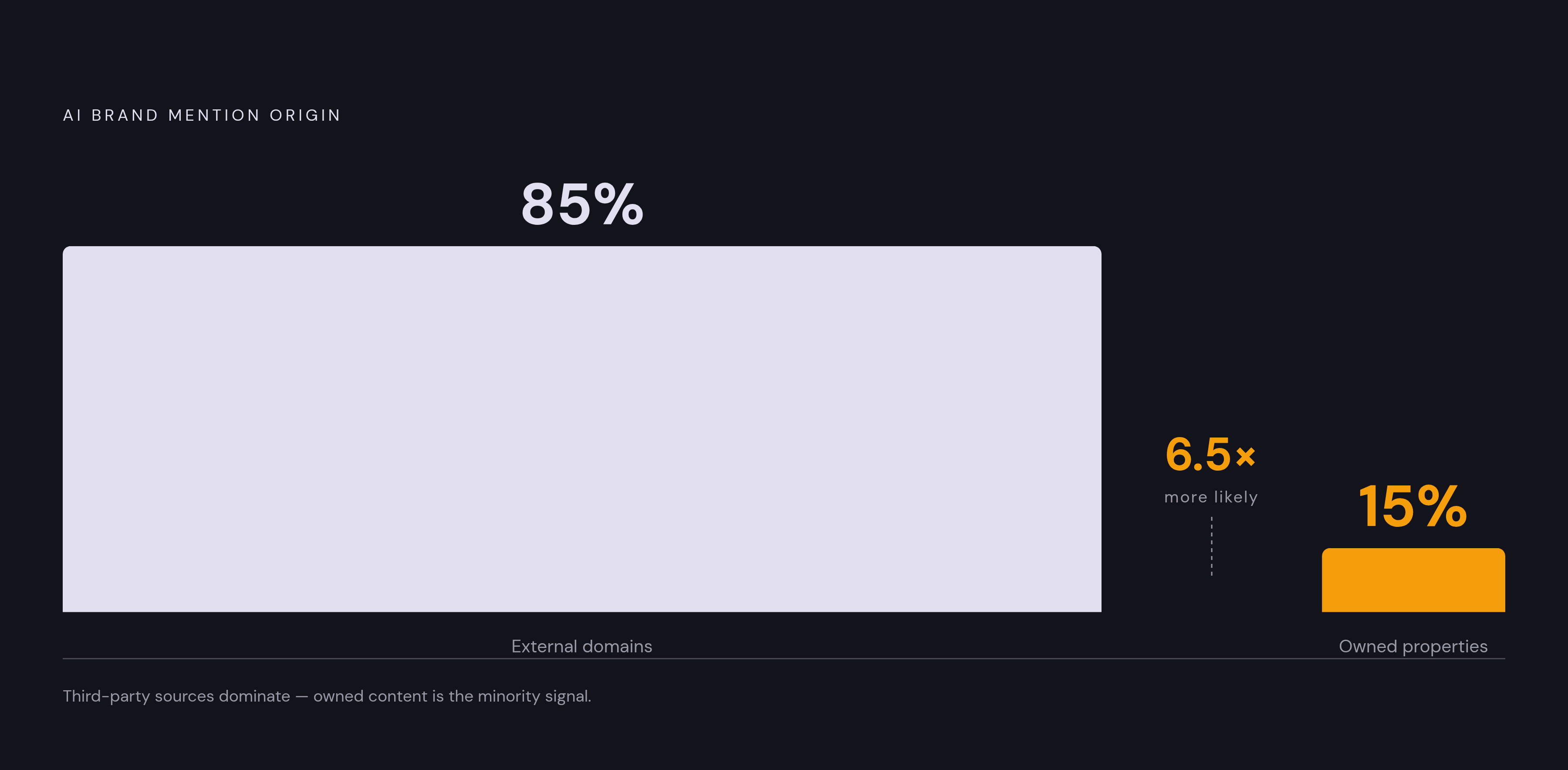
Often, the uncomfortable truth is that the quality of the content was never the main thing holding the vendor back. Roughly 85% of brand mentions come from external domains, and brands are approximately 6.5× more likely to show up through third-party sources than through their own sites. The owned website is the minority signal. That makes spending heavily on more owned articles a poor way to make up for a lack of external evidence.
Independent corroboration has a different role from a vendor’s own assertions. A detailed review, comparison, or outside discussion shows that someone beyond the company treats it as an option in the category. A sales page cannot establish that by itself. The distinction resembles a buyer weighing a peer’s account against a pitch, because the person making the sale is not an independent witness to its merits.
Better content can still win the grounding contest by supplying a clear passage once a brand is being discussed. It does much less to win the shortlist contest when the brand is barely mentioned across the wider web. The content team may be producing excellent answers to the wrong problem.
A better explanation of the product can sharpen how it is described, but it cannot manufacture independent agreement that the product belongs among the buyer’s options.
How does ChatGPT decide which software vendors are trustworthy?
The evidence hierarchy is best understood as a series of filters. A source must be accessible, relevant to the question, and clear about the entity it describes before its contents can help. Early failures can make later strengths irrelevant. A strong passage about a brand in the wrong category does not establish that brand’s suitability for the buyer’s actual request.
Access is a concrete constraint on the retrieval path. OpenAI’s ChatGPT Search help page states that website eligibility depends in part on allowing OAI-Searchbot to crawl the site and allowing traffic from its published searchbot IP addresses. Eligibility makes a site available for consideration.
A mention in a high-authority trade publication, a detailed review on a major review platform, or an analyst report has more evidential weight than many low-authority blog mentions. Freshness is a separate dimension. Citations skew toward recently published material, so a strong historical footprint can lose usefulness without becoming any less distinguished on paper.
Entity recognition adds another possible failure point. Product, Organization, and FAQ schema help AI systems interpret a brand’s category and attributes. If the brand is misclassified, adequate corroboration may still fail to connect it to relevant queries.
How incumbent brands hold shortlist positions and where challengers break through
Incumbents have an edge on broad category questions because they have a lot of evidence behind them across many sources. Their names have accumulated across the public record in contexts that connect them to the category. The body of evidence that often comes with an established position makes generic prompts difficult territory for challengers.
Specific prompts change the contest by narrowing what counts as relevant evidence. A challenger may not be able to contest “best CRM software” in the near term, yet it can contest “best CRM for HIPAA-conscious healthcare implementation teams.” That is a more precise opening. It makes evidence of a particular fit more useful than broad familiarity alone.
This is also where B2B vendors can run into an awkward mismatch between expertise and visibility. Knowledge shared in direct sales conversations, conference presentations, or private client communications does not necessarily enter the public corroboration record. Market leadership and AI visibility can diverge sharply. A company can be well known to the people in the room and effectively absent from the evidence available outside it.
A narrower buyer question can expose a gap in an incumbent’s evidence and give a specialist a credible route into the answer. Being the right tool is not the same as being publicly documented as the right tool.
The four patterns that explain why a specific competitor is named instead of you
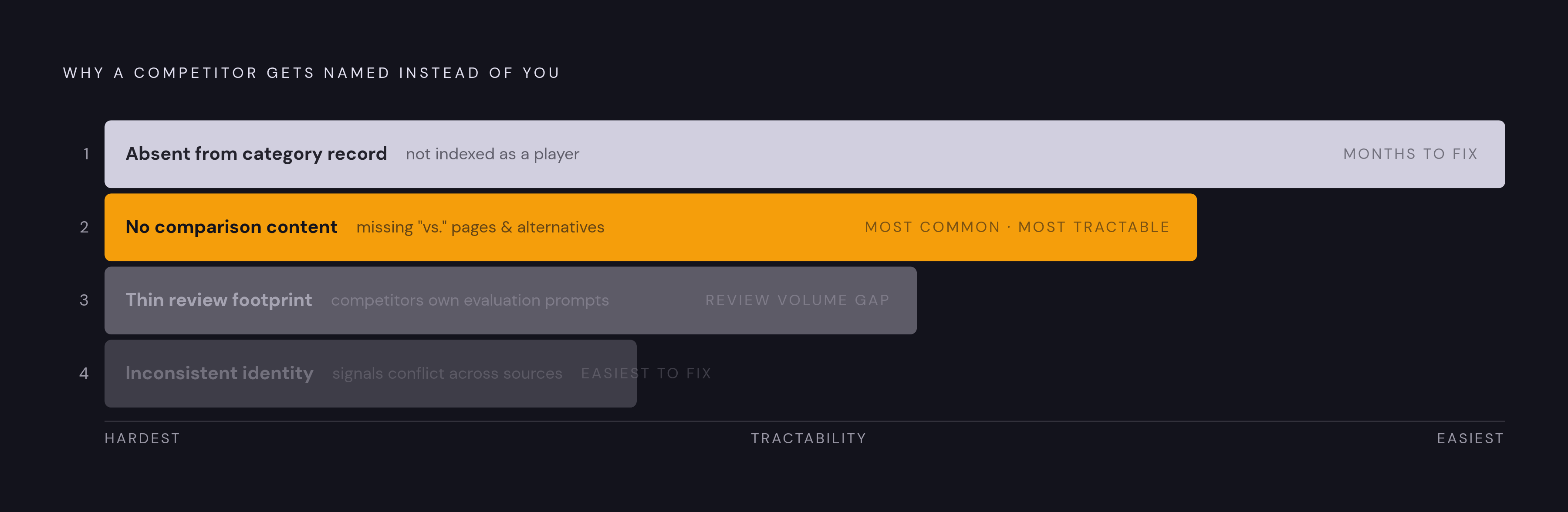
The first pattern is absence from the category record, where the vendor never appears across category prompts. This is the hardest diagnosis, usually indicating a genuine category-presence problem with a timeline measured in months.
The second pattern is absence from comparison content, where ChatGPT can discuss the brand when asked by name but omits it from “best X for Y” answers. This is the most common pattern among established B2B vendors and the most tractable, because the gap sits in a specific kind of evidence.
The third pattern is a thin review footprint, where the vendor appears occasionally but competitors dominate evaluation prompts. Here the gap is independent evaluative evidence.
The fourth pattern is inconsistent identity, where the vendor is named but miscategorized or described using stale facts. This is often the cheapest correction and the easiest to overlook, because a mention-count dashboard can celebrate an answer that describes the wrong business.
These patterns call for different fixes and expectations. Ad copy does not contribute meaningfully to the independent corroboration behind recommendations, so dominant paid search presence and no AI recommendation visibility can coexist. An advertising budget is not a guest pass.
What actually changes a brand’s position on the shortlist
For a vendor absent from the category record, the task is to build corroborated external evidence of category membership. No amount of hurried owned publishing can quickly substitute for a public record that does not yet exist.
For an established brand missing from comparisons, getting into third-party comparison content will do the most to help. Inclusion in “best X for Y” roundups on high-authority domains addresses the precise query format where the brand is being displaced and where purchase intent concentrates. The target is specific. A generic mention elsewhere does not necessarily supply evidence that the vendor fits the buyer’s stated use case.
A vendor with few reviews needs a steady process for getting more on the platforms AI systems actually retrieve. Those reviews provide independent corroboration in the material used for evaluation questions. Platform presence alone is not the whole objective. The work needs to fill the shortage of review evidence that lets competitors dominate those answers.
For inconsistent identity, the fix is alignment across the owned site, review profiles, directories, and earned media. Category descriptions and facts about features or positioning need to give the model a stable account of the brand. Accuracy deserves its own check. Counting a stale or misclassified mention as a success hides a problem that can actively weaken shortlist performance.
These responses differ because the missing evidence differs. A comparison gap calls for comparison coverage, while a review gap calls for reviews and an identity gap calls for correction. That connection keeps the work practical. It also keeps teams from falling into the familiar habit of treating every problem as a reason to publish another batch of articles.
Why measuring AI visibility requires a different instrument than an SEO dashboard
How well the owned site performs cannot, on its own, show whether those fixes work. The signals behind shortlist inclusion extend across citation footprints, prompt-specific corroboration, and entity consistency, much of it outside the vendor’s properties. Standard SEO metrics show little of that landscape. A site can do well in search without showing whether AI answers keep treating its brand as a credible choice for buyers.
Direct testing must also account for response variability. The same prompt can produce different outputs with changes in phrasing, context, timing, and platform. One flattering screenshot proves very little about repeatable inclusion. It belongs in the souvenir folder, while the measurement plan requires prompt-level testing across many query variants.
“Share of model” captures how often a brand appears in AI-generated answers compared with competitors. It is an AI-era counterpart to share of voice, with shortlist inclusion earned through evidence. Frequency still needs context. The earlier diagnostic patterns show why a brand appearing inaccurately is not enjoying the same position as one repeatedly recommended for the right use case.
Evident scores brands on the signals that shape how AI, algorithms, and people see them, so companies can see their corroboration footprint and place on the shortlist without having to rely on proxies. Its role follows from the measurement gap. Before a team can choose between building comparisons, strengthening reviews, or correcting identity, it needs to know which problem it has and where it appears.