The Evaluator Stack Every AI Era Brand Needs to Instrument
Brands must monitor how AI assistants describe them, not just search rankings and reviews.

A perception intelligence platform for AI era brands must bring together three views of a brand: algorithmic visibility, AI representation, and human opinion. To check whether AI assistants describe a brand accurately, brands need systematic model queries as well as search rankings or review scores. Evident is built for this missing AI perception layer, but all three views must work together in the full instrumentation stack.
Why brands now have three distinct evaluators, not one
A buyer types a question into ChatGPT, receives a synthesized answer, and forms a purchase shortlist. The buyer may consider the brand without visiting its website. Or it may never enter consideration at all. Between that question and the shortlist sits an evaluator that does not work like either a search engine or a customer.
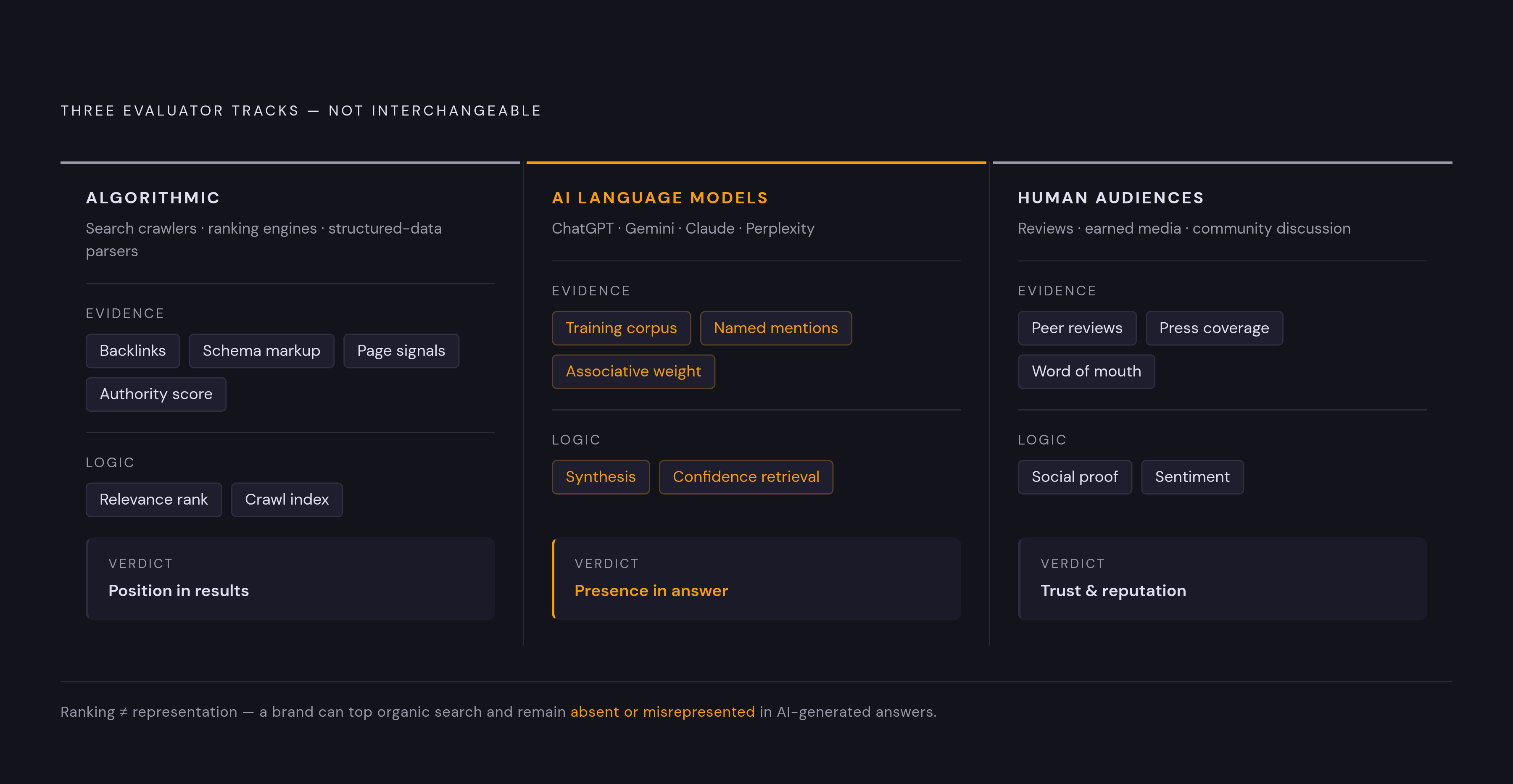
That evaluator joins two others that already judge the brand. Algorithmic systems, including search crawlers, ranking engines, and structured-data parsers, assess machine-readable presence, consistency, and authority. AI language models, including ChatGPT, Gemini, Claude, and Perplexity, synthesize a brand narrative from training patterns and, where enabled, retrieved content. Human audiences judge a brand through reviews, earned media, community discussion, and their own experience. Each bases its verdict on different evidence and logic.
Those verdicts are not interchangeable, even when they concern the same company. A brand at the top of organic search can still be left out or described wrongly in an AI answer, because ranking and representation do different jobs. Yet most tools for brand monitoring track human signals, such as public mentions, reviews, and media coverage. The other judges have been seated without anyone setting up their microphones.
How AI language models actually form a brand opinion
An LLM does not look up a brand in the same way a search engine crawls it. It generates a probable account from patterns learned during training, sometimes supplemented by content retrieved when the question is asked. Retrieval varies by platform and context. Perplexity searches on almost every query, while Claude uses its web tool only under certain conditions, so a new website page has a different chance to shape each answer.
This creates two routes into AI recommendations. Prominent brands can appear through the base model prior, meaning their presence in training data is enough to bring them into an answer. Less prominent brands depend more on retrieval from third-party coverage, review platforms, and well-indexed owned content. For challenger brands, the practical opportunity is therefore to earn a place in the evidence retrieved at query time.
“Company X has received positive reviews for customer service” is explicit sentiment, while “also offers” or “attempts to provide” can quietly cast a brand as an afterthought. These positioning patterns reflect how sources discuss the brand relative to alternatives. Models also draw on extractable facts. An old “startup-friendly” association can persist long after the product moves upmarket, leaving the brand wearing its graduation photo on every sales call.
What the algorithmic layer actually evaluates — and why it differs from AI perception
Algorithmic evaluators assess entity consistency, schema completeness, crawlability, and NAP uniformity, meaning Name, Address, Phone. These establish whether machines can identify and interpret a business clearly. Small naming differences can create disproportionate confusion. Variations such as “GEO Metrics,” “GEOMetrics,” and “Geo Metrics” can fragment entity authority.
When NAP matches exactly across the website, Google Business Profile, directories, and social platforms, systems can more easily recognize them as the same business. Schema has a related but different role: it tells systems the content type and helps content qualify for rich results. It amplifies good content. A neatly labeled empty cupboard is still empty.
Access creates another potential failure point, because robots.txt directives written for an earlier search environment can inadvertently block AI crawlers. The llms.txt standard offers a plain-text map of priority site content for AI engines and RAG parsers. Fixing access or identity can help retrieval, but it does not establish that the retrieved evidence tells an accurate, persuasive story.
Why the perception gap between AI verdicts and human verdicts is a measurement problem
A brand that people think well of can get a weak AI recommendation even when the business has not got worse. Humans may forgive minor flaws because of heritage, habit, or personal experience, while a model does not share that emotional history. Its account depends on the available evidence and learned associations. Strong consumer equity can end up as generic category language if the brand's digital footprint has no clear proof points.
That mismatch is a measurement problem before it is a brand-quality problem. Social listening can detect a public complaint, but a lukewarm recommendation in a private ChatGPT conversation creates no public post to collect. The missing observation is the model’s answer itself. Capturing it requires systematic querying and analysis of generated responses.
Even then, one friendly answer proves little. A brand may appear in a general recommendation but disappear when the question emphasizes affordability or enterprise needs. Time adds another complication, because public discussion can change immediately while base-model associations reflect older training data. Retrieval can mix recent evidence with those older associations, so a single sentiment score for every channel cannot explain the gap.
How do brands measure whether AI assistants represent them accurately?
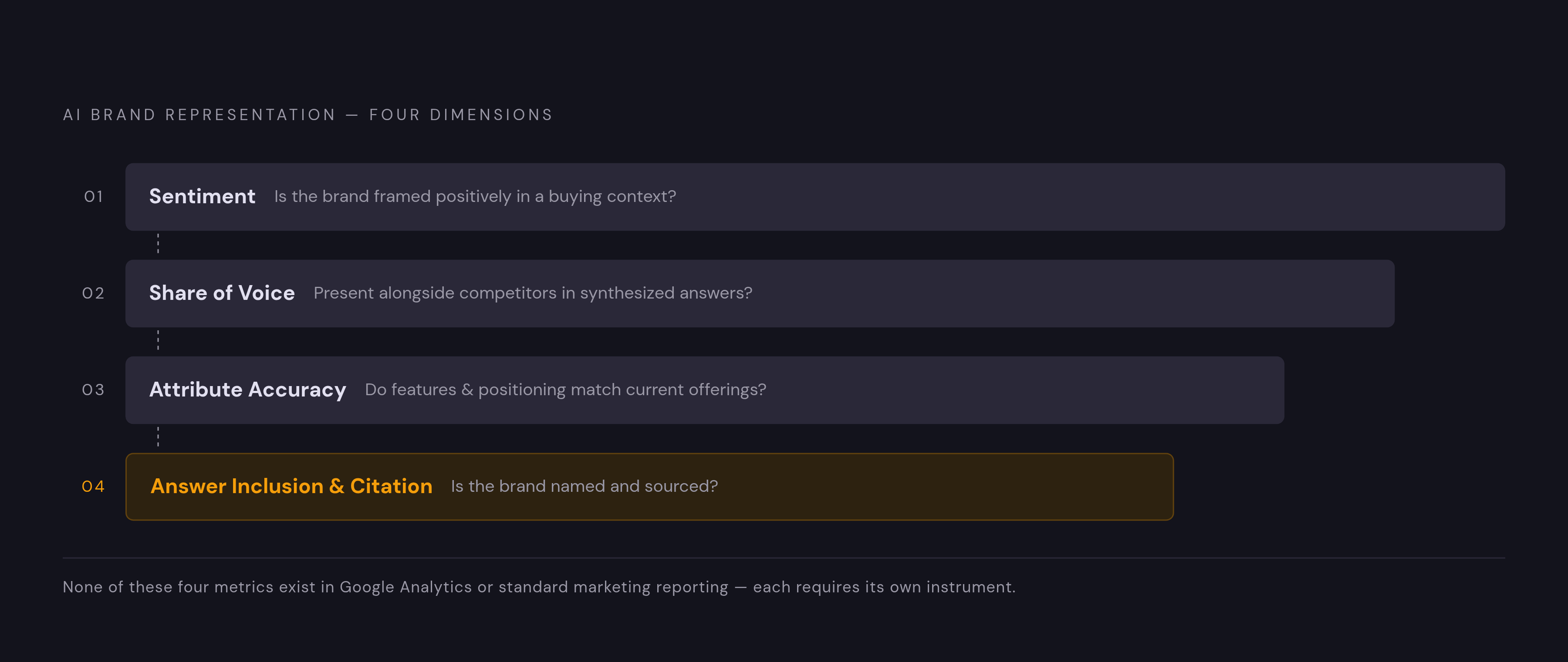
Four dimensions turn that gap into something measurable, starting with sentiment. The question it answers is whether the model describes the brand positively, neutrally, or negatively in the buying context being tested. Context changes the verdict. A favorable general recommendation can become a qualified comparison that says the brand “lacks some enterprise features compared to X.”
Share of voice shows whether the brand appears alongside named competitors in synthesized answers to target queries. Attribute accuracy then asks whether the model understands the brand correctly. The features, benefits, and positioning in its answers need comparison with current offerings, particularly where old associations may have outlived the product they describe.
Answer inclusion rate and citation frequency cover two more questions in the fourth dimension: whether the brand is named and whether the answer gives a source. An answer can include a citation but say little about the brand, or mention the brand without evidence to back it up. None of these measures exists natively in Google Analytics or standard marketing reporting, so they require their own instrument.
The signals that determine AI evaluator verdicts — and how they differ from SEO signals
Off-site earned media is a major source for AI citation as well as publicity for the brand website. Domains with profiles on major third-party review platforms have materially higher citation rates than those relying on owned content alone. Ahrefs’ study found that branded web mentions correlate more strongly with AI visibility than backlinks do. The correlation points toward authoritative discussion of a brand, rather than treating every reference mainly as a link.
The content signals follow a useful order. Clarity and summarizability come first, because a model needs a clean, attributable claim, followed by E-E-A-T signals covering Experience, Expertise, Authoritativeness, and Trustworthiness. Named expert authorship and verifiable credentials help establish expertise, especially for YMYL topics. Next come Q&A format, clear section structure, and structured data that makes entity relationships readable.
Evidence also strengthens content that starts with less authority. A Princeton/Allen Institute for AI/IIT Delhi study published at KDD found that citing sources from elsewhere raised visibility by 115% for lower-ranked content. Original research on structured landing pages gives another reason to trust the content, while structured data sameAs attributes, NAP details that stay the same, and proprietary terminology that independent sources cite help tie claims to the right entity.
Search ranking and AI citation have a weaker relationship than many brands expect, and that relationship varies by platform. SEO helps with discoverability, but it does not serve as an inheritance certificate for AI recommendations.
What instrumenting the human evaluator layer requires that brands already underestimate
Human-generated content is also an upstream input to AI representation. Review aggregators, news publications, and community forums provide third-party evidence that models draw on heavily relative to brand-owned websites. A brand that leaves these sources out of its monitoring misses more than customer feedback. It also leaves the brand with a poor view of the material AI may use to describe it.
Reviews that spell out what a buyer achieved give both a prospective customer and a retrieval system seeking support for a claim more to work with than reviews that only say the buyer was satisfied. Applause is pleasant, but it is not a product specification.
Most traditional monitoring tracks mentions as they arrive without auditing the aggregate account they form. A brand can have plenty of reviews even when they describe conflicting attributes across segments or time periods. The instrumentation task needs to go beyond counting praise and complaints. It includes checking whether reviews, forum discussions, and earned coverage consistently reflect current positioning, or preserve several incompatible versions of the business.
Why a snapshot audit is insufficient and continuous monitoring is the minimum viable instrument
An AI answer is a reading at a particular moment. Model updates, retrieval changes, and new content can alter how a brand appears, and visibility can vary across consecutive runs of the same prompt. A one-time audit captures a brand’s position at a single moment, like a photograph of traffic.
The inputs also change at different speeds. Social signals can peak and fade within days, while news and PR influence lasts longer but can be superseded by new coverage. Associations embedded in base-model weights have a longer half-life and do not change because one new article appears. Retrieval updates more dynamically, but its influence depends on the query and platform.
Accuracy introduces another reason to keep watching. The Tow Center’s March 2025 study found that AI search tools returned incorrect answers to source-attribution queries at a substantial rate. That finding concerns attribution rather than every brand claim, but it makes a concrete point about the reliability of cited evidence. An answer can supply an apparent source and still get the attribution wrong.
Brands that do not monitor cannot detect those misrepresentations, while occasional checks can discover them too late to respond. The algorithmic layer has its own quieter drift through schema deprecations, crawler-policy changes, and directory inconsistencies. Continuous monitoring therefore means an ongoing measurement program across the stack, with repeated model tests and scheduled technical checks.
How to build the instrumentation stack across all three evaluator layers
The practical response is to combine tools built for each layer rather than stretch a single-channel tool beyond its design. For the algorithmic layer, an entity consistency audit should check exact NAP matching across directories, Google Business Profile, and social platforms, then resolve naming variations. A schema audit should assess JSON-LD coverage and relationships. Crawler governance should include reviewing robots.txt for unintended blocks and implementing llms.txt to map priority content. These checks need a cadence tied to major content or infrastructure changes.
For the human layer, review monitoring should cover Gartner Peer Insights, G2, Capterra, and TrustRadius, with attention to attribute consistency as well as volume. An earned-media audit should map the publications covering the brand and the attributes and sentiments they attach to it. Community monitoring should track patterns in the discussions that AI retrieval brings up.
For the AI layer, systematic querying should cover ChatGPT, Claude, Gemini, and Perplexity using general recommendations, comparisons, and category-specific use cases. Running the queries again and again sets a baseline for sentiment, competitive share of voice, attribute accuracy, and inclusion with citation tracking. A reasoning-model audit adds scrutiny by asking models to evaluate the available evidence about brand claims. Evident is built specifically for this layer, scoring the signals that shape algorithmic, AI, and human evaluation and surfacing which problems to fix first.
The outputs need to connect. Evidence that people create feeds AI representation, while a clear identity in the algorithmic layer helps retrieval tie that evidence to the right business. A perception intelligence platform earns its place by making those relationships visible, so a team can address the source of a weak verdict.