Multi-Signal Scoring Methodologies for Brand Perception
Brand perception forms across people, search, and AI, so measure all three.
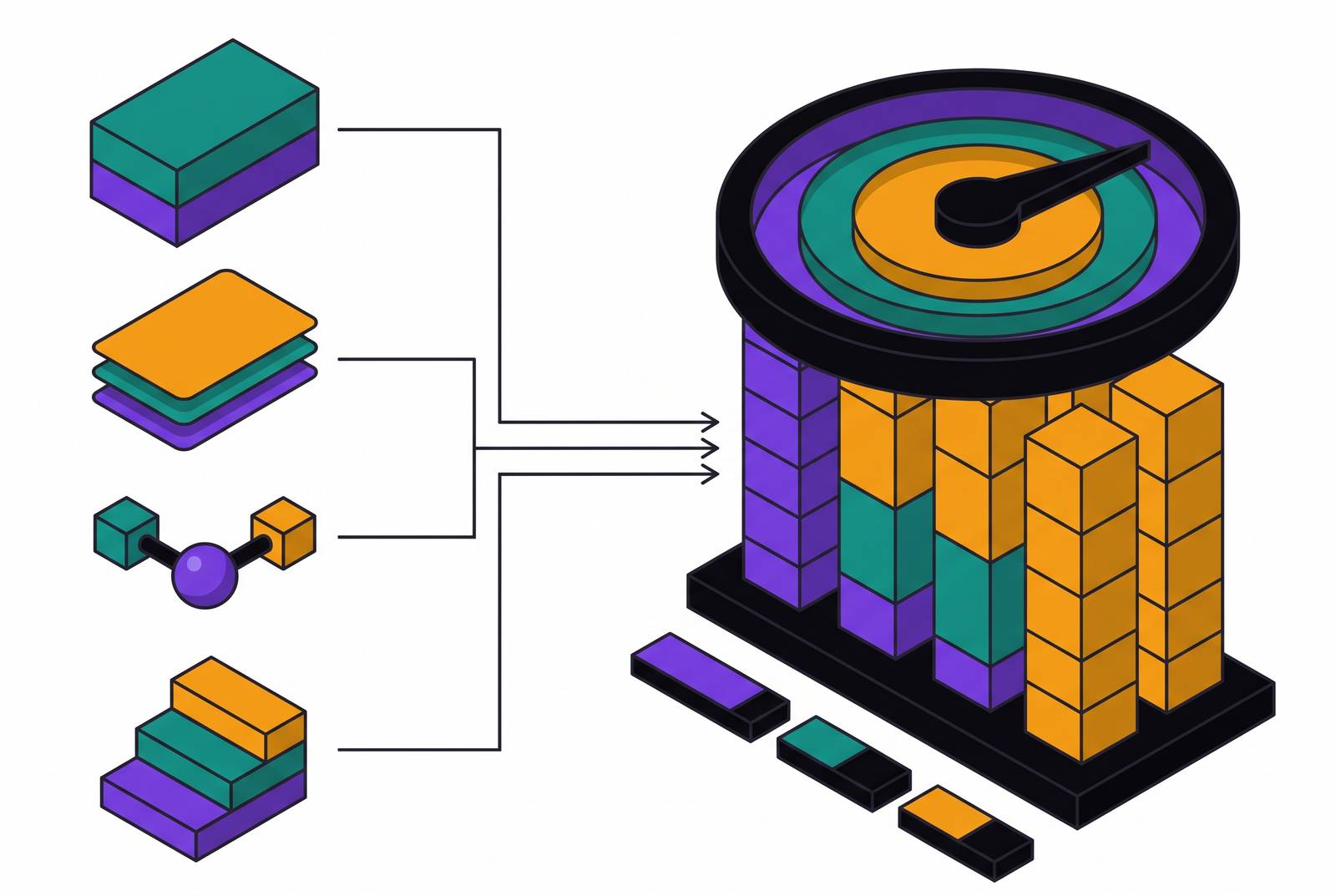
Brand perception can no longer be measured by any single method, because it no longer forms in any single place. A brand today is evaluated at the same time by human audiences, by search and ranking algorithms, and by AI models like ChatGPT and Gemini, and each of those three environments scores a brand on different terms. A tool built to monitor just one of them, no matter how well it does that job, will always produce an incomplete answer about how a brand is actually being perceived in the world. That is the case for multi-signal scoring: a methodology that measures human sentiment, algorithmic credibility, and AI representation together, as one system, rather than as three separate reports that never get compared.
Why measuring brand perception has become structurally harder
The environments doing the evaluating have multiplied, not because brands have gotten more complicated to track, and each one moves at a different speed than the tools built to watch it. Brand tracking in 2026 needs to be continuous, driven by narrative, and predictive, because the thing it watches, online conversation and AI-generated output, forms and shifts in real time. Most tracking programs still in use are periodic, built on surveys, and look backward at what already happened. That mismatch between how perception actually forms and how most companies still measure it has gotten wider, not narrower, as AI systems have become active participants in shaping what people believe about a brand before they ever visit its website.
Search algorithms, AI engines, and human audiences also don't agree on what makes a brand credible. A company can rank near the top of Google for its category and still get described poorly, or barely get mentioned at all, when an AI model answers a comparison question. A brand can be liked by its customers and still lose the algorithmic trust signals that search engines and LLMs weigh heavily. None of these evaluation systems defer to the others, so a measurement approach built around only one of them is, by definition, only ever telling part of the story.
How single-source measurement produces a systematically incomplete picture
Every measurement method built around one channel has a blind spot baked into its design, and that blind spot appears exactly where a business needs visibility the most. Social listening tools pick up the loudest conversations happening on the platforms they're built to watch, but they miss the full arc of how a story moves, say, from a single complaint on one platform to a full-blown category conversation days later on another. Sentiment scoring built for social data also tends to miss sarcasm, miss how context changes meaning within a specific industry, and miss the way people switch registers depending on the audience they're writing for. A complaint that spikes on one platform and a review pattern that spikes on another can look like two unrelated events, when both actually trace back to the same cause, a packaging change or a product failure, and the tools simply don't talk to each other to connect them.
Survey-based tracking has its own blind spot. It tells a company what people say when asked a direct question, not what they actually believe when nobody is asking. Perception can shift inside online communities weeks before a quarterly survey panel picks it up. Search data and branded query volume reveal something real, consideration, comparison shopping, intent to buy, but they say nothing about how an AI system is actually describing that brand when a buyer asks it directly. A brand can rank first on Google and still get described thinly, or inaccurately, inside an AI-generated answer, a gap that search data alone cannot reveal.
The sharpest evidence that this is a structural problem, not a volume problem, comes from a 2026 study in the Journal of Sensory Studies. Using Signal Detection Theory to test consumers in Thailand and Colombia, researchers found that communicating a brand attribute does not guarantee that consumers actually perceive it. Positive attributes were harder for consumers to pick out than negative ones, and sustainability and health claims were weakly perceived even when brands communicated them heavily. In other words, the gap between what a brand says and what a consumer actually absorbs is real and measurable, and no single channel, not social listening, not surveys, not search data, is built to catch it. It takes a discrimination test to find it, and single-source tools aren't built to run one.
Multi-signal Scoring
Multi-signal scoring works by combining signal types that each capture something distinct, human sentiment, algorithmic credibility, and AI representation, into one composite score that no single input could produce on its own. The underlying principle is familiar from other fields that score complex behavior: a score built from behavioral signals, firmographic data, intent data, and engagement patterns together reflects a fuller picture of reality than any one of those signals alone. Applied to brand perception, that means building three layers that run simultaneously.
The human sentiment layer draws from several sources working together: survey tracking for stable, long-term benchmarks; social listening for perception that forms without being prompted; review sentiment for signals captured right at the moment of purchase; and qualitative research for the kind of nuance, emotional tone, attribute discrimination, that a sentiment score alone can't show. The algorithmic credibility layer covers branded search volume, the specific terms people use when they search for a brand, backlink authority, structured data, and how often third parties cite the brand across the open web. The AI representation layer measures how often a brand gets mentioned across a defined set of prompts, what sentiment trend shows up in LLM answers over time, how much share of voice a brand holds against competitors inside AI-generated answers, and how closely the attributes AI associates with a brand line up with what that brand actually intends to stand for.
The most careful programs running in 2026 don't pick one method over another, so they run survey-based tracking and AI narrative detection side by side. Surveys hold the long-term benchmark steady. AI narrative detection catches early warning signs that a periodic survey structurally cannot, because a shift may already have been shaping AI-generated answers for weeks before it appears in a quarterly panel.
How the AI representation layer changes what the other layers can accomplish
AI systems don't evaluate a brand the way a search engine or a human buyer does. An LLM produces something closer to a weighted average of everything it has read about a brand across its training data, and that changes which signals actually move the needle. The signals that shift AI representation are concentrated in a small number of sources, mostly third-party, and much harder to influence directly than a company's own website or ad copy.
One of the clearest and most counterintuitive findings in this layer involves confidence. AI models assign a confidence level to their own recommendations, and that confidence level changes the language they use. A brand that triggers high confidence gets described in definitive terms, "X is excellent for," while a brand that triggers lower confidence gets hedged language, "X might be suitable for." That difference in phrasing shapes how a buyer reads the recommendation downstream, and it happens before a human ever forms their own opinion.
Running the same set of prompts, discovery questions, evaluation questions, sentiment probes, across ChatGPT, Gemini, Perplexity, Claude, and Google AI Overviews shows that these models don't agree with each other. A brand can come across as a clear category leader in one system and barely register in another. A buyer's experience of a brand depends heavily on which AI tool they happen to ask. That divergence across models is measurable, and it is invisible to a human sentiment score or a search ranking, because neither of those was built to compare one AI model against another.
The source base behind these answers is also narrower than most marketers assume. Most of the URLs AI models cite when describing a brand point to sites the brand doesn't own, and the distribution of those citations is heavily concentrated: a small number of domains account for most of the citations in any given category. That means earning presence on the specific domains an AI model actually draws from matters more than broad coverage spread across many sites. Brand mentions across the open web predict AI visibility far more strongly than backlinks do, which is a meaningful break from the signals that dominated search engine optimization for two decades. Community platforms, Reddit, LinkedIn, Wikipedia, YouTube, now make up a large share of what AI systems cite. A trust layer long treated as secondary in traditional marketing has become central to how AI models describe a brand.
Taken together, these mechanics mean the AI representation layer can't be inferred from the other two. A perception intelligence platform that scores algorithmic, AI, and human dimensions at the same time, instead of watching each channel in isolation, is the only way to see how a brand is actually being evaluated across all three environments right now.
The gaps between intended positioning and actual perception
The real value in a multi-signal score is the divergences it's built from, the places where what a brand intends to communicate, what humans actually believe, what algorithms reward, and what AI systems say about it all pull apart from one another. When an LLM describes a brand as "trusted" while interview data shows customers hesitating specifically at the word "reliable," that's a gap a business can now measure directly. AI-moderated interviews can flag exactly that kind of divergence, where LLM-generated sentiment contradicts what satisfaction surveys already show about real customers.
The Signal Detection Theory framework from the Journal of Sensory Studies research gives you a useful diagnostic model here, one that extends well beyond human consumers. The original test asks whether target consumers can actually tell apart the attributes a brand is trying to communicate before that brand launches into a market at scale. The same logic applies directly to AI outputs: a business can test whether AI systems discriminate its intended positioning from a generic description of its category, or whether, to an LLM, it sounds like every other competitor in the space. A scoring threshold is starting to emerge for this layer, where a low AI mention rate signals a brand hasn't reached visibility yet, and a high rate signals real category dominance, giving companies a way to compare their standing against competitors on consistent terms.
Narrative intelligence adds a second layer to this diagnostic. Rather than asking whether a given post or mention is positive or negative, it asks what story is actually being built around a brand across hundreds or thousands of individual posts, and whether that story is gaining structural weight across a community. That question reveals belief structures forming in a conversation, patterns that a simple positive-or-negative sentiment score would never catch, because the story is about which version of a brand's identity is winning out in public conversation.
Where the strongest objections to multi-signal scoring hold
Multi-signal scoring beats any single-source method at producing a complete picture, yet three objections about its remaining limits deserve a direct answer.
The first is an attribution gap. Most marketers now say they're prioritizing AI search optimization as a priority, yet only a small fraction can actually measure all the metrics tied to that work. A multi-signal program that tracks scores moving up or down without a clear link back to business outcomes, revenue, retention, pipeline, risks becoming measurement for its own sake rather than a tool that actually drives decisions.
The second is what might be called the dark social ceiling. B2B buyers consistently name colleagues and internal management as their most trusted source of information, more trusted than external peers or industry experts. Those conversations happen in Slack channels, WhatsApp threads, Discord servers, and LinkedIn direct messages, places no brand intelligence platform currently in use has any real way to measure. It has no reach into the private, high-trust conversations happening behind closed doors, a limit this analysis names directly.
The third is an adoption-trust paradox specific to the AI layer. Use of AI search has climbed sharply, but trust in it has dropped significantly within a single year, so AI-generated answers are reaching more people even as fewer of those people actually believe what they're being told. So you can't read a brand's AI representation score on its own. It has to be weighed against how much the specific audience being measured actually trusts AI output in the first place, because a strong AI sentiment score carries different weight depending on whether the audience behind it believes what AI tools tell them.
Starting a Multi-Signal Scoring Program
Multi-signal scoring only works if measurement comes before optimization, so the right place to start is an audit that sets a baseline across all three layers, human, algorithmic, and AI, at the same time. Without that baseline in place first, any single fix a team makes afterward has nothing to anchor it, and there's no way to tell whether a change actually moved the needle.
The audit should begin with a prompt-based test of the AI layer: running discovery questions, evaluation questions, and sentiment-probe questions across the major LLMs, and logging mention rate, how a brand gets positioned, what sentiment classification it receives, and which entities AI associates with it, model by model. Any place where models disagree with each other on a brand's core attributes should be flagged early, because that disagreement is itself a finding. From there, the next step is mapping the third-party source base an AI model actually draws from for a given category, identifying the specific domains it cites, and checking where a brand already has earned presence versus where it has none. Because citations concentrate so heavily in a small number of domains, targeted presence on the domains that actually matter will do more than spreading effort thin across many sites.
The human sentiment layer needs to run in parallel with the AI audit rather than after it, since survey benchmarks and real-time narrative detection serve two different jobs, one catching slow shifts over time and the other catching fast-moving conversations as they happen. The most useful output of the whole exercise is the specific gaps it surfaces: places where AI sentiment contradicts human sentiment, where a brand's algorithmic authority doesn't match how often AI actually cites it, or where a company's intended positioning simply doesn't match the attributes that either AI systems or real consumers associate with it. Before spending effort optimizing owned channels, a brand gets more out of earning independent, third-party corroboration of the same claim, a trade publication, a review site, a directory listing, a customer's own public post, since confirmation from sources outside a company's control consistently produces the strongest confidence scores inside AI systems. Evident's approach, scoring more than 400 signals across algorithmic, AI, and human evaluation dimensions, was built around exactly this audit-first, divergence-led logic, giving practitioners one baseline across all three layers before they commit to any specific fix. Scale Labs, the company behind Evident, built the platform specifically to quantify how algorithms, AI systems, and human audiences each evaluate a business simultaneously, so that divergence across those three layers becomes something a team can act on rather than guess at. The gaps between what a brand intends, what people believe, and what machines say are where the real intelligence in this kind of program actually lives.
Sources
- Bridging the Gap Between Brand Communication and Consumer Perception: An Experimental Study Using Signal Detection Theory in Colombia and Thailand - Peralta‐Granados - 2026 - Journal of Sensory Studies - Wiley Online Library
- S-CARD-CMSA: A Score-Aware Candidate Archive with Density-Filtered Reporting for Multimodal Optimization