How Perception Intelligence Differs From Traditional Online Reputation Management
Review dashboards miss how AI systems describe your brand.

Perception intelligence is the discipline of measuring how a brand is represented across three distinct evaluators, humans, search algorithms, and AI systems, rather than tracking sentiment for a single human audience.
A marketing director who checks the dashboard every Monday morning sees the numbers that are supposed to signal health, review volume climbing, average star rating holding steady, search rankings stable for the terms that matter, and by every one of those measures the brand looks fine. Then a colleague pastes in a response from an AI assistant, asked to recommend a company in the same category, and the brand isn't in it. Nothing in the ORM stack flagged this, because nothing in the ORM stack was built to look for it.
How ORM was architected: one audience, one feedback loop
A business publishes or earns content. Humans encounter that content: a review, a news mention, a social post, a listing. Those humans form opinions, and the opinions show up as star ratings, written reviews, or measurable shifts in sentiment. The business then monitors that surfaced opinion and responds to it, soliciting more positive reviews, addressing complaints, managing a crisis before it compounds.
Every major ORM practice is an intervention somewhere in that loop. None of this is a flawed design. It solved a real problem for the era it was built in, when the only entity capable of forming an opinion about a business and then acting on that opinion, by buying, avoiding, recommending, or warning others, was a human being. Measurement followed the same assumption: star ratings, review counts, sentiment scores, and share of voice in human-readable media were the complete picture, because human opinion was the only opinion that mattered.
The three evaluators that now assess every business simultaneously
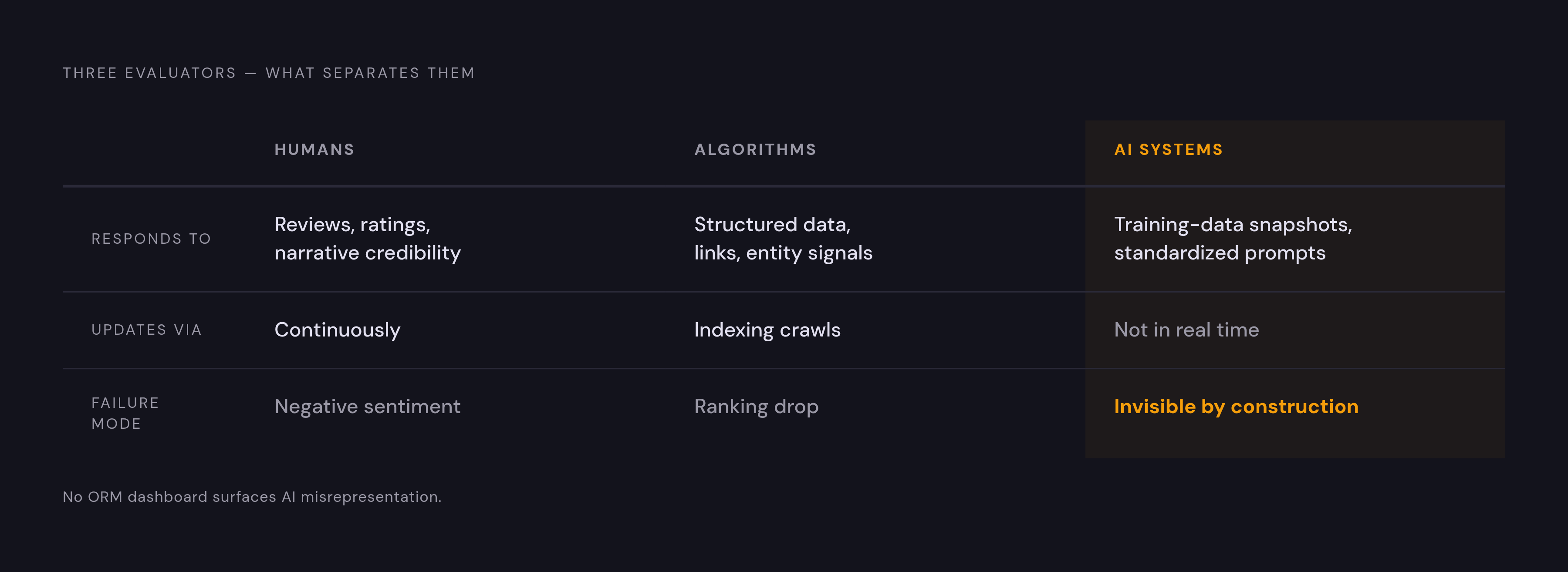
That assumption no longer holds. Every business today is assessed continuously by three distinct evaluators, humans, algorithms, and AI systems, and each one applies its own criteria, draws on different inputs, and produces consequences a business cannot address through the same channel.
Human evaluators still work roughly the way ORM assumed. They respond to experience signals: a review that describes a specific interaction, a star rating that aggregates many such interactions, the emotional credibility of a brand's public voice, the narrative consistency between what a company claims and what customers report. This evaluator hasn't gone anywhere, and you still need to read it for brand health.
Algorithmic evaluators, the search and ranking systems that have governed discoverability for two decades, respond to a different category of input. This evaluator has always run in parallel with the human one, and conventional SEO practice was built to satisfy it.
The third evaluator is the one ORM has no mechanism for. AI systems, the large language models now mediating a growing share of commercial discovery, do not crawl a business's listings in real time the way a search engine does. A model that comes to associate a brand with a specific attribute, whether that attribute is accurate, outdated, or simply wrong, repeats that same association across different users asking different kinds of questions. This is a genuinely different kind of evaluator: it doesn't update the way a search index updates, and it doesn't form an opinion the way a human forms one from direct experience. It forms a representation, once, from a fixed snapshot of the internet, and then repeats that representation at scale.
Why AI systems produce a different risk profile
The risk an AI evaluator poses to a business differs in kind from the risk posed by a bad review or an algorithmic ranking drop, in three properties: persistence, opacity, and disconnection from the signals a brand can actually monitor.
Persistence is the mechanical consequence of stickiness. Once a model links a brand to a given set of attributes, whether that pairing is accurate or just stale, the association tends to recur across many query types, from direct brand lookups to competitive comparisons to category recommendations. A single flawed data signal absorbed during training can propagate across millions of subsequent queries, and there is no dashboard alert, no review notification, no ranking-position drop that tells the brand this is happening. The failure mode is invisible by construction.
Opacity compounds the problem across models. Faruk Tugtekin's AI Perception Index 2026 study, built on the Perception Control Framework v2 and published on SSRN, found that the same brand can be described in materially different terms depending on which model answers the query, meaning cross-model perception drift is substantial. There is no single source of truth to check the way there is a single star rating to check on a review platform.
Once AI systems start mediating transactions directly, not just descriptions, the stakes stop being reputational in the narrow sense. Research examining the hotel sector describes large language model assistants functioning as an "algorithmic infomediary," a gatekeeper whose selection function determines which eligible properties a traveler ever sees, since major assistants began enabling hotel search and are able to surface, and on some platforms transact, bookings directly inside the chat interface. When the evaluator doesn't just describe a business but decides which businesses a user sees as options at all, a misrepresentation is no longer a matter of tone. It's a matter of whether the business is in the consideration set.
Unlike a negative review, which is visible, attributable to a specific platform and date, and addressable through a documented dispute process, AI misrepresentation becomes apparent only when a customer or prospect happens to mention it back to the business. No review platform equivalent exists for contesting what a model says.
What perception intelligence is
Perception intelligence is the practice of scoring a business's signals across all three evaluation dimensions, human, algorithmic, and AI, and identifying specifically where representation breaks down within each one, rather than producing a single aggregate sentiment score. Where ORM asks "how do humans feel about us," perception intelligence asks that question three times, for three different kinds of reader, because the answer is no longer the same each time.
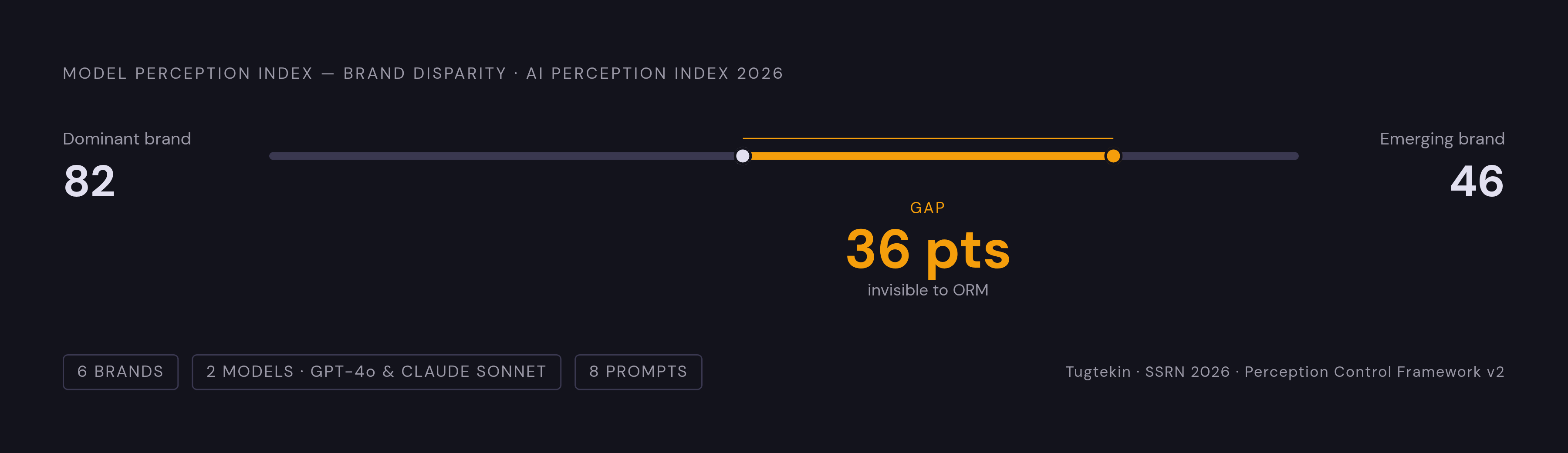
The discipline is young, and its empirical base is still being built. Tugtekin's SSRN study offers what its authors describe as the first empirical measurement of brand perception across large language models using the Perception Control Framework v2, analyzing six brands across GPT-4o and Claude Sonnet using eight standardized prompts, and finding a gap of more than 36 points in the Model Perception Index between dominant and emerging brands. That is a meaningful finding about the scale of disparity models can produce, but it is a six-brand, two-model study, not an industry-wide census, and it should be read as early validation of a measurement category rather than a finished map of how AI perception works across sectors.
A second line of work, Spectral Brand Theory, developed by researcher Dmitry Zharnikov in 2026, argues from a different angle that collapsing brand health into a single score destroys the information that explains why different observers form irreconcilable perceptions of the same brand. The four core dimensions most AI-specific perception analysis now tracks, sentiment, share of voice, attribute accuracy, and competitive positioning, map onto four distinct failure modes that a single sentiment number cannot distinguish between: a brand can be mentioned often but inaccurately, mentioned rarely but favorably, or positioned well against one competitor and poorly against another, and a single aggregate score flattens all of these into the same number.
The signal stack that perception intelligence measures but ORM ignores
The signals governing how algorithms and AI systems evaluate a business are largely invisible to traditional ORM because they are machine-legible inputs that shape what a system generates, not public-facing material designed to shape a human reader's opinion.
On the AI-specific side, content freshness carries a timing nuance ORM has no equivalent for. Community platforms carry disproportionate weight within a specific slice of this picture: a large share of AI citations classified as social in origin come from platforms like Reddit and YouTube, even though the majority of all AI citations overall still trace back to branded or editorial sources. ORM rarely tracks community platform presence as a reputational input. And narrative consistency, the gap between how a brand describes itself and how an AI system describes it, is a measurable, addressable signal with no dashboard equivalent in conventional ORM tooling.
One finding complicates the instinct to treat this as simply "do more technical SEO." The signals that have dominated technical SEO practice for years turn out to be weak predictors of how AI systems actually represent a brand.
Why AI systems can misrepresent a brand that passes ORM benchmarks
A business can hold a strong star rating, maintain a clean set of search results, and earn positive press coverage, and still be described inaccurately, unfavorably, or not at all by the AI systems an increasing share of its prospective customers now consult before a human review ever enters the picture.
The Greenlane Marketing AI Brand Perception Analysis, launched in September 2026, surfaced an early and concrete example of this class of failure. One brand received a positive recommendation when only training-bot knowledge was queried, then was, in the analysis's own terms, skewered by the same models once retrieval bots ran against live web content. The gap between those two states existed entirely inside AI-generated responses. No indexed content changed. No review appeared. ORM monitoring, built to watch what humans publish and what search engines index, had no way to detect a shift that occurred only in what a model synthesized and then generated as an answer. That example shouldn't be read as proof every brand will encounter the same swing, but it illustrates precisely the category of failure ORM cannot detect by design, because the failure doesn't touch any of the surfaces ORM watches.
The exposure isn't evenly distributed. Analysis of the 2026 brand trust landscape notes that smaller companies carry disproportionate risk here, because a single outdated or inaccurate AI summary can shape a prospect's first impression at scale, long before any human review process would have a chance to catch or correct it. A large brand with deep, redundant coverage across the web has more signal to dilute any single bad input. A smaller brand with a thinner footprint has less room for a model to get it right by averaging across many sources.
Measurement across three evaluators
Measuring perception across three evaluators calls for three distinct measurement approaches, because each evaluator produces evidence in a different form, at a different cadence, and through different channels.
Human perception measurement, review sentiment, share of voice in earned media, narrative consistency across human-facing coverage, remains necessary. It is no longer sufficient as a standalone read of brand health, because it answers only one of the three questions a business now needs answered.
Algorithmic measurement tracks entity recognition, citation patterns, dual-signal presence, and structured data completeness, the inputs that are largely invisible on a sentiment dashboard but function as the actual raw material for AI discoverability. This is the layer where conventional SEO practice already has instrumentation, even if, as the Ahrefs findings suggest, some of its long-standing priorities need reweighting for the AI context.
AI perception measurement requires something ORM has no analog for: actively querying models with standardized prompts across multiple systems, repeatedly and on a defined schedule, and tracking four specific outputs. AI mention rate asks whether the brand surfaces in a given answer. Share of Model asks how prominently it appears relative to named competitors within generated answers. Sentiment in AI responses tracks how a model's tone shifts between a general recommendation prompt and a direct comparison prompt, since the two frequently diverge. Attribute accuracy asks the most basic and most often skipped question: is what the model says about the brand actually true and current.
Some practitioner frameworks have begun proposing scoring thresholds for this kind of measurement. The AI brand perception analysis guide published by Listen Labs describes scores below a defined threshold as indicating "pre-visibility," a state in which AI systems don't yet hold enough signal to represent a brand with any confidence, and scores above a higher threshold as indicating category dominance, where a brand is the default answer models reach for.
The practical implication is that human-facing trust signals and machine-legible credibility signals are now the same underlying signals, read by three different evaluators applying three different standards. Perception intelligence measurement doesn't need a separate data infrastructure from what ORM already collects. It requires reading the data a business already generates, its reviews, its citations, its published content, its third-party mentions, through three distinct lenses rather than one, and building the discipline to query AI systems directly rather than assuming that what ranks well and reads well to a human also reads correctly to a model.