The Measurement-First Principle in AI Era Brand Management
Standard dashboards miss how AI describes your brand, so measure it first.

Brand perception has split in two. What human consumers feel about a brand and what AI systems say about it when asked now diverge systematically, and the gap is measurable. AI systems are now active evaluators of brands, not passive mirrors of human opinion, and everything brand managers assumed about monitoring is incomplete.
How LLMs Actually Form a Judgment About a Brand
Large language models do not hold opinions in any human sense. They encode probabilistic associations between brand names and the contexts in which those names appear across billions of training examples, and those associations govern every recommendation the model produces. When a brand consistently shows up alongside terms like "reliable" or "innovative" in authoritative sources, the model internalizes that pairing. When the same brand appears near "complaints" or "disappointing," those patterns get encoded instead. Sight's 2026 guide describes this pattern-learning mechanism directly, and it carries practical stakes: a brand's AI representation is the residue of how the web talks about it, not how the brand talks about itself.
Sentiment operates on two levels. Explicit sentiment appears in statements like "Company X is known for strong support." A model that lists a brand third in a set of alternatives is expressing something about that brand's standing, even when every sentence about it reads as neutral. These implicit signals shape buyer intent as much as any overt recommendation does.
The knowledge that drives these judgments comes from two distinct layers. Static sentiment is baked into the model's training data, carrying associations formed at whatever point the data was collected. Dynamic sentiment enters through retrieval-augmented generation, which pulls live sources into the response as the query is processed. A model might hold positive static associations with a brand, retrieve a recent negative review mid-query, and shift its answer accordingly. That interaction between layers is why AI brand perception is not a fixed score but a distribution that changes with what the model happens to retrieve.
Source preferences tilt heavily toward earned media. Third-party review platforms, forums, and news publications dominate the citations that shape AI brand judgments, while brand-owned content barely registers. Tools built to score across this landscape, like Scale Labs (Evident), a multi-signal platform that measures how algorithms, AI systems, and humans simultaneously evaluate a business, exist precisely because no single source tells the whole story. Cairrot's 2026 analysis found that a brand's own testimonials page has almost no influence on what models say, while Reddit threads and review aggregators carry outsized weight. The AI Perception Index 2026 documents this cross-model perception drift as a measurable phenomenon, not an occasional anomaly.
Why the Signals That Determine AI Recommendations Are Not Visible in Standard Dashboards
The tools most brand and marketing teams rely on were built to track what humans say about brands, and they cannot, by design, capture what AI systems say. Social listening and review monitoring platforms crawl public posts and review sites. Sight's 2026 guide identifies this as a structural gap rather than a feature gap, and the distinction matters: adding more keywords or more alert rules to an existing listening tool cannot surface a signal that the tool's architecture was never designed to capture.
The invisibility runs deeper than tool coverage. The zero-click dynamic compounds the problem: a brand can be prominently featured or actively misrepresented in AI-generated answers without producing any referral traffic, so traffic analytics offer no signal that the representation is happening at all. A buyer who is told a brand is overpriced or outdated simply moves on, and no dashboard records the loss.
Accuracy failures are especially dangerous inside this blind spot. No one complains about them, no review flags them, and no social post mentions them. They just sit in the model's retrieved sources, quietly shaping every answer the model gives.
The natural objection is that tracking reviews and press coverage should cover the inputs that shape AI responses. The metrics the field is developing to close this gap, including answer inclusion rate, entity presence score, and AI citation frequency, do not exist natively in standard reporting tools. Tracking them requires deliberate instrumentation, and most teams have not built it.
What Rigorous AI Brand Measurement Actually Scores
Measuring how AI evaluates a brand requires a structured, multi-signal framework, not a single query run once. The first dimension is presence: whether the brand appears at all when buyers ask relevant category questions. A brand that does not show up in AI answers about its own category is losing discovery opportunities in a channel where silence carries cost.
Sentiment and tone form the second dimension. Whether the AI recommends the brand, mentions it neutrally, hedges it, or raises reservations matters, but tone is as important as overall valence. Snezzi's 2026 guide distinguishes these as separate scoring dimensions, because a brand that gets mentioned favorably but always as a fallback option occupies a different competitive position than one the model names first.
Framing relative to alternatives is the third dimension. Whether the brand appears as a category leader, a credible alternative, a niche option, or a cautionary example shapes buyer intent as much as the raw sentiment does. A wrong framing requires deeper work.
The same brand can get a very different perception score across AI systems, as the AI Perception Index 2026 documents. Source attribution completes the picture: which domains the AI is citing when it describes the brand. Tracing negative or inaccurate answers back to their source is what makes the score actionable rather than merely diagnostic.
Prompt variability must be controlled for any of this to be meaningful. The same brand receives different treatment depending on how the query is framed, so a repeatable measurement protocol runs a fixed set of representative buyer queries on a schedule, across multiple engines, and looks at patterns rather than single responses. The Algorithmic Brand Legibility Framework published in 2026 at Research Square formalizes the structural signals that determine how legible a brand is to AI evaluation systems: semantic clarity, structured knowledge representation, entity identity, contextual consistency, digital authority, verifiable trust signals, transparency, and technical accessibility.
Why Measurement Must Precede Optimization, Not Follow It
Acting on AI perception without first scoring it produces effort that is directionally wrong as often as it is right. The signals that matter differ by brand, category, query context, and AI platform in ways that cannot be guessed in advance, and the cost of guessing is concrete: a team spends a quarter producing more content when the actual problem was outdated third-party listings that the AI kept retrieving and repeating. The evidence against proxy-based assumptions is stark. The gap between dominant and emerging brands on the Model Perception Index spans 36 points, and without measurement a brand cannot know which group it falls into, regardless of its market position by human metrics. A company that leads its category in revenue can be an emerging player in AI's representation of the market, and it would have no way to know.
The case for measurement before optimization becomes even clearer when the Levi's divergence is recalled. Human consumers placed Levi's in the 94th percentile for brand love, yet three leading LLMs ranked it substantially lower. The only way to know where such gaps exist is to score them.
The objection that a brand can audit its own web presence and infer what AI sees fails on structural grounds. What the AI says is a function of inputs the brand cannot see, weighted by a process the brand cannot observe. Measurement is the only access point.
Prioritization is where measurement pays for itself. With it, the highest-leverage intervention stands out: a source that feeds negative answers across multiple models, an accuracy error that corrupts every query in a category, a framing problem that costs the brand placement in a substantial share of relevant answers. Measurement enables triage, not just diagnosis.
What a Measurement-First Workflow Looks Like in Practice
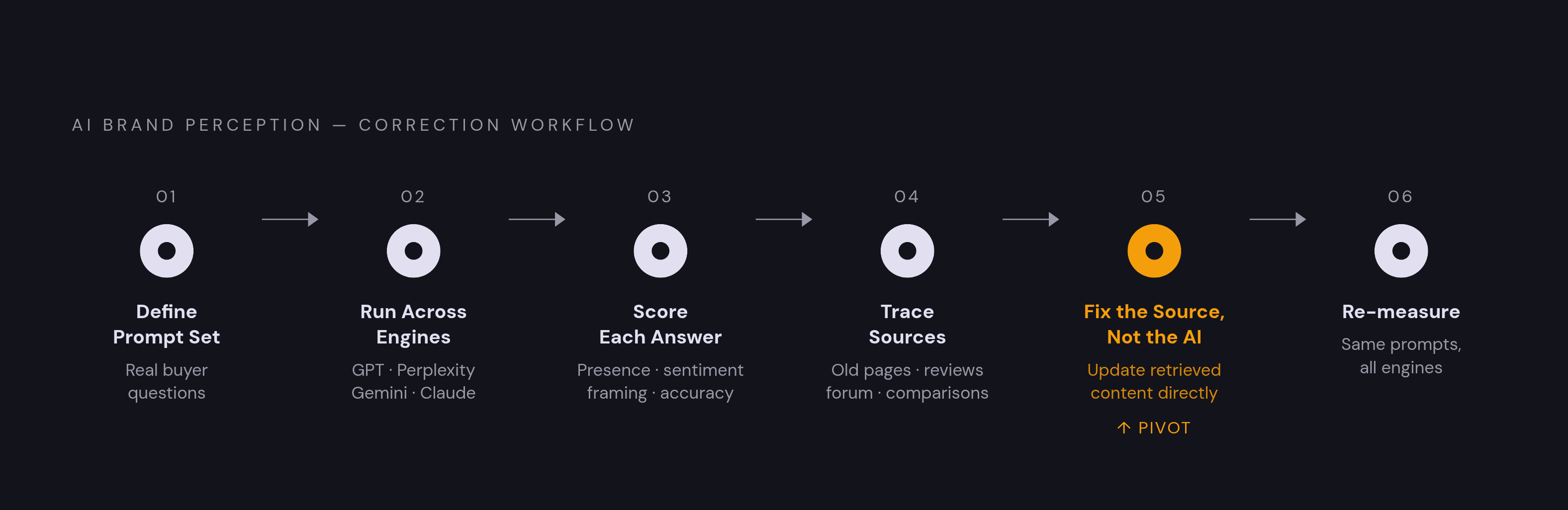
A measurement-first workflow is a repeatable protocol, not a one-time audit. The first step is defining the prompt set: identify the actual questions buyers ask when researching the category, not hypothetical queries invented by a marketing team. These become fixed inputs that stay consistent across every measurement cycle. The point is to see change over time, and change is only visible against a stable baseline.
The second step is running those prompts across engines. ChatGPT, Perplexity, Gemini, Claude, and AI-powered search features each have their own retrieval logic and source preferences, and which platform matters varies by category. Platform source patterns shift over time, so single-engine measurement understates the variance a brand actually experiences. A brand that scores well on one model and poorly on another needs to know that, because buyers are distributed across all of them.
Scoring each answer against a consistent rubric is the third step. The rubric covers presence, sentiment, framing, and accuracy, and Snezzi's 2026 guide provides a practical scoring structure with defined values for each dimension. The fourth step is tracing negative or inaccurate answers to their cited sources. The cause is usually one of four things: an outdated page on the brand's own site, an old review or comparison article, a forum thread, or a competitor's comparison page. Knowing which one is the source is what makes the score actionable.
The fifth step is intervening on the identified source, not on the AI response itself. Direct attempts to control LLM output fail. Models do not take correction from brands. But correcting the sources those models retrieve does change responses over time, because the models re-read the web on every query that triggers retrieval. The sixth step closes the loop: re-measure on the same prompt set after each intervention. A single improved answer is not a trend. Consistent improvement across engines on the same query is.
At scale, this workflow outgrows a spreadsheet quickly. The scheduling, the scoring, the source capture, and the trend tracking across engines and prompts generate more data than a manual process can hold. Platforms built for this purpose, such as Evident, automate the cycle across more than 400 signals, giving brand teams a continuous read on how AI systems perceive them rather than a periodic snapshot. The association score and market prominence score framework, which separates what a brand is known for from how strongly that quality is associated with the brand across the category, shows how multi-dimensional scoring surfaces distinctions that a simple positive or negative read misses.
The Brands That Act Without Scoring First Are Accumulating a Liability They Cannot See
A brand that is not measuring its AI perception is not standing still. It is allowing AI systems to represent it based on whatever evidence those systems happen to retrieve, with no feedback loop and no correction mechanism. The representation is happening either way. The only question is whether the brand knows what is being said about it and can do something about it.
AI hallucinations make the asymmetry worse. Research surfaced by the Columbia Tow Center found that major AI search tools frequently returned incorrect answers to source-attribution queries, which means a brand can be actively misrepresented in ways it cannot detect through standard monitoring. The liability runs in both directions. Positive AI representations drive recommendations that brands cannot attribute to a source and cannot reinforce, so the upside is invisible. Negative or inaccurate representations erode pipeline that brands cannot see and cannot defend against, so the downside is invisible too. Both directions leave the brand blind.
The window for establishing a measurement baseline is closing. As AI-mediated discovery becomes the norm rather than the exception, the brands that built scoring infrastructure early will hold trend data that late movers cannot reconstruct. There is no way to backfill a historical record of what AI systems said about a brand last year. The Perception Control category, the discipline of measuring and managing how AI systems semantically represent brands, is now validated by empirical research. The AI Perception Index 2026 treats it as an established and measurable domain, not a speculative one.
The practical conclusion is not to monitor everything but to measure before acting. Without a scored baseline, every optimization dollar is allocated on assumption. With one, the highest-leverage interventions are visible and the impact of each fix is trackable. Evident exists precisely for this moment, giving brand teams a definitive, scored read on how algorithms, AI systems, and human audiences perceive their business. Improvement follows measurement, not guesswork, and the brands that accept this early will be the ones AI recommends.