How AI Systems Use Web Sources to Form Brand Judgments
Measuring which web sources drive AI verdicts comes before optimizing.

AI systems form brand judgments from patterns in training data and retrieved web sources. A perception intelligence platform for AI era brands must therefore measure which sources shape those judgments, how often brands appear, and how they are characterized. The central requirement is measurement before optimization, with AI representation assessed beside human perception.
How AI systems form brand judgments: the source-to-verdict pipeline
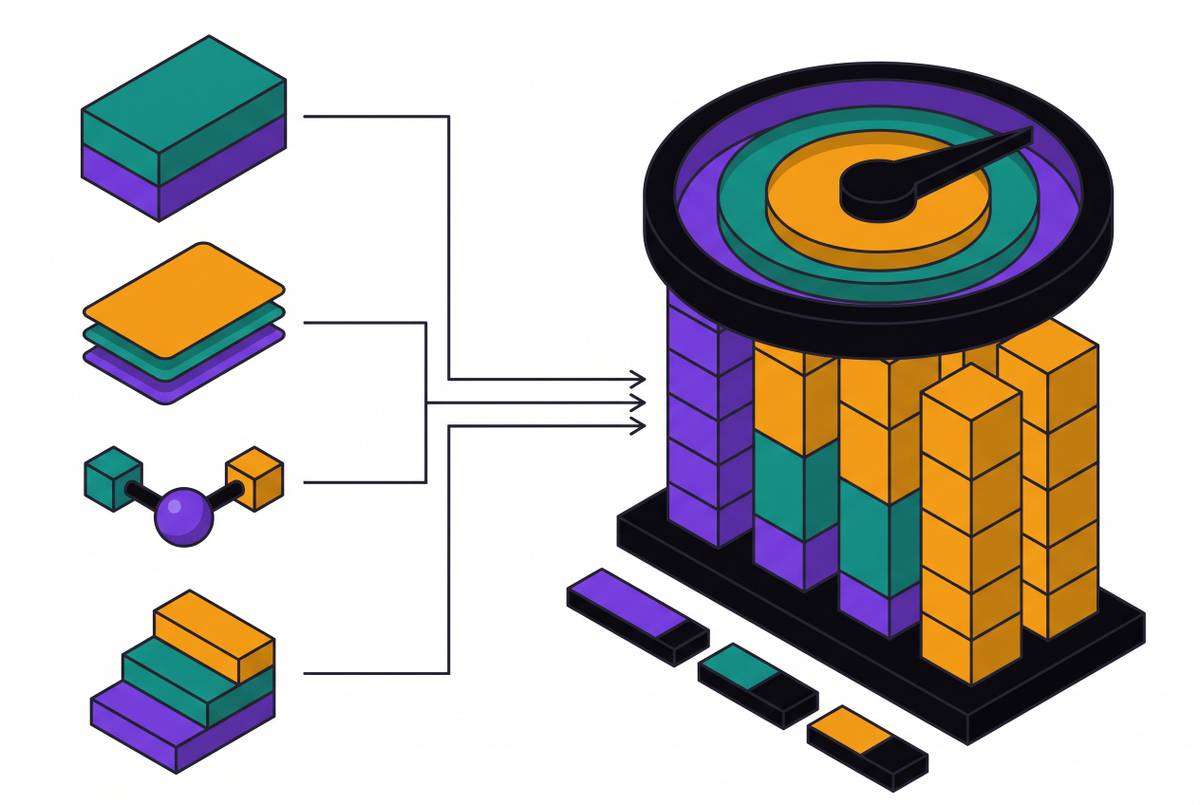
When someone asks an AI system about a brand, the answer draws on information the system learned during training or retrieves for that query. The system synthesizes that material into a response that may describe, compare, recommend, or omit the business. What reads as a single verdict is therefore the output of a source-to-judgment pipeline. The raw material comes from the web, but systems reach it through different routes. Those routes affect which parts of a brand’s public record can influence the answer.
The training-data layer holds associations the system learned from crawled web content, articles, reviews, and forums during pre-training. The retrieval layer adds documents found through live lookups in systems that use retrieval-augmented generation. Zatuchin’s 2026 study provides a concrete distinction in its methodology, with GPT-5.2 and Gemini 3 Flash called without search or grounding tools. By contrast, a retrieval system such as Perplexity sonar-pro can retrieve documents at query time. A brand’s current web presence and its learned associations are thus related but distinct inputs.
This distinction makes “AI visibility” too broad to serve as a single management target. Strong presence in one layer does not establish presence in the other, so measurement must account for both. Scale Labs, a perception intelligence platform built for the AI era, scores how algorithms, AI systems, and humans evaluate a business across a broad range of signals. Its relevance to this problem lies in making source patterns and credibility signals visible within a broader evaluation framework. The diagnostic question comes before any intervention, namely which layer and which sources are shaping the verdict.
Why third-party sources dominate what AI systems say about a brand
Zatuchin’s 2026 study found that 85.7% of the URL citations in AI answers about brands pointed to third-party sites. Owned sources supplied only a small minority. This is the sharpest distinction between controlling a brand’s message and influencing its AI representation. A company can determine what its website says, but it cannot assume that the evaluating system will give that website decisive weight. The cited evidence is predominantly held elsewhere.
That finding concerns URL-grounded citations. Publishing more owned content does not, by itself, address a judgment grounded chiefly in external sources. The relevant signal is corroboration beyond the brand’s own claims. Control over publication is not the same as influence over evaluation.
The citation pool also concentrates attention on a relatively small share of domains. Broad but shallow coverage may therefore matter less than substantive presence on the high-authority platforms a system actually cites. Multi-signal measurement, including the approach described by Scale Labs, provides a way to diagnose that uneven distribution before attempting to reshape it. The task is to establish which third-party platforms matter for a particular business, rather than assume that all external mentions carry similar weight.
What the citation pool is actually made of and why that concentrates power
The influential third-party tier includes editorial publications, analyst reports, review platforms, forums, and structured reference sources. These source types supply different forms of description and corroboration, but their importance comes from their place in the citation pool. That pool is long-tailed, with a relatively small share of domains producing most citations. A brand’s exposure depends on its distribution across the sources AI systems consult, so the number of places it appears is an incomplete measure.
This concentration explains why prolific publishing on an owned domain can coexist with weak representation in AI answers. The business may have a substantial public record without that record reaching the source tier that shapes the response. This concentration is a structural constraint on how evidence enters the evaluation process. Quantifying which source tiers drive a business’s verdict is a prerequisite to improvement in the approach Scale Labs describes.
Zatuchin’s 2026 study found relatively close inclusion rates across the ten sampled brands within an industry, with a mean Gini of 0.30 in the February wave. That finding leaves room for lesser-known brands while challenging the assumption that established names will always appear. The study also found competitive vacuums, meaning queries where no brand in the sampled set was named. Such a vacuum shows why category coverage cannot be assumed from a company’s market standing.
How AI systems decide which brands to include and how prominently to rank them
Malthouse et al.’s 2026 Northwestern framework separates two measurable outcomes, which are recommendation prevalence and recommendation prominence. Brand Recommendation Probability (BRP@k) measures how often a brand appears when queries are repeated. Mean Reciprocal Rank (MRR@k) captures how prominently it appears. This distinction matters because the same query can produce different brands and different orderings.
Malthouse et al. found substantial omission of established brands in category-only queries across six LLMs. They also found little evidence that recommendation prominence simply tracked how popular a brand was. Prominence was linked to a broader set of marketplace-visibility signals, especially search interest and online brand conversation. Those associations show why a brand’s market standing alone cannot tell a business what AI systems will recommend.
User needs also change the selection process. Malthouse et al.’s needs-based queries gave goals and constraints that could bring up brands left out of category-only answers. Their diagnostic positioning probes showed that some absent brands remained conditionally retrievable when given cues consistent with their intended positioning. Omission can therefore mean that a brand is not being matched to a broad query, rather than that the system cannot retrieve it at all.
Zatuchin’s 2026 study found strong cross-system agreement on which brand was named most often under a query. That agreement supports repeatable benchmarking. The useful object of measurement is the pattern across responses.
The structural biases built into AI brand evaluation that brands cannot fix with content
Not every disadvantage in AI recommendations is a correctable content gap. What goes into the training data and how the model architecture is built can shape how a system represents a business before it uses current web content. Research on GPT-4o and Llama-3 found a systematic association of global brands with positive attributes and local brands with negative ones. Specifying a domestic country could reverse that bias through a country-of-origin effect. The implication is that query framing and learned associations can change a verdict without any change to the brand itself.
Zatuchin’s 2026 study also found that larger brands tended to have higher inclusion rates, with that descriptive association persisting across waves. The relationship varied by industry and query type, consistent with the limited connection between popularity and prominence in the Northwestern work. Inclusion and prominence are different outcomes, and neither study supports a universal rule that the largest brand always wins.
Cross-model perception drift also limits how much better content can help. The same brand can be represented differently across AI systems, so strong performance on one platform does not establish strong performance elsewhere. A weak result on another platform alone does not show that something is wrong with the brand’s content. Treating every gap as a publishing problem can lead a business to work on the wrong cause. Knowing which disadvantages are structural makes the signals a brand can influence easier to prioritize.
The signals that are within a brand’s control and why they operate differently than SEO signals
The controllable signals concern whether a brand can be identified, understood, and supported by evidence. Technical health, verified organizational identities, and consistent cross-platform profiles contribute to algorithmic trust, but that composite is not the same as domain authority in search. The distinction is between making a page competitive for a search query and making a brand’s claims usable in a synthesized answer. Those objectives can overlap without being interchangeable. A search-ranking measure alone cannot show whether an AI system gets the business right.
Five signal categories give this distinction practical form, namely identity, expertise, evidence, consistency, and accountability. Identity establishes who stands behind the brand and its content, while expertise explains why it can credibly speak to a topic. Evidence shows how specific the claims are and what backs them up. Consistency shows how well descriptions match across platforms and sources. Accountability concerns whether the business updates and corrects its public record.
Together, these categories support citation-worthiness. Citation-worthiness requires that a system can extract content cleanly, attribute it confidently, and present it as a trustworthy source. That is a more specific requirement than publishing a page around a keyword. It also connects owned content to the external corroboration that dominates the citation pool. A clear claim and a consistent public record address different parts of the same evaluation problem.
Positioning adds a further controllable signal. Malthouse et al.’s 2026 findings show why clear associations with particular use cases and consumer needs matter for conditional retrievability. Generic positioning gives a system fewer distinctive cues with which to match a brand to a needs-based query. This does not make SEO and AI visibility, or GEO, separate tracks, because retrieval-augmented systems still draw on live web content. Technically sound, well-structured, third-party-corroborated content can serve both, while the measurement of its effect must distinguish search visibility from AI representation.
How do brands measure AI representation before optimizing it
Measurement must establish more than whether an assistant mentions a brand. A meaningful framework captures prominence, favorability, citation context, and cross-engine consistency. Prominence shows where the brand appears, while favorability shows how it is characterized. Citation context connects the mention to the claims and sources surrounding it. Cross-engine consistency shows whether systems represent the brand in the same way or whether that changes with the platform.
Human perception and AI representation concern the same business, but they are not interchangeable outcomes. A framework spanning both can distinguish a gap in public credibility from a gap in how AI systems express that credibility. Scale Labs is one option for that broader, multi-signal assessment. Evident fits the same measurement-first principle here, with the diagnostic requirement taking precedence over any optimization program.
Malthouse et al.’s 2026 BRP/MRR framework supplies the repeated-query discipline needed to avoid overinterpreting individual answers. Zatuchin’s 2026 study also shows that brands’ overall presence can be tracked over time: cross-date Recommendation Share correlation was strong, and cross-model agreement was above the query-independent null. Together, these findings support systematic monitoring without pretending that the pipeline is fully transparent. They also make single-platform monitoring insufficient for a cross-platform problem. A gain in one system cannot stand in for a measured improvement across the field.
The supported sequence is to measure representation across models and query types, identify controllable signal gaps, prioritize third-party source presence and positioning clarity, and track changes in BRP and cross-model consistency. This order ties changes to a problem that has been found while avoiding guesses about how ranking works. It also separates source deficiencies from structural disadvantages that more content may not solve. As AI systems become more central to brand discovery, companies that invest in measurement infrastructure will have the diagnostic clarity to act. Those that do not will be optimizing blind.