How Perception Intelligence Differs From Share of Voice Measurement
Counting mentions misses what AI systems actually conclude about a brand.

Share of voice tells a brand how often it shows up next to its competitors. It does not tell the brand what that showing up means. The metric started in paid advertising as a plain ratio: a brand's ad spend or impressions divided by the total spend or impressions in its category, a way to size up how much of the available attention one advertiser had captured relative to everyone else buying the same airtime. A widely cited guide to the concept traces how it later spread from ad impressions into organic search rankings, social mentions, PR placements, and paid media, but the math underneath never really changed. It is still presence measured as a slice of a shared pie. Sprout Social and Talkwalker both define SOV along the same lines, as a gauge of visibility and market share potential, not as a measure of what anyone, human or machine, actually understands about the brand once they see it.
That gap between being visible and being understood sat quietly for decades because it rarely cost brands anything. A mention is a mention, and SOV treats every one of them the same: a glowing endorsement and a hostile complaint add to the same tally, a line that shapes a buyer's decision counts no differently than a line nobody reads. For most of SOV's history, this flattening was a tolerable simplification, because the people encountering those mentions, journalists, forum users, potential customers scrolling a search results page, did the work of sorting good signal from bad on their own. A human reader could tell a five-star review from a scam warning even when a counting tool could not. SOV didn't need to make that distinction because it wasn't the thing forming the final judgment. It was only counting how often the subject came up.
That division of labor breaks down the moment the thing forming the judgment is not a person anymore but a language model stitching together an answer. When an AI system is the one deciding what to tell a prospective buyer, the equivalence SOV relies on turns from a tolerable shortcut into a real blind spot, because the system is no longer just exposing mentions for a human to weigh. It's doing the weighing itself, and an instrument that cannot distinguish a trusted citation from a buried complaint has no way of knowing what judgment the system actually reached.
How AI systems evaluate brands
The reason SOV's blind spot matters now is that AI systems don't operate the way search engines or human audiences do. A traditional search engine hands you ten blue links, and then you decide which source to trust, read, and act on. A large language model skips that step. It absorbs a brand's entire footprint, articles, reviews, forum threads, documentation, competitor comparisons, and compresses all of it into a single narrative answer, with no ranked list underneath for the user to inspect or second-guess. You never get to weigh source credibility directly, because the model already did that weighing before a word of the response appeared.
That shift means the brand an AI system recommends is the brand whose evidence the model found credible and easy to extract, not necessarily the brand that showed up most often across the training data or the live web. Credibility takes the place frequency used to hold, and that is a different contest with different winners. A brand can appear constantly and still lose the recommendation to a competitor whose claims were cleaner, better sourced, and easier for the model to pull apart and reuse.
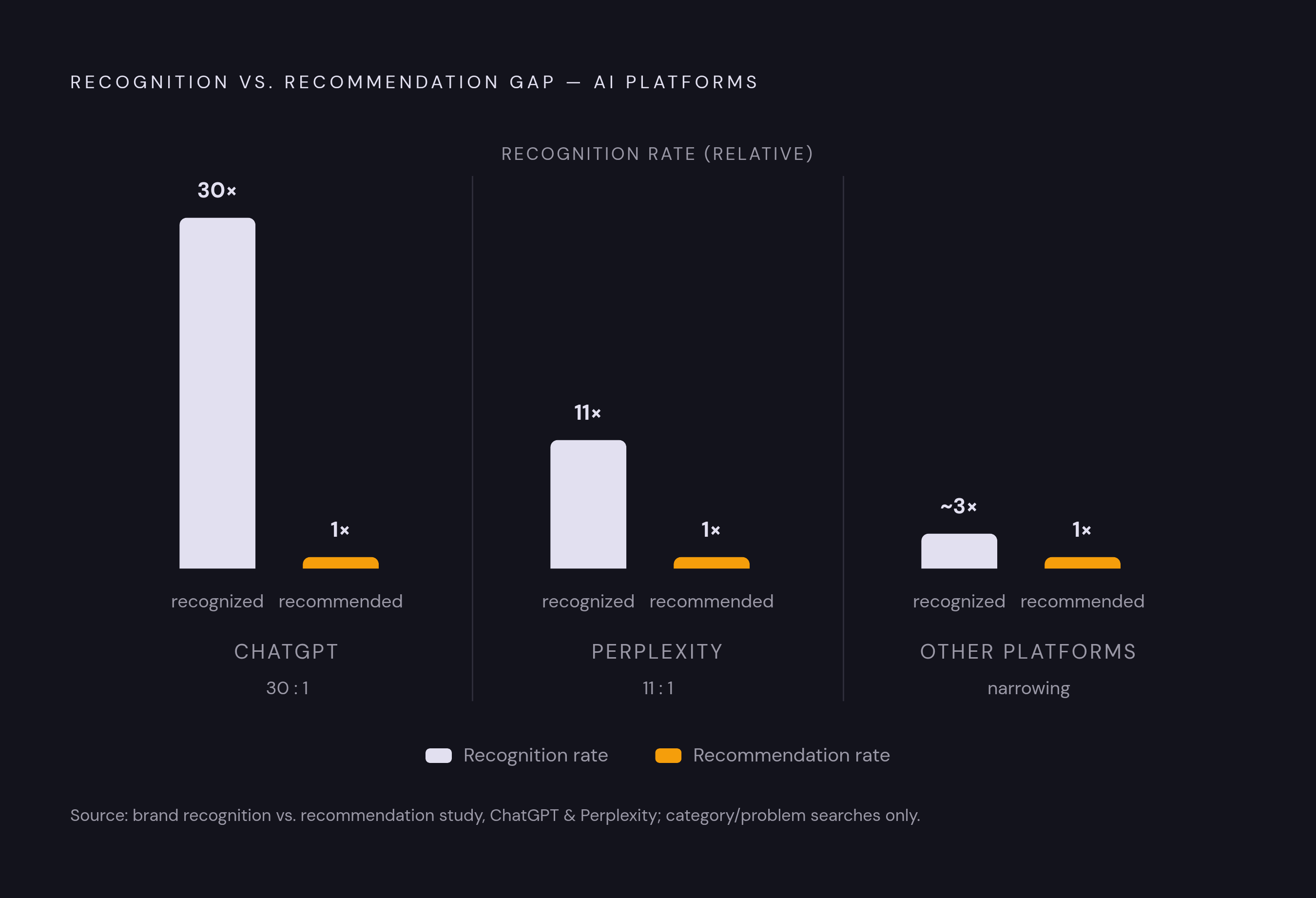
The size of that gap is easy to document and hard to ignore. A study looked at startups across thousands of queries and found that when users searched by brand name directly, AI models recognized those brands at high rates, so the brand existed somewhere in the model's training. But when users searched the way real buyers actually search, by category or by problem rather than by name, recommendation rates fell to a small fraction of those recognition rates. On ChatGPT, you saw the gap between being recognized and being recommended run roughly 30 to one. On Perplexity, it ran roughly 11 to one, narrower but still substantial, and the gap closed further on other platforms without disappearing. Those numbers describe two separate conditions that SOV cannot tell apart: a brand an AI system has heard of, and a brand an AI system will actually put forward when a buyer asks for help solving a problem. Standard share of voice sits much closer to the first condition than the second, which is exactly the condition that doesn't move revenue.
Why cross-model variation undermines a single SOV number
Even if a company adapts share of voice for the AI era, and counts mentions across multiple AI platforms instead of across traditional search results, the number it gets is far less solid than it looks. AI share of voice emerges from a long chain of methodological choices: which prompts get asked, which AI platforms get queried, how a mention gets counted versus a citation versus a recommendation, how many times each prompt gets run, and over what window of time the results get averaged. If you change any one of those choices, the same brand, answering from the same underlying model outputs, returns a different number.
The prompt shape compounds the instability further. The Machine Relations Index shows that the competitive landscape around a given brand shifts completely depending on which of six buyer question shapes gets asked, "best tools" lists, "how buyers choose" framing, "is it worth it" scrutiny, problem-first research, top-ten roundups, and head-to-head comparisons. Pooling the answers to all six into a single blended score doesn't measure a brand's actual standing in its market. It measures the composition of whichever prompt library happened to generate the score, which is a methodology artifact dressed up as a market fact.
Cross-model disagreement adds a second, independent layer of instability on top of the instability caused by prompt shape. Research examining who gets recommended across AI systems, published as "Who Owns the AI Recommendation?" Tugtekin et al. found that full agreement on the top recommendation for a given query occurred in only 41.6% of cases across the two models studied. A brand ranked first on one AI platform can be absent entirely on another, for the same query, asked the same way, on the same day. Two companies can measure the same brand in the same month, use different AI platforms or different prompt sets, and land on different numbers, so neither number is wrong. Competitive benchmarking under these conditions only works if you fix and agree on the measurement methodology in advance, the same way a clinical trial fixes its protocol before anyone looks at results. Absent that agreement, a single SOV figure is less a fact about the brand than a fact about the test that produced it.
What perception intelligence measures beyond AI share of voice
Perception intelligence is a different instrument built to answer a different question. Rather than counting how often a brand shows up, it measures the semantic framing of what AI systems say about a brand when it does, the tone of the language, the company it keeps in the response, and how it stacks up against named competitors in that same answer. Mention rate and share of model answer breadth: how often, how wide. Perception intelligence adds the dimensions that breadth cannot touch on its own, sentiment, the other entities a brand gets associated with, competitive framing, and the depth to which a brand's evidence actually gets absorbed into a model's reasoning, and a brand cited once by name near the bottom of a response occupies a weaker position than a brand whose data or framework visibly shapes the argument of the response itself, moving from a passing mention through citation and on to outright recommendation or, in finer-grained analysis, through citation into full source absorption.
That framing is not evenly distributed or random across platforms, either. An AI system might treat a brand as a credible category authority in one kind of query but as a secondary afterthought in another, and those two framings drive two very different buyer outcomes even though a basic mention count would register them identically. You also need to isolate the gap between how AI systems represent a brand and how the brand's own customers actually experience it.
Brands scoring low on this kind of semantic measure sit in a pre-visibility state: they may turn up in AI answers here and there, but those appearances carry no meaningful semantic presence. Brands that score high show something closer to category dominance, where AI systems don't just mention them but actively frame them as the answer. Because AI outputs shift from run to run, from prompt to prompt, and across time even on a single platform, the right way to think about AI visibility is as a distribution of outcomes. A single query sent to a single model on a single day is an observation. It is not a stable estimate of anything, and treating it as one is the same mistake as calling one coin flip a measure of the coin's fairness.
The signals that determine how AI systems evaluate a brand's credibility
If AI systems make credibility judgments instead of simply counting appearances, you have to ask what actually drives those judgments, and the answer looks different from what moved traditional SOV. Traditional SEO-driven share of voice rewarded keyword rankings and backlink volume above almost everything else. AI-mediated evaluation runs on a structurally different set of signals, and the brands winning AI recommendations today are, by and large, not the brands that simply published the most.
Structural trust signals carry real weight here: accurate schema markup, factual consistency across a brand's own pages, and sourcing that a model can actually see and verify. These turn scattered mentions into a coherent, legible presence that an AI system can treat as signal. Third-party corroboration matters just as much, arguably more. Community and platform sources, forums, professional networks, and independent editorial coverage, hold strong citation positions across many buyer question shapes in the AI indexes researchers have examined, though which source type dominates varies a good deal by engine and by query vertical. Owned content by itself tends not to move a leaderboard when independent corroboration is what shapes it. A brand's own site can say anything it wants about itself, but what moves an AI system's judgment is whether other, unaffiliated sources back up that claim. Brands with a wider base of referring domains and an active presence on community platforms tend to show stronger AI visibility than brands relying mainly on their own published material, a relationship that points toward the same conclusion search-adjacent research into generative engine optimization has been converging on, that independent, third-party corroboration functions as a credibility signal AI systems weigh in ways that owned content alone cannot replicate.
The structural limit of SOV, treating every mention as interchangeable, turns from a minor simplification into a real liability once credibility, not frequency, is what's actually being judged. A multi-signal approach that scores the quality and consistency of evidence across algorithmic, AI, and human evaluation layers gets closer to the evidence AI systems are actually weighing, rather than just its raw volume, and that is the kind of layered measurement perception intelligence platforms, Scale Labs among them, are built to produce.
Building a measurement system for presence and perception
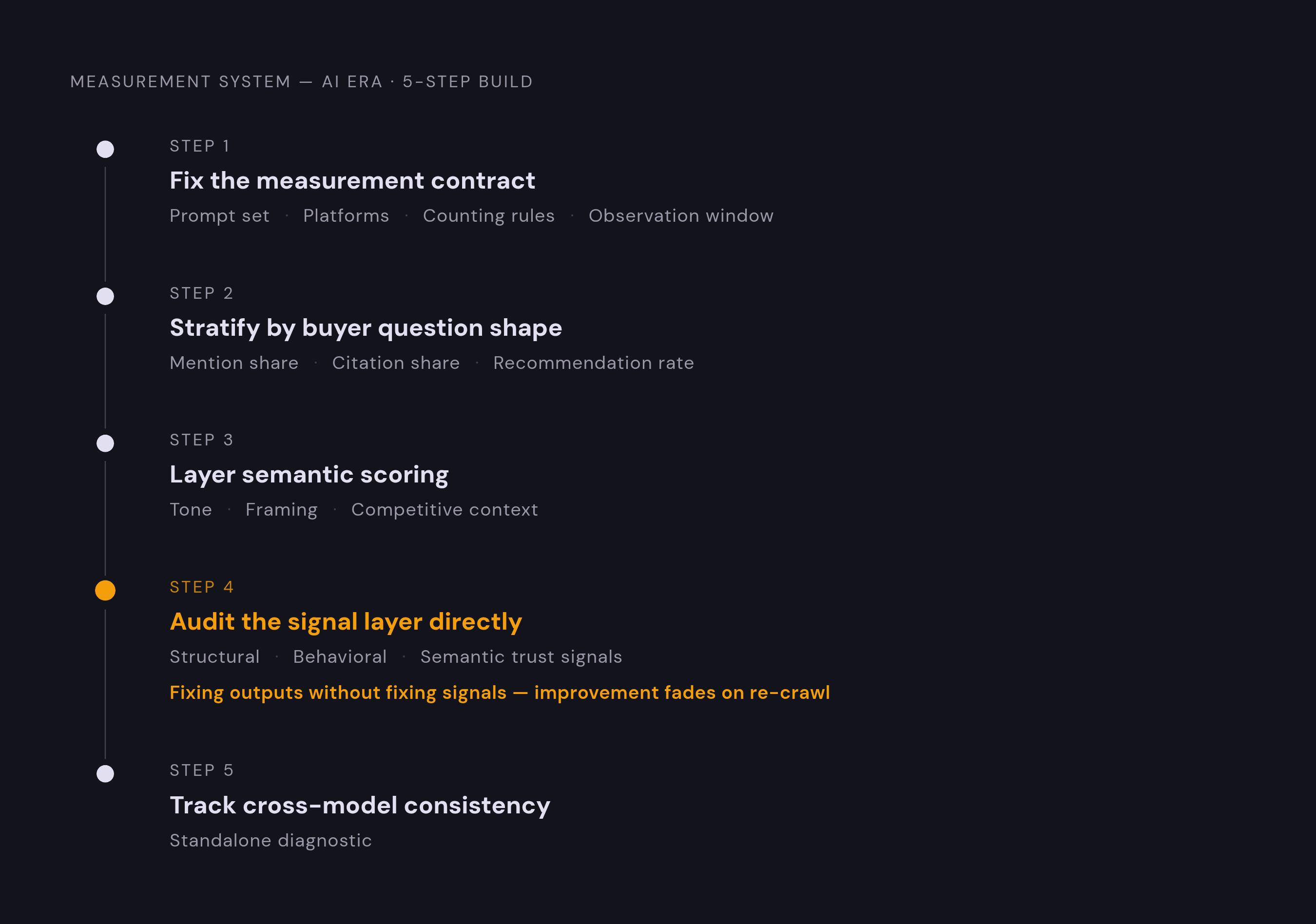
A measurement system fit for this environment has to start where SOV starts, with presence, and then build semantic scoring, cross-model consistency checks, and signal-level diagnosis on top of it, because no brand can fix what it has not first measured accurately.
The first step is to fix the measurement contract before collecting a single data point: decide in advance on the prompt set by buyer question shape, the AI platforms to be covered, the exact rules for counting a mention versus a citation versus a recommendation, and the observation window across which results get compared. If that methodology isn't fixed in advance, the number it produces is a snapshot with no frame of reference, one that won't mean the same thing next quarter that it means today.
The second step is to stratify results by prompt shape, and not by platform alone. Mention share, citation share, and recommendation rate should each get reported separately for problem-first research prompts, comparison prompts, best-tools prompts, and the other buyer question shapes, rather than blended into one aggregate score that hides exactly where a brand is strong and where it is nowhere to be found.
The third step is to layer semantic scoring on top of those breadth metrics, assessing the tone, framing, and competitive context of what AI systems actually say, beyond whether the brand's name appears. A hostile or heavily hedged mention inside a high-profile AI answer is a liability you need to manage, not a win you report alongside everything else.
The fourth step is to audit the signal layer directly rather than the outputs alone, identifying which structural, behavioral, and semantic trust signals are thin, inconsistent, or missing, since those signals are the actual inputs AI systems draw on to form a credibility judgment. Repairing the outputs without repairing those inputs tends to produce improvement that fades the moment the underlying evidence gets re-crawled.
The fifth step is tracking consistency across models directly, because a brand represented one way on one AI platform and a different way on another has a perception drift problem, one that occurs across platforms and that a simple mention-share count will never surface on its own. Cross-model comparison needs to stand on its own as a diagnostic, apart from any single platform's score.
Because AI systems synthesize brands through structural, behavioral, and semantic trust signals, none of which map cleanly onto a mention count, companies need a framework that scores how each of these evaluation layers actually shapes what gets recommended. The instability documented across models and prompt shapes points toward the same conclusion: what matters is not which single platform happens to recommend a brand today, but how consistently that brand presents credible, extractable evidence across the full range of signals AI systems and human audiences both draw on. Perception intelligence treats that cross-model variation as a starting assumption rather than a flaw to explain away, scoring a brand's standing as a profile of perceived fitness across algorithms, AI systems, and human audiences at once, rather than compressing all of it into one number that only answers how often a name came up. A business cannot improve what it has no way to score, and scoring perception, not merely presence, remains the capability most organizations pursuing AI visibility still haven't built.
Sources
- AI Perception Index 2026 How Large Language Models Position Brands in the AI Era by Faruk Tugtekin :: SSRN
- [2609.16304] Evaluating Brand Retrieval and Ranking in Large Language Model Recommendations
- Who Owns the AI Recommendation? A Multi-Industry Empirical Map of Brand Category Ownership Across Large Language Models