How AI Systems Evaluate Hospitality and Hotel Brand Credibility
AI systems judge hotels on guest ratings and price far more than hotels realize they do.

Travelers now ask a chatbot to compare hotels before they ever land on a hotel's own website, and the machine doing that comparing runs on logic that has almost nothing to do with the two decades hotels spent learning Google. Booking.com's early-2026 integration into ChatGPT made that shift structural: a traveler now browses and narrows options inside the chat window itself, and can complete the reservation without leaving the chat environment. This piece breaks down which signals actually move an AI system's recommendation, which ones hotels think matter but don't, and why the gap between the two is costing independent properties visibility they can't even measure.
Roughly 80% of travelers now use AI for research and comparison, but only about 2% let an AI system book on their own behalf. That gap is the whole story: research is where the decision gets made, so what the AI shows at that stage decides who wins the booking, even though the AI never touches the transaction itself. A hotel's competitive set used to mean chain versus independent, or OTA versus direct booking. Now it means AI-engine recommendation share, and almost no hotel has a way to track it.
Search rewarded visibility. You built pages, earned links, targeted keywords, climbed a ranking. AI answers reward something else entirely: confidence. The system has to trust what it knows about a hotel enough to state it as fact in one synthesized paragraph, and that confidence gets built from signals almost nobody in hospitality marketing has been optimizing for.
How AI systems read a hotel: the machine logic underneath recommendations
Large language models don't evaluate a hotel the way a traveler does. A line like "best-in-class service" on a homepage carries zero weight with a machine, because it's an unverified claim from an interested party. Machines want corroboration across a system of signals, not an assertion from the brand itself.
ChatGPT, Claude, Gemini, Perplexity, and Google AI Overviews all compress everything they can retrieve about a hotel into one synthesized paragraph. That paragraph is increasingly the first thing a traveler reads about a property, ahead of the homepage, ahead of the OTA listing. Whatever that paragraph says carries more weight at that moment than anything the marketing department believes it's been saying for the last five years.
A hotel's brand story, as far as an LLM is concerned, was never a page of copy. It's an aggregate: every review, every piece of press coverage, every directory listing, every Wikipedia mention, pulled into one system of record the model reads all at once.
That makes the AI assistant something close to a gatekeeper. A June 2026 arXiv audit by Baig, Gillani, and Ali (arXiv:2606.16344) underscores that dynamic: which properties a traveler sees depends heavily on what the model surfaces. Unlike a page-two ranking on Google, a hotel has no way to see the recommendation slot it just lost. There's no dashboard showing "you almost got mentioned here." It just doesn't happen, and nobody at the property finds out.
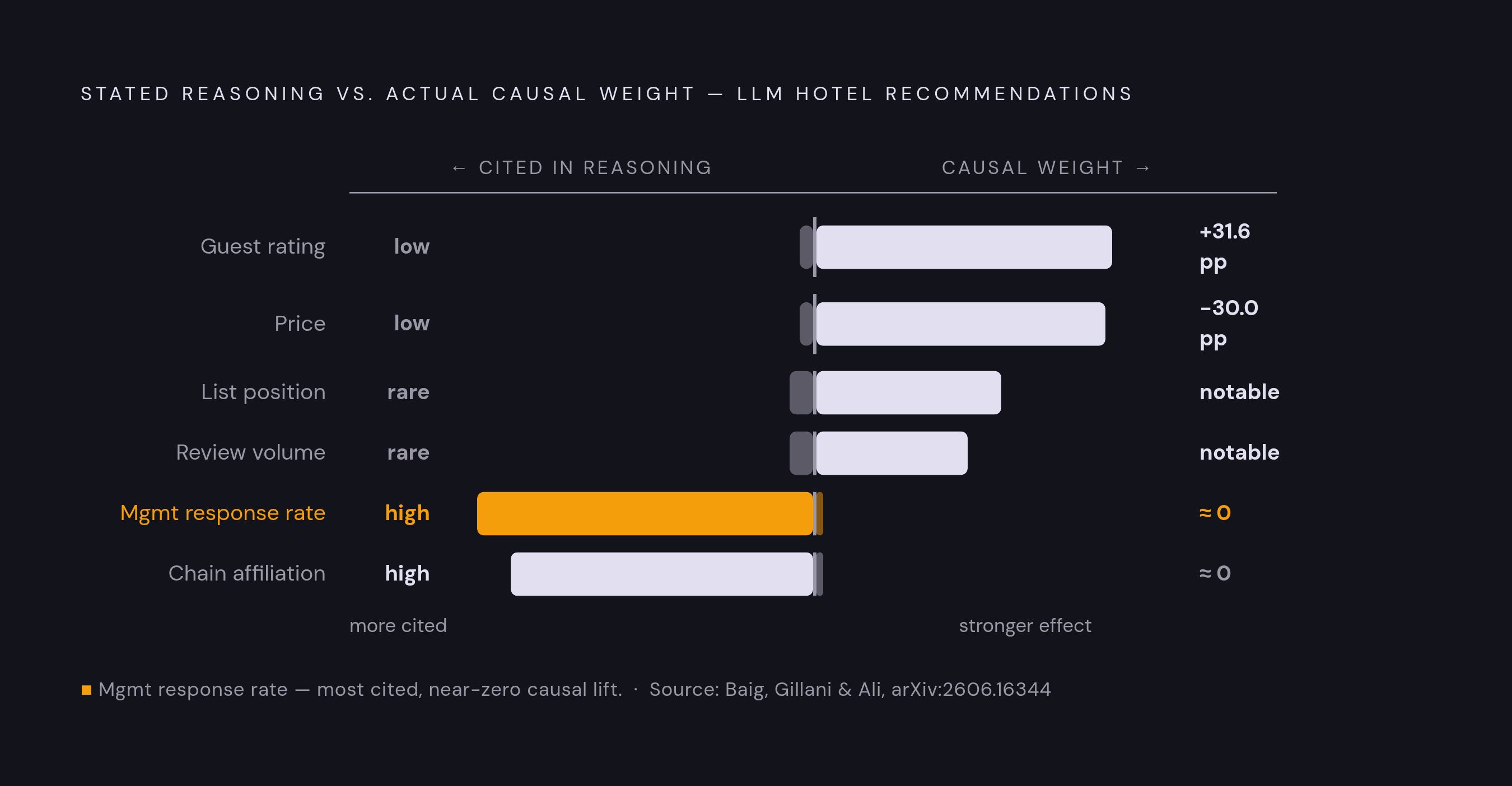
The same audit found something more unsettling. The models' own stated reasoning for a recommendation only partly lines up with what actually drove the selection: per-model rank correlation between what a model says it weighed and what it actually weighted ran from +0.59 to +0.85, meaningfully positive but far from reliable. Models lean hard on list position and review volume while almost never mentioning either in their reasoning, and they cite chain affiliation constantly despite it carrying close to zero actual influence on the outcome. A hotel trying to reverse-engineer an AI's logic by reading its explanations is chasing a signal that doesn't match the mechanism producing it. The only move that works is strengthening the signals the audit found causal, regardless of what the model claims to be doing.
There's an operational layer beneath this as well, produced by how machines process a property's listings, as shown by the way inconsistent data feeds into machine assessments. Inconsistent room-type descriptions, vague cancellation policies, stale availability data, reviews that flatly contradict the marketing copy: all of it reads to a machine as data risk. Humans read past small inconsistencies all the time. Machines don't extend that same grace.
The seven signals the Baig et al. audit found LLMs weight in hotel selection
The Baig, Gillani, and Ali audit ran a randomized, choice-based conjoint experiment across personas, prompt templates, and twelve models, open-weight and proprietary. Five hotels had their guest rating, review volume and recency, management response, chain affiliation, price, eco-certification, and list position independently randomized, which isolates what actually causes a model to pick one property over another rather than what merely correlates with it.
Two signals dominated everything else. A top guest rating raised the probability of selection by 31.6 percentage points, the largest positive driver in the study. Price ran the opposite direction just as hard: a high price cut selection probability by 30.0 percentage points, the dominant negative driver. Between those two numbers, most of the variance in AI hotel selection gets explained.
Eco-certification came in over-weighted relative to how human travelers actually value it, based on established consumer research. That's a real opening for hotels that can earn a legitimate certification, though it says something less flattering about the models too: they're miscalibrated against actual traveler preference on this one dimension.
Management response rate landed at close to zero causal weight, despite the staff hours hotels pour into it and despite showing up constantly in the models' verbalized reasoning. The models talk about it. They don't act on it. List position and review volume ran the opposite pattern: both moved outcomes substantially, and both went almost unmentioned when the models explained their own reasoning. That's the signal a hotel can't diagnose by asking an AI why it wasn't recommended, because the AI's own explanation skips right past the thing that actually mattered.
Chain affiliation showed the same mismatch: near-zero causal weight, heavy over-citation in stated reasoning. For independent hotels, the sharper finding is structural. The audit documented that the assistant systematically declines to surface certain properties at all, and for the growing slice of travelers relying on AI to narrow their options, a hotel that doesn't clear the model's implicit threshold simply isn't in the running. No error message, no lost-ranking notification. Just absence.
Review score, volume, and recency as AI selection thresholds
Review scores aren't a smooth gradient. On most platforms they behave like a series of trip wires, and crossing one changes what happens next in a way a fractional point difference elsewhere on the scale never does.
On Booking.com, a score between 8.5 and 8.9 unlocks "Fabulous" categorization and the ranking lift that comes with it. On Google, a 4.5-plus average is the threshold that reliably triggers favorable placement in the local pack. On TripAdvisor, Travellers' Choice eligibility is tied to landing among the top-rated properties on the platform.
Volume matters just as much as the score, sometimes more. A hotel averaging 9.2 across 12 reviews will rank below one averaging 8.8 across 340 reviews on most OTAs, because volume and recency turn the raw number into something closer to a confidence interval than a grade.
Google has moved further in this direction by breaking reviews into topic-level sentiment categories, cleanliness, service, location, value, surfaced as structured highlights on a property's profile. A hotel with consistently strong marks in specific categories can present a more differentiated profile than one with a higher blended score but no standout dimension. The pattern across individual categories is becoming a more meaningful signal alongside the overall star rating. AI systems draw on this same Google structured data, so they inherit that granularity directly.
Response rate plays into this too, but indirectly. Review response behavior contributes to a hotel's overall local search presence, which in turn feeds the source graph AI systems pull from. Management response carries near-zero direct causal weight in LLM selection, matching the audit's finding above. The value sits upstream instead: a well-managed response cadence supports a hotel's ongoing local search visibility, and that visibility is what feeds the source graph AI systems draw from.
The financial stakes aren't abstract, either. The pricing leverage of review scores is well-documented: higher ratings have been consistently linked to meaningful rate-yield gains without corresponding occupancy loss. Review quality now compounds across multiple channels at once, with AI visibility and OTA ranking both pulling from the same underlying scores.
The source graph's role in determining what AI says about a hotel
The source graph is everything retrievable about a hotel across editorial coverage, review platforms, directories, Wikipedia, Reddit threads, podcasts, and the brand's own content. The synthesis layer compresses all of it into one answer, and the depth of that graph decides how confident the answer sounds.
Brands with a deeper source graph get the synthesized paragraph. Brands without one simply don't come up. What builds that density is editorial coverage from outlets like Condé Nast Traveler, Travel + Leisure, Forbes Travel Guide, Skift, FT Weekend, and Robb Report, combined with primary-source data, a maintained Wikipedia entry, active Reddit discussion, and brand-owned editorial, all running at once rather than one at a time.
What doesn't build it is just as instructive: press releases distributed but never picked up, brand-owned content operating in isolation, and generic positioning along the lines of "luxury hotel" or "premium experience." That language is ambiguous precisely because it fails to distinguish one property from every competitor making the identical claim.
Some brands have built postures specific enough that the synthesis layer can retrieve and describe them distinctly: Four Seasons on its service-recovery legacy, Aman on destination-immersion luxury, Mandarin Oriental on Asian-luxury cultural authority, Rosewood on local-cultural integration, Belmond on heritage rail and river travel. Each owns a sub-category clearly enough that an AI system doesn't have to guess. Generic positioning erodes by comparison, and so does a thin source graph propped up only by brand-owned content, or a crisis episode that went unmanaged and got absorbed permanently into the record with no correction ever appearing.
The clearest illustration of what a thin graph costs comes from a Wellows analysis of Marriott's AI presence: 10 explicit AI mentions against 214 implicit ones. AI systems routinely drew on strengths that matched Marriott properties but credited other hotels instead, ones with cleaner or more complete digital signals attached to the same underlying attributes. The hotel with the better schema gets named. Not necessarily the hotel with the better asset.
How platform-level citation mechanics fragment visibility across AI systems
Citation behavior isn't consistent across AI platforms, and that alone fragments a hotel's visibility in ways a single SEO strategy can't fix. A property can appear with real confidence in one engine's answers and be entirely absent from another's, because each engine sources its citations differently.
A Yext analysis of 6.8 million citations found that Gemini pulls 52.15% of its citations from brand-owned websites, behaving something like a stricter version of Google: it rewards a strong, authoritative first-party presence. ChatGPT runs the opposite way, pulling roughly 48% of its citations from third-party directories, review aggregators, and other consensus sources. It rewards distribution breadth across the wider web rather than strength on a single owned domain.
Both numbers stem from a wider gap. Research into AI citation patterns has found that brands are named in an AI's answer text substantially more often than they receive an actual citation link back to a source. The platforms travelers turn to most for hotel recommendations are not always the ones where a hotel is most likely to get clean, attributable credit for the mention.
That mismatch carries a direct strategic consequence. What strengthens a hotel's position on Gemini, brand-owned authority, is not what strengthens it on ChatGPT, breadth of third-party distribution. A single-channel approach to AI visibility produces a fragmented result almost by design. A hotel's AI visibility needs to be checked platform by platform, not collapsed into one score, and right now, most hotels have no system in place to do that.
Why chain-affiliated properties dominate AI recommendations
A Lighthouse study presented at Luminate 2026 ran thousands of distinct ChatGPT prompts across multiple global destinations and traveler personas, producing tens of thousands of named hotel mentions. The distribution wasn't close to even.
In the US, Marriott captured a dominant share of all branded hotel mentions. If ChatGPT names a branded hotel in a US city, roughly one in four times that hotel is a Marriott property. Hilton trailed a distant second, and the top three brand families combined accounted for more than half of every branded mention counted.
Geography breaks that pattern wide open. In Europe, Accor and Marriott sit close to tied, each around 11% share, a far more democratized market than the US. Tokyo goes further still: the leading brand there holds just 5.8% share, and Marriott doesn't appear until eighth place. AI concentration turns out to be a direct function of how densely the source graph has been built out in a given market, not of brand size on its own.
So why does Marriott dominate in the US specifically? Not brand recognition on its own. It comes down to data infrastructure: schema markup implemented at scale across hundreds of properties, NAP (name, address, phone) consistency enforced system-wide, and years of accumulated editorial coverage from sustained press activity that a single independent property, working alone, hasn't had the reps to build.
That's good news buried inside an intimidating number. The gap is infrastructural, and infrastructure is something an independent hotel can close regardless of size. A property that implements schema correctly, keeps its NAP data consistent everywhere it appears, and invests in real editorial coverage is building the same underlying signals that produce chain-level AI visibility, just scaled to a single property instead of a portfolio. Recall the audit's finding on this exact point: chain affiliation itself carried near-zero causal weight in actual LLM selection. What chains have is better-organized data. That's replicable. Decades of brand equity aren't, but decades of brand equity also aren't what's driving the recommendation, so the absence of them isn't the disqualifier it looks like.
Schema markup, NAP consistency, and structured data as prerequisites for AI readability
None of the above matters if the AI can't parse the hotel's data to begin with. A hotel without Schema.org-formatted, machine-readable data risks exclusion from AI recommendations no matter how strong its reviews or press coverage happen to be. Any property must decide whether it can afford to stay invisible to the growing share of travelers already using AI as a planning tool.
AI agents filtering through properties optimize for two things above all: certainty and speed. They favor listings that make a decision easy and route around anything that requires interpretation. Inconsistent room-type descriptions, cancellation policies that read as ambiguous, availability data gone stale, reviews that contradict what the marketing copy claims: every one of those registers as data risk to a machine, even when a human reader would just shrug and move on.
That produces a strange but very real outcome. Two hotels can share the identical physical asset, the same rooftop view, the same location, and only one gets recommended, purely because its schema markup is complete and the other's isn't. The asset was never the differentiator. The data infrastructure describing the asset was.
NAP consistency is the baseline requirement. Name, address, and phone number need to match exactly across every directory, every OTA listing, and the hotel's own site, because that consistency is what lets an AI system treat the property as one coherent entity rather than several fragmented, contradictory records. Get that wrong, and every other signal built on top of it, reviews, editorial coverage, schema, has to work twice as hard to convince a machine that isn't even sure it's looking at the same hotel.