Restaurant and Hospitality Brand Perception in AI-Driven Discovery
AI now picks a single restaurant or hotel for you, leaving most brands invisible to discovery.

Restaurants and hotels used to compete for a spot on a results page. Now they compete for a spot inside a single answer, and most of them lose without ever knowing the contest happened. When an AI platform recommends a place to eat or stay, it delivers a single verdict for a diner to act on. It's producing one verdict, and a brand either makes that verdict or disappears from the decision entirely.
The shift appears in the numbers. Phocuswright found the share of travelers in one large market using traditional search engines for trip planning fell from 51% to 36% between 2024 and 2025. Booking.com's Global AI Sentiment Report, surveying 37,325 consumers across 33 markets, found 67% had already used AI somewhere in their travel planning. Google's AI Overviews now show up in an estimated 30 to 40% of all search queries, answering the question directly, no click required.
Ranking low used to mean page two. Page two was still findable, still a link a determined customer could click. Omission from an AI answer is categorical. There's no page two, and there's no consolation prize for being technically listed somewhere a person will never scroll to.
What AI systems read when they evaluate a restaurant or hotel
An AI model doesn't look at a star rating and stop there. It reads the sentences underneath the stars, pulling patterns out of review text across dozens of sources, then stitching them into a picture of what a place actually is. That picture draws from reviews, business listings, public mentions, and website copy all at once, not from any single feed, and most owners get this backwards: they assume their own website is the main input. It isn't the main input.
The gap between a useless review and a useful one is stark. Birdeye's research draws the line clearly. "Great food and nice service" gives a model almost nothing to work with. "Exceptional truffle risotto, perfect for anniversary dinners, attentive service" teaches it four things in one sentence: cuisine, price tier, occasion, and service quality. That second review lets the model match the restaurant to a query like "romantic Italian dinner." The first review just sits there, dead weight.
Birdeye's analysis breaks the entity-building process into four parts. Sentiment consistency asks whether the same attribute appears across many independent reviewers; one diner mentioning great lighting gets treated with suspicion, but a dozen diners saying it becomes a signal worth trusting. Attribute coverage handles the basics a model needs to match intent to place: cuisine, dining style, price range, dietary options, ambiance. Recency acts as a proxy for whether the business is still open and the experience still current. Volume raises confidence at scale, so a location with a thousand reviews at a solid but unspectacular rating often beats one with thirty reviews at a near-perfect rating.
None of this leans much on what the restaurant says about itself. NYU adjunct professor Max Starkov has noted that AI bots pull only about 25% of their answers from a hotel's own website, with the rest coming from reviews, blogs, and other public sources. Reporting on the sources these systems favor points to travel forums, review aggregators, and third-party booking platforms as places AI returns to repeatedly, and a niche travel blog will often outrank a major guidebook brand in the results. A hotel's homepage, in other words, is close to the weakest lever it has. Third-party text is the actual curriculum.
Why most hotels and restaurants are simply absent from AI recommendations
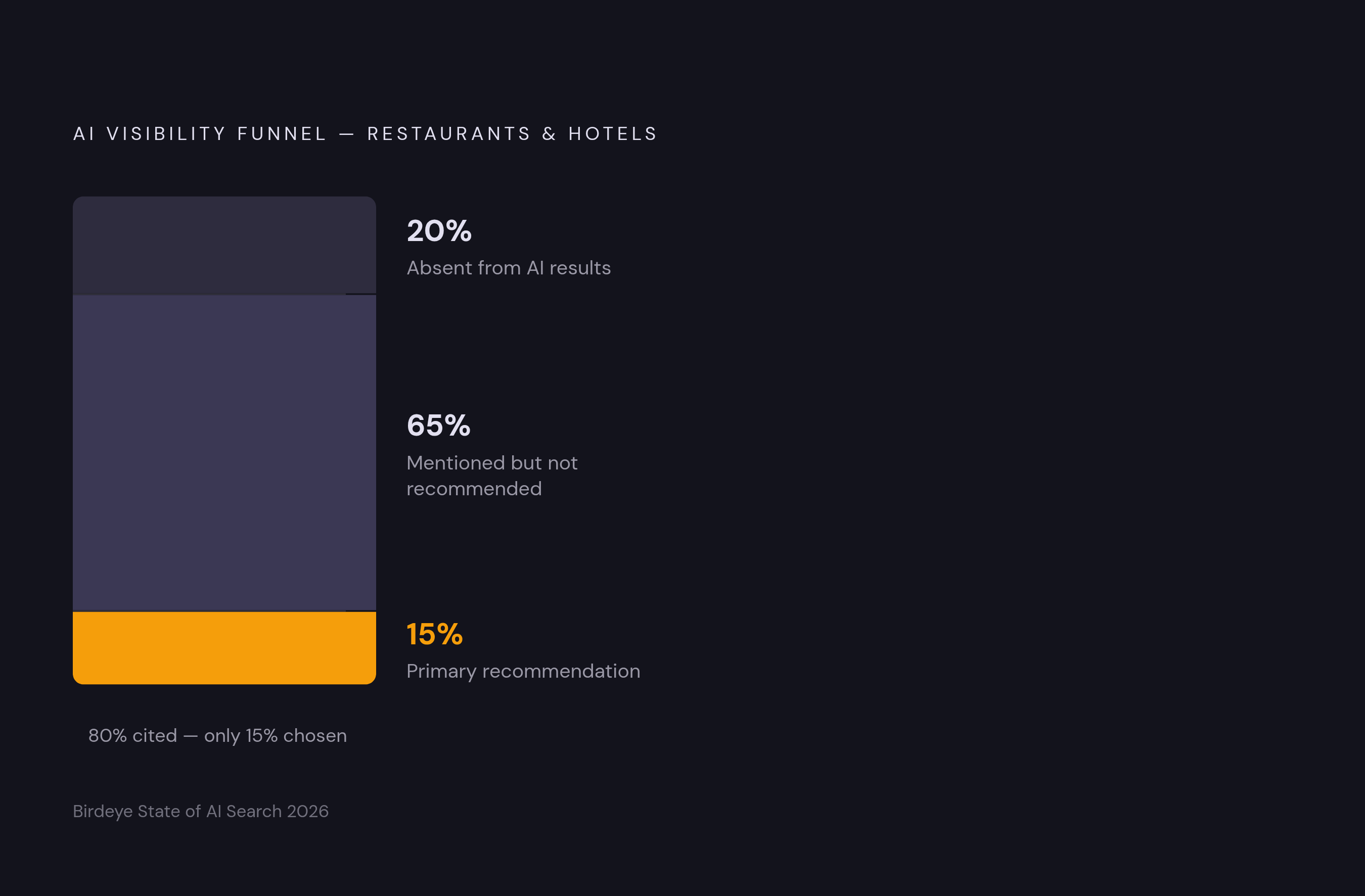
The visibility numbers are not close, and they should worry anyone running an independent property. HotelWorld AI's World's Best at AI 2025 Index, built from 131,000 properties across 30 countries, found only about 16% of global hotel supply appears at all in AI search results across ChatGPT, Google's AI tools, and Perplexity. Birdeye's State of AI Search 2026 report found a similar split on the restaurant side: 80% of brands get cited somewhere in an AI response, but only about 15% land the primary recommendation. Getting mentioned and getting recommended are two different outcomes, and most brands only manage the first one.
Chains dominate the second category, and the reason isn't complicated. Birdeye's research found seven parent chains account for the top 25 most visible brands in AI results, which produces a two-tier system: brands the model already knows well, and everyone else. Online travel agencies built exactly what these systems reward: structured, high-volume, regularly updated listings across thousands of properties with deep review histories and consistent formatting. Among independent properties, OTAs' share of total bookings hit 63.4% in 2025. Six hotel groups now control 84% of organic search traffic. The visibility gap in traditional search and the visibility gap in AI answers are the same gap wearing different clothes.
Adoption lag makes the problem worse, and it falls hardest on the businesses that can least afford it. Research by Opinium for OpenAI, surveying 1,000 decision-makers at UK small and mid-size businesses, found three in ten hospitality businesses aren't using AI at all, one of the lowest adoption rates of any sector studied. Where hospitality does use AI, it's mostly for scheduling, inventory, and staffing, not for checking how AI systems describe them to the outside world. The independent restaurant or boutique hotel most likely to vanish from an AI answer is, almost by definition, the one least equipped to notice.
The signals that determine whether a brand gets recommended: review quality, recency, volume, and listing accuracy
Recency carries more weight than most operators assume, and it should. A restaurant sitting on 400 reviews collected over five years can lose to a competitor with 40 reviews from the last two months, because recent activity tells the model the place is open and still delivering whatever the reviews describe.
Volume acts as a credibility floor. A location with a strong rating but few reviews gets treated cautiously, and for multi-location brands this plays out unevenly: the flagship might carry thousands of reviews while satellite locations sit with a few dozen, so the AI treats each address almost as its own case rather than reading brand reputation as one continuous thing. Specificity compounds all of it. The more occasions, dishes, and details a body of reviews names, the more queries a restaurant can plausibly answer.
Structured data decides a lot of this before a single review even gets read. AI systems parse machine-readable listing data, schema.org markup, JSON-LD tags, at scale, which means a beautifully designed website with none of that underlying structure loses the comparison on a technicality. Name, location, category, and attributes need to match exactly across every surface a business appears on. A hotel with incomplete schema risks getting excluded from consideration before a traveler starts comparing anything.
None of this happens on a single channel, and operators who treat it as one still lose. The properties that appear consistently aren't the highest-rated or the cheapest. They're present across multiple OTAs, active on review platforms, mentioned in travel editorial, and backed by a website that's actually maintained. Birdeye's State of Online Reviews 2025 report found 81% of reviews now include written comments, reflecting how much richer review content has become, yet most hotels keep pouring budget into paid search instead, a mismatch that gets more expensive as AI-driven discovery leans harder on editorial credibility.
Platform policy is tightening around all of this too. Review platforms are applying greater scrutiny to suspicious content, so authentic reputation signals carry growing weight in local search. Review platforms are increasingly processing user-generated content in ways that feed into how AI systems describe businesses. Harvard Business School research found a one-star increase on a review platform can correlate with a 5 to 9% revenue jump. Ninety-four percent of diners check reviews before booking, and a significant share of diners skip a restaurant entirely after reading one negative review.
How LLMs build a brand image from review patterns: the Functional–Experiential–Symbolic structure
A study published in the Journal of Theoretical and Applied Electronic Commerce Research used the Qwen3-32B model to map consumer feedback, drawn from Dianping reviews spanning 2016 to 2022, onto a three-part structure researchers call a functional, experiential, and symbolic framework. Functional covers what a restaurant delivers on the operational level: food quality, service speed, whether the bill matches the menu. Experiential covers what visiting feels like: atmosphere, staff interaction, whether the place fits the occasion someone came for. Symbolic covers what the brand represents beyond the meal itself: heritage, identity, cultural standing.
The study found symbolic scores stayed high and stable across the dataset, while functional and experiential scores ran lower and swung far more erratically. Two clusters fell out of that pattern. One group, comprehensive performers, converted symbolic capital into consistent operational delivery, food and service that actually matched the reputation. The other, heritage strugglers, carried strong heritage and name recognition but weak functional and experiential scores, brands trading on a reputation the dining experience no longer earned.
That finding should worry any legacy steakhouse, regional cuisine specialist, or long-established hotel chain leaning on heritage as its primary pitch, because the model doesn't grade on reputation. Symbolic strength doesn't paper over inconsistent food or indifferent service. It exposes the gap between reputation and reality instead of smoothing over it.
Research posted to arxiv explored using large language models to analyze restaurant reviews and produced rankings that don't necessarily match what a simple average of star ratings would produce. AI-generated consensus runs on its own math, not a mirror of the numbers already sitting on a listing page. For brand managers, the lesson lives in the experiential dimension specifically: the attributes reviewers mention unprompted shape the AI's read of a brand far more than anything the brand writes about itself. Operational consistency has become the entry price for showing up in AI-generated answers. It's the entry price for showing up at all.
Why consistent brand language across every surface matters to AI, and how inconsistency creates a fragmented entity
An AI system has to recognize a restaurant or hotel as one coherent thing before it can recommend it as anything. That recognition depends on the name, location, category, and attributes matching across every surface where the business appears. Get those out of sync and retrieval gets confused, sometimes badly enough that a model treats one business as two.
Menu language is an underappreciated part of this problem, and the scale of it is bigger than most operators would guess. Research from NUST and Careem, working from a dataset of more than 700,000 unique menu items, found that inconsistent naming across platforms causes real trouble for recommendation systems downstream. A "Spicy Chicken Wrap" and a "Zinger Wrap" might be the identical item, but clustering algorithms treat them as two distinct products unless something corrects for it. The researchers built a framework called CPSAF that used LLM-guided cluster refinement to fix this: intra-cluster similarity rose from 0.88 to 0.98, and singleton clusters, items wrongly isolated as unique when they weren't, dropped by 33%. Naming consistency has a measurable effect on how AI systems sort and recommend food, not a cosmetic one.
Brand voice fragments the same way across platforms. A restaurant describing itself one way on Google, another way on its OTA listings, a third way on its own website, and a fourth way in its menu copy hands the model a blurred, sometimes contradictory picture to work from. Multi-location brands feel this most acutely: each location's listing, review history, and menu language can drift apart until the AI stops treating them as one brand and starts treating them as several unrelated businesses that happen to share a name. Consistency has to hold across the boring fields too, business name format, category tags, cuisine descriptors, price tier language, hours, location attributes, because these are what a model parses before it ever reaches a single review.
This is why OTAs keep winning the visibility contest. They enforce the same structured data format across every property in their system, and that uniformity is exactly why AI models trust OTA-sourced information over most brand-owned content. Consistency stands as the mechanism of trust here. It's the mechanism of trust, full stop.
What reputation scoring looks like when the audience is an AI system, not a human diner
The reputation metrics restaurants have relied on for years were built with a human reader in mind: average star rating, total review count, response rate. Those numbers still matter, but they were never built to answer the question that matters now: what does an AI system currently believe about this brand?
Black Box Intelligence's Definitive Reputation Management Benchmark Guide for Restaurants, built from a dataset that's 28% Black Box Intelligence clients and 72% market competitors, organizes reputation around three measures. Cumulative review volume provides social proof that boosts placement in the local map pack. Monthly review velocity signals freshness, telling algorithms a business is still actively generating feedback. Average star rating remains a psychological threshold for human diners and a baseline confidence input for AI weighting.
Momos, working with more than 700 restaurants, tracks a wider set of measures built for this environment: net promoter score, negative review rate (the share of reviews at three stars or below), review platform distribution, guest recovery rate after a complaint, and the competitive rating gap against nearby restaurants. It's a fuller stack than the traditional three, and the added tracking overhead is worth it for any operator serious about reputation.
None of these frameworks, old or new, actually measures how an AI platform represents a brand right now: what attributes it associates with the business, whether it surfaces the brand in the categories that matter, how it frames that brand against the restaurant next door in a generated answer. That's a different measurement problem, and it's mostly unsolved. Malou's study found 86% of US restaurant operators were already using AI weekly to analyze their own reputation signals, proof the appetite for this kind of monitoring exists. But analyzing internal reputation data and understanding external AI representation are not the same exercise, and most of the industry has only started the first one.
The stakes sit downstream of all of it. A large share of diners choose their next meal based on online reviews, and a growing share of adults now trust AI-generated review summaries as a stand-in for reading the reviews themselves. The summary has become the product. Whoever controls what goes into it controls the recommendation.
Sources
- Your reviews are now shaping AI recommendations: What that means for restaurant reputation
- Brand Image of Beijing’s Time-Honored Restaurants: An Analysis Through Large Language Model-Driven Review Mining | MDPI
- Restaurant Menu Categorization at Scale: LLM-Guided Hybrid Clustering
- Dynamic Sentiment Analysis with Local Large Language Models using Majority Voting: A Study on Factors Affecting Restaurant Evaluation
- phocuswire.com