AI Perception Signals for B2B SaaS Brands in Competitive Category Queries
Brands must master five measurable signals to appear when AI answers category questions.

Buyers now ask ChatGPT and Perplexity to name the best vendor in a category before they ever open a comparison spreadsheet. A specific, measurable set of signals decides which brands get named in that answer, and most B2B SaaS teams have never scored those signals, let alone tried to move them. This piece maps what those signals are, how they drift over time without any product change or market event to explain it, and what actually shifts each one.
The scale of the shift isn't really in question. A 6sense study from 2025, covering more than 4,000 global B2B buyers, found 94% now use large language models somewhere in the purchase journey. Gartner projects that by 2028, 90% of B2B buying will run through AI agents that converge on one or two sources rather than the five to seven sources a conversational LLM might cite. That second number matters more than the first, because a market converging on one or two winners per category isn't a market where "good enough" visibility holds up. Most vendors will lose by default, simply by never entering the conversation at all.
How LLMs actually form a category recommendation, synthesis, not indexing
A search engine indexes. A language model synthesizes. That distinction changes what "ranking well" even means, because there's no ledger entry for a brand sitting in position four. Instead, the model builds something closer to an impression, an association formed from every mention, description, and comparison of a company scattered across the training corpus and, increasingly, pulled live from the web.
That impression draws on a mix of sources: company websites, news coverage, trade publications, review sites like G2 and Capterra, developer forums, GitHub repositories, technical docs, and the endless supply of "best of" listicles every SaaS category generates. Deciding whether to name a brand and how to describe it comes down to a few questions running underneath the surface. Does the source carry real, verifiable expertise? Does it agree with other sources saying the same thing? Is the brand described consistently, or does one page call it a "workflow platform" and another call it a "project management tool"? Has anything been touched recently? And does the claim rest on more than one independent source, or is it just one vendor's word against nothing?
Research published on arXiv confirms something worth taking seriously: the narrative layer sitting between vendor and buyer is neither neutral nor stable. An Ahrefs analysis found 65.3% of cited pages in ChatGPT came from domains with a domain rating of 80 or higher, meaning the model leans hard on established, high-authority publishers rather than spreading trust evenly. A community-maintained reference site is the single most-cited domain in 11 of 12 languages tested in cross-market research, a reminder that corroborated, reference-grade content still carries outsized weight even in a world where AI mediates access to information.
Platform behavior isn't uniform either, and this is the part most teams get wrong first. One cross-market study found Perplexity pulling from nearly 16,000 unique domains, with only 11% of domains cited by both ChatGPT and Perplexity. Optimizing for one model's habits doesn't buy visibility on another. Chasing "AI visibility" as a single target means chasing the wrong thing.
The five concrete signals that determine whether a B2B SaaS brand gets named in a category query
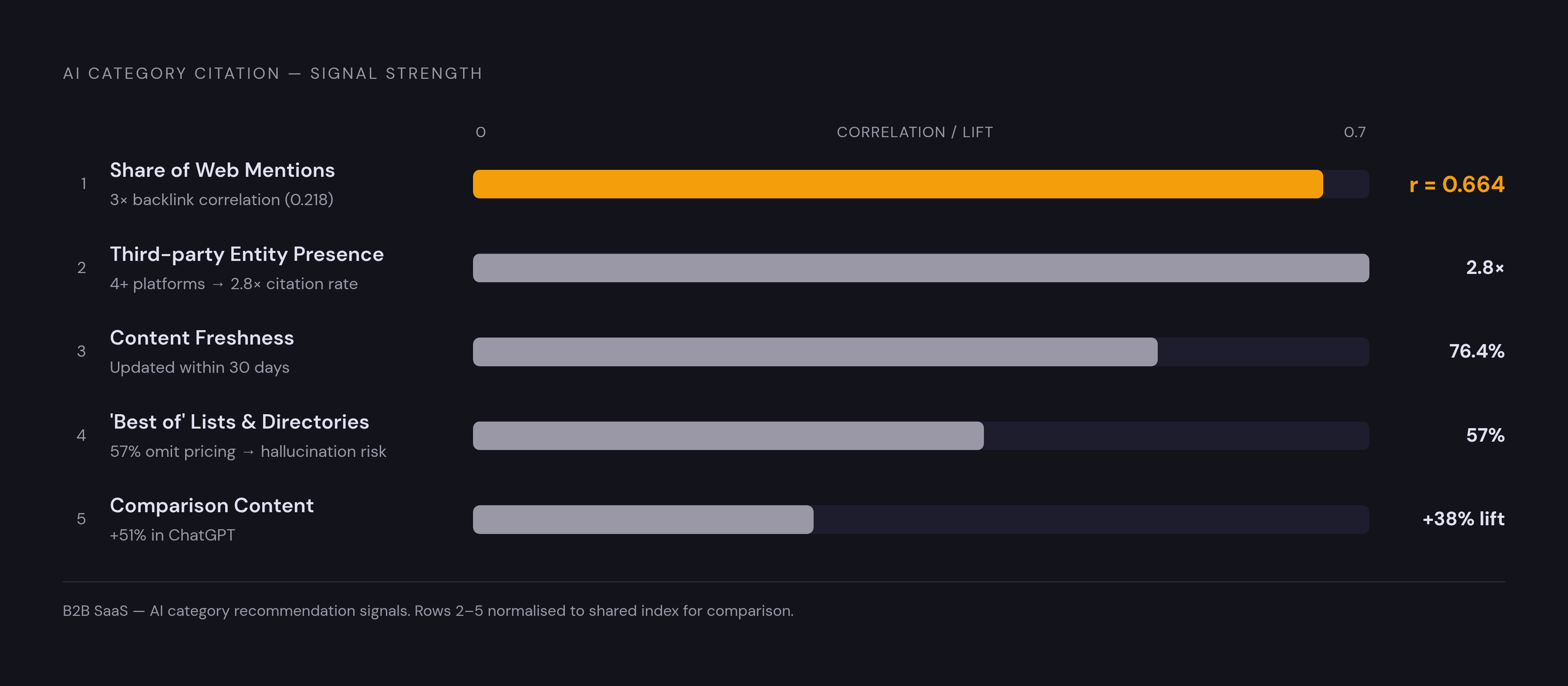
Five signals show up again and again in the available data. Treat them as a checklist, not a theory, because each one is measurable on its own.
Share of mentions across the web. Ahrefs found brand mentions correlate with AI visibility at 0.664, roughly three times stronger than the 0.218 correlation for backlinks. Brand search volume correlates at 0.334, itself stronger than any link-based metric tested. Brands with stronger web mention profiles earn significantly more AI Overview citations than those with weaker ones. The old SEO habit of chasing links wins less here. What wins is showing up, by name, across a wide, credible set of domains, and this is the one place where "just get more backlinks" actively misleads a team.
Third-party entity presence and consistency. A presence across four or more third-party platforms increases citation likelihood by 2.8 times. Organization schema on the homepage helps a model connect a brand name on its own site to the same name in the Google Knowledge Graph. Inconsistency, one property calling a company a CRM add-on, another calling it a full platform, works against it directly. Models don't resolve that confusion in a brand's favor. They just describe the confusion back to the buyer.
Content freshness. Onely found 76.4% of ChatGPT's most-cited pages were updated within the last 30 days. But there's a lag built into the system too: model perception of a brand can trail actual content publication by a meaningful lag, so what a model says about a company today reflects what the internet said last spring, not what shipped last week. Stale cornerstone pages and neglected product docs aren't neutral background noise. They quietly work against citation, every day they sit untouched.
Presence in high-authority "best of" lists and review directories. Models draw on listicles to determine who belongs in a category and to aggregate opinion. The CommonMind 2026 survey of 169 respondents found some B2B SaaS companies started appearing in AI answers within a week of getting listed on a major directory. That same survey found 57% of B2B SaaS companies don't publish pricing anywhere public, which leaves a vacuum models fill with guesswork, sometimes wrong guesswork. Publishing pricing removes a major source of hallucination risk, and it's one of the cheapest fixes on this whole list.
Category-defining and comparison content. Establishing the definitive "What is X?" article for a category tends to win the citation for nearly every downstream query in that space, since the model treats that page as the canonical definition. Pages built around clear, structured head-to-head comparisons against named competitors tend to earn meaningfully higher citation rates. Models favor pros-and-cons structure over thin, adjective-heavy marketing copy, every time. Depth and specificity beat polish.
LLM perception drift, how brand positioning inside AI models changes without any market event
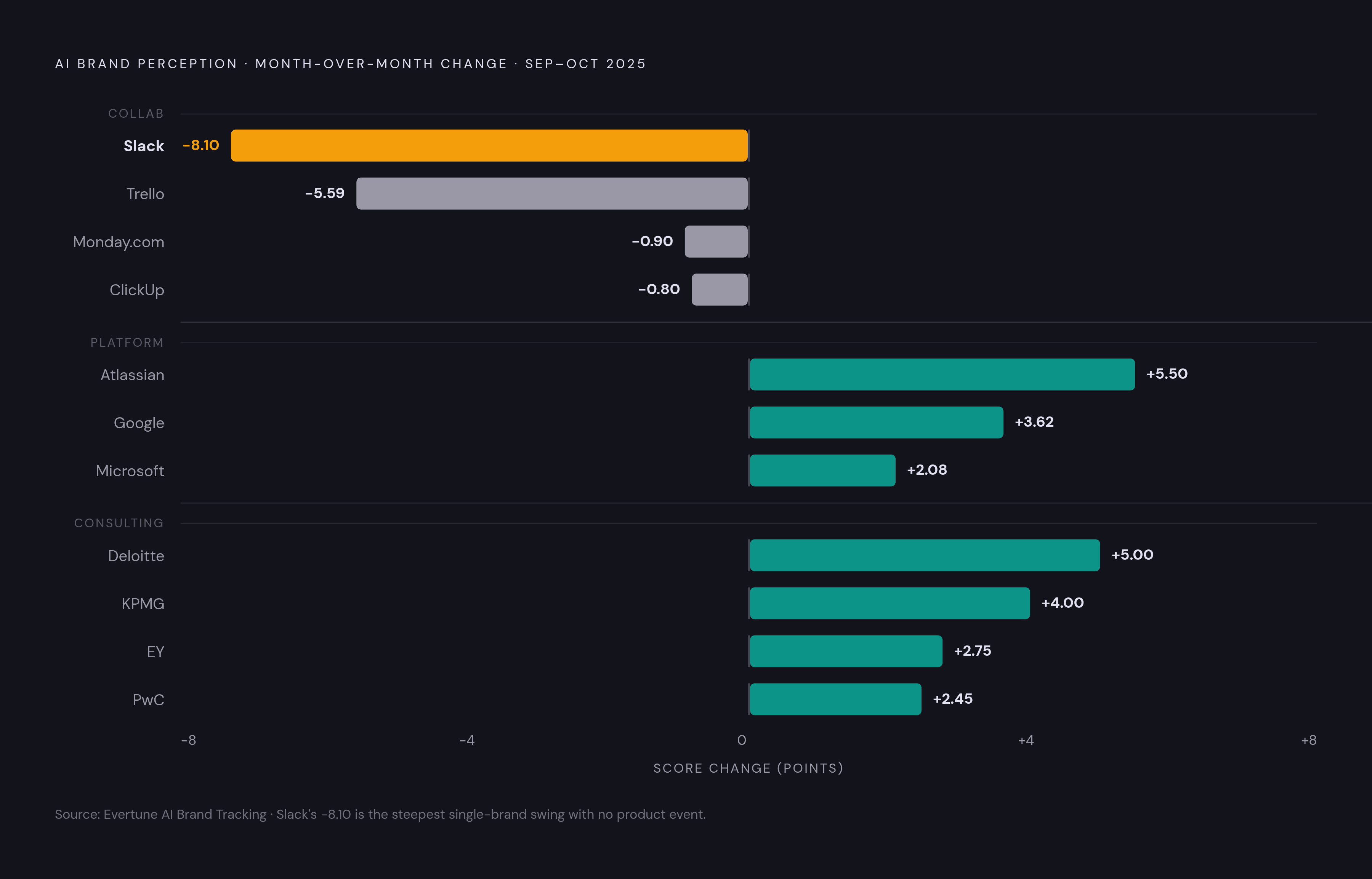
Perception drift catches most marketing teams off guard: month-over-month change in how a model talks about a brand, driven not by anything the company did, but by shifts in the underlying corpus the model draws from.
Evertune's September to October 2025 data on project management software makes the point concretely. Slack's AI brand perception score fell 8.10 points. Trello dropped 5.59. Monday.com and ClickUp each slipped under a point. Atlassian gained 5.50, Microsoft gained 2.08, Google gained 3.62. Professional services firms picked up ground too: Deloitte gained 5.00, KPMG 4.00, PwC 2.45, EY 2.75, a pattern Evertune ties to "category entanglement," where models increasingly pull project management into a broader conceptual neighborhood that includes operations consulting and digital transformation work. Smaller, specialized players moved as well, gains tied to directory listings, GitHub activity, and technical documentation rather than any marketing push.
What does drift look like day to day for a brand living through it? An enterprise security product gets casually described as "a good option for SMBs" because the corpus shifted toward reviews aimed at smaller businesses. A feature the company killed two years ago still shows up as a current differentiator. A competitor's exact positioning language creeps into the model's description of a rival product. A brand gets left out of a category answer despite holding real market share. Tone shifts too, from confident and declarative to hedged, "some users report," where a model once stated something as plain fact.
None of that, on its own, triggers a crisis meeting. That's the danger. Drift builds up in small increments across thousands of buyer conversations, quietly wearing down positioning that took years to build, and nobody notices until the pipeline numbers force the question.
Atlassian's gain isn't an accident of timing. It reflects strong documentation, deep cross-product integration, and high contextual density, meaning the brand shows up in enough different contexts that models have a stable, well-corroborated picture to draw from. Brands living across multiple contexts get surfaced more often and more consistently. It's the same logic entity-based SEO established years ago, just running with more volatility and on a much shorter clock.
Why most B2B SaaS teams cannot see what AI is doing to their pipeline
Most marketing teams are flying blind here, and not by choice. ChatGPT, Perplexity, and Claude generally don't pass referrer data the way a Google search does, so a large share of that traffic, in the neighborhood of 70% by some estimates, lands with no referrer header at all and gets dumped into the "Direct" bucket inside GA4 or whatever analytics platform a team runs.
The CommonMind 2026 survey, again 169 respondents, found nearly six in ten marketers can't identify AI-referred traffic in their current analytics stack at all. No number means no budget case, and no budget case means the strategy stalls. That's exactly the gap 93% of B2B SaaS marketers describe when they call AI search visibility critically important while only 14% say they have a mature strategy in place. Urgency without execution runs wider in B2B SaaS than almost anywhere else surveyed.
This isn't just a reporting nuisance, either. AI-referred visitors convert at a meaningfully higher rate than Google organic visitors, based on available data, which turns the blind spot into a financial problem rather than a dashboarding inconvenience. Forrester estimates AI-generated traffic already sits at 2 to 6% of total organic traffic and is growing more than 40% a month, a share that looks negligible today and won't for long. CommonMind respondents flagged something close to a "death of attributability," the fear that if AI interactions can't be measured, marketing can never prove the channel's return, which locks in underinvestment in exactly the channel now shaping buyer shortlists. Perception of what works hasn't caught up with where these signals actually form, and that lag is costing pipeline right now, not hypothetically.
Building a systematic read on AI perception signals, what to score and how to track it
Measurement has to come before optimization, full stop. Each of the five signals above, mentions, entity consistency, freshness, directory presence, and content type, needs a baseline number before anyone can say whether a fix actually worked.
A workable tracking setup, drawn from frameworks like Averi's, centers on five metrics: a composite Brand Visibility Score built from citation frequency across a defined query set, raw citation frequency (how often a brand gets named as a source), brand mention rate within synthesized answers, AI share of voice relative to named competitors, and downstream LLM conversion rate, meaning what AI-referred visitors actually do once they land on the site.
Stability matters as much as the raw score, maybe more. The Previsible and Evertune framework treats AI brand signal stability as its own KPI: how consistent a brand's presence and positioning stays across model outputs over time. Sharp swings point to a fragile, thinly-corroborated model understanding, often the result of retraining cycles or a competitor suddenly flooding the corpus with content.
Tracking has to start with a query library, category, comparison, and use-case prompts mapped to what a real buyer would type, not just branded searches for the company's own name. And it has to run per platform. With only 11% of domains cited by both ChatGPT and Perplexity, checking one platform alone gives a distorted picture of where a brand actually stands.
One published reputation-scoring method tracks the ratio of positive to negative mentions over time and reduces it to a single trackable number, something a marketing team can put in front of leadership without a paragraph of caveats attached. Qualitative sentiment, however accurate, doesn't move budget on its own. A number does. Some platforms score brands across 400 or more individual signals spanning three lenses: algorithmic ranking, AI system behavior, and human audience response, giving a fuller baseline than any single-channel check could produce. The score itself isn't the point. Knowing exactly which gap to close first is.
None of this is optional in the current climate. PwC's 2025 CEO survey found 84% of global chief executives now rank reputation risk as their top external threat, ahead of both cyber risk and regulatory risk. AI perception has moved from a marketing metric to a board-level concern, whether marketing teams have caught up to that fact or not.
Concrete moves that shift each signal, prioritized by impact and speed
Signals with the strongest correlation to AI visibility and the shortest feedback loop deserve the first dollar. Brand mentions and entity consistency move faster than freshness gains from a slow content overhaul, so that's where the sequencing starts, not with the biggest project on the list.
For share of mentions, the priority is earned coverage on high-authority domains, the DR80+ tier that accounts for 65.3% of ChatGPT's citations. A fifteen-minute interview with a subject matter expert, placed on the right trade publication, does more for AI visibility than a dozen mid-tier guest posts. Coverage on domains with real editorial standing is worth chasing even when the SEO value looks modest on paper, because AI visibility doesn't track backlink metrics the way traditional SEO does.
For entity consistency, the fix is mechanical but tedious: audit every third-party listing, a CRM review site, a comparison platform, a company data directory, industry directories, and make the description, category, and key facts match word for word across all of them. Add organization schema to the homepage if it isn't there. This is unglamorous work, but it's the fastest of the five signals to move, since it doesn't require new content, just correcting what already exists.
For freshness, the target isn't publishing more. It's touching what already ranks well and updating it on a real cadence, since 76.4% of ChatGPT's top-cited pages were refreshed in the prior month. Old cornerstone pages sitting untouched for a year are quietly losing ground even if nothing on them is factually wrong.
For directory and listicle presence, getting listed matters, but getting the pricing page public matters just as much, given that 57% of competitors leave that information out entirely and hand models a vacuum to guess into.
For category-defining content, writing the canonical "What is X?" piece for the category, and building direct, named comparisons against real competitors in a clear pros-and-cons structure, produces the largest single lift documented here: a 38% jump in citation rate overall, 51% within ChatGPT specifically. That's the highest-leverage content investment available, and it's also the one most B2B SaaS teams leave unwritten, worried it looks too commercial. The data says otherwise: structured, specific, and comparative is exactly what a model wants to cite.
Sources
- The 2026 State of AI Visibility in B2B SaaS: 5 Data-Backed Shifts
- The Complete Guide to AI Visibility for B2B SaaS
- 94% of B2B Buyers Now Use LLMs to Research Software — Is Your Company Visible When They Ask? - Development Corporate
- 200+ AI SEO Statistics (Updated August 2026, B2B SaaS Data)
- LLM SEO for SaaS: The Complete 2026 Playbook