AI Perception Signals for Law Firms and Legal Service Providers
AI visibility now depends on being named in trusted legal directories, not ranking high in Google.

The way people find a lawyer has changed, and this piece is about the mechanics that produced that change. A prospective client used to type a query into Google, scan a page of blue links and a map with three pinned firms, and click around. Now that same person asks ChatGPT, Perplexity, or Google's AI Mode a question and gets back a synthesized answer naming one to three firms by name, with no map pack, no ad slot, and no page two to hide on. If a firm isn't in that answer, it isn't in the conversation at all.
The trust math is different too. When a search engine ranks a firm third, the user still has to decide if that firm is any good. When an AI assistant names a firm directly, the assistant's own credibility rubs off on the recommendation, and the prospect who calls has already been half-convinced before the phone rings. That shift matters more given where usage is headed: the global large language model market was valued at $6.4 billion in 2024 and is projected to hit $36.1 billion by 2030, which says this isn't a side channel, it's the direction traffic is already moving. And the queries most likely to trigger an AI-generated answer, things like "what should I do after a car accident" or "do I need a probate attorney," are exactly the pre-contact questions that precede a call to a law firm.
Understanding this shift is one thing. Understanding the mechanism behind it, how an AI system actually decides which three firms get named and which hundred get ignored, is the harder and more useful problem.
Differences in how AI systems and search engines evaluate law firms
Traditional search indexes pages and ranks them by relevance to a keyword. Type "personal injury lawyer Los Angeles" into Google and you get a list of documents that contain some version of that phrase, weighted by backlinks, site speed, and a few hundred other ranking factors. An AI system doesn't do that. It synthesizes entities. Ask ChatGPT who the best personal injury lawyers in Los Angeles are, and it isn't crawling live pages for a keyword match, it's retrieving names it has already learned to associate with "personal injury" and "Los Angeles" as concepts.
That distinction sounds academic until you see what it does in practice. LLMs are pattern matchers, trained or grounded on a defined pool of sources their operators trust for a given topic. Legal is treated as its own vertical with its own trusted source pool, separate from, say, restaurants or plumbers. A firm can be completely absent from that pool for reasons that have nothing to do with quality: geographic bias, language bias, thin authority signals, or simple recency gaps in training data create what amounts to a data desert, a firm that's excellent and simply isn't represented in the model's knowledge.
That's why a firm can rank on page one of Google and be invisible in ChatGPT at the same time. Keyword optimization and entity recognition are not the same project, even though they get talked about as if they were. Solving for AI visibility means building a verifiable, consistent identity that appears the same way across many surfaces, going well beyond polishing one website until it ranks.
The signal stack AI systems use when evaluating a law firm's credibility
Three broad categories decide whether an AI system trusts a firm enough to name it. The first is entity identity: does the name, address, phone number, list of practice areas, and roster of attorneys match everywhere the firm shows up online, or does it drift from one directory to the next? The second is evidence and citation: do outside parties, bar associations, legal publications, news outlets, actually vouch for the firm independently, or is every claim self-reported? The third is technical and structural: can the site be parsed cleanly, does it load fast, is the information organized in a way a machine can extract without guessing?
Sentiment has become a heavier part of that stack. Research pointing toward 2026 suggests AI systems increasingly weigh the language inside reviews and social mentions, layering that on top of the star average sitting above them. A high-star profile built on five generic reviews reads differently to these systems than a slightly lower one built on language that specifically describes what an attorney did well.
Freshness carries similar weight. A practice area page or attorney bio that hasn't been touched in three years reads as stale to a system built to favor recency, the same way it would to a human skimming for the most current information. And structure beats prose: content that resolves cleanly into attorney name, practice area, jurisdiction, and credential gets cited far more reliably than a page of well-written but unstructured narrative that buries those facts in the middle of a paragraph.
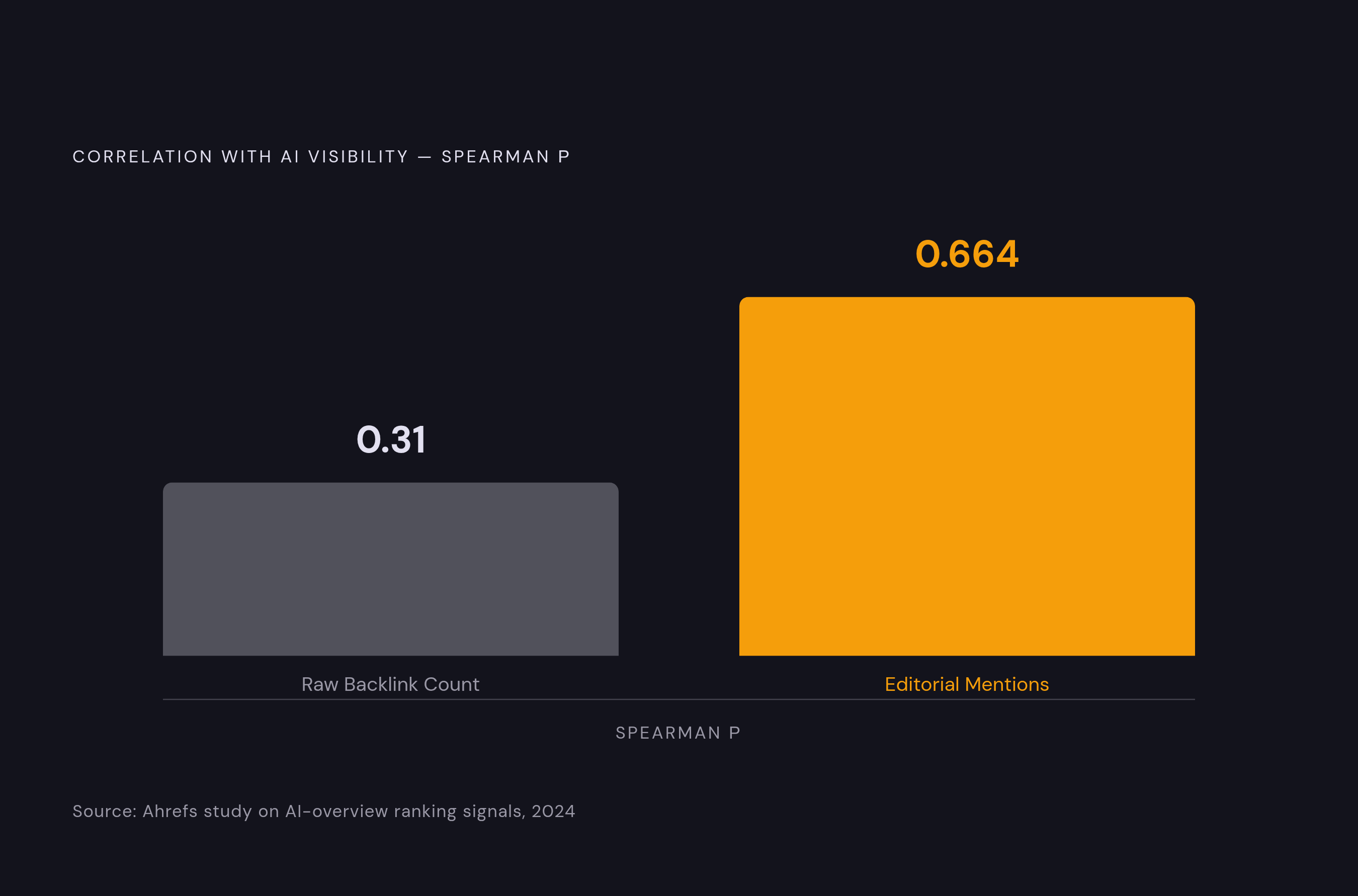
The clearest evidence for where the weight has shifted comes from an Ahrefs analysis of a large sample of brands, which found editorial mentions correlated with AI visibility at a Spearman correlation of 0.664, while raw backlink counts correlated far more weakly. Backlinks were the currency of the old SEO game. Editorial authority, being written about by sources the AI already trusts, is the currency of this one.
The seven directories that determine whether a law firm appears in AI answers
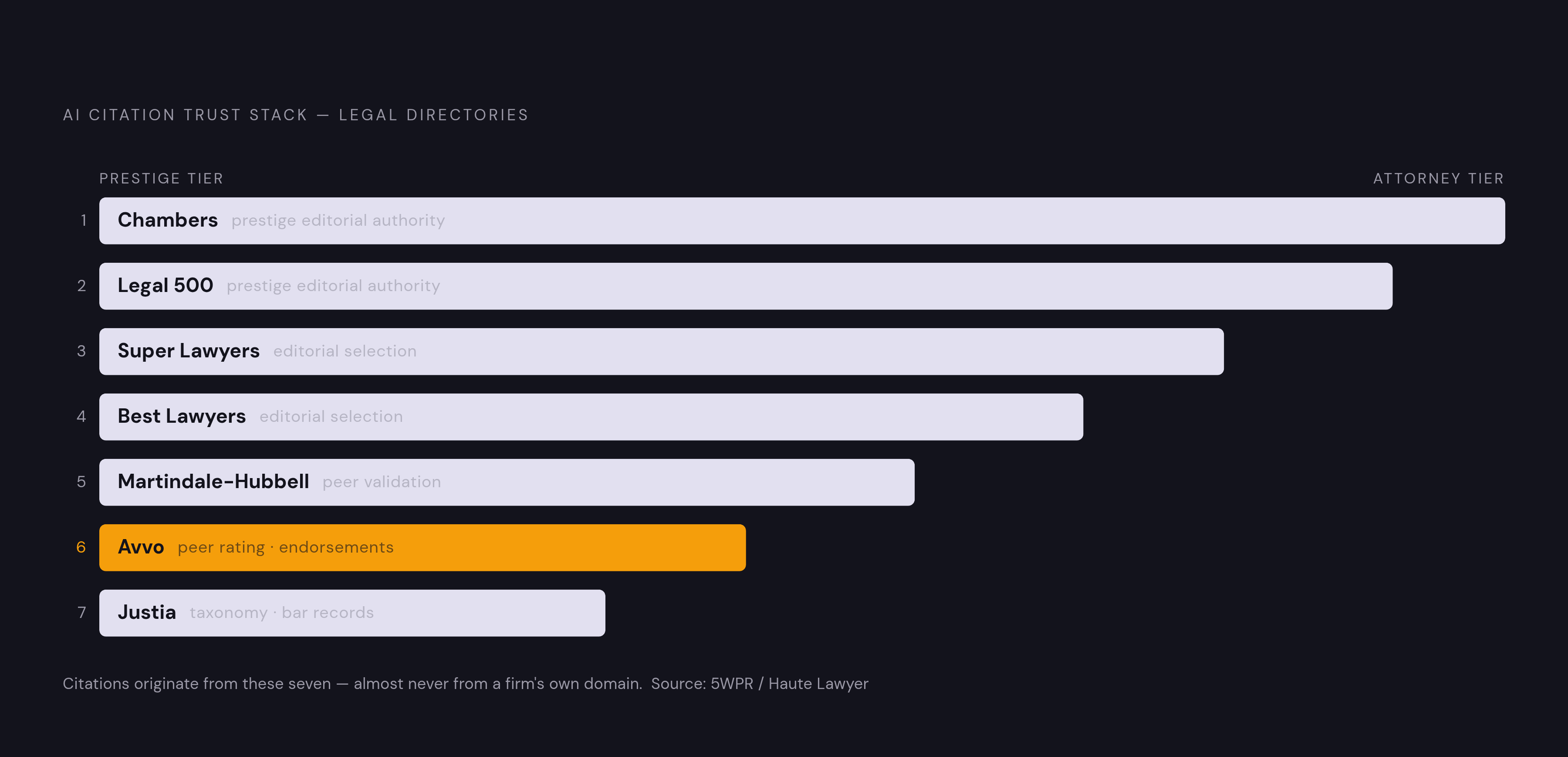
A report from 5WPR and Haute Lawyer narrowed this down to a specific and surprisingly short list: Chambers, Legal 500, Super Lawyers, Best Lawyers, Martindale, Avvo, and Justia account for nearly every AI citation across major legal query categories. The citation almost never comes from the firm's own domain. It comes from one of these seven, because AI operators have effectively pre-approved them as trusted sources for the legal vertical.
Each one feeds something different into the system. Avvo passes attorney-level signals: the 1.0-to-10.0 Avvo rating, peer endorsements, client reviews, and disciplinary history, all wrapped in schema that's nearly identical across every listing, which makes it easy for an LLM to parse. It tends to be the strongest source when a query names a specific attorney or asks who's best for a narrow situation.
Martindale-Hubbell contributes peer-validation data, most notably the AV Preeminent and BV Distinguished ratings. When an AI system sees that AV Preeminent designation echoed across multiple independent sources, it acts as a shortcut, a signal the firm doesn't have to re-earn from scratch every time. Justia supplies broad attorney and firm profiles with practice area taxonomy and bar admission records, which matters most for matching a firm to a specific geography or specialty. Super Lawyers and Best Lawyers both function on editorial selection: because a third party chose the firm rather than the firm nominating itself, AI systems read that inclusion as earned rather than claimed. Together, these directories form a mutually reinforcing trust stack, each feeding a different signal into the systems that decide which firms get named.
The failure mode that occurs most often is inconsistency. A firm listed on five of these seven but with a different phone number on one, an outdated practice area on another, and half-finished attorney bios on a third is telling every AI system reading those pages that it can't fully trust the entity. And if the firm isn't present, consistent, and complete across these seven at all, no amount of website polish or Google ranking fixes that. It simply isn't in the answer.
Review signals inside those directories
Presence in these directories is step one. What AI systems actually evaluate for sentiment and credibility is what sits inside the listing. This includes the reviews, ratings, and how recent they are.
The star-rating threshold shapes whether a firm gets considered at all, since the large majority of prospective clients won't consider a firm below a 4-star rating, and that human threshold doubles as a proxy signal inside AI evaluation. That human threshold doubles as a proxy signal inside AI evaluation models, since sentiment analysis is effectively modeling the same client behavior, which should reorder how firms think about where their marketing dollars go.
Recency counts on its own, separate from the average score. A profile with a near-perfect star average built entirely from reviews three years old reads as inactive to a system weighting freshness, the same way an abandoned blog does. Response behavior matters too: the large majority of clients say they're more likely to engage with a business that responds to its reviews, and a pile of unanswered one-star reviews signals a firm that isn't paying attention to its own reputation, a pattern sentiment analysis can pick up in aggregate even without reading every word.
Volume matters alongside score. Research indicates prospective clients weigh both the average rating and how many reviews sit behind it, so a perfect average built on very few reviews carries less weight than a solidly high average built on many. Avvo also has its own separate mechanic: peer endorsements from other attorneys are a distinct data point from client reviews, a professional credibility layer that AI systems can and do read apart from client satisfaction.
How a law firm's own content earns or loses AI citations
Firms with strong traditional SEO but thin content depth showed up rarely in AI-generated recommendations in the research reviewed here. Ranking for a keyword and being cited as an authority turned out to be two different achievements, and a lot of firms have only built for the first one.
Content that gets cited tends to share a few traits. It resolves into clear entities, attorney name, practice area, jurisdiction, credential, rather than burying those facts inside narrative paragraphs. It answers questions directly, in the same phrasing a person would type or speak to an assistant: "what happens if I'm hit by an uninsured driver," "how long does probate take in this state." It carries schema markup that labels attorneys, practice areas, and credentials in a machine-readable way. And it adds something the model doesn't already know, a jurisdiction-specific procedural detail or a local court quirk, rather than restating the same generic explainer that sits on five hundred other firm websites.
Freshness works here the same way it works in directory listings: a practice area page updated on a regular schedule reads as a maintained, current entity, while a static page from four years ago reads as neglected. Third-party editorial coverage, news stories, bar association mentions, legal publication features, builds exactly the kind of authority signal these systems weight most heavily. A firm that gets written about by outside authorities is building exactly the signal these systems weight most heavily.
None of this guarantees the citation lands on the firm's own URL. An AI system may still cite Avvo or Justia instead of the firm's site even when that site is excellent. But a strong site raises the odds the entity gets recognized and named correctly in the first place, even when the link goes elsewhere.
Measuring AI visibility: why a one-time audit is already out of date
Research tracking AI citations across answer sets over short observation windows found that a large share of cited sources churn between observations. That's the number that should end any argument for treating AI visibility as a project with a finish line. The set of sources an AI system cites for a given query shifts substantially over a short window. A firm that ran one audit and considers the job done is holding a snapshot that expired almost as soon as it was taken.
Building a framework means tracking a handful of things on a rolling basis, sustained over time. An AI visibility score, how accurately and favorably the firm gets described across ChatGPT, Gemini, Perplexity, Google AI Overviews, and Google AI Mode, can expose the firm to damage from a wrong or outdated description that equals or exceeds the damage of not showing up at all. An entity consistency score, the percentage of directory listings and third-party references that agree on the firm's basic facts, catches directory listings and third-party references drifting out of agreement before it compounds. Search result composition, what share of first-page results the firm actually controls versus what's uncontrolled or negative, matters alongside review trends over time and how often authoritative outside sources are mentioning the firm in a positive context.
No single tool covers every platform at once, and that's a real operational problem, not a minor inconvenience. A firm that only checks its standing in Google AI Overviews has no idea how it's being described inside ChatGPT or Perplexity, and those systems can behave very differently given the same query. The broader principle, measure before you optimize, is visible in adjacent industries too: platforms built to benchmark digital maturity in other professional sectors score institutions on specific dimensions so leadership knows what to fix first rather than guessing. Law firms need the equivalent discipline applied to their own vertical.
The prioritized fixes that improve AI perception for law firms
Not every fix carries equal weight, and firms with limited time and budget should start with the highest-leverage move: entity consistency across the seven directories that decide most AI citations.
Start with an audit of all seven, Chambers, Legal 500, Super Lawyers, Best Lawyers, Martindale, Avvo, and Justia, checking each for completeness and for agreement with the others. Fix any mismatch in firm name, address, phone number, practice area labels, or attorney names. A half-finished profile is worse than no profile at all, since it reads to an AI system as an entity that was claimed and then abandoned.
Second, build an actual system for reviews rather than hoping they accumulate. Ask clients for reviews on the platforms that carry the most weight, Avvo chief among them, and respond to every review that comes in, negative ones included, since the response itself is a signal these systems can detect. A steady trickle of recent reviews beats a large stockpile that stopped growing a year ago.
Third, restructure content so it answers the exact questions people ask AI assistants: what a personal injury attorney actually does, how long a probate case typically runs, whether a given situation calls for a criminal defense lawyer at all. Add schema markup that ties each attorney to a practice area and a jurisdiction explicitly, rather than leaving that connection implied in prose. None of these fixes is complicated in isolation. Done together and kept current, they let an AI system name a firm with confidence instead of quietly leaving it out of the answer.