Entity Disambiguation and AI Perception for Brands With Common Names
Language models misidentify brands by name through probabilistic inference, not verification.
A brand that shares its name with something else doesn't just compete against other businesses in its market. It competes against whatever else answers to that name every time a language model decides who it's talking about, and that decision happens in milliseconds, through probability, not lookup. Most brand teams still think findability is the whole game: get mentioned, get cited, get named in the answer. Being named and being correctly identified are two different outcomes, and the gap between them is where revenue quietly leaks to somebody else.
The mechanism is worth spelling out. A large language model doesn't check a registry the way a search engine checks an index of URLs. It infers identity from patterns baked into its training data, weighted by how often and how densely a name shows up in context. Friction AI's April 2026 breakdown of the process names four stages: entity detection, contextual parsing, probabilistic resolution, and generative completion. Somewhere in that chain, the model decides which real-world thing a brand name refers to, and it makes that call the same way it predicts the next word in a sentence: by weight of prior evidence, not by verification.
That's the structural gap, and it's the one worth staring at directly. Nowhere in those four stages does the model verify its guess before it speaks. A low-confidence resolution comes out sounding exactly as fluent and certain as a high-confidence one, so the reader can't tell the difference, and often, neither can the brand being described.
This is a different problem from training data lag, and the distinction is the whole ballgame for anyone trying to fix it. Lag is a timing issue in which the model knows who a brand is but is working off stale facts, an old price, a former executive, a discontinued product. Disambiguation is an identity issue: the model has confused the brand with someone else entirely, and no amount of retraining fixes that on its own, because the confusion was never about time. It's about which entity owns the name inside the model's internal map.
The commercial weight of being misidentified in an AI answer
Search used to hand back ten blue links and let the user sort it out. AI search hands back one answer, maybe two or three named brands if the user's lucky, and that's the entire results page. If the model resolves a name to a competitor or an unrelated entity, there's no runner-up slot. The click, the citation, and the implied endorsement all go somewhere else, in full.
Being named is not the same as being credited, and brands mix these up constantly. A model can say a brand's name while attributing a competitor's founding story, a competitor's pricing, or a competitor's product spec to it. The name shows up; the substance attaches elsewhere. A reader walks away pairing the right name with the wrong facts, and nothing in the interface flags the mismatch.
The scale here isn't marginal. AI search traffic grew sharply through 2025 and into 2026, with AI-generated answer surfaces reaching an expanding share of queries across major platforms. Reporting from 2026 has consistently found that a large share of enterprise brands remain invisible to generative AI models despite heavy, sustained spending on traditional SEO. Invisibility and misidentification are two sides of the same coin: a brand the model can't confidently place gets either erased or handed to somebody else.
The legal exposure isn't hypothetical, either. In Starbuck v. a technology company (2025), a conservative activist sued after alleging its chatbot, running on another company's language model, falsely attributed criminal acts to him. Whatever the underlying cause, that case shows misidentification carries real operational and financial consequences beyond branding. Regulators and courts are already being asked to weigh in.
The revenue math is starting to show up in early data, too. Matt Britton reported in May 2026 that early enterprise adopters already credit up to 15% of branded search influence to AI-generated recommendations rather than direct organic clicks, a share expected to roughly double by 2027. If a growing slice of demand runs through a probabilistic resolution process, getting that process wrong carries real, compounding costs. Call it a leak with interest attached.
Three distinct failure modes when a brand name is ambiguous
Not every disambiguation failure looks the same, and treating them as one problem leads to the wrong fix. Three deserve naming, plus a fourth pattern that locks the other three in place.
The most common failure is conflation with a bigger, more established entity that happens to share the name. A newer brand launches with a word already claimed by an older company in a completely different industry. The model's training data simply holds more volume and more context about the established name, so its prior wins the resolution by weight of evidence, not by relevance to what the user actually asked.
The second failure is conflation with a common noun or a place name. Names that double as ordinary English words, or as cities, rivers, regions, hand the model a high-confidence non-brand completion sitting right there as a default. A query's surrounding context might nudge it toward the brand meaning, but often that nudge isn't enough to override a prior that strong.
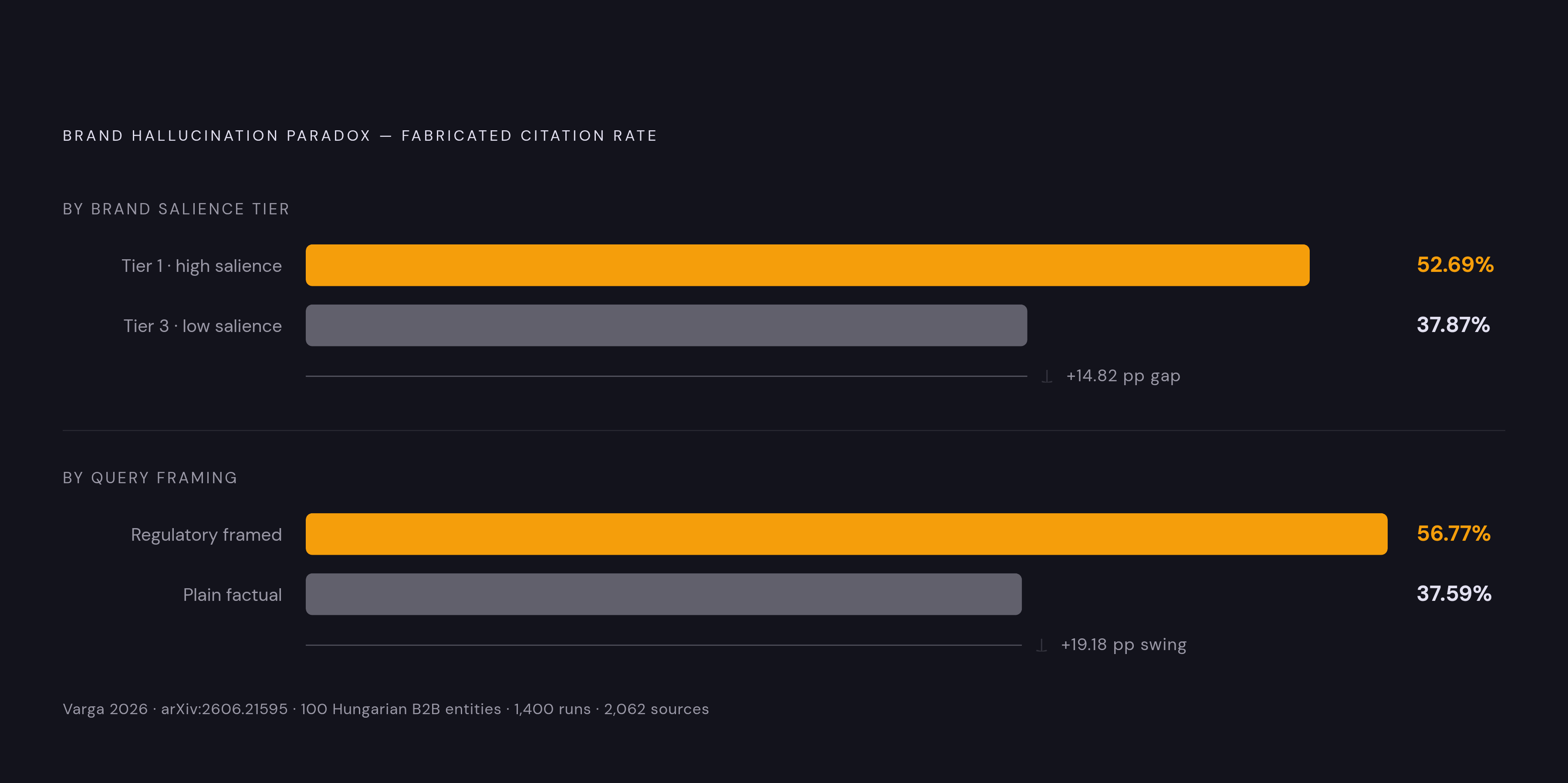
The third failure is the strangest one, and it flips the intuitive assumption that fame protects a brand. It doesn't. Research by Varga (arXiv:2606.21595, 2026) identifies what's called the Brand Hallucination Paradox: high-salience, widely recognized brands suffer more fabricated citations than obscure ones, not fewer. In that study, Tier 1 high-salience brands produced fabricated citations at a rate of 52.69% (95% CI [49.76%, 55.61%]), against 37.87% for Tier 3 low-salience entities, a gap of 14.82 percentage points, based on 100 Hungarian B2B entities probed across 1,400 runs and 2,062 sources. Partial recognition activates a schema in the model without enough evidential density to keep the output anchored to real sources. The model knows enough to speak fluently but not enough to stay source-faithful, a phenomenon the paper calls ghost cartography. Framing makes it worse: regulatory-framed queries pushed fabrication up to 56.77%, against 37.59% for plain factual queries, a 19.2 percentage-point swing that needs no access to the model at all, just a different phrasing of the question.
A fourth pattern compounds all three: training data contamination that locks in an early error. A brand's first press coverage gets a fact wrong, a founding year, a pricing figure, an executive's name, and the error enters the training corpus before any correction gets published. The correction, arriving later on the brand's own site or in a smaller outlet, never builds up the citation volume needed to outweigh the original mistake's training weight. The wrong fact becomes the model's parametric knowledge, held with more confidence than the truth that came after it.
One more structural wrinkle: what Varga calls the Parametric-Retrieval Lag Asymmetry. Retrieval-augmented systems can update within days of new information appearing online, while a model's parametric memory only updates at retraining intervals running roughly twelve to twenty-four months. The identical brand can sit correctly described on a retrieval-based system like Perplexity while being actively misdescribed, at the same moment, inside ChatGPT.
How each major AI platform resolves the same ambiguous name differently
There's no single "AI" making this call. Each major platform leans on a different substrate, and a brand resolved correctly on one can still get scrambled on another. Anyone building a fix for just one platform is building half a fix, and most teams do exactly that.
ChatGPT leans heavily on parametric training data, and third-party analysis suggests it uses an internal knowledge structure that functions something like a machine-readable identity record. An outdated or wrong description baked into that structure shapes every conversation the model has about the brand, no matter what the brand's own site says.
Perplexity leans on the live web through retrieval augmentation, so it updates faster than a purely parametric system. A brand that picks up strong, recent third-party coverage can see its representation correct itself on Perplexity well before that same correction ever reaches ChatGPT.
Gemini leans on Google's Knowledge Graph, so entity identity there is partly inherited from the same structured data signals already powering Google's search knowledge panels. Claude leans more on long-form documents, so brands with a real footprint in substantive third-party writing, research papers, deep-dive journalism, detailed independent reviews, get an edge specifically there.
The practical implication follows directly: a disambiguation fix built for one platform's substrate can fail completely on another. Correcting a Knowledge Graph entry helps ChatGPT and Gemini and does nothing for Claude if the underlying long-form coverage doesn't exist. The correction has to spread across each platform's actual inputs, not get published once and left to propagate on its own.
Even the best dedicated disambiguation systems built for this exact problem leave real error sitting on the table. According to LLM Disambiguation SEO: How to Ensure AI Knows Exactly Who You Are, the AGNUS model hit an 86.9% macro-F1 score across six public entity-disambiguation benchmarks, about 10.2% better than traditional label-based systems. That's a real gain. It's also a reminder that even purpose-built systems get it wrong more than one time in ten, so no brand should assume correct resolution happens by default, on any platform.
Why off-site signals determine which entity a model trusts
Third-party content gets cited far more often than a brand's own website does, and that single fact should reorder how most companies spend their AI visibility budget. Most don't reorder it at all, which is the mistake. Consistent findings across multiple analyses show that AI-generated answers cite third-party sources far more often than a brand's own domain.
Wikipedia sits at the top of that hierarchy. Independent analysis has found it ranks as the single most cited source inside ChatGPT, ahead of established editorial outlets and review platforms. A brand with no Wikipedia presence, or a thin one, leaves the model to infer identity from weaker signals by default. Citation analysis has repeatedly found brands get cited via third-party sources far more often than via their own domains, the same pattern showing up across different data sets.
Varga's 2026 research frames this as a field phenomenon rather than a content problem: entities become recognizable to a model through how other sources describe and cross-link them, not through what the entity says about itself. Self-description is a weak signal in this system. Co-citation, the pattern of independent sources mentioning a brand alongside consistent facts and consistent context, is the strong one.
Freshness compounds all of this. Observed citation patterns show that pages not updated regularly are far more likely to lose citations across consecutive AI answer runs, and only a minority of brands hold onto AI citation presence across multiple queries run back to back. The fix isn't a one-time push, it's ongoing upkeep, closer to how a company treats its financial filings than how it treats a blog post.
A brand trying to solve disambiguation by editing its own homepage is polishing a secondary signal. The signal that actually decides how the model resolves the name is how the rest of the web talks about it, and no amount of on-site copy substitutes for that.
The structured data footprint that gives AI a machine-readable identity anchor
Structured, machine-readable signals cut down the ambiguity a model has to resolve during inference by improving an entity's verifiability, authority, and structural clarity as AI systems perceive it. Give the model less guessing to do, and it guesses wrong less often. That's the whole logic of this section.
The footprint that does this has a specific shape. Start with a canonical entity homepage. Add a single Organization schema node carrying a stable @id, so the entity has one fixed identifier instead of several conflicting ones scattered across pages. Keep sameAs, founder, and location properties consistent, not drifting from page to page. Write the disambiguatingDescription category-first, stating the industry or function before the brand name, so a parser hits "a project management software company" before it hits the name itself. And get a corresponding Wikidata item, sitting outside the brand's own control, carrying independent weight precisely because it isn't self-published.
The sameAs chain deserves particular attention. Links from a brand's schema to its Wikipedia page, LinkedIn profile, Wikidata entry, and primary review platform give AI crawlers something close to a machine-readable identity statement, one that actively separates the entity from other things sharing its name. Pages without that chain leave disambiguation entirely to probabilistic inference from unstructured text, exactly the process most prone to the failure modes above.
One assertion belongs specifically on Wikidata and nowhere else: the explicit "not the same as" statement, formalized through property P1889. It has to live on a neutral, third-party record rather than the brand's own site, because a brand insisting "we are not that other company" on its own domain reads as defensive at best and manipulative at worst to systems trained to catch exactly that kind of cloaking.
None of this is cosmetic SEO decoration. Multiple analyses have found that Knowledge Graphs used as structured external sources meaningfully improve a model's entity disambiguation performance. Structured data is literal input to the disambiguation process itself, not a search engine reward mechanism. Semrush data cited by Matt Britton in May 2026 found pages carrying structured data and FAQ schema were roughly 30% more likely to show up in AI-generated summaries, a gap too large to write off as optional.
Building the off-site corroboration that overrides probabilistic defaults
Ghost cartography is the failure state to design against. When a brand occupies a sparse region of a model's latent space, meaning thin third-party corroboration, the model still has to produce an answer, so it interpolates from whatever denser, neighboring region is sitting nearby. That neighboring region often belongs to a different entity, and the output reads as confident and evidence-backed even though the evidence belongs to someone else.
Getting out of that sparse region means working a hierarchy of corroboration, and the order matters. Wikipedia presence comes first, given its position as the most cited source inside ChatGPT: no owned content substitutes for its absence. PR-driven coverage in credible editorial outlets comes next, and Available citation data consistently shows a substantial share of AI citations trace back to PR-driven coverage rather than brand-authored material. Community platform presence matters too, Reddit threads, YouTube, specialist forums; Observed citation patterns show community platforms account for a meaningful share of citations turning up in AI answers generally. Structured review platforms, Trustpilot, G2, and their equivalents, function as machine-readable validators of an entity's existence and category, showing up repeatedly as named sources in citation analysis.
There's a dual-signal effect worth planning around. AirOps' 2026 research found brands earning both mentions and citations are far more likely to reappear consistently across AI answer runs than brands that earn only one signal type. A brand heavy on mentions but light on citations, or the reverse, sits on structurally unstable ground, liable to vanish from one query to the next even if it showed up fine last week.
Volume matters, but only to a point, and it isn't the whole story for disambiguation specifically. Brandi AI data shows brands producing a high volume of new or optimized content each month see faster AI visibility gains than low-volume producers. Still, for disambiguation, the quality and topical specificity of third-party descriptions carries more weight than sheer volume. A hundred vague mentions do less work than ten precise ones, and brands chasing volume alone are optimizing the wrong variable.
Consistency across platforms is its own signal, maybe the most overlooked one. If LinkedIn, Wikipedia, Wikidata, and a review platform each describe the brand's category, customers, or function slightly differently, the model gets handed conflicting inputs and has to pick one. It resolves to whichever signal carries the highest confidence weight in training, and that signal might belong to a competitor, or to the more established namesake sitting one probability tier above.
How to detect whether an AI system is resolving your brand correctly
Surveys and interviews, the tools reputation teams have leaned on for decades, cannot see this problem. They measure what humans think of a brand. They say nothing about what a model is quietly attributing to it in real time. A systematic review of 104 studies published between 2000 and 2024, run by H. Molavi and published in Acta Psychologica in November 2025, found AI-powered approaches meaningfully improve the accuracy and predictive power of reputation measurement compared with these older methods, a strong signal that the old toolkit was never built for this job.
A real disambiguation audit needs to test several things at once, and none of them show up on a standard brand tracker. Raw mention rate versus verified mention rate comes first: Varga's 2026 PEBM framework draws this line explicitly, arguing a mention isn't a positive signal at all if the facts attached to it belong to a different entity. Hallucination rate is next, the share of attributed claims that turn out fabricated or misattributed. Citation fidelity matters too: when a source gets cited next to a brand's name, does that source actually discuss the brand in question, or something adjacent to it?
Parametric-retrieval lag is worth checking directly, by comparing how a brand shows up on a retrieval-augmented system like Perplexity against how it shows up on a parametric system like ChatGPT. A divergence between the two confirms the lag asymmetry described earlier is actively in play. Framing sensitivity deserves its own test: does a brand's representation shift when a query is phrased in regulatory or risk-related terms rather than plain factual ones? Varga's 19.2 percentage-point fabrication jump under regulatory framing is a concrete, testable target, not an abstract risk.
The practical version of this audit is simple to run. Query each platform with the brand name alone, then with the brand name plus its category, then with the brand name alongside a competitor's name. The three answers, compared side by side, tend to show exactly where the resolution process breaks down and which prior is winning.
Score what comes back against a short checklist. Is the entity present in the platform's Knowledge Graph at all? Is the disambiguatingDescription accurate and category-first? Is the sameAs chain intact and pointing to the right pages? Is there an accurate Wikipedia entry, and does the parametric representation match the retrieval-based one? Evident's approach, scoring a brand across more than 400 signals spanning three evaluation dimensions (algorithmic, AI system, and human audience), is built around exactly this kind of multi-platform, multi-signal audit. Measurement has to come before optimization, and it has to come first specifically because misidentification stays invisible until someone actually goes looking for it.
Why disambiguation failures compound over time if left unmanaged
An unresolved disambiguation error doesn't sit still. Every fluent, confident answer that conflates a brand with the wrong entity becomes another data point circulating online, and some share of that circulation eventually gets scraped back into a future training run. The error doesn't just persist, it builds up supporting evidence for itself, generated by the very systems that got it wrong in the first place.
That's the compounding mechanism worth taking seriously. A correction published today competes against months or years of accumulated wrong signal sitting in a model's parametric memory, refreshed only at the next retraining cycle, itself months or years away. The longer a brand waits to build the off-site corroboration described above, the deeper that wrong signal gets embedded, and the more third-party volume it takes to outweigh it later.
None of the fixes here are exotic. Wikipedia presence, a clean sameAs chain, category-first schema, consistent third-party description, review platform validation: these are known, buildable things, not speculative bets on how AI might behave next year. What's required is treating disambiguation as its own discipline, distinct from SEO and distinct from PR, with its own audit cadence and its own success metric. Brands that start that work now are correcting a small, manageable gap. Brands that wait are negotiating with a model's memory, and memory, once set, is the most expensive thing in this entire system to change.