AI Visibility Challenges for Professional Services Firms Without Review Volume
AI systems prioritize entity signals over review volume for professional services recommendations.

How AI systems evaluate businesses differently from search ranking logic
AI search traffic grew 527% year-over-year through 2025 and into 2026. That number describes demand, not success: it measures how many people now ask a chatbot for a recommendation instead of typing a query into Google and clicking through ten blue links. For professional services firms, that shift changes who gets shortlisted before a single phone call happens, and most firms are optimizing for the wrong audience while it happens.
Search engines used to be matchmakers. They handed back ten options and let the user pick. AI systems behave more like advisors: when a model names one or two firms in answer to "who should I hire for X," it's making an endorsement, not offering a menu. Advisors are far more conservative than directories, because naming the wrong firm carries reputational cost for the advisor too. That conservatism is the whole game and the reason so many firms with strong Google rankings are getting skipped.
A model can't read intent the way a human colleague reads a client's hesitation on a call. It reads evidence instead, in the form of editorial mentions, backlinks, structured data, clear attribution, and consistency across everywhere the firm shows up online. Dr. Patrick McAvoy's doctoral research on this makes a sharp distinction: AI systems rank entities, not pages. The signals that make an entity trustworthy to an algorithm are not the signals that make a page persuasive to a human sitting in front of it, and firms that keep optimizing pages while ignoring the entity behind them are solving the wrong problem.
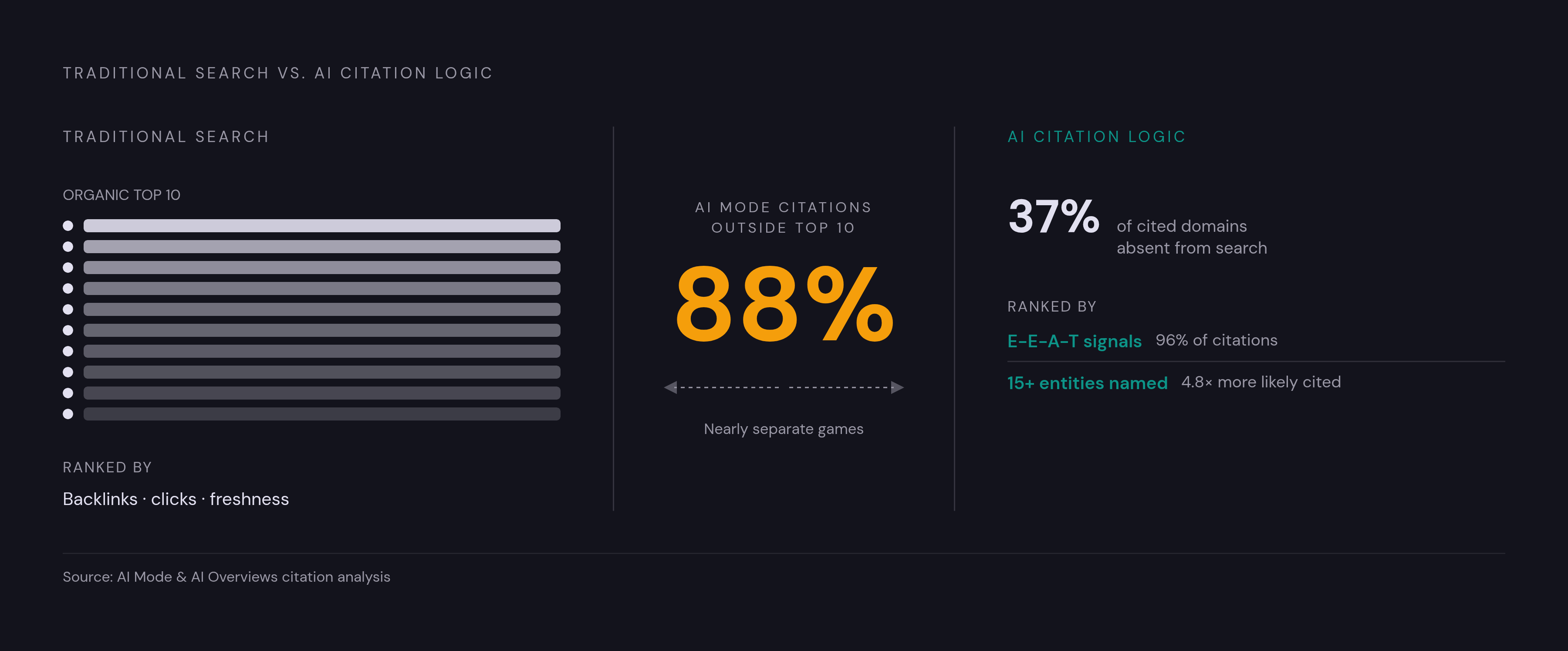
The numbers back up how different the mechanics are. Ninety-six percent of AI Overview citations come from sources carrying strong E-E-A-T signals (experience, expertise, authoritativeness, trust), and pages naming 15 or more recognized entities see a 4.8-fold higher selection probability than pages that don't. Entity richness, not page-level keyword density, is doing the work. Moz's 2026 analysis of 40,000 queries found that 88% of AI Mode citations go to pages that don't even appear in the traditional organic top 10. Ranking well on Google buys almost nothing in AI citation terms, which is the opposite of what most SEO teams have been telling their partners for the past decade.
Research from Zhang et al. found that 37% of domains AI engines regularly cite don't show up in traditional search results. A separate credibility economy runs in parallel to the one SEO teams have spent two decades optimizing for, and the firms that treat them as the same game will keep losing ground in the one they can't see.
Research from authority-engine.ai identifies a set of signals AI systems prioritize, centered on entity coherence across every platform, corroboration from independent and credible sources, topic-specific authority, semantic completeness paired with structured data, and the kind of consistency that lowers the algorithmic risk of naming the entity. Entity coherence sits at the base of everything else on that list. The same company name, the same product descriptions, aligned bios for the same partners, and a clear topical lane keep a firm's identity from fragmenting across the web. A page here saying one thing and a directory listing there saying another leaves the model looking at scattered fragments instead of one confident entity worth recommending.
Reviews matter inside this framework. But they're one corroboration signal among several. Professional services firms are structurally disadvantaged on that one signal specifically, and that is where the real trouble starts.
The structural review deficit in professional services, and a new risk it creates
Professional services firms carry thin review footprints by design, not by neglect. Client confidentiality rules, proprietary outcome data, engagement cycles that run months or years instead of days, and a cultural norm against public client endorsement all work against the kind of review volume a restaurant or a retailer racks up without trying. Calling this a marketing failure misreads what's going on. It's an industry characteristic, and no amount of asking clients to leave a Google review is going to close a gap built into how the work gets done.
The consequence follows directly: thin review volume doesn't generate the sentiment patterns AI systems lean on to assess credibility for commercial recommendation queries. There isn't enough corroborating signal for a model to feel confident naming the firm out loud, even when the firm's actual work is excellent.
Google's older algorithm treated review volume and star rating largely as a numbers game, more reviews and a higher average score outranking a thinner profile. AI systems read differently. They parse sentiment patterns and thematic consistency across whatever review text exists, checking whether what clients actually say holds together across sources rather than just counting stars.
Trust in reviews generally is eroding, which raises the stakes further. Only 42% of consumers now trust reviews as much as a personal recommendation, down from 79% in 2020, and 74% check two or more review sites before deciding anything. Even human buyers are compensating for thin signal by reading more widely, across more platforms, which reinforces why firms need a credibility footprint spread across multiple surfaces rather than concentrated on one review site.
A second risk compounds the first. Fast Company has documented what it calls "hallucinated reputation": AI summaries in search results and chatbots can misquote trusted sources or pull from bad data, manufacturing false narratives about a brand that never happened. For a firm with thin corroborating signal, a hallucinated description is harder to displace, because there isn't enough dense, consistent, cross-platform evidence competing against the error. A firm the model knows little about is simply more exposed to being mischaracterized than one surrounded by consistent evidence from a dozen sources, and most reputation teams haven't priced this in yet.
The CBI (Consumer Behavior Index) found that 91% of consumers rely on reviews to evaluate local businesses, and 55% now see fake reviews as a growing concern. Trust in the review ecosystem was already fragile before generative AI got involved. AI-generated misrepresentation adds a layer of exposure most firms aren't monitoring, because no dashboard built for the pre-AI web captures it.
Reviews are not, however, the only lever available. Firms have other credibility signals they can develop, several of which carry real weight with AI systems, and some of them are stronger than reviews ever were.
The credibility signals professional services firms can develop beyond reviews
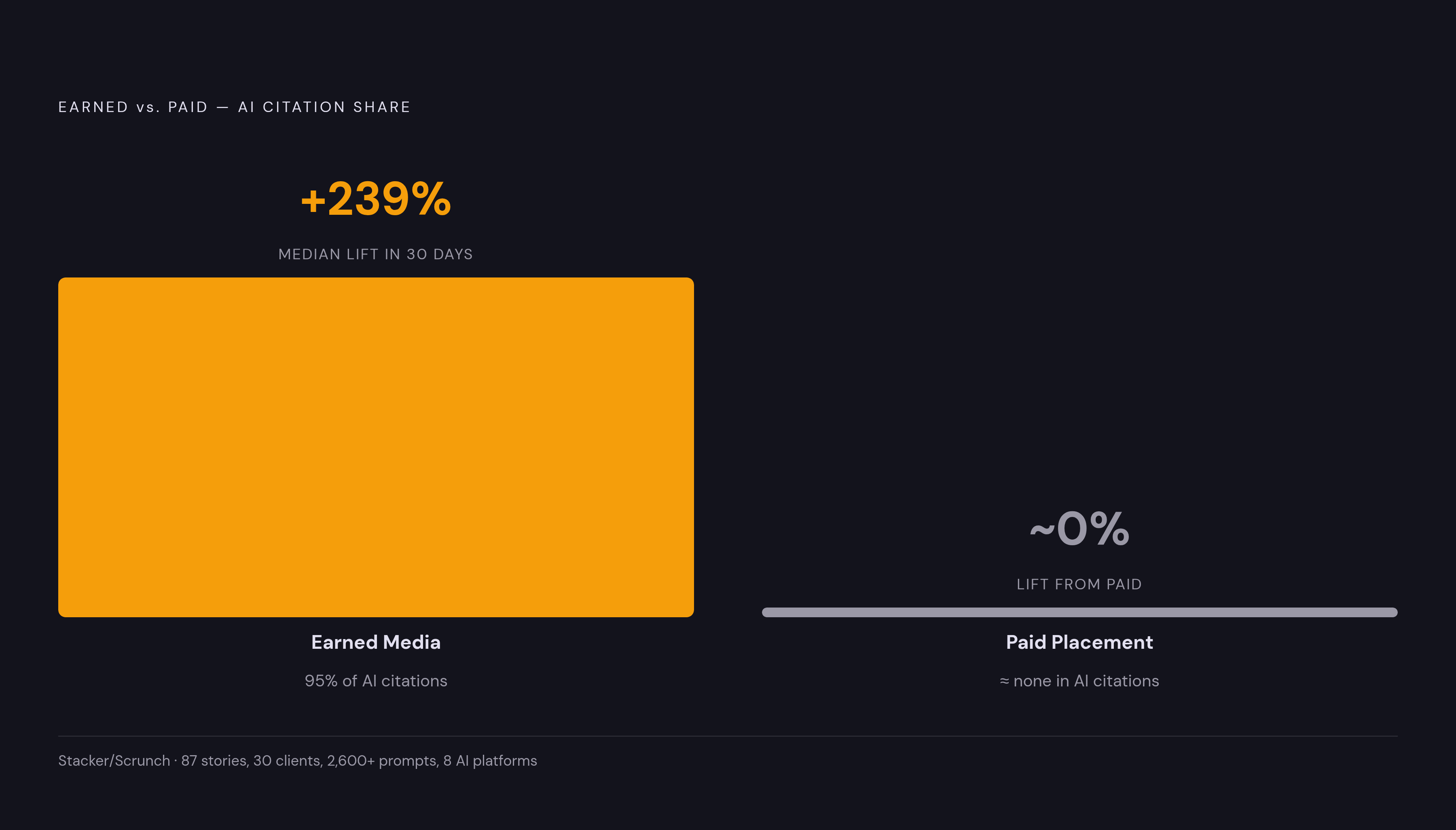
Earned media is probably the single highest-leverage signal available, and the research on this is specific rather than directional. A Fullintel and University of Connecticut academic study found that 89% or more of AI-cited links came from earned media sources, and 95% came from unpaid media. Paid placement generates close to nothing in AI citation terms, dollar for dollar, which should worry any firm still funneling budget into sponsored content expecting an AI visibility return.
Stacker's research with Scrunch, tracking 87 stories across 30 clients and more than 2,600 prompts across 8 AI platforms, found a 239% median lift in AI brand citations within 30 days of strategic earned media distribution. That lift came entirely from earned editorial placements, not paid ones. For a law firm or consultancy, a placement in Harvard Business Review or The American Lawyer still carries the same third-party validation clients have always used to pick a provider, and now that validation doubles as an AI credibility signal.
Entity coherence is table stakes, and it means the same thing everywhere a firm's name appears: consistent name, consistent description, consistent topical focus, across the firm's own website, partner bios, LinkedIn, directory listings, and press bylines. When a firm describes itself one way and third parties describe it another, the result is entity fragmentation, and a fragmented entity is one a model can't resolve into a stable node worth recommending.
Source authority isn't flat either. Research into AI citation behavior points to a hierarchy in what AI engines trust. Academic and government sources sit near the top: if a firm's research, data, or tools get cited by a university or a government body, those.edu and.gov links carry outsized weight relative to almost anything else available. Professional directories and associations add to entity verification through consistent brand information. Community and Q&A platforms, Quora, Reddit, Stack Exchange, rank further down, but genuine, useful contributions there still add to an AI trust profile, especially for informational queries. Wikipedia deserves its own mention: it consistently ranks among the most-cited domains for ChatGPT, so for firms or executives who qualify for a Wikipedia entry, that presence is a strategic asset most competitors haven't bothered to secure.
LinkedIn's weight has climbed fast. As of early 2026, LinkedIn sits among the most-cited domains across large language models, and partner or executive profiles with consistent, authoritative bios contribute meaningfully to a firm's overall entity signal.
Branded search offers a downstream way to watch all of this working. Among the most AI-visible professional services firms in Semrush's June 2026 cohort, Deloitte's branded organic traffic climbed 71%, Accenture's 45%, and Oliver Wyman's 130%, even as their non-branded traffic fell. That pattern fits buyers discovering a firm through an AI answer first, then coming back later through a branded search to confirm and dig deeper. Tracked over time, branded traffic growth works as an indirect but useful leading indicator of AI-driven discovery.
Knowing the signal set is the easy part. Knowing where a firm actually stands against it is the harder one, and that's a measurement problem before it's ever an optimization problem.
Why measurement must come before any optimization effort
Online reputation now spans five separate surfaces: reviews, search results, news coverage, social platforms, and AI answers. Trust has scattered across all five, which is part of why trust in reviews has fallen sharply, with a large share of consumers no longer treating them as equivalent to a personal recommendation. No single surface tells the whole story on its own, and firms that keep measuring only one are missing most of the picture.
Incumbent monitoring tools built for the pre-AI web cover reviews, social chatter, and news mentions reasonably well. None of them sample what AI engines are actually saying about a firm when someone asks. That's the blind spot, and it's a real one: the fifth surface, AI answers, sits outside the reach of tools built for the other four.
Closing that gap takes a standing set of brand prompts run repeatedly across every major AI engine, the same basic approach behind AI share-of-voice tracking, pointed instead at reputation and credibility language specifically, not just mention frequency.
The stakes for getting this right keep climbing. A Gartner survey found that 69% of B2B buyers still prefer to validate AI-generated insights with a sales rep before making a final call. The emotional framing an AI engine applies to a brand shapes how a buyer walks into that first human conversation, well before the conversation starts. Firms running no AI perception monitoring at all are letting model beliefs about them shape shortlisting, unobserved and uncorrected. That's a strange place for a firm's reputation to sit unattended, especially for firms that spend real money protecting it everywhere else.
The citation landscape doesn't hold still, either. A one-time audit won't do the job. By August 2026, Reddit's share of ChatGPT's cited sources had fallen to 0.20%, a dramatic drop from its earlier prominence. No single source dominates any engine for long: the most-cited domain on a given platform accounts for only a small share of total citations, a spread narrow enough that rankings shuffle constantly. An audit run in January says almost nothing about what's true in July.
Scoring a firm's position has to cover several dimensions at once: entity coherence, earned media presence, the domain authority of whatever sources are citing the firm, sentiment patterns inside AI-generated summaries, and how complete the firm's structured data actually is. A composite read across those dimensions gives a firm a prioritized repair list. Without it, a firm is just guessing at what to fix first, and guessing is expensive when the fix cycle runs months.
A practical sequence for professional services firms recovering AI visibility
Start with entity coherence before building anything new. Check the firm's name, practice descriptions, and key partner bios across the website, LinkedIn, directory listings, press bylines, and any association profiles. Inconsistency here is the most common source of entity fragmentation, and it's also the one a firm can fix entirely on its own, without waiting on a journalist, an editor, or any third party to cooperate.
Establish a baseline for what AI engines currently say about the firm before touching anything else. Run a structured set of recommendation and reputation prompts across the major AI engines. Doing so reveals what comes back. Inconsistent or thin source coverage causes hallucinated descriptions, missing citations, and competitor framing to appear in AI responses that a firm may have no idea is happening in front of prospective clients. Platforms like Evident (evident.so) score firms across more than 400 signals spanning algorithmic, AI, and human evaluation dimensions, giving a composite read on where AI perception sits today and what's driving it, so a firm can prioritize fixes instead of guessing at them. Skipping this step leaves any optimization work that follows without direction. Measurement comes first because it tells you which of the five signal categories is actually broken.
Build earned media systematically. Target the specific publications AI engines cite for the firm's practice area: industry trade press, legal and financial journals, business media with.edu or.gov adjacency where that's realistic. Stacker and Scrunch's research showed a 239% median lift in AI citations within 30 days of consistent earned media distribution, so this signal responds fast to sustained effort rather than a single big hit. Thought leadership under a named partner's byline builds two things at once: entity coherence, through a consistent name appearing across platforms, and topic-conditional authority in the firm's specific domain.
Address the review gap through the alternatives that are actually available, rather than pretending the gap will close on its own. Where confidentiality allows it, structured client testimonials hosted on the firm's own site add sentiment signal even without third-party review platforms in the mix. Case studies describing outcomes in general terms, without naming the client, build the thematic consistency AI systems read as evidence of real competence. Directory profiles on credible professional association platforms, bar associations, accounting bodies, consulting registries, function as Tier 3 entity verification, the kind almcorp.com's research points to as meaningful even without a single star rating attached.
Monitor continuously. Not once a quarter, not once a year. Citation source weights move fast: Reddit's share of ChatGPT citations fell to 0.20% by August 2026 while LinkedIn's weight climbed over the same stretch. Whatever drove a firm's AI visibility last quarter may not be doing much work next quarter. AI answers are the fifth surface most firms still aren't watching, and a standing prompt-and-monitor process is what catches a hallucinated description before it shapes a buyer's shortlist rather than after the damage is already done.
Review volume is one corroboration signal among several that AI systems weigh, and firms that can't generate it at scale, for reasons rooted in how the profession actually works, have more paths open to them than most realize. Those paths only open up once a firm understands, with real precision, how it's currently perceived across all three audiences doing the judging: search algorithms, AI systems, and the humans still reading everything both of them produce.